

Building a Progressive Lock Picking Set: The 2026 Belt Ranking Roadmap
Most beginners fail to reach their Black Belt because they start with a hundred tools they'll never use. It's frustrating to waste money on cheap sets that snap the moment you hit a security pin, leaving you stuck at a plateau while others progress through the ranks. By focusing on building a progressive lock picking set, you ensure that every pick in your case serves a specific purpose as you climb from foundational skills to expert-level mastery.
We've all felt that confusion when looking at the 2026 LPU standards and wondering which tension wrench actually fits a paracentric keyway. You want to feel that satisfying click and the rush of a successful open, not the frustration of a gear mismatch or a lack of direction. This article provides a clear roadmap to help you navigate the belt system with confidence, precision, and the right tools for your specific skill level.
We're going to break down the journey from White Belt to Black Belt with a focus on ethical locksport. You'll get a tier-specific shopping list for your kit, learn the mechanics of advanced security pins, and understand the video verification requirements for high-level ranks. It's time to stop guessing and start picking with a collection that grows as fast as your talent does.
Key Takeaways
- Learn why building a progressive lock picking set is the most efficient way to master tactile sensitivity and avoid the common "chinesium" tool plateau.
- Identify the essential hardware for White and Yellow belt ranks, including using the Trainee 2.0 to establish solid foundational skills.
- Master the transition from standard pins to security pins by upgrading to the Carbon Fiber Gen 2 Pro Series for superior tactile feedback.
- Understand when to integrate specialty tools like dimple picks and wafer jigglers to tackle Blue Belt high-security locks and beyond.
- Discover how to document your journey through the Black Belt Challenge and earn community rewards via our interactive share-to-earn loop.
What is a Progressive Lock Picking Set?
A progressive lock picking set isn't just a random pile of metal. It's a curated collection where every pick and every practice cylinder has a specific job. Think of it as a ladder. You don't start at the top; you climb one rung at a time. By building a progressive lock picking set, you align your tools with the 2026 Locksport Belt Ranking system. This ensures you always have the right amount of challenge without hitting a wall of frustration. Your set consists of two symbiotic halves: high precision tools and repinnable hardware that grows with your skill.
The goal is to match the difficulty of the lock to your current tactile sensitivity. If you try to pick a high security lock with zero experience, you won't learn anything. You'll just bend your tools. A progressive approach lets you feel the subtle movements of the pins as they set. This foundation is what carries you from a White Belt novice to a Black Belt master in the ethical locksport community.
The Philosophy of Incremental Difficulty
Why starting with a 5-pin Master Lock is a common beginner mistake often comes down to sensory overload. Beginners lack the "ear-to-hand" feedback loop required to process five pins at once. It's better to start with The Trainee 2.0, which allows you to master foundational skills on just one or two pins. This builds the muscle memory needed to identify a "set" pin versus a "binding" pin.
You'll eventually move from "seeing" the mechanics in clear acrylic locks to "feeling" them inside opaque metal cylinders. This transition is vital. In the 2026 LPU standards, technical precision is everything. You need to develop a mental map of the lock's interior. As you progress through the belt ranks, the feedback becomes quieter and the tolerances get tighter. Incremental difficulty is the only way to keep your progress steady and your motivation high.
Tools vs. Hardware: The Symbiotic Growth
When building a progressive lock picking set, your tools must evolve alongside your hardware. Beginners often start with thicker picks because they're durable and forgiving. However, these same picks will hinder your intermediate progress. Thicker steel can't navigate the paracentric keyways found in Green or Blue belt locks. This is where moving to the Carbon Fiber Gen 2 Pro Series makes a massive difference. The thinner, stronger profiles provide the feedback you need to "hear" security pins like spools and serrations.
- Hooks over Rakes: Your first set should prioritize hooks. Raking might get a quick open on a White Belt lock, but it won't teach you the Single Pin Picking (SPP) required for higher ranks.
- Tension is Key: Advanced tension wrenches are just as important as the picks. They're your primary sensor for identifying pin states.
- Carbon Fiber Durability: As you move into intermediate tiers, the rigidity of carbon fiber picks prevents the "numb" feeling of cheap steel.
This balance between tool quality and lock complexity is the secret to avoiding plateaus. Every time you level up your belt rank, you'll find that a slight upgrade in your tool kit unlocks a whole new world of mechanical puzzles.
Building Your Foundation: White and Yellow Belt Essentials
The journey to mastering locksport starts with a White Belt mindset. At this stage, your primary goal is understanding the pin-tumbler mechanism. You aren't just trying to "get lucky" with a rake; you're learning to visualize what's happening inside the keyway. Building a progressive lock picking set begins with tools that provide clear, loud feedback. This is why we recommend starting with The Trainee 2.0. It allows you to strip away the complexity of a full lock and focus on the core physics of picking.
Once you've mastered the basics, the Yellow Belt rank challenges you to apply those skills to real-world hardware. You'll move from controlled practice cylinders to common commercial padlocks. This transition is where many hobbyists get hooked on the "click." It's about developing the patience to feel each pin and the discipline to use the right amount of force. For more details on gear, check out our guide on how to choose your first beginner lock pick set.
Step 1: Mastering the 2-Pin and 3-Pin Stack
Start simple. It's the best way to learn binding order. In any lock, manufacturing imperfections mean one pin will always bind before the others. By using 2-pin and 3-pin practice cylinders, you can isolate this sensation. Your go-to tool here is a standard short hook in .025 steel. This thickness is durable enough to handle the "heavy-handedness" common in beginners. Use heavy bottom-of-the-keyway (BOK) tension. This provides a solid platform for your pick and makes the pin movement easier to track. When you set a pin correctly, the plug will rotate slightly, sending a vibration straight through your tension wrench.
Step 2: Transitioning to the Master Lock #3
The Master Lock #3 is the classic Yellow Belt gateway. It features four standard pins and notoriously loose tolerances. While the loose fit makes it "pickable," the heavy spring tension can be deceptive. You'll need to learn the difference between a "click" and "mush." A set pin will feel firm and give a distinct snap; a "mushy" pin is often stuck or overset. Because the tolerances are wide, you'll need significant tension to keep the pins at the shear line. This lock is perfect for refining your Single Pin Picking (SPP) technique before you encounter security pins. As your hands get used to these sensations, you might find that the feedback from professional-grade tools helps you identify these states even faster.
By the time you can open a Master Lock #3 consistently, you've built the muscle memory required for the next tier. You're no longer just poking at metal. You're communicating with the lock. This foundational work is the most important part of building a progressive lock picking set that will eventually carry you to the higher belts.
Crossing the Intermediate Plateau: Orange and Green Belts
Transitioning to Orange and Green belts marks the biggest shift in your locksport career. You're moving away from standard pins and entering the world of security pins. This is where many hobbyists feel stuck. Standard steel picks often feel "numb" because they don't transmit the subtle vibrations of a spool pin correctly. To keep progressing, building a progressive lock picking set means upgrading your feedback sensors. You need tools that can communicate the tiny mechanical shifts happening inside the keyway.
The Carbon Fiber Gen 2 Pro Series is the answer for this tier. Carbon fiber is more rigid than standard spring steel. It acts like a megaphone for what's happening inside the lock. You'll need this clarity to handle the ABUS 64TI/30 or the infamous Master Lock 410 LOTO. These locks are designed to punish mistakes, but they're also the best teachers for intermediate pickers.
Defeating Spool Pins and False Sets
A false set is that heart-pounding moment where the plug turns about 15 to 20 degrees, but the lock won't open. You've trapped a spool pin. To beat it, you need to feel for counter-rotation. As you lift the pin, the plug will actually try to turn back toward the locked position. Don't fight it. Ease off your tension slightly and let the pin set. This technique is essential for the ABUS 64TI/30. We recommend using a deep hook for reaching behind low-set pins without disturbing the ones you've already placed. Building a progressive lock picking set that includes varied hook profiles is the only way to navigate these tighter tolerances.
Serrated Pins and Micro-Clicks
Serrated pins are the opposite of spools. Instead of one big movement, you'll hear multiple tiny micro-clicks. These are designed to trick you into thinking the pin is set when it's actually still trapped in a groove. If you're picking a Master Lock 410 LOTO, you'll encounter a mix of these. The trick is very light tension. If you push too hard, you'll overset the pin and have to start over. High-quality tools make these micro-clicks much easier to distinguish. For more technical details on how materials affect your feel, check out our guide on the benefits of carbon fiber lock picks.
- Hardware Focus: Focus on the ABUS 64TI/30 to master spools.
- Feedback: Listen for counter-rotation in the plug.
- Tension: Lighten your touch as the pins get more complex.
Mastering these security pins is the gateway to high-security locks. Once you can consistently open a Green Belt lock, you've proven you have the tactile sensitivity for professional-grade hardware.
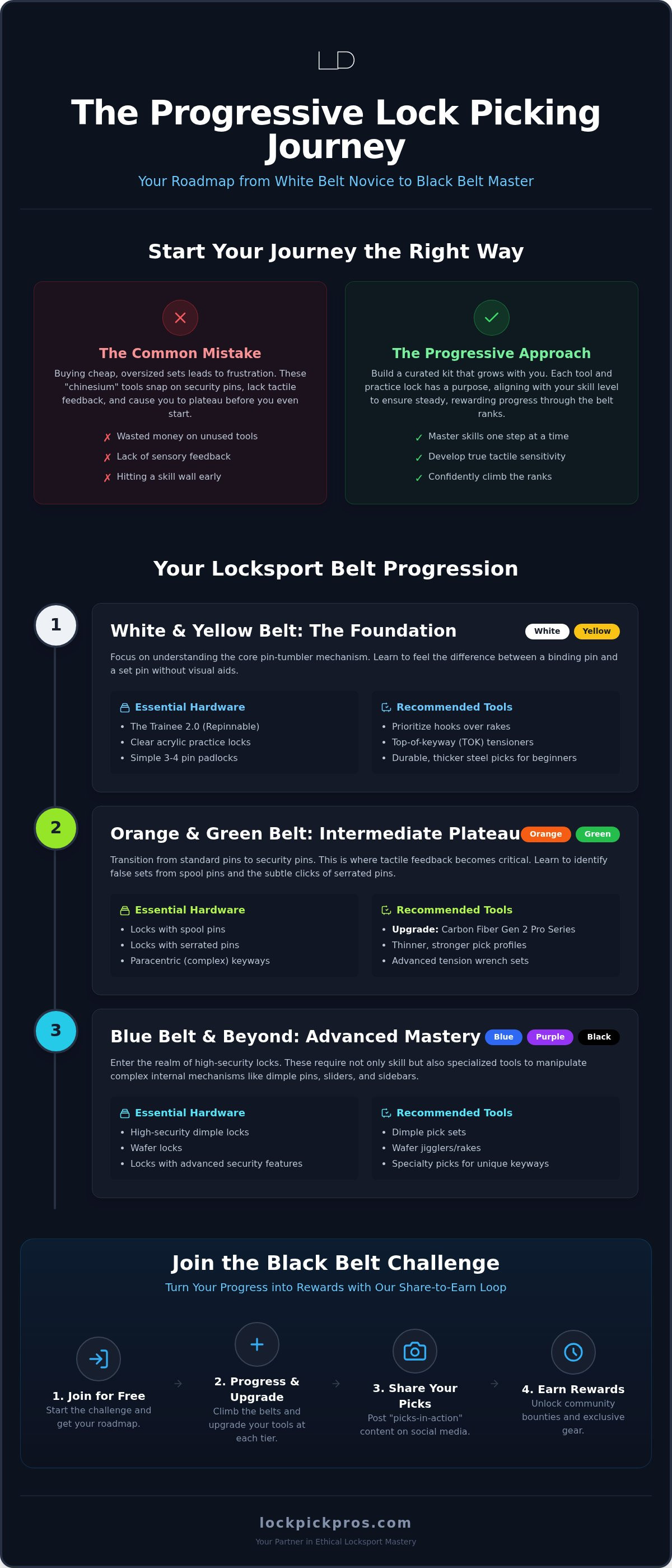
Advanced Hardware and Specialty Tooling: Blue Belt and Beyond
Reaching the Blue Belt rank is a watershed moment for any ethical lockpicker. It's the point where you leave standard commercial hardware behind and enter the challenging territory of high-security (HiSec) locks. Your strategy for building a progressive lock picking set must now account for specialized keyways and complex pin interactions that a basic kit simply cannot handle. At this level, tolerances are microscopic. You need the surgical precision of the Gen 2 Pro Max Stealth Edition to feel the difference between a true set and a high-security trap.
This tier introduces you to locks like the American Lock 1100 and various dimple cylinders. These aren't just harder to pick; they require a completely different tactile vocabulary. You'll find that your intermediate tools, while excellent for Green Belt challenges, might be too thick or lack the specific profiles needed for these advanced mechanical puzzles.
Mastering the American Lock 1100
The American Lock 1100 is a legendary rite of passage in the locksport community. It's famous for its "crunchy" feedback, caused by a mix of serrated pins and serrated spools. Unlike the locks you've faced before, the 1100 requires "feather-touch" tension. If you apply too much pressure, the serrations will bind so tightly that you won't be able to move the pins at all. You're looking for tiny, sharp clicks. A common trap is picking the lock open without realizing it, as the core spring is incredibly strong. Always give the tension wrench a firm "check" if you think you've hit the shear line. For these tight, paracentric keyways, we recommend using .015 thin hooks to navigate the warding without rubbing against the sides.
Introduction to Dimple and Wafer Picking
As you progress toward Purple Belt and beyond, you'll encounter dimple locks. These differ fundamentally from standard pin-tumblers because the pins are located on the side of the keyway. You can't use a traditional hook; you need "flag" picks that rotate to lift the pins. Using specialized tools like HUK Kaba Tools is essential for these civil locks. The feedback is much more subtle, requiring you to master the "jiggle test" to confirm if a pin is set. If you're ready to dive deeper into these complex mechanisms, our detailed guide on mastering the advanced lock covers everything from sidebar logic to slider interactions.
If you want to maintain your momentum through these advanced ranks, ensure your kit is up to the task. Upgrade your feedback potential by adding the Carbon Fiber Gen 2 Pro Series to your arsenal today.
The Black Belt Challenge: Community and Ethical Mastery
Building a progressive lock picking set eventually leads you to the pinnacle of the hobby: the Black Belt. This rank isn't just about technical skill; it's about your contribution to the locksport community. Our "Share-to-Earn" loop is designed to reward your dedication. As you document your journey from White to Black, you can earn community bounties and store credit by hitting social reach goals. It transforms the practice from a solo activity into a shared adventure where your success helps inspire the next generation of pickers. By building a progressive lock picking set, you aren't just collecting steel; you're joining a global network of ethical hobbyists.
The Black Belt Challenge is our roadmap to the highest tier. Per the 2026 LPU standards, reaching this level requires more than just a successful open. You must demonstrate mastery by single-pin picking and gutting two different locks from the Black Belt list, such as the MIWA WR or the EVVA MCS. Additionally, you're required to mentor at least two other pickers through the ranking system. This ensures that the knowledge remains within the community and that the sport continues to grow ethically and sustainably.
Recording Your "Picks-in-Action"
To earn your belt, your evidence must be undeniable. A continuous, unedited shot is mandatory for any rank from Blue Belt and above. Start by showing the lock is functional with a key. Then, transition directly into the pick without the lock ever leaving the frame. For these high tiers, you must "gut" the lock on camera. This involves disassembling and reassembling the cylinder to prove no pins were removed or bypassed. Use high-contrast lighting and a top-down camera angle so the community can clearly see the pin stack on your pinning tray. Sharing these "picks-in-action" on social media doesn't just verify your rank; it builds your reputation and unlocks those community rewards.
The Ethical Standard of Lockpick Pros
As you refine your skills, remember that with great precision comes great responsibility. We exclusively support ethical lockpickers. This means following two non-negotiable golden rules. First, never pick a lock you don't own or have explicit permission to pick. Second, never pick a lock that is "in use." Even a simple practice session on your front door can lead to a broken spring or a jammed cylinder, leaving you stranded. Keep your practice focused on "locks-in-hand" and dedicated practice hardware to maintain the integrity of the sport.
Unlock Your Potential in the Locksport Community
Join 50,000+ ethical lockpickers in our community who rely on precision gear to sharpen their skills. Our carbon fiber tools are tested by professional locksmiths to ensure maximum tactile feedback and durability. Don't forget that we offer free shipping on all Pro Series expansion kits to keep your collection growing without extra costs. The Black Belt Challenge is waiting for you, and our community is ready to celebrate every successful open you share.
Start Your Journey with The Trainee 2.0 Set. We can't wait to see your first "picks-in-action" video as you climb the ranks. Happy picking!
Frequently Asked Questions
What is the best lock pick set for a total beginner?
The Trainee 2.0 is the best choice for anyone starting their locksport journey. It focuses on the foundational skills you need without overwhelming you with unnecessary tools. This set includes essential hooks and tension wrenches designed for White and Yellow belt locks. By starting here, you begin building a progressive lock picking set that can be expanded as your tactile sensitivity improves. It's about quality over quantity when you first start.
Is lockpicking legal in the United States?
Lockpicking is legal in the vast majority of the United States. Most states allow the possession and use of picks as long as there is no intent to commit a crime. However, laws vary locally; some states may have different regulations regarding possession as evidence of intent. You must only use your tools on locks you own or have explicit permission to pick. Always stay within our community's ethical guidelines to keep the sport respected.
What are the different lockpicking belt levels?
The community uses a system inspired by martial arts, ranging from White to Black Belt. White and Yellow represent beginners, while Orange and Green signify intermediate skill with security pins. Blue through Purple enter the high-security realm. Finally, Brown, Red, and Black belts are reserved for the most advanced pickers. Each tier has specific lock requirements and verification standards, such as unedited video evidence for the Blue belt rank and above.
Do I need a clear practice lock to start?
A clear practice lock is a fantastic tool for visualizing the pin-tumbler mechanism during your first hour of practice. It helps you see how the driver pins interact with the key pins at the shear line. However, you should transition to opaque metal cylinders quickly. Clear locks are made of plastic and don't provide the realistic tactile feedback you need to master Single Pin Picking. Real metal hardware is essential for developing true locksport skill.
What is a spool pin and how do I pick it?
A spool pin is a security pin with a narrow center that gets caught on the shear line, causing a "false set." You'll feel the plug rotate slightly, but the lock won't open. To pick it, you must use counter-rotation. Gently lift the pin while easing off the tension. You'll feel the plug turn backward against your wrench. Once the wide part of the spool clears the shear line, the pin will set and the plug will turn.
Why should I choose carbon fiber lock picks over steel?
Carbon fiber picks offer superior feedback compared to traditional steel. The material is more rigid, meaning it doesn't absorb the tiny vibrations from the pins like softer metals do. This clarity is vital when building a progressive lock picking set for intermediate and advanced belts. Our Carbon Fiber Gen 2 Pro Series is designed to stay stiff in tight keyways, allowing you to "hear" exactly what's happening with security pins like serrations.
Can I use these tools to become a professional locksmith?
While these tools help you master mechanical manipulation, they aren't a shortcut to becoming a professional locksmith. Locksmithing is a regulated trade that often requires specific state licensing, apprenticeships, and insurance. Our focus is strictly on locksport as a recreational hobby. We sell precision tools for ethical hobbyists to use on their own locks in a legal setting. Professional locksmiths often use different specialized equipment for residential and commercial service calls.
How do I join the Black Belt Challenge?
You can join the Black Belt Challenge by signing up on our website and documenting your progress. Start at the White Belt level and work your way up one rank at a time. To earn rewards, participate in our "Share-to-Earn" loop by posting your "picks-in-action" content on social media. As you hit specific belt milestones and community reach goals, you'll earn store credit and exclusive bounties while helping other pickers grow through mentorship.