

Thin vs Standard Thickness Lock Picks: The 2026 Locksport Guide
What if the sturdiest tool in your kit is actually the reason you can't open that Blue belt Abus? You've likely felt the frustration of a 0.025 inch pick wedged tight in a paracentric keyway or, worse, the heart-sinking snap of a 0.015 inch pick when you applied just a hair too much tension. It's a common hurdle for every ethical lockpicker as they move beyond basic padlocks and into the world of restrictive tolerances. Mastering the technical nuances of thin vs standard thickness lock picks is about more than just buying gear; it's about matching your technical reach to the specific challenge of the lock.
We know you want tools that provide crisp tactile feedback without sacrificing durability. You're here to sharpen your skills and earn that next belt. In this 2026 guide, we'll explore the tactical trade-offs between accessibility and strength. We'll show you how to build a kit that evolves as you climb the LPU belt ranks, ensuring you always have the right profile for tricky, restrictive keyways. Let's dive into the science of pick thickness so you can stop snapping expensive tools and start popping shackles with confidence.
Key Takeaways
- Learn why 0.025" picks are the foundational benchmark for beginners and why thinner profiles are essential for navigating tight, paracentric keyways.
- Discover how High Yield Stainless Steel and Carbon Fiber lockpicks provide the necessary rigidity to prevent permanent bending in thin tools.
- Understand the critical trade-offs between thin vs standard thickness lock picks to ensure you choose the right tool for every unique keyway.
- Map your tool selection to the LPU belt ranking system to build a kit that grows with your technical skills.
- Find out how to join the Black Belt Challenge and earn community rewards as you progress through the ranks of ethical lockpicking.
Understanding Lock Pick Thickness: Why Thousands of an Inch Matter
In the world of locksport, the difference between a successful open and a snapped tool often comes down to a few thousandths of an inch. While a beginner might think any hook will do the job, experienced hobbyists know that the choice of thin vs standard thickness lock picks is central to their progression. This decision impacts everything from the tactile feedback you feel in your fingertips to your ability to actually reach the pins in a tight, paracentric keyway. Understanding these measurements is a foundational step for every ethical lockpicker.
Picking is widely recognized as an essential skill for locksmithing, but for the locksport community, it's a game of precision and finesse. Standard picks provide a rigid platform that transmits heavy, distinct vibrations. This makes them ideal for learning the basics of pin states. However, as you level up your skills, you'll encounter the fundamental dilemma of durability versus access. Thicker picks are much harder to break, but they simply cannot navigate the complex "S" curves found in high security locks. Choosing the right tool requires balancing the strength of the steel against the spatial constraints of the cylinder.
The Standard 0.025" Benchmark
The 0.025 inch measurement is the undisputed gold standard for most North American pin tumbler locks, such as common Schlage or Kwikset models. These keyways are generally wide and open, allowing a thicker shaft to move freely without binding against the warding. For those just starting their journey, tools like The Trainee 2.0 utilize this thickness to provide maximum structural integrity. Beginners often apply heavy tension or excessive leverage by mistake; a 0.025 inch pick can survive those early errors while providing the clear feedback needed to identify a set pin. Mastering the 0.025 inch pick is the primary requirement for achieving White Belt mastery in the community.
The Rise of Slimline and Euro-Style Picks
As you move into international locks or high security cylinders, you'll find that standard picks often get stuck. This is where 0.020 inch and 0.015 inch measurements, frequently labeled as "slimline" or "Euro-style" picks, become necessary. These thinner tools are designed to reach past restrictive, paracentric warding that would otherwise trap a standard pick. By reducing the height and width of the tool, you gain the maneuverability needed for advanced locksport challenges. Using a thinner pick also helps you avoid accidentally bumping and over-setting adjacent pins in a crowded keyway, though it requires a much lighter touch to prevent the steel from bending.
Standard vs. Thin Lock Picks: A Technical Comparison
Choosing between thin vs standard thickness lock picks isn't just about what fits in the keyway. It's a technical trade-off. Standard 0.025 inch picks act like a rigid lever. They provide a direct, loud connection between the pin and your hand. Thin picks, usually 0.015 to 0.020 inches, behave more like a spring. They require a completely different approach to tension and lift to avoid permanent deformation or the dreaded "snap" during a session.
Tensile Strength and Steel Quality
The durability of a pick is largely determined by its tensile strength. High-yield alloys like 301 Stainless Steel offer a tensile strength between 250,000 and 280,000 psi. This superior material quality is what allows a 0.015 inch pick to survive the tight tolerances of modern locks. When you're analyzing the mechanical and physical construction of a high-security cylinder, you'll see why high-yield steel is non-negotiable. Standard carbon spring steels often have tensile strengths below 80,000 psi. That's a massive difference when you're prying against a stubborn security pin. Using a Carbon Fiber Gen 2 Pro Series pick helps maintain that necessary rigidity even when the steel is incredibly thin.
Feedback and Pin Sensation
Feedback is the language of the lock. A standard 0.025 inch pick is a loud communicator. It transmits sharp, clear "clicks" that are easy for a trainee to interpret. Thin picks are much quieter. The reduced mass of a 0.015 inch shaft dampens the vibrations, making it harder to feel a pin hitting the shear line. You'll need to compensate by using feather-light tension and focusing on the subtle counter-rotation of the plug. Budget thin picks often reach their snapping point because the user pushes too hard to find feedback that isn't there. Professional series tools use carbon fiber handles to amplify these tiny vibrations. This gives you a tactical advantage in restrictive keyways where every micro-movement counts toward the open.
If you're ready to feel the difference that high-quality materials make in your feedback loop, check out our Carbon Fiber Gen 2 Pro Series picks for your next technical challenge.
When to Reach for Thin Picks (And Why Beginners Should Wait)
It's tempting to jump straight into the thinnest, most professional looking tools available. We see it all the time in the locksport community. New pickers often assume a 0.015 inch profile will make the hobby easier by providing more room. In reality, this is the classic "Beginner Trap." When you're first learning to feel the pins, your tension is naturally going to be a bit heavy. Thinner picks are precision instruments; they don't have the structural mass to withstand the "heavy handed" tension that most novices apply. This is why we always suggest starting with The Trainee 2.0. It gives you the durability of a standard pick while you develop the muscle memory needed for more delicate work.
Understanding the balance of thin vs standard thickness lock picks is about knowing when the lock is fighting your tool rather than your skill. If you find your pick is getting physically stuck or you're unable to move it vertically without rubbing against the sides of the keyway, you've found the limit of your standard gear. At this point, the tool is no longer a help; it's an obstacle. Learning to identify this transition is a key part of your growth as an ethical lockpicker.
The Heavy-Tension Hurdle
High tension is the number one killer of thin picks. If you bind a pin too hard and then try to lift it with a thin tool, the steel will likely bend or snap before the pin moves. Finesse is a skill that takes time to cultivate. We recommend sticking with the foundational techniques in our White Belt Guide using standard tools first. Once you can consistently open basic locks without deforming your picks, you'll have the "light touch" required to use 0.015 inch tools on intermediate and advanced cylinders.
Restrictive Keyway Analysis
You'll know it's time to reach for the thin stuff when you encounter a paracentric keyway. This is a technical term for a keyway where the warding—those metal shelves inside the plug—actually crosses the center line. This creates a zig-zag path that "eats" standard 0.025 inch picks. Specific lock examples like those from ABUS or Yale are famous for these tight tolerances. In these scenarios, thin picks allow for "picking from the warding" techniques. This involves using the internal shelves of the lock as a fulcrum to reach pins that would otherwise be inaccessible.
Tactical picking is another pro strategy to protect your kit. You don't have to use one pick for the entire lock. Many experts start with a standard hook for the pins at the front of the keyway where there is more room. If a deep pin is hidden behind a narrow piece of warding, they swap to a 0.015 inch pick just for that specific stack. This hybrid approach saves your thin tools from unnecessary stress while still giving you the reach you need for a successful open.
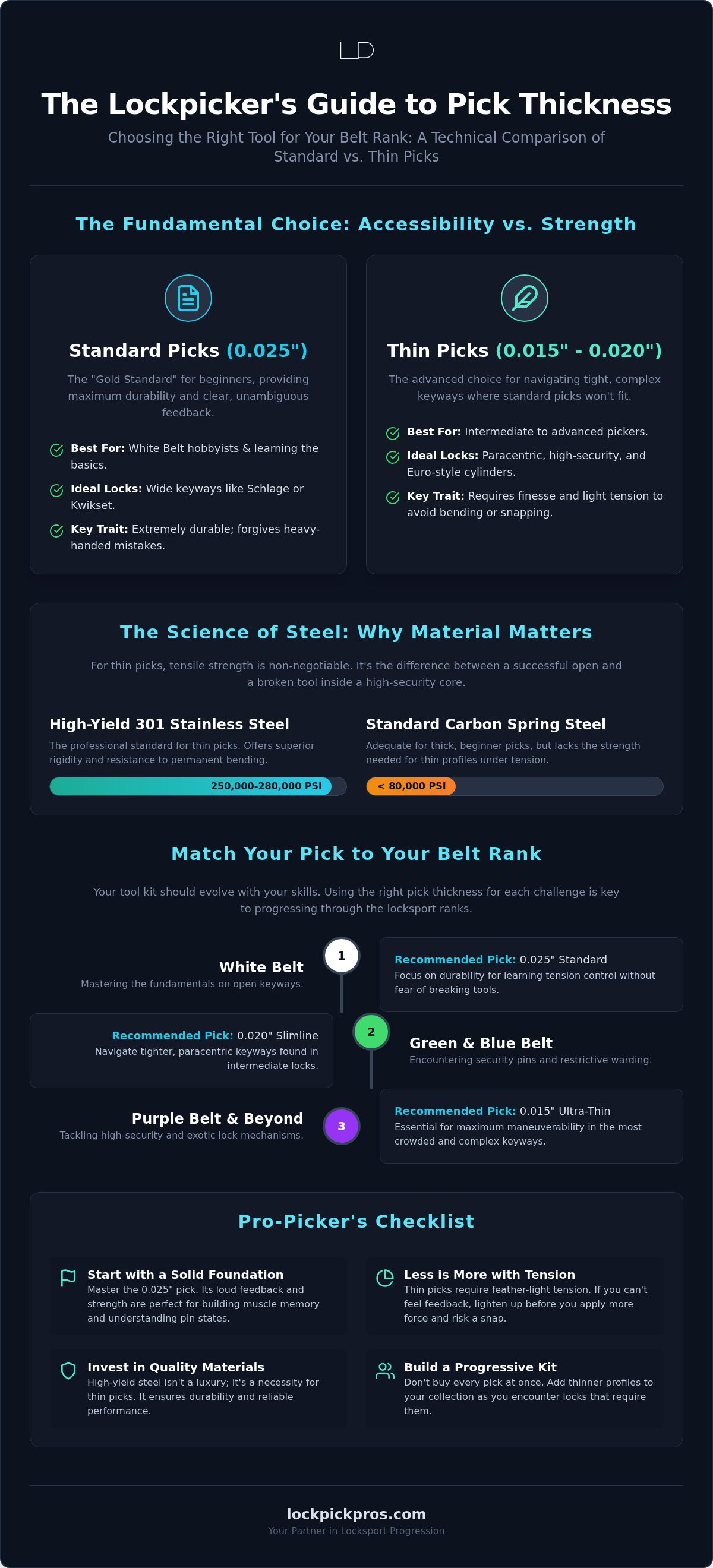
Matching Pick Thickness to Your Belt Rank
In the locksport community, we treat our tools like a badge of honor. You don't start your journey with a black belt, and you shouldn't start it with a full set of ultra-thin tools either. The "Progression Kit" philosophy is simple: earn your tools as you earn your ranks. This approach prevents you from wasting money on delicate instruments you aren't ready for yet. Understanding the situational use of thin vs standard thickness lock picks allows you to build a kit that evolves alongside your technical abilities.
Building a kit shouldn't happen all at once. By matching your tool acquisition to your belt level, you ensure that you've developed the necessary tension control before moving to more fragile steel. It's a journey of mastery where each new pick represents a hurdle you've cleared in your technical training.
The Foundational Tiers (White & Yellow)
When you're tackling your first Master Lock #3 or a Brinks brass padlock, reach for your 0.025 inch workhorses. These locks have wide, forgiving keyways that don't require surgical precision. At this stage, your goal is to master the fundamentals of single pin picking (SPP). You need to learn how a pin feels when it's binding versus when it's set. Using a thicker pick removes "tool anxiety" from the equation, allowing you to focus entirely on the feedback from the lock core. If you aren't sure what to look for in your first kit, check out our guide on what is in a beginner lock pick set to get started the right way.
The Intermediate Tiers (Orange & Green)
As you progress to Orange and Green belt locks, the tolerances get tighter. You'll start seeing security pins like spools and serrated drivers that require more finesse. Transitioning to a 0.020 inch or 0.022 inch pick is often the sweet spot here. These tools provide enough room to navigate the warding of an ABUS 64TI/30 without being so thin that they lose all rigidity. This is where you really start to feel the difference in steel quality. The American Lock 1100 typically utilizes a five-pin stack filled with serrated key pins and serrated or spool driver pins, making a 0.015 inch pick the preferred choice for navigating these complex security features without accidentally bumping the warding.
By the time you reach Blue belt and beyond, you'll be a master of the 0.015 inch profile. These tiers demand specialty High Yield tools that can withstand the stress of high-security warding while remaining incredibly thin. You've earned the right to use the best gear available. If you're ready to upgrade your intermediate kit for these technical challenges, take a look at our Carbon Fiber Gen 2 Pro Series to experience professional-grade feedback.
Building Your Progressive Kit with Lockpick Pros
Ready to take your locksport journey to the next level? At Lockpick Pros, we aren't just selling tools; we're building a community of ethical lockpickers who value skill over shortcuts. Choosing between thin vs standard thickness lock picks becomes a tactical decision once you commit to the Black Belt Challenge. Our goal is to help you build a kit that grows with you, ensuring you have the right profile for every keyway without cluttering your bench with tools you aren't ready to use yet.
We've designed a unique Share-to-Earn loop to keep our community engaged and motivated. When you post your "picks-in-action" content on social media, you aren't just showing off your skills; you're earning rewards toward your next gear upgrade. We even have a community bounty for hitting collective social reach goals. It's our way of encouraging you to document your journey from White belt to Black belt. Whether you're starting with the Trainee series or eyeing the high-performance Stealth Edition, every open is a step toward mastery.
The Stealth and Pro Series Advantage
As you move into the intermediate and advanced ranks, the Gen 2 Pro Max Stealth Edition becomes the ultimate goal for many hobbyists. This set represents the pinnacle of our design philosophy. By utilizing carbon fiber technology, we've pushed the boundaries of the sport. Carbon fiber handles provide a level of rigidity that traditional plastic or bare metal handles can't match. This is especially critical when using 0.015 inch picks. The handle helps offset the natural flexibility of the thin steel, amplifying the vibrations and feedback from the pins directly to your fingertips.
Remember that all our products, from basic hooks to the Pro Series Expansion, are designed for ethical use. We advocate for the sport as a legal and responsible hobby. All tools should only be used on locks you own or have explicit permission to pick in a legal setting. This commitment to ethics is what defines a true Lockpick Pro and keeps our community thriving.
The Black Belt Challenge Call-to-Action
- Step 1: Join the challenge for free on our community hub to get your personalized roadmap to mastery.
- Step 2: Progress one belt at a time. Record your successful opens and document your journey to share with fellow hobbyists.
- Step 3: Upgrade your tools as you hit Blue and Purple belt tiers. Reach for our Carbon Fiber Special sets when those keyways get tight and paracentric.
Don't wait for a restrictive lock to beat your current kit. Build your toolset progressively and join a community that celebrates every click and every successful turn of the plug. We'll see you on the leaderboards.
Scale the Ranks and Master Your Keyway Navigation
Choosing the right profile is a tactical decision that defines your success in our ethical locksport community. You've learned that standard 0.025 inch tools provide the foundational durability for White belt locks; however, 0.015 inch profiles are essential for conquering paracentric keyways at higher tiers. The debate of thin vs standard thickness lock picks isn't about which is better. It's about matching your tool's reach to the lock's technical constraints. By utilizing our High Yield Stainless Steel Guarantee and Carbon Fiber Precision Technology, you can push the boundaries of what's possible without fearing a snapped tool.
Your journey to mastery is just beginning. Document your progress, share your "picks-in-action" content, and earn rewards as you climb toward Black belt status. If you're ready to upgrade your intermediate kit with tools that provide the ultimate feedback, it's time to take the next step. Join the Black Belt Challenge and Earn Your Rewards! We can't wait to see you pop that next high-security shackle. Keep practicing, stay ethical, and keep picking.
Frequently Asked Questions
Is a 0.015" lock pick too thin for a beginner?
Generally, yes, a 0.015 inch pick is too thin for someone just starting out. Beginners haven't developed the "light touch" required to prevent thinner steel from deforming. When you're first learning to feel the pins, you'll likely apply too much tension and leverage. This heavy-handed approach will quickly snap a delicate tool. Stick with 0.025 inch tools until you've mastered White and Yellow belt locks consistently without bending your equipment.
Can I use standard 0.025" picks on European locks?
You'll find that standard 0.025 inch picks are often too thick for European locks. Euro cylinders typically feature much tighter and more paracentric keyways compared to North American Schlage or Kwikset models. A thicker pick will get stuck against the warding, preventing you from reaching the pins. For these locks, a 0.020 inch or 0.015 inch pick is necessary to navigate the restricted space and achieve a successful open.
What is the best thickness for picking Master Locks?
The best thickness for picking Master Locks is almost always 0.025 inches. Most Master Lock padlocks, like the #1, #3, and #5, feature wide, open keyways with very little restrictive warding. There's plenty of room for a standard, sturdy pick to move freely. Using a thinner tool on these locks is unnecessary and actually makes the job harder since the feedback won't be as crisp or loud as it is with a thicker shaft.
Will thin lock picks break more easily than standard ones?
Thin picks do have less physical mass, so they can break more easily if you use them incorrectly. However, the durability gap in thin vs standard thickness lock picks is often bridged by using high-yield stainless steel. These professional-grade materials can withstand significant stress if your tension control is precise. Most breaks happen when a picker tries to force a binding pin with a thin tool. If you use light tension, they'll last for years.
Do I need different tension wrenches for thin vs standard picks?
You don't need entirely different wrenches, but you do need a wider variety of tension tools. When using thin picks in tight keyways, Top of Keyway (TOK) tension is almost mandatory. TOK wrenches keep the bottom of the keyway clear, giving your thin pick the maximum amount of room to maneuver. Without this extra space, even a 0.015 inch pick might struggle to reach the back pins in a restrictive, paracentric cylinder.
What does "Euro-style" mean in lock picking tools?
"Euro-style" refers to a pick designed with a slimmer profile to handle the restricted keyways common in Europe. This doesn't just mean the steel is thinner; the actual height of the pick's shaft is often reduced as well. This "slimline" design allows the tool to reach deep into the lock without getting hung up on the side warding. It's an essential design for anyone progressing into intermediate and advanced locksport ranks.
How do I know if my lock has a paracentric keyway?
You can identify a paracentric keyway by looking directly into the lock's face. If the metal shelves, also called warding, extend past the center line of the keyway, it's paracentric. This creates a zig-zag path that prevents a straight line of sight to the pins. These keyways are designed to block standard tools, making the choice of thin vs standard thickness lock picks vital. If your 0.025 inch pick won't fit, you're likely facing paracentric warding.
Can I sand down a standard pick to make it thinner?
While you can technically sand down a standard pick, it's not recommended for most hobbyists. It's incredibly difficult to maintain a uniform thickness across the entire shaft by hand. You also risk overheating the steel, which ruins the heat treatment and makes the tool brittle or soft. Precision-engineered thin picks are made from high-yield alloys specifically designed for that thickness. It's much safer and more effective to buy a tool designed for the job.