

Raking vs. Single Pin Picking: Which Technique Should You Master First?
You aren't "cheating" when you reach for a rake to pop a White Belt Master Lock in three seconds flat. Many new hobbyists get caught in the raking vs single pin picking debate, fearing that speed somehow diminishes the craft. In reality, understanding when to use kinetic energy versus surgical precision is what separates a trainee from a true locksport athlete. It's a foundational skill that helps you understand exactly how pins react under different types of tension.
It's natural to feel frustrated when single pin picking feels slow or when you're unsure if a rake will even work on a lock with security pins. We've all been there, staring at a stubborn keyway and wondering if we're using the right tool for the job. You want to progress through your sets, but you don't want to develop bad habits that stall your growth when you reach the intermediate tiers.
This guide will help you discover the tactical differences between raking and single pin picking to accelerate your journey through the locksport belt ranks. We'll explore the mechanics of both techniques, help you choose the right tools for your specific practice locks, and show you how to use both skills to climb the ladder toward your Black Belt.
Key Takeaways
- Learn why the raking vs single pin picking debate is less about which is better and more about choosing the right tool for your current belt rank.
- Discover how to use kinetic energy to quickly clear White and Yellow belt locks using foundational raking techniques.
- Understand why Single Pin Picking is the mandatory gold standard for conquering security pins in Green Belt locks and beyond.
- Master the diagnostic hybrid approach by raking a lock into a false set before finishing it with surgical precision.
- Identify the exact tool categories needed for each tier and learn how to join our community focused Black Belt Challenge.
The Great Debate: Raking vs. Single Pin Picking in Locksport
Welcome to the community of ethical locksport athletes. As you begin your journey, you'll quickly encounter two primary methods for non-destructive entry: raking and single pin picking. These aren't just different ways to open a lock; they represent two distinct philosophies of the craft. The raking vs single pin picking debate is often framed as speed versus skill, but that's a narrow view. In reality, both are essential lock picking techniques that serve different tactical purposes as you progress through the community rankings.
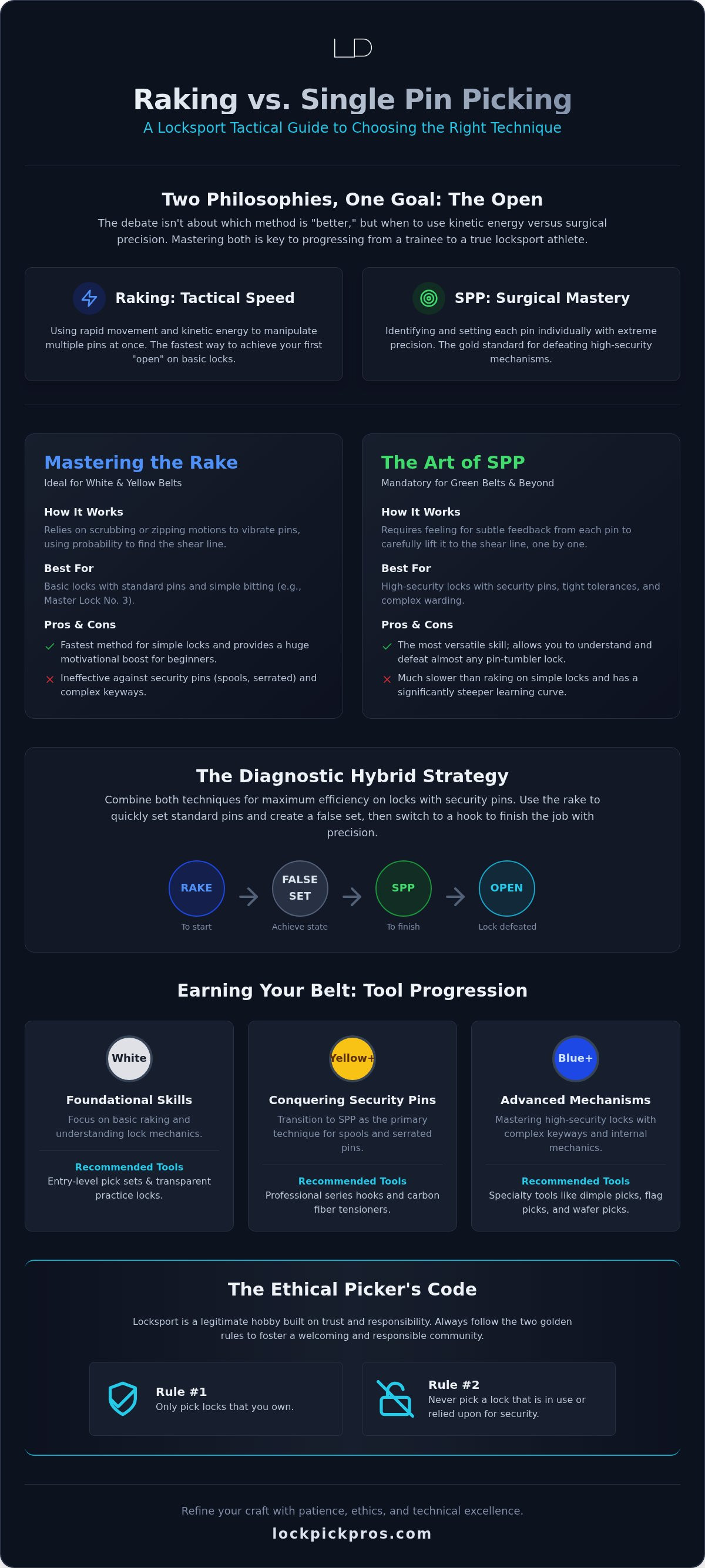
Raking is all about "Tactical Speed." It involves using a tool to manipulate multiple pins simultaneously, relying on kinetic energy and probability to find the shear line. On the other hand, Single Pin Picking (SPP) is "Surgical Mastery." It requires you to identify and set each pin individually with extreme precision. Both methods serve as the technical foundation for the Lock Picking Belt Levels Explained system, which helps hobbyists track their growth from White Belt beginners to Black Belt experts.
Speed vs. Precision: The Fundamentals
Raking is almost always the fastest way to get your very first "open" on foundational White Belt locks. For a newcomer, there's no feeling quite like that first click when a plug turns. It provides a massive psychological boost that keeps you motivated to learn more. Raking works beautifully on locks with standard pins and simple bitting because it exploits the mechanical tolerances of the lock body.
However, as you advance, you'll find that raking has its limits. High-security locks with complex keyways or security pins are specifically designed to defeat kinetic attacks. This is where SPP becomes the gold standard. You'll need the precision of a hook pick to navigate tight spaces and feel the subtle feedback of a spool or serrated pin. Mastering SPP is what truly allows you to understand the internal mechanics of any lock you encounter.
The Ethical Picker's Toolkit
Before you dive into the nuances of raking vs single pin picking with a set like The Trainee 2.0, you must commit to the ethical code of our sport. Locksport is a legitimate hobby built on trust and responsibility. Always follow the two golden rules: only pick locks that you own, and never pick a lock that is currently in use or relied upon for security. Picking a lock that is "in service" can cause damage that leaves someone stranded or unprotected.
Transitioning from a curious beginner to an ethical locksport athlete means focusing on the challenge of the mechanism itself. Most jurisdictions recognize the legality of owning these tools when they're paired with "lawful intent." By treating lockpicking as a sport of skill and precision, you help foster a welcoming, responsible community. Every time you sit down with a practice lock, you're not just learning a bypass; you're refining a craft that rewards patience, ethics, and technical excellence.
Mastering the Rake: Tactical Speed for White and Yellow Belts
Raking is the kinetic engine of locksport. It relies on the physics of bouncing pins to the shear line using rapid movement and inconsistent pressure. While the raking vs single pin picking debate continues, most pros agree that raking is the most efficient way to clear standard pin tumbler locks with low-security bitting. If you're looking for your White Belt certification, identifying rake-friendly locks like basic Master Locks or cutaway practice cylinders is your first step toward success.
How Raking Works: The Kinetic Method
Visualizing the pin stack is crucial for success. Imagine the pins as tiny pistons. When you perform a scrubbing or zipping motion, you're essentially vibrating those pistons until they happen to land at the shear line simultaneously. Scrubbing is a rhythmic movement where you move the pick back and forth across all pins while applying light tension. Understanding the internal physics of the pin stack is vital for any hobbyist. You can find a detailed breakdown of these mechanics in this guide on The Art of Single Pin Picking (SPP): Surgical Precision for Advanced Tiers, which explains the science behind pin manipulation.
Mastering tension is the most difficult part of the raking vs single pin picking learning curve. The secret sauce isn't in your pick hand; it's in your tension hand. Heavy, static tension will lock the pins in place and prevent them from bouncing. Instead, use a "light and bouncy" approach. Flutter your tension wrench like you're tapping a drum. This allows pins that are over-set to drop back down while others find their home. A common mistake is using too much upward pressure, which jams the pins above the shear line and prevents the plug from turning.
Recommended Tools for Speed
Your choice of rake depends on the keyway and the lock's bitting. The Bogota is a community favorite for its versatility, while the Snake Rake is excellent for locks with shallow bitting. The City Rake acts more like a "jiggler," mimicking a key's profile. For those just starting, The Trainee 2.0 provides the perfect selection of rakes and tension tools to master these foundational skills. It's an accessible kit designed to get you those first few satisfying opens without the frustration of professional-grade tools that require more experience.
Once you've mastered the kinetic speed of raking, you'll eventually hit a wall with security pins. That's when you'll want to upgrade to more surgical instruments like the Carbon Fiber Gen 2 Pro Series to tackle higher belt ranks. These tools provide the feedback necessary for the precision work required in the next stage of your locksport journey.
The Art of Single Pin Picking (SPP): Surgical Precision for Advanced Tiers
Single Pin Picking is the ultimate test of a hobbyist's skill. It involves identifying and manipulating one pin at a time until the plug finally turns. This technique is the gold standard for anyone aiming for Green Belt ranks or higher in the raking vs single pin picking journey. While raking is about speed and kinetic energy, SPP is about surgical precision. You'll likely start with transparent practice locks to see the pins move. However, you must quickly transition to metal cutaways and blind locks to master the sport. This shift helps you develop the feel needed for real-world locksport challenges.
The Feedback Loop: Sensing the Pins
Mastering SPP requires a deep understanding of the feedback loop. You start by identifying the binding pin, which is the specific pin that binds first due to microscopic manufacturing tolerances. No lock is perfect, and one pin will always hit the side of the chamber before the others. When you set it correctly, you'll feel a solid, satisfying click. If the feedback feels mushy or the plug turns slightly without opening, you might be in a false set. To test a pin's state, apply gentle upward pressure with your hook and feel for a solid resistance or a springy bounce. This simple test prevents you from over-setting pins and losing your hard-earned progress. Learning the binding order is like solving a mechanical puzzle that changes with every lock you touch.
SPP for Security Pins
Advanced locks use security pins to defeat common raking vs single pin picking attempts. Spools, serrated pins, and mushroom pins create false sets and counter-rotation that can frustrate even experienced pickers. You need tools that offer superior feedback to beat these traps. The Carbon Fiber Gen 2 Pro Series is specifically designed for these intermediate and advanced tiers. The high-yield steel and precision handles let you feel every tiny movement inside the keyway. This allows you to detect the subtle counter-rotation of a spool pin before it sets. Slim-profile hooks are also vital for this work. They allow you to navigate tight, paracentric keyways and reach past low-hanging pins without accidentally disturbing them. This level of control is what separates a trainee from a true expert in the locksport community.
The Diagnostic Strategy: When to Rake vs. When to SPP
The most successful locksport athletes don't pick a side in the raking vs single pin picking debate. They use a hybrid approach that leverages the strengths of both methods to conquer complex locks. This diagnostic strategy helps you save time and energy. By using a rake as a feeler tool, you can quickly gather intel on the lock's internal state before committing to a specific pick. It's about working smarter, not harder, as you move through your practice sets.
One of the most effective tactics is raking to a false set. On locks with a mix of standard and security pins, a few rhythmic scrubs can often set the standard pins instantly. This drops the plug into a deep false set, leaving only the security pins for you to finish with surgical precision. It's a massive time-saver for anyone following our Lock Difficulty Reference Guide to climb the community ranks. This hybrid method bridges the gap between foundational speed and expert-level refinement.
Technique Comparison Framework
Choosing the right approach depends on your goals for the session. Consider these factors before you insert your first tool:
- Speed: Raking is high speed (seconds), while SPP is low speed (minutes).
- Skill Level: Raking is foundational; SPP is expert-level.
- Lock Security: Raking is for White/Yellow belts; SPP is for Green belts and beyond.
- Tool Wear: Raking causes high wear; SPP causes low wear.
Grab a rake for unknown locks, low-security padlocks, or speed challenges. Stick to SPP when you're facing security pins or working toward higher belts where precision is mandatory.
The Transition: From Rake to Hook
Adopt the "30-Second Rule" to keep your practice sessions efficient. If a lock doesn't rake open within 30 seconds, stop. The rake has done its job as a diagnostic tool. At this point, you've likely identified if the lock contains security pins. If you feel the tension wrench pushing back against your finger while raking, you've discovered counter-rotation. This is a clear sign of spool pins. Switch to a hook immediately to finish the job.
Bullying a lock with a rake for too long is a stop sign you shouldn't ignore. Aggressive scrubbing leads to bent tips and metal fatigue. Always perform pick maintenance after heavy sessions by checking for stress marks or thinning metal. If you're ready to move beyond basic raking and start conquering security pins with high-fidelity feedback, upgrade to the Carbon Fiber Gen 2 Pro Series to take your skills to the next level.
Earning Your Belt: Tool Progression and the Black Belt Challenge
Your journey through the locksport belt ranks is a marathon, not a sprint. While your first opens likely came from the kinetic speed of raking, the long-term debate of raking vs single pin picking eventually resolves into a need for both. Mastery isn't just about popping a lock once; it's about understanding the internal mechanics and having the right tool for every situation. By following the sequential path from White to Black using our Lock Difficulty Reference Guide, you mirror the natural progression of the sport and build a solid technical foundation.
Practice locks play a massive role in this progression. You can't jump from a White Belt Master Lock to a Black Belt high-security cylinder overnight. You need to refine your feel on progressively difficult mechanisms. As you move from the foundational tiers into Orange and Green belt territory, your tool requirements will shift. You'll need more feedback, thinner profiles, and specialized hooks to navigate the traps set by security pins. Matching your equipment to your current skill tier ensures that your progress is never stalled by your gear.
Upgrading Your Kit for Higher Ranks
Entry-level sets are great for getting started, but they often lack the reach or feedback needed for paracentric keyways found in intermediate locks. This is where the Pro Series Expansion becomes vital. It provides the specialized hooks and profiles required for the precision work we discussed in the SPP section. Professional-level hobbyists often carry a balanced mix of rakes and hooks in a kit like the Gen 2 Pro Max Stealth Edition. These sets often feature carbon fiber handles, which are a game-changer for long picking sessions. They reduce hand fatigue and transmit vibrations better, helping you feel that one elusive binding pin.
Join the Black Belt Challenge
We're dedicated to fostering a community of ethical lockpickers who are passionate about the sport. That's why we created the free 'Black Belt Challenge' for all our members. It's a structured way to track your growth and connect with fellow hobbyists. We use a 'Share-to-Earn' loop where you can post your 'picks-in-action' content on social media. You can earn community bounties by hitting social reach goals with your shared content, which helps grow our sport. Whether you're mastering the raking vs single pin picking balance or gutting your first high-security lock, your journey inspires the rest of the community. Join the challenge today, start your journey to mastery, and let's see those opens!
Master the Art of the Open
The choice between raking vs single pin picking isn't about picking a side. It's about building a versatile toolkit that prepares you for any keyway. Raking gives you the tactical speed to clear foundational locks quickly. Single pin picking provides the surgical mastery needed to defeat complex security pins and climb the community belt ranks. By combining these techniques into a single diagnostic strategy, you'll progress faster and with more confidence.
Join a global network of ethical lockpickers worldwide who value skill and precision. Our tools feature precision carbon fiber engineering to give you the feedback required for high-level success. With our deep community belt-ranking integration, you'll always know exactly which skill to refine next. Your journey to mastery starts with a single click. Keep practicing, stay ethical, and we'll see you at the top of the ranks!
Join the Black Belt Challenge and Earn Your First Rank Today!
Frequently Asked Questions
Is raking considered 'cheating' in the locksport community?
Raking isn't cheating; it's a foundational locksport skill. The community views it as a tactical entry method that teaches essential tension control. While it's perfect for White Belt challenges, you won't earn higher ranks without mastering precision hooks. Think of raking as a speed tool and single pin picking as a surgical instrument. Both are necessary to become a well-rounded ethical lockpicker.
Can I rake a lock that has security pins like spools?
Raking a lock with security pins is possible but often unreliable. Spools and serrated pins are specifically engineered to trap your pick during kinetic attacks. You might rake the lock into a deep false set, but you'll rarely get a full open. At that point, you must switch to single pin picking to identify which pin is providing counter-rotation and set it manually.
What is the best rake for a total beginner?
The Bogota rake is widely considered the best choice for beginners. Its triple-peak design is incredibly effective at bouncing pins in standard padlocks. For those just starting their journey, the Trainee 2.0 kit provides the perfect selection of beginner-friendly rakes. It allows you to experience the thrill of your first open while building the muscle memory needed for more advanced picking techniques later on.
Why does everyone recommend single pin picking for higher belts?
Single pin picking is the gold standard for higher belts because it requires total control. Advanced locks feature tight keyways and complex security pins that simply won't yield to a rake. Earning a Green Belt or above requires you to prove you can feel every individual pin state. It transforms the sport from a game of chance into a refined craft of mechanical diagnostic skill.
Can raking damage my lock picks?
Raking can definitely damage your picks if you use excessive force. The rapid "scrubbing" motion creates friction and heat, which can lead to thinning metal or snapped tips. It's much more taxing on your tools than the slow, controlled movements of single pin picking. To protect your gear, always use light tension and avoid "bullying" the lock. High-quality picks are durable but not indestructible.
How do I know if I should switch from raking to SPP?
You should switch to SPP if your rake doesn't produce an open within 30 seconds. This is the heart of the raking vs single pin picking diagnostic strategy. If you feel the plug turn slightly but stop, you've likely hit a false set caused by a security pin. At this stage, a rake will only frustrate you. Grab a hook pick to feel for the counter-rotation and finish the open.
What belt level can I reach with just raking?
You can usually reach the Yellow Belt rank using only raking. Most locks at this level, like basic Master Locks, lack the security pins needed to defeat kinetic attacks. However, the raking vs single pin picking progression requires SPP for Orange Belt and beyond. Community standards mandate that higher-tier opens are performed one pin at a time to prove you have mastered the mechanical feedback of the lock.
Do professional locksmiths use raking or SPP more often?
Professional locksmiths typically reach for a rake first because speed is their priority. If a lock opens in seconds with a rake, they can move on to the next job quickly. However, they are also masters of SPP for times when a high-security cylinder refuses to budge. While hobbyists focus on the technical challenge of each pin, professionals use whatever ethical method provides the fastest non-destructive entry.