

How to Pick the ABUS 64TI Titalium: A Yellow Belt Locksport Guide (2026)
What if the biggest obstacle to your next belt rank isn't the strength of the metal, but the subtle, mushy feedback of a lightweight alloy? Many hobbyists find that the ABUS 64TI Titalium is a surprising challenge because it doesn't talk back like a traditional brass lock. Learning how to pick ABUS 64TI padlocks is a true rite of passage for any ethical picker aiming for that Yellow Belt. You've likely felt the frustration of over-setting pins in its narrow keyway or getting lost in a confusing false set.
We've all been there, and we're here to help you bridge that gap. This guide promises to turn that mushy feeling into clear communication by mastering the technical nuances of the Titalium body. You'll learn to navigate the paracentric keyway with precision and gain the confidence to set spool pins every time. We'll walk through the specific pin stack of the Yellow Belt models, the best pick choices for tight spaces, and the exact tension adjustments needed to earn your next rank and advance your locksport journey.
Key Takeaways
- Understand the official LPU belt ranking and why the 30mm ABUS 64TI is the gold standard for earning your Yellow Belt.
- Master the technical nuances of spool pins and learn how to pick ABUS 64TI padlocks by navigating its restrictive paracentric keyway.
- Identify the right gear for the job, including why thinner picks from our Carbon Fiber Gen 2 Pro Series are essential for tight tolerances.
- Learn to interpret the unique "mushy" feedback of Titalium alloy to identify false sets and achieve successful Single Pin Picking (SPP).
- Discover the sequential steps to advance your skills from foundational Yellow Belt locks toward Orange Belt mastery and our Black Belt Challenge.
Mastering the ABUS 64TI Titalium: Your Yellow Belt Challenge
The ABUS 64TI Titalium is more than just a padlock. It's a milestone. For many in the locksport community, this lock represents the first real step away from the loose tolerances of beginner hardware. If you've spent time mastering the basics of lock picking on clear acrylic practice sets or a standard Master Lock #3, the 64TI is your next logical target. It offers a tighter keyway and more sophisticated internal components that require a lighter, more deliberate touch. Before we dive into the mechanics of how to pick ABUS 64TI models, we must emphasize the golden rule of our sport. Always practice on locks you own. Never pick a lock that is currently in use or protecting something you need to access. We pick for the challenge and the growth of the community, not for utility.
The 64TI series is the perfect transition lock. It bridges the gap between basic pin tumbler locks and the more advanced security features you'll find in higher belt ranks. While the Master Lock #3 might open with a bit of heavy-handed tension, the ABUS demands respect. It forces you to develop better tension control and a more refined sense of pin placement. It's a foundational teaching tool that prepares you for the world of security pins.
What is a Yellow Belt Lock?
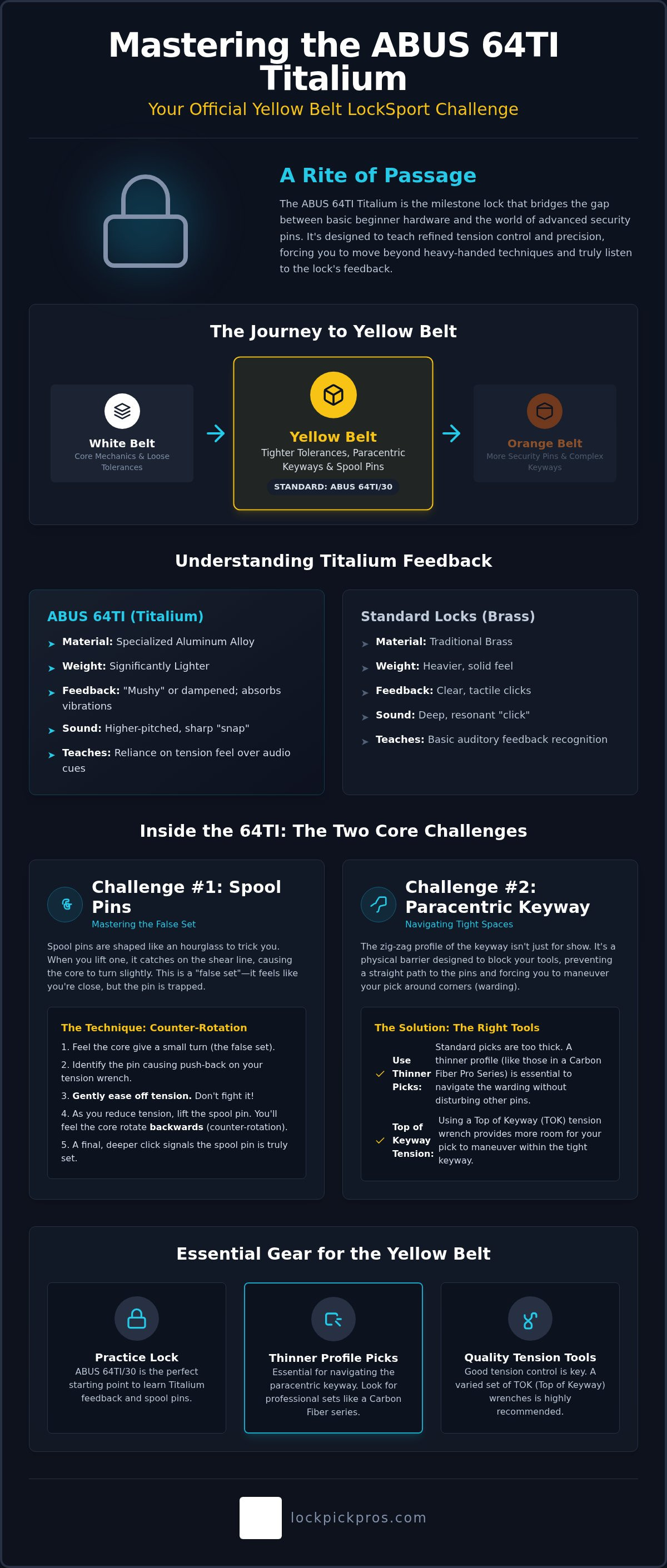
The 2026 locksport ranking system provides a clear roadmap for your skill progression. White Belt locks focus on the core mechanics of movement. Yellow Belt locks, like the ABUS 64TI/30, introduce tighter tolerances and paracentric keyways. This tier is designed to test your ability to navigate warding without over-setting pins. You'll find a full breakdown of these milestones in our guide on Lock Picking Belt Levels Explained. Successfully opening this lock proves you've moved past basic raking and are ready for consistent Single Pin Picking (SPP).
The Titalium Material Advantage
The "TI" in 64TI stands for Titalium. This isn't just a marketing buzzword. It's a specialized aluminum alloy that makes the lock significantly lighter than brass alternatives while maintaining impressive strength. However, for a hobbyist, the material change is all about the feedback. Titalium is a specialized alloy that provides unique acoustic feedback during picking. While brass provides a deep, resonant click, Titalium can feel a bit mushy or produce a higher-pitched, sharper snap. Learning to interpret these sounds is a vital skill. It forces you to rely more on the tension in your fingers than the sound in your ears. This transition is exactly why we recommend starting with The Trainee 2.0 set. Its feedback sensitivity is perfect for learning the nuances of this specific alloy.
Inside the 64TI: Pin Stacks and Paracentric Challenges
You've felt the lightweight body, but what's happening inside the core is where the real challenge begins. Understanding the internal layout is the first step in learning how to pick ABUS 64TI locks effectively. While the 30mm version is our primary focus for the Yellow Belt, it still utilizes the same sophisticated security features found in its larger siblings. The most striking thing you'll notice is the feedback. Titalium doesn't ring like brass. It tends to absorb vibrations, creating a "mushy" sensation that can confuse beginners. Many hobbyists mistakenly think they've encountered serrated pins because of the friction, but it's actually the alloy's unique tactile signature.
As you travel to locksport meetups or carry your gear, always stay informed on the latest regulations. Checking the TSA guidelines on lock picks is a great habit for any ethical picker who wants to stay on the right side of the law while pursuing their hobby. It's this commitment to responsibility that defines our community.
The Spool Pin Mechanism
ABUS uses spool pins to provide significant pick resistance. These pins are shaped like an hourglass, designed to catch on the shear line and create a false set. You'll feel the plug rotate slightly, giving you the illusion that the lock is almost open. However, the pin is actually trapped. To beat this, you must look for counter-rotation. As you apply pressure to a trapped spool, the tension wrench will actually push back against your finger. Don't fight this movement. Lighten your tension slightly and let the core rotate back until the pin clicks into place. The 64TI is a forgiving teacher for this technique because its feedback is consistent once you learn to ignore the alloy's dampening effect.
Navigating the Tight Keyway
The paracentric keyway is a zig-zag profile that serves as a physical barrier to your tools. It's designed to prevent a straight shot to the pins, forcing you to pick around corners. The paracentric keyway limits pick movement and requires thinner tools. If you use a standard 0.025 inch pick, you'll likely find yourself wedged against the warding rather than lifting pins. Instead, try using the warding itself as a fulcrum. By resting your pick on a lower ledge of the keyway, you can lever the tip upward with much more control. This technique is essential for avoiding over-sets in such a cramped environment. To handle these tight tolerances, many pickers upgrade to the Carbon Fiber Gen 2 Pro Series for better feedback and thinner profiles.
Choosing the Right Tools for ABUS Padlocks
Picking an ABUS 64TI isn't just about skill; it's about having the right gear in your kit. If you're coming from basic practice locks, your standard 0.025-inch picks might feel like using a sledgehammer for surgery. The paracentric keyway we discussed earlier is tight. Thicker picks often get stuck on the warding, which kills your ability to feel what the pins are doing. When you're figuring out how to pick ABUS 64TI padlocks, you need tools that offer both thin profiles and high-fidelity feedback. Using a pick that's too wide will only result in frustration and a lack of clear signals from the core.
Tension choice is your next big decision. While Bottom of Keyway (BOK) tension is common for beginners, it often crowds the 64TI's narrow channel and limits your pick's range of motion. Top of Keyway (TOK) tension is almost always the better play here. It clears out the bottom of the keyway, giving your pick the room it needs to reach those back pins without dragging on your tension wrench. For pick profiles, a classic short hook is your workhorse for most pins. However, if you encounter a "high-low" bitting—where a very short pin sits behind a very long one—you'll want a steep hook to reach up without disturbing the pins in front. This combination of TOK tension and a steep hook is the secret to consistent opens.
The Trainee 2.0: Your Yellow Belt Starter
If you're just starting your journey toward the Yellow Belt, The Trainee 2.0 is specifically designed for this level of challenge. It provides the foundational hooks and tensioners needed to navigate standard and spool pins alike. The tension wrenches in this kit are cut for precision, ensuring they don't slip out when you're managing that critical counter-rotation. It's the perfect entry point for hobbyists who want to move past White Belt locks without breaking the bank. This set ensures you have the right tools to learn the fundamentals before moving on to more complex security features.
Pro-Series Upgrades for Precision
As you progress toward the larger 64TI models or even Orange Belt targets, you'll find that 0.015-inch picks become a necessity. Our Carbon Fiber Gen 2 Pro Series offers the thin profile required to dance through the most restrictive warding without rubbing against the sides of the lock. Beyond just the size, the material itself is a total game-changer for serious hobbyists. Carbon fiber doesn't dampen vibrations like plastic or heavy rubber handles do. You can read more about why this matters in our guide on the Benefits of Carbon Fiber Lock Picks. This extra sensitivity is exactly what you need to master the "mushy" feedback of Titalium and eventually conquer our Black Belt Challenge by sharing your progress with the community.
Step-by-Step Guide: Single Pin Picking the ABUS 64TI
You've got your tools. You've studied the keyway. Now it's time to put that knowledge into practice. Learning how to pick ABUS 64TI padlocks requires patience and a delicate touch. Before inserting your pick, take a close look at the key. The bitting heights will tell you exactly how far each pin needs to travel. A deep valley on the key means that pin sits low; a high peak means you'll need to lift it significantly. If your lock feels gritty, a quick blast of dry lubricant can help clear out debris so you can feel the true feedback of the pins. Ready? Let's get that shackle to pop.
Step 1: Establishing Tension
Success starts with your tension wrench. For the 64TI, Top of Keyway (TOK) tension is your best friend. Place your wrench firmly in the top of the keyway, ensuring it doesn't rub against the first pin. Use feather-light tension. If you push too hard, you'll bind the plug against the lock body, making it impossible to feel the pins move. You want just enough pressure to hold the plug's rotation but light enough that a pin can still move when you lift it. This light touch is the secret to navigating the "mushy" Titalium feedback without getting stuck.
Step 2: Identifying the Spools
Start at the front and gently probe each pin. You're looking for the binding pin, the one that feels stiff and resists your pick. Once you set a standard pin, the core might rotate slightly. This is a false set. It means a spool pin has caught on the shear line. When you find the spool, you'll feel counter-rotation. The tension wrench will actually push back against your finger as you lift the pin. Don't fight it. Ease off your tension slightly, let the core rotate back, and gently click that spool into place. If you drop other pins in the process, don't worry. It's part of the dance.
Step 3: Dealing with Over-sets
It's easy to push a pin too far in this tight keyway. If the pins suddenly feel "dead" and you lose all feedback, you've likely over-set a pin. A true set provides a crisp, audible click, while an over-set pin feels dead and lacks any springy resistance. To fix this, try the "pulse" technique. Quickly and lightly flutter your tension wrench. This can often jar an over-set pin back down without dropping everything else you've already set. If you're struggling with feedback, upgrading to the Carbon Fiber Gen 2 Pro Series will help you distinguish these subtle differences much more clearly. Once the final pin clicks, the plug will rotate fully, and you'll earn that satisfying shackle pop. Record your win and share it with the community as you work toward our Black Belt Challenge!
Beyond the 64TI: Advancing Your Locksport Ranking
Opening that shackle for the first time is a rush that never gets old. By mastering how to pick ABUS 64TI padlocks, you've officially moved past the basics of standard pin tumblers. You've learned to navigate a paracentric keyway and manage the counter-rotation of spool pins. This is a massive milestone in any locksport journey. While many beginners start with the Master Lock 140, the 64TI is a more technical teacher. The 140 provides clear, loud feedback, but the 64TI forces you to develop the "soft hands" required for high-security locks. You're no longer just a trainee; you're a student of the craft ready for the next level.
Success here means you've earned your Yellow Belt. In the locksport community, we celebrate these wins by looking at the next challenge on the horizon. Your skills are now sharp enough to tackle Orange Belt targets, where the tolerances get even tighter and the pin stacks become more complex. It's a journey of constant refinement, and every open is a step closer to mastery. Don't let your progress stall here. Grab your gear and let's see what you can do with the next tier of security.
The Orange Belt Roadmap
Your next logical targets are locks like the ABUS 72/40 or the Master Lock 410 Deadbolt. These locks often introduce serrated pins, which provide a different kind of challenge than the spools you found in the 64TI. If you're still using basic tools, you might want to check out our guide on What is in a Beginner Lock Pick Set? to ensure your kit is ready for the jump. Orange Belt locks require even more precision, so having a varied selection of hooks is vital. You'll need to distinguish between the "click" of a serration and the "pop" of a set pin, a skill that builds directly on the feedback lessons you learned from the Titalium alloy.
Join the Black Belt Challenge
We want to see your skills in action! Our community thrives on shared knowledge and celebrated victories. Join our free Black Belt Challenge to track your progression from Yellow all the way to the elite tiers. It's simple: record a "pick-in-action" video of your successful opens and share them on social media. When you tag us and share your progress, you'll earn points toward exclusive rewards and discounts on professional gear like our Carbon Fiber Gen 2 Pro Series. We even have a community bounty for hitting social reach goals. When our collective content reaches new audiences, we unlock special gear drops for the most active participants. It's our way of fostering a supportive, ethical community of hobbyists who push the boundaries of the sport together.
Claim Your Yellow Belt Rank Today
Mastering the ABUS 64TI is a significant achievement for any ethical picker. You've learned to navigate the restrictive paracentric keyway and identify the subtle counter-rotation of spool pins. By understanding the unique, dampening feedback of the Titalium alloy, you've gained a technical skill that many beginners overlook. This guide has provided you with the foundational steps for how to pick ABUS 64TI padlocks; moving you one step closer to true locksport mastery. You're now ready to transition from foundational practice to more advanced security challenges.
Our community is waiting to celebrate your success. Join the free Black Belt Challenge and start recording your progress with community-vetted gear. If you're ready to upgrade your precision for the next tier, shop the Carbon Fiber Gen 2 Pro Series and start your challenge today! We provide the precision tools necessary for ethical hobbyists to push their boundaries and earn their next rank. Keep practicing, stay legal, and we'll see you at the Orange Belt level.
Frequently Asked Questions
Is the ABUS 64TI hard for beginners to pick?
The ABUS 64TI is moderately difficult for absolute beginners because it introduces tighter tolerances and a paracentric keyway. If you've only practiced on clear acrylic locks, learning how to pick ABUS 64TI padlocks will feel significantly more challenging. It requires a refined sense of tension and pin placement. However, it's the perfect training tool for those ready to move past the White Belt level and start a locksport journey.
Does the ABUS 64TI have security pins?
Yes, the ABUS 64TI series features spool pins designed to provide pick resistance. These security pins create a false set, making the plug rotate slightly before the lock is actually open. This is an intentional design feature meant to trick pickers into thinking they've set a pin when they're actually trapped. Learning to handle these spools is a vital part of your skill refinement as you progress toward your next belt rank.
What is the best pick for an ABUS 64TI/40?
A thin short hook or a steep hook in 0.015 inch or 0.018 inch thickness is the best choice for the 64TI/40. The larger 40mm model often has a more restrictive keyway than the smaller versions, making standard 0.025 inch picks feel clunky or stuck. Using a thinner profile from our Carbon Fiber Gen 2 Pro Series allows you to navigate the warding without rubbing. This ensures you get clean feedback from the five-pin stack.
What belt is the ABUS 64TI in locksport?
The ABUS 64TI ranking depends on the specific size of the lock body. As of 2026, the smaller 64TI/30 and below are categorized as Yellow Belt locks by the community. If you're picking the 64TI/40 or larger, these are typically considered Orange Belt locks due to their five-pin cores and tighter tolerances. Always check the latest community standards to ensure your practice lock matches your current belt progression goals.
Why does my ABUS 64TI feel mushy when picking?
Your ABUS 64TI feels mushy because of the Titalium aluminum alloy used in the lock body. Unlike traditional brass, which provides a sharp and resonant click, this lightweight alloy tends to dampen vibrations. This change in acoustic feedback can make it harder to tell when a pin has reached the shear line. Developing a lighter touch on your tension wrench is the best way to compensate for this unique material signature during practice.
Can I rake the ABUS 64TI instead of single pin picking?
You can sometimes rake an ABUS 64TI, but it's much less reliable than Single Pin Picking (SPP). The spool pins and paracentric keyway are specifically designed to defeat low-skill attacks like raking. If you're pursuing a belt rank, the community standards usually require a successful SPP open. Mastering how to pick ABUS 64TI padlocks using technical skill builds the foundational control you'll need for advanced high-security hardware and our community's Black Belt Challenge.