

What to Learn After Single Pin Picking: Your 2026 Locksport Roadmap
What if that satisfying "pop" of a standard padlock is actually holding you back from the real thrill of the sport? If you've mastered the basics but feel stuck on a plateau, you aren't alone. Many ethical lockpickers reach a point where they wonder exactly what to learn after single pin picking to keep their skills sharp. It's common to feel confused by "false sets" or unsure which advanced tools are actually worth your investment.
We understand that the jump from a White Belt to the more complex Green or Blue Belt tiers can feel like a massive hurdle. This guide provides a clear roadmap for 2026, helping you master the transition from foundational SPP to advanced security pins and specialty tools. You'll learn how to navigate the latest community belt ranking updates, decode the feedback from serrated pins, and decide when it's time to upgrade to precision gear like the Carbon Fiber Gen 2 Pro Series. We're diving deep into the 2026 standards so you can stop guessing and start earning your next rank.
Key Takeaways
- Master the nuances of security pins like spools and serrations to overcome the common "false set" plateau.
- Discover what to learn after single pin picking by diversifying into wafer and dimple locks using specialty dimple picks.
- Learn when to transition from beginner sets to high-feedback professional gear like the Carbon Fiber Gen 2 Pro Series.
- Explore the 2026 community belt ranks and how to join the Black Belt Challenge to track your ethical locksport progression.
Mastering Security Pins: The First Step Beyond Standard SPP
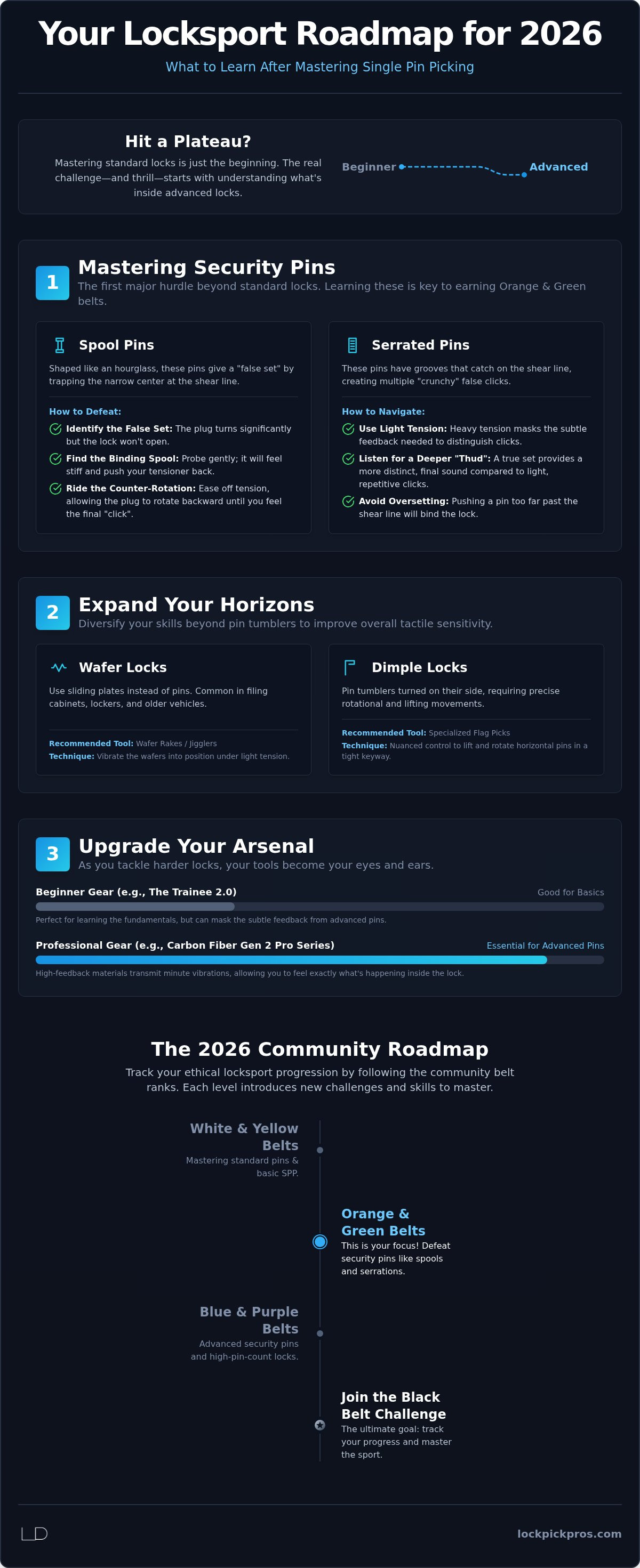
Once you've popped your first few basic padlocks, you'll likely hit a wall. Standard single pin picking (SPP) works great on foundational pin tumblers, but intermediate locks introduce security pins specifically designed to trick you. Understanding these pins is the most critical step when deciding what to learn after single pin picking. In the sport or recreation of defeating locking systems, moving beyond standard pins is how you progress from a Yellow Belt to the more challenging Orange and Green tiers.
Security pins like spools and serrations are the primary obstacles for intermediate pickers. Standard techniques often fail because these pins are designed to give "false" feedback. You might think you've set a pin when you've actually fallen into a trap. To beat them, you need to adopt a "light tension" mindset. Heavy tension, which works on cheap hardware store locks, will completely mask the subtle feedback these pins provide. Success at this level is about listening to the lock rather than forcing it.
Defeating Spool Pins and Counter-Rotation
Spool pins are shaped like an hourglass. When the narrow center of the spool crosses the shear line, the plug rotates slightly, creating a "false set." This is a milestone of progress; it means you've successfully trapped the spool. To finish the job, follow these steps:
- Identify the False Set: The plug will turn significantly, but the lock won't open.
- Find the Binding Spool: Gently probe each pin. The binding spool will feel stiff and cause the tension wrench to push back against your finger.
- Ride the Counter-Rotation: As you lift the spool, carefully ease off your tension. Let the plug rotate backward slightly until the spool's wide base clears the shear line.
A common mistake here is rushing the counter-rotation. If you drop your tension too much, you'll hear other set pins drop back down, forcing you to start the sequence over from the beginning.
Navigating Serrated Pins and Subtle Clicks
Serrated pins feel "crunchy" rather than smooth. They have small grooves cut into them that catch on the shear line, mimicking the click of a set pin. To distinguish a true set from a serration click, listen for the depth of the sound and feel the resistance in the plug. A true set usually provides a more distinct, final "thud" compared to the light, repetitive clicks of serrations. Oversetting occurs when you push a pin too far past the shear line, causing the bottom pin to bind the plug and prevent the lock from opening.
As you tackle these advanced pins, your tools become your eyes. Beginner picks can sometimes "mask" the feedback you need for these delicate movements. Upgrading to the Carbon Fiber Gen 2 Pro Series can help you feel those minute vibrations that tell you exactly what's happening inside the keyway.
Exploring Specialty Mechanisms: Wafer and Dimple Locks
Diversifying your skills is the best way to prevent "hook-pick fatigue." If you've spent weeks chasing spool pins in standard padlocks, switching to a completely different mechanism can reignite your passion for the sport. When considering what to learn after single pin picking, looking beyond the standard vertical pin stack is essential. It forces you to rethink tension and tool placement, which drastically improves your overall tactile sensitivity. Before diving into advanced specialty tools, make sure you've mastered the basics with a solid foundation like The Trainee 2.0.
Learning different mechanisms isn't just about opening more locks; it's about refining your internal map of how metal interacts with metal. Each new mechanism type acts as a puzzle that requires a different "vocabulary" of movement. By the time you return to standard pin tumblers, you'll find your hands are much more responsive to the tiny vibrations of the plug.
The Mechanics of Wafer Locks and Jigglers
Wafer locks use a sliding plate mechanism rather than individual pins. These are commonly found in filing cabinets, lockers, and older vehicle doors. Unlike pin tumblers, wafers are pushed into position by the key's profile to clear the housing. You can pick these using standard hooks, but many hobbyists prefer jiggler tools or wafer rakes. Jigglers work by vibrating the wafers into the correct position under light tension. If you want to practice, look for double-sided wafer locks used in desk drawers. They provide excellent feedback and help you understand how different mechanisms respond to tension.
Dimple Picking and Flag Tool Techniques
Dimple locks are essentially pin tumblers turned on their side. The "dimples" on the key face interact with pins that move horizontally. While some claim dimple picking is just SPP on its side, the reality is more nuanced. You need specialized flag picks to rotate and lift the pins within the tight constraints of the keyway. Precision is everything here. Tools like the HUK 8pcs Kaba tools are designed specifically for this horizontal movement. They allow you to apply rotational force that a standard hook simply can't manage.
Once you start feeling the distinct "click" of a dimple pin setting, you'll realize how much your sensitivity has grown. If you find your current picks are feeling a bit "numb" against these high-security mechanisms, consider upgrading to the Carbon Fiber Gen 2 Pro Series for unmatched feedback.
Strategic Bypassing: Expanding Your Ethical Skillset
Bypassing is the art of ignoring the pins entirely to attack the lock's internal mechanism. While SPP is the heart of locksport, understanding how to circumvent a lock's security through its design flaws is a critical part of what to learn after single pin picking. It shifts your perspective from a narrow focus on pin stacks to a holistic understanding of lock engineering. For a deep dive into the gear used by experts, check out The Ultimate Professional Locksmith Tool Kit Guide for 2026.
In a professional setting, speed and non-destructive entry are priorities. Bypass tools allow you to open a lock in seconds without ever touching a pick. This knowledge makes you a better picker because it teaches you to identify where a manufacturer cut corners. Ethical lockpickers study these vulnerabilities to appreciate high-security design and to build a more versatile skillset.
How to Use Padlock Shims Effectively
Padlock shims are thin pieces of spring steel designed to retract the locking lug. In many standard brass padlocks, the spring-loaded latch can be pushed aside by sliding a shim into the gap between the shackle and the lock body. This interaction bypasses the need for a key or a pick. To shim a lock effectively, follow these steps:
- Insert the Shim: Slide the curved part of the shim into the shackle hole on the side where the locking lug resides.
- Rotate and Push: Apply a twisting motion while pushing downward to force the lug back into the housing.
- Pop the Shackle: Once the lug is cleared, the shackle will spring open.
You can save significant time by identifying "shim-proof" locks before you start. Locks that use double ball bearings rather than spring-loaded latches cannot be shimmed. Look for a shackle that doesn't "spring" open when unlocked; this usually indicates a ball-bearing mechanism that requires the plug to rotate.
Kinetic Entry and Raking Refinement
Raking is often dismissed as beginner luck, but advanced raking is a controlled, kinetic skill. When speed is the goal, raking can be much faster than SPP. The "bitch-pick" method involves using a rake to set several pins quickly before finishing the last one or two with a hook. Alternatively, the rock-and-rake method uses a scrubbing motion to bounce pins toward the shear line. Always maintain tool integrity by using light tension. High-speed entry shouldn't mean snapping your favorite picks. If you're looking for tools that can handle this intensity, our Carbon Fiber Gen 2 Pro Series offers the durability needed for high-performance raking.
Upgrading Your Arsenal: Transitioning to Pro-Grade Tools
Your first lockpick set was likely designed for durability and comfort. While thick handles and sturdy steel are perfect for White Belt locks, they often "mask" the very feedback you need for intermediate challenges. Understanding when your gear is holding you back is a vital part of what to learn after single pin picking. As you move into paracentric keyways, those tight, winding paths found in European or high-security locks, standard picks become too bulky to navigate without oversetting pins.
Transitioning to professional-grade tools isn't just about spending money; it's about increasing your sensitivity. Thinner pick profiles, often around 0.015 to 0.019 inches, allow you to reach deep into a lock without rubbing against the warding. This clearance is essential for feeling the difference between a set pin and a binding spool. If you're ready to stop guessing and start feeling every click, it's time to explore the Carbon Fiber Gen 2 Pro Series for maximum feedback.
Feedback and Material: The Carbon Fiber Advantage
Carbon fiber isn't just for aesthetics. In locksport, material choice determines how much information reaches your fingertips. Unlike rubber or plastic handles that absorb energy, carbon fiber handles transmit pin vibrations directly into your hand. This clarity is the "Carbon Fiber Advantage" that separates intermediate hobbyists from masters. For a deeper technical breakdown, read our guide on The Benefits of Carbon Fiber Lock Picks. In 2026 standards, "high-yield" steel refers to specialized alloys that maintain high tensile strength even when ground to ultra-thin profiles, ensuring your picks don't snap under tension.
Building a Progressive Practice Station
Mastery also requires understanding the "gut" of the lock. You'll eventually need a pinning tray to keep your springs, driver pins, and key pins organized during rekeying. Setting up a progressive practice station allows you to learn a difficult lock by removing most of its pin stacks and adding them back one by one. This method reduces frustration and builds muscle memory. Our article on Lock Rekeying for Beginners explains this process in detail. By stripping a lock down to its core, you can see exactly how your pick interacts with the pins, which is the fastest way to refine your technique.
Ready to feel the difference in your hands? Check out our Carbon Fiber Gen 2 Pro Series to see how professional tools can transform your picking experience.
The 2026 Roadmap: Joining the Black Belt Challenge
The journey from a casual hobbyist to a master of the craft requires more than just practice; it requires a structured path. Finding exactly what to learn after single pin picking becomes much simpler when you have a community-validated goal to chase. The Lockpick Pros Black Belt Challenge is designed to turn your practice sessions into a rewarding sport. This roadmap provides a clear sense of achievement, guiding you through every tier of the locksport community. For a full breakdown of the journey ahead, check out our guide on Lock Picking Belt Levels Explained.
We believe in the power of community. That's why we've built a "Share-to-Earn" loop into our challenge. As you progress through the ranks, you can earn rewards by sharing your journey. This isn't just about opening locks; it's about contributing to the culture of ethical lockpickers. Whether you're upgrading your kit to the Carbon Fiber Gen 2 Pro Series or mastering your first dimple lock, your progress helps others learn and grow.
Earning Your Ranks: From Yellow to Green
In the early stages, you'll focus on foundational locks like the Master Lock 140. This is a classic Yellow Belt lock that tests your ability to handle basic security pins. However, the jump to Green Belt is where the real challenge begins. To earn a Green Belt in 2026, you must pick and gut a lock like the ABUS 72/40. This requires you to show the pin stack on camera to prove you've mastered the internal mechanics. Recording your "picks-in-action" is essential for community validation. It ensures that every rank you earn is respected by hobbyists worldwide.
The Community Bounty and Social Rewards
Our "picks-in-action" social media bounty is designed to foster engagement and reward skill refinement. When you hit social reach goals by sharing your successful opens, you earn community rewards that help you upgrade your arsenal. This creates a cycle of growth: you join the challenge for free, progress one belt at a time, and earn the gear you need for the next tier. For those aiming for the ultimate Black Belt rank, the June 2026 requirements now include mentoring at least two other pickers and completing two "Epic Quests." This ensures that our masters are not just skilled pickers, but leaders in the sport. Join the Black Belt Challenge today and start your journey toward mastery!
Take Your Locksport Skills to the Next Level
Mastering the basics is just the beginning of your journey in the ethical locksport community. You've learned how to feel standard pins; now it's time to interpret the complex feedback of spools, serrations, and horizontal dimple stacks. Deciding exactly what to learn after single pin picking doesn't have to be overwhelming when you follow a structured roadmap. By focusing on progressive skill refinement and understanding the mechanics of bypassing, you're building a professional-grade foundation.
Success at higher belt ranks requires precision. Our Carbon Fiber Pro Series is engineered to provide the expert feedback you need to conquer paracentric keyways. Plus, our unique Share-to-Earn rewards program means your dedication to the sport literally pays off as you climb the ranks. Don't let your progress plateau. It's time to put your skills to the test and earn your next belt rank among fellow hobbyists.
Join the Free Black Belt Challenge and Start Your Progression!
We're excited to see your "picks-in-action" and celebrate every satisfying "pop" with you. Keep picking ethically, keep learning, and we'll see you at the top of the leaderboard!
Frequently Asked Questions
What is the easiest security pin to learn first?
Spool pins are generally considered the easiest security pins for intermediate pickers to master first. They provide unmistakable feedback through a "false set" where the plug rotates significantly but doesn't open. This clear signal tells you exactly where the pin is trapped. Once you feel that distinct rotation, you can practice the delicate balance of tension needed for counter-rotation. It's the perfect entry point for anyone wondering what to learn after single pin picking.
Do I need a new pick set to pick locks with spool pins?
You don't strictly need a new set, but standard beginner tools often lack the sensitivity required for advanced feedback. While a basic hook can open many spool-pin locks, thicker picks can rub against the keyway walls and dampen vibrations. Upgrading to a professional series, like our Carbon Fiber Lockpicks, provides the clarity needed to feel counter-rotation. These tools use high-yield steel and thin profiles to navigate tight paracentric keyways without oversetting pins.
What is a "false set" and how do I know if I am in one?
A false set occurs when a security pin, usually a spool, gets caught at the shear line, allowing the plug to rotate partially. You'll know you're in one because the tension wrench will move significantly, giving the illusion that the lock is almost open. However, the lock remains stuck. This is a milestone in intermediate picking. It indicates that you've successfully set all standard pins and are now dealing with the security features.
Can I use a beginner lock pick set for dimple locks?
No, standard hooks and rakes are not designed for the horizontal movement required in dimple locks. Dimple mechanisms use pins that move sideways, which requires specialized Dimple Picks with a "flag" shape. These tools allow you to rotate the pick head to lift the pins within the narrow constraints of the keyway. Attempting to use a standard hook often leads to tool damage or frustration because you simply can't apply the correct force.
How do I know what belt rank my current lock is?
You can identify your lock's rank by checking the community-standard belt lists maintained by LockPickers United (LPU) or the r/lockpicking subreddit. These lists are updated frequently, with major re-rankings occurring in January and June of 2026. For example, the ABUS 72/40 is currently classified as a Green Belt lock. Always refer to these community hubs to ensure you're practicing on hardware that matches your current skill progression and technical goals.
Is it legal to own bypass tools as a hobbyist?
Ownership of bypass tools is generally legal for ethical hobbyists in most jurisdictions, provided they are used for locksport on your own property. However, laws vary significantly by region. Some areas classify certain items as "burglary tools" if carried in public without a professional license. At Lockpick Pros, we emphasize that all our products are for legal use only. Always research your local statutes to ensure you remain a responsible and ethical member of the community.
What is the best practice lock for learning serrated pins?
The American Lock 1100 series is widely considered the gold standard for learning serrated pins. It features a mix of serrated drivers and key pins that provide a "crunchy" feedback. If you find this too difficult, using a pinning tray to create a "progressive" lock is a great alternative. By starting with just two serrated pins and gradually adding more, you can learn to distinguish a true set from a serration click.
How does the Share-to-Earn program work?
Our Share-to-Earn program rewards you for documenting your locksport journey. When you share "picks-in-action" content on social media and hit community reach goals, you earn rewards that can be used for tool upgrades. It's a simple loop: join the Black Belt Challenge for free, progress through the ranks, and post your videos. This program fosters community engagement and helps you build a professional-grade kit as you move from White to Black belt.