

How to Use Dimple Picks: Flag Techniques for Advanced Locksport (2026)
Dimple picking isn't a new skill; it's a 90-degree evolution of single-pin picking that turns rotation into leverage. If you've spent hours watching your standard hooks slip off a rounded dimple pin, you know the frustration of hitting a wall at the Green or Blue belt level. Learning how to use dimple picks is the essential bridge between intermediate picking and the high-security world of Purple and Brown belt locks. It's about moving beyond the lift and embracing the twist to find that perfect binding pin.
We've all been there, squinting into a cramped keyway and wondering if we should rotate our flag clockwise or counter-clockwise. This guide will help you master the specialized rotation techniques and tool selection needed to defeat advanced dimple locks. You'll learn how to match specific flag profiles to brands like Mul-T-Lock or ABUS and understand the feedback required to advance your belt rank. We're going to break down everything from initial tensioning to the final click of a Kaba-style core, ensuring you're ready for your next Black Belt Challenge. Let's get those flags turning and earn that next rank in the locksport community.
Key Takeaways
- Understand why horizontal keyways in high-security locks require specialized flag picks instead of standard hooks to navigate cramped spaces.
- Learn how to use dimple picks by mastering the rotation technique that turns lateral leverage into precise pin manipulation.
- Identify the critical components of professional sets, focusing on flag shape and shaft rigidity to ensure you receive clear feedback from the pins.
- Discover which dimple locks, from the Green belt Mul-T-Lock 7x7 to Brown belt Kaba Gemini, align with your skill progression.
- Find out how to join the Black Belt Challenge to track your mastery of advanced locks and earn community rewards for sharing your successful opens.
What are Dimple Locks and Why Do They Require Flag Picks?
Dimple locks look intimidating, but they share the same DNA as your favorite padlocks. At its core, a dimple lock is a Pin tumbler lock mechanism where the pins interact with the flat side of the key rather than the edge. Instead of deep cuts on a thin blade, you'll see small craters or "dimples" milled into the face. This design allows manufacturers to pack more security into a smaller space without making the lock larger.
The real challenge isn't the pins; it's the orientation. Most dimple locks use a horizontal keyway. When you try to use a standard hook, you'll immediately feel the "cramp." There's simply no vertical room to lift a pin to the shear line without the pick stem hitting the top of the keyway. Understanding how to use dimple picks starts with recognizing that you aren't picking "up" anymore. You're picking "sideways" by rotating a flag tool. Learning how to use dimple picks effectively means changing your mental map of the lock core. Mastering this technique is often what separates a hobbyist from someone ready to climb the Lock Picking Belt Levels Explained guide. In the 2026 community standards, this skill becomes vital as you approach the Green and Blue belt tiers.
The Mechanical Shift: From Lifting to Rotating
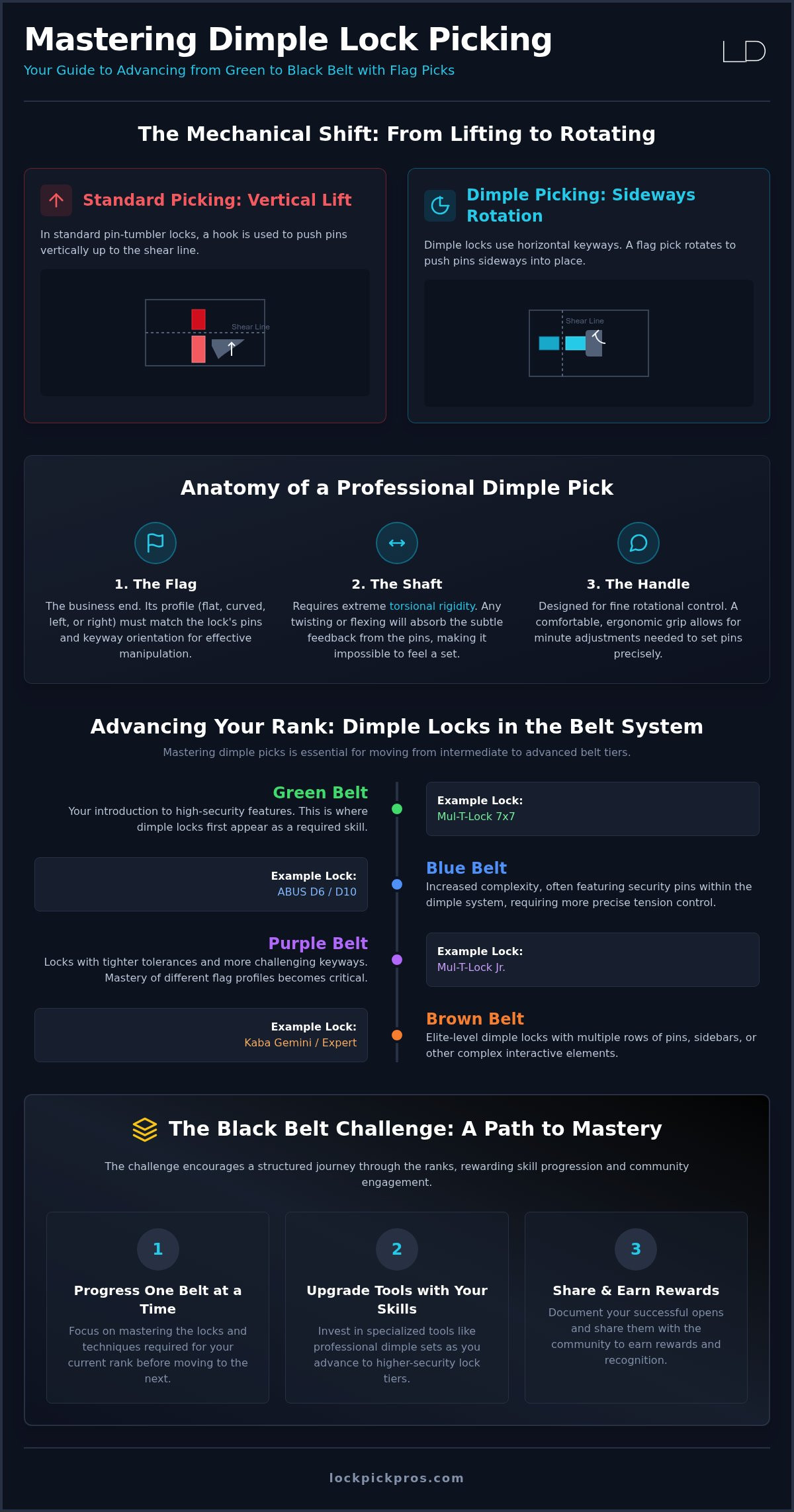
In a standard lock, you use a hook to push pins vertically. Dimple locks use the same springs, drivers, and key pins, but they're tucked away on the side. To reach them, you need a tool that can navigate the narrow shelf of the keyway and rotate into the pin stack. This requires a stable fulcrum point. You'll rest the shaft of your pick on the warding and twist the handle, using the flag to nudge the pin into place. A dimple lock is a pin-tumbler system that utilizes side-milled bitting to increase keyway complexity.
Why Standard Hooks Struggle in Dimple Keyways
Standard hooks are too tall for these tight tolerances. Many high-security dimple locks feature paracentric keyways, meaning the warding overlaps the center line. This leads to "pick profile collision." Your pick stem will hit a piece of metal before the tip even touches the pin. Even if you manage to reach a pin, the vertical lifting motion is often blocked by the ceiling of the keyway. Flag picks are the surgical solution. They're thin enough to slide under the pins and shaped to provide the necessary leverage through rotation rather than raw lifting force.
Anatomy of a Professional Dimple Pick Set
A standard hook set won't cut it once you start tackling high-security cylinders. To master how to use dimple picks, you need to understand the anatomy of the flag pick itself. Each component is designed to handle the unique stresses of rotational picking. The Honest 12pc Professional Dimple Set is a perfect example of a kit that balances variety with precision, offering the specific profiles needed for civil and Kaba-style locks.
The flag is the most critical part of the tool. Its thickness determines if it will fit between the narrow warding and the pin, while the "roundedness" of the tip allows it to glide under pins without snagging. Next is the shaft. Unlike standard picks that sometimes benefit from a bit of flex, dimple pick shafts require extreme torsional rigidity. If the shaft twists like a spring under pressure, you'll lose the "click" of the pin setting. Finally, the handle must be ergonomic. Since you're performing minute rotational movements rather than large vertical lifts, a chunky, grippy handle provides the tactile control needed for delicate feedback.
Choosing Your Flag Profile: Left vs. Right
Flag picks have a specific "handedness." A right-hand flag rotates clockwise to lift a pin, while a left-hand flag rotates counter-clockwise. You'll choose your flag based on which side of the keyway offers a better fulcrum point for your shaft. Flat flags are excellent for the flat-headed pins found in many foundational dimple locks. However, curved flags are essential for the domed or tapered pins seen in high-security Kaba or Mul-T-Lock cylinders. Having a mix of both ensures you're never locked out by a profile mismatch when you're trying to learn how to use dimple picks on more complex targets.
Material Matters: Steel vs. Carbon Fiber
High-tensile steel is the industry standard for durability, but advanced pickers are increasingly moving toward carbon fiber. This material offers a superior weight-to-stiffness ratio, which is vital for feeling the subtle vibrations of a binding pin. You can explore the Benefits of Carbon Fiber Lock Picks to see how they enhance sensitivity during long picking sessions. When you apply heavy tension to a stubborn pin, a carbon fiber shaft won't flex or damp the feedback. If you're ready to upgrade your tactile response, consider our Carbon Fiber Gen 2 Pro Series to give yourself a competitive edge.
Step-by-Step: How to Use Dimple Picks with Flag Techniques
Transitioning from standard hooks to flags requires a fundamental shift in your tactile approach. You aren't just pushing pins anymore; you're orchestrating a series of controlled rotations within a confined space. To master how to use dimple picks, follow this systematic progression to ensure you're getting the most out of your tools and the lock's feedback.
- Step 1: Selecting the tension tool. Top-of-keyway (TOK) tension is almost always the right choice for dimple locks. Bottom-of-keyway (BOK) wrenches often block the very pins you need to access, especially in horizontal keyways where space is at a premium.
- Step 2: Finding the "shelf." You can't pick in mid-air. Explore the keyway to find a warding ledge that can act as your pick’s fulcrum. This "shelf" provides the stability needed for precise rotation.
- Step 3: Navigating the pins. Slide your flag pick along the side of the pin stack. You want to reach the back of the lock without bumping or disturbing neighboring pins, which could lead to accidental oversets.
- Step 4: The Rotation. This is the core of how to use dimple picks correctly. Instead of lifting, twist the handle of the pick. This movement uses the flag tip to nudge the binding pin upward toward the shear line.
- Step 5: Interpreting feedback. A binding pin will feel stiff and resistant to the twist. Once set, you'll feel a distinct "click" and the pin will feel solid. If it feels "mushy," you're likely caught on warding or a false gate.
The Pivot Point: Picking Off the Warding
One of the most common mistakes is trying to lift pins without a support. Professional pickers rest the shaft of the pick directly on a warding ledge. By "rolling" the flag tip across the pin head, you gain a mechanical advantage that makes even heavy springs feel manageable. Use the warding as a lever to ensure precise pin placement without oversetting. This technique allows for micro-adjustments that are impossible with a standard lifting motion.
Mastering Tension for Dimple Locks
Dimple pins have a larger surface area than standard pins, which creates more friction against the plug. This often requires a "feather-touch" tension. If you press too hard, you'll lock the pins in place and lose all feedback. When you encounter security pins like spools, you'll feel counter-rotation. You must slightly ease off your tension wrench to let the plug move backward, allowing the pin to set. For those tackling varied cylinders, the HUK 8pc Kaba Set provides excellent tension feedback and a variety of flag shapes to handle these delicate shifts.
Advancing Your Rank: Dimple Locks in the Belt System
Progression is the heartbeat of locksport. From White to Green belt, your focus should remain on standard pin tumblers. These initial tiers build the foundational tension control and sensitivity you'll need for more complex mechanisms. Once you set your sights on Blue belt, however, the game changes. This is the "Blue Belt Breakthrough." You'll encounter your first "simple" dimple locks, like the Abus EC series. At this stage, learning how to use dimple picks isn't just a fun side project; it's a mandatory skill for your next rank.
Purple and Brown belts introduce high-security "pin-in-pin" technology, most famously found in Mul-T-Lock cylinders. These require specialized flags that can manipulate an inner pin without dropping the outer one. By the time you reach Red and Black belts, you're dealing with the pinnacle of mechanical security. These locks often involve sliders and extreme element counts, like the Kaba experT, that demand absolute precision. Mastering how to use dimple picks at this level requires a deep understanding of how individual components interact under tension.
Mapping Common Dimple Locks to Belt Tiers
Choosing the right practice lock is essential to avoid burnout. The Abus 75IB/40 (Blue Belt) is the perfect entry point for flag practice. It provides clear feedback and relatively forgiving tolerances. For those aiming higher, the Mul-T-Lock Junior (Purple Belt) is your gateway to mastering inner pin manipulation. For a deeper dive into these mechanisms, check out our Mastering the Advanced Lock guide for tier-specific strategies. If you're ready to tackle these advanced challenges, upgrading to our Carbon Fiber Gen 2 Pro Series ensures you have the sensitivity required for high-security feedback.
The "Share-to-Earn" Progression Loop
We believe in rewarding your dedication to ethical locksport. To earn your next belt, you'll need to film your dimple opens for community verification. This isn't just about proof; it's about sharing knowledge. Our "Share-to-Earn" loop allows you to turn these "picks-in-action" videos into tangible rewards. By posting your successful opens on social media and tagging the community, you earn reward points toward your next gear upgrade. We even offer a community bounty for hitting collective social reach goals. It's our way of fostering a supportive environment where every set pin counts toward our shared growth. Every rank you earn is a testament to your skill refinement and commitment to the craft.
The Black Belt Challenge: Join the Elite Locksport Community
Mastering how to use dimple picks is your ticket to the upper echelons of the sport. Skill alone doesn't make a pro; it's about the community you build and the standards you uphold along the way. Our Black Belt Challenge is a free community roadmap designed to guide you from your first successful click to the most complex high-security cylinders. It turns your practice sessions into a journey of mastery. By signing up, you can track your opens, share your progress, and join a network of passionate hobbyists who are all pushing the boundaries of what's possible.
We live by a clear philosophy: your locks, your home, your sport. Ethical picking means respecting the craft and using your skills in a legal, responsible setting. This mindset is what separates a true locksport athlete from the rest. As you advance, the challenges will get tougher, but the rewards of community recognition and skill refinement are worth every hour at the vise. It's time to stop wondering if you can open that Purple belt lock and start proving it.
Earn Your Black Belt in Lockpicking
To reach the pinnacle of the sport, you must do more than just pick a lock. In 2026, the Black Belt rank requires you to mentor at least two other advanced pickers and complete "Epic Quests," such as picking exotic additions like the MIWA WR. You'll need to document your progress with unedited, single-take videos to prove your technical proficiency. This level of transparency ensures that every rank earned is a genuine reflection of your expertise. Understanding how to use dimple picks in high-stress, tight-tolerance scenarios is the only way to secure this elite certification. Ready to start? Join the Black Belt Challenge for Free and begin your ascent.
Essential Gear for the Advanced Tier
Feedback is everything when you're dealing with the tight tolerances of a Red or Black belt lock. We recommend the Carbon Fiber Gen 2 Pro Series for pickers who demand maximum sensitivity. The rigidity of the carbon fiber shaft ensures that every vibration from a binding pin reaches your fingertips without being dampened by flex. Once you've mastered basic flag techniques, the Pro Series Expansion is the logical next step. It provides the specialized profiles needed to navigate the complex warding of high-security European and Japanese cylinders. The only difference between a beginner and a pro is the number of locks they’ve opened. Keep picking, keep learning, and we'll see you at the top.
Master the Art of the Flag
Dimple picking represents the ultimate evolution for intermediate locksport enthusiasts. You've discovered how to identify the unique "shelf" in horizontal keyways and mastered the rotational twist required to set high-security pins. By learning how to use dimple picks, you've officially opened the door to the prestigious Purple, Brown, and Black belt tiers. This journey is about precision, patience, and the right equipment.
Our training is Ethical Locksport Approved and fully Community Belt-System Aligned. We specialize in providing Precision Flag Tools for 2026 Standards to ensure you feel every subtle click in the core. Whether you're tackling your first Abus EC or a complex Mul-T-Lock, the right technique makes the impossible feel accessible. The community is eager to see your progress and celebrate your successful opens on social media.
Ready to prove your skills and earn your next rank? Join the Free Black Belt Challenge and Master the Dimple Lock Today! The only thing standing between you and the elite ranks is your next practice session. Grab your gear, trust your feedback, and let's get those flags turning.
Frequently Asked Questions
Can I pick a dimple lock with a regular lock pick set?
You can't effectively pick a dimple lock with standard hooks because the horizontal keyway is too narrow. A standard hook will hit the warding before it ever touches a pin. Flag picks are designed to slide into these tight gaps and rotate sideways. This allows you to nudge the pins without the pick stem colliding with the lock body. It's the only reliable way to clear the shear line.
What is the best dimple lock for a beginner to start with?
The Abus 75IB/40 is the gold standard for beginners entering the dimple world. It's a Blue belt lock that provides clear, tactile feedback without the complexity of security pins or inner elements. Another great option is the Mul-T-Lock 7x7. These foundational locks allow you to practice your rotation and fulcrum placement before you move on to high-security pin-in-pin mechanisms that require more advanced skills.
How do I know if I need a left-handed or right-handed flag pick?
You determine the "handedness" of your flag based on which side of the keyway provides the best fulcrum. If you rest your pick on the right side and need to lift a pin, a right-handed flag rotates clockwise to apply pressure. Many professional sets include both styles. Testing different flags helps you understand how to use dimple picks to navigate complex paracentric warding found in modern European cylinders.
What are pin-in-pin dimple locks and how do I pick them?
Pin-in-pin locks feature a small inner pin nested inside a larger outer pin. To pick them, you must first set the outer pin until you feel a slight plug movement. Then, you use a thin flag to reach through the outer pin and set the inner one. This technology, pioneered by Mul-T-Lock, requires extreme precision and is a staple requirement for reaching the Purple and Brown belt ranks in the community.
Why does my flag pick keep slipping off the pins?
Your flag is likely slipping because the tip profile doesn't match the pin head shape. Flat flags often slide off domed pins used in high-security locks. Switching to a curved flag or adding a tiny bit of texture to your pick tip can solve this. Also, ensure your shaft is resting firmly on a warding ledge. This stability is crucial when learning how to use dimple picks for consistent opens.
Are dimple locks more secure than standard pin tumbler locks?
Dimple locks aren't necessarily more secure, but they offer more space for complex security features. Their horizontal orientation allows manufacturers to use pin-in-pin designs or sidebars that wouldn't fit in a vertical keyway. This increased complexity makes them a favorite for high-security applications. For ethical lockpickers, this means a much higher technical challenge compared to standard padlocks found at your local hardware store or garden center.
How much tension should I use when picking a dimple lock?
You should use significantly lighter tension than you might be used to with standard pin tumblers. Dimple pins have a larger surface area, which creates more friction against the plug wall. If you apply too much pressure, the pins will bind so tightly that you won't feel any feedback. A "feather-touch" approach allows the pins to move freely while still giving you that distinct click when they hit the shear line.
Is dimple picking required for the Lockpickers United (LPU) belt ranks?
Dimple picking becomes a core requirement as you progress toward the Blue belt and beyond. While you can earn a Green belt with standard pin tumblers, the majority of locks in the Purple, Brown, and Black tiers utilize dimple or slider mechanisms. Mastering these flag techniques is the most efficient way to advance through the LPU ranking system and join the elite ranks of the global locksport community.