

Common Lock Picking Mistakes to Avoid: A 2026 Locksport Progression Guide
What if the reason you're stuck on that stubborn Orange belt lock isn't a lack of talent, but simply the way you're holding your tension wrench? It's incredibly frustrating to spend hours on a single pin only to realize you've accidentally bent your favorite hook. We've all been there, staring at a lock that won't budge while our hands cramp from over-tensioning. You want to progress, but the feedback from the pins feels like a foreign language.
We agree that the jump between belt ranks can feel like a vertical wall when you can't distinguish between a set pin and a binding pin. This guide identifies the most common lock picking mistakes to avoid to help you master the subtle art of locksport. By fixing these technical errors, you'll start hearing those satisfying, consistent clicks that signal real progress. We'll preview the essential adjustments needed to move from a White belt beginner to a Black belt master in the updated 2026 ranking system. Whether you're struggling with feedback or stalling on a specific keyway, it's time to refine your skills and earn your next rank.
Key Takeaways
- Learn why the "death grip" is your biggest enemy and how to lighten your tension to finally feel subtle pin movements.
- Identify common lock picking mistakes to avoid, such as using thick 0.025" picks in narrow Euro keyways that stifle your feedback.
- Stop "ghost picking" by learning how to distinguish between a set pin and a binding pin instead of relying on luck.
- Discover why memorizing a single practice lock stalls your progress and how to diversify your training for higher belt ranks.
- Find out how to join the Black Belt Challenge to track your journey and earn rewards through our community share-to-earn loop.
Why Beginners Struggle: The Learning Curve of the Belt System
Many newcomers approach lock picking with the wrong mindset. They see it as a clandestine trick or a way to bypass security. In reality, it's a legitimate hobby known as locksport. This shift in perspective is crucial for your growth. When you view each lock as a puzzle, you stop trying to force the open. Instead, you treat the lock as a ranking reference for your current skill level. This mindset keeps you patient. It prevents you from ruining your equipment in a fit of frustration. Understanding the Lock Picking Belt Levels Explained guide for 2026 is the first step in this journey. It provides a structured map for your development from a curious novice to a technical expert.
The Myth of the 'Magic' Pick
A major hurdle for beginners is believing that a specific tool will magically open any lock. This is one of the most common lock picking mistakes to avoid. Your pick isn't a key. It's a high-precision sensor. It transmits tiny vibrations and resistance from the pins directly to your fingertips. Locksport is a journey of skill refinement rather than a manual for entry. Tools like The Trainee 2.0 are designed specifically to help you interpret these signals. They are durable enough to handle the learning curve while you develop a light touch. High-quality tools assist your progress, but your hands do the actual work of decoding the lock's internals.
Skipping the Foundational Belt Ranks
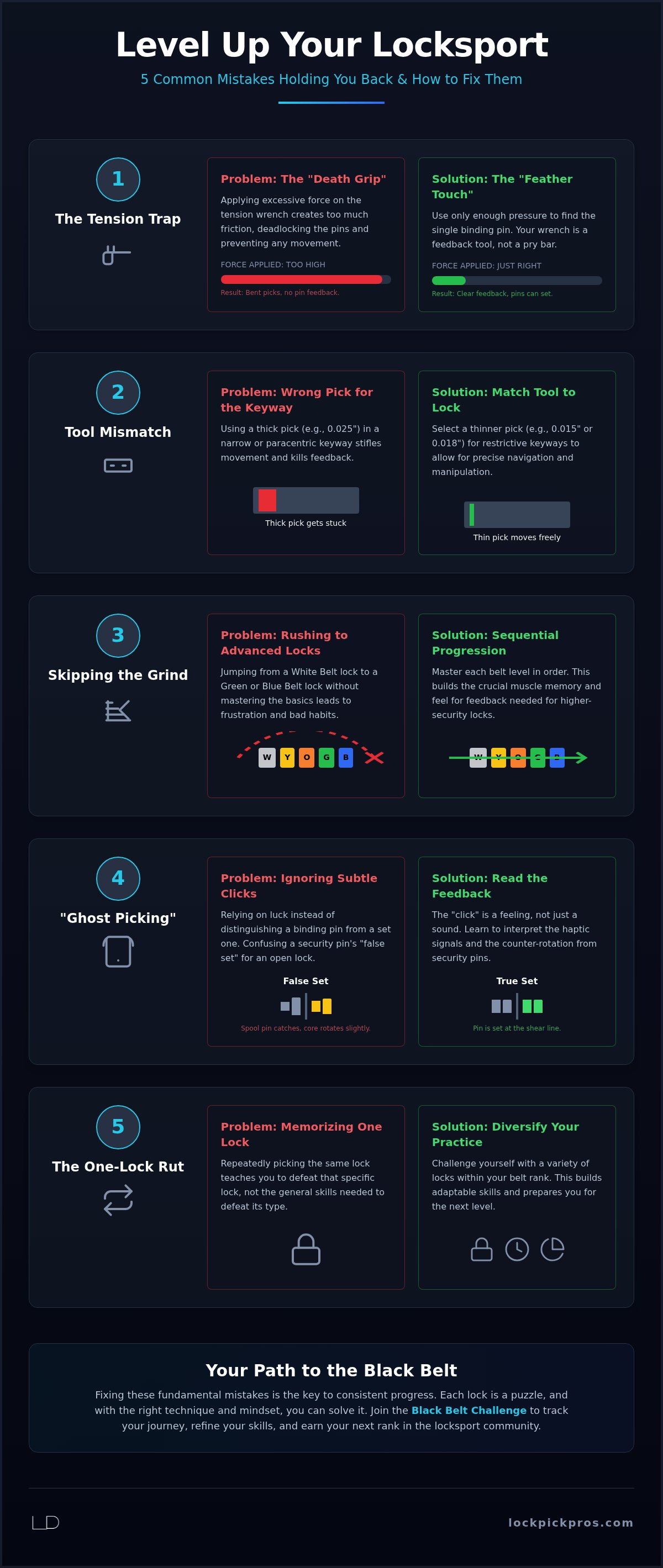
The White Belt wall is a real challenge. That first successful click is often the hardest to master because you haven't learned what a set pin feels like yet. Beginners often get impatient. They try to tackle an American Lock 1100 before they've mastered a simple Master Lock #3. This is a recipe for failure. Skipping ranks prevents you from building the muscle memory needed for complex feedback. You must learn the basics of single pin picking on low-security locks first. If you jump straight to intermediate locks, you'll likely develop bad habits. These include using too much tension or "scrubbing" pins blindly. Such habits will stall your progress at the Green belt level. Stick to the sequential progression to ensure your skills are solid at every tier. This foundation is what eventually allows you to tackle high-security locks with confidence.
The Tension Trap: Balancing Force and Feedback
Your tension wrench is a steering wheel, not a pry bar. The most frequent error in locksport is the "death grip." Beginners often assume that pushing harder on the wrench will force the lock to open faster. It does the opposite. When you apply too much pressure, you create so much friction that the pins cannot move to the shear line. You are effectively deadlocking the mechanism yourself. Understanding the mechanics of Bypassing Physical Locks requires a respect for these tight tolerances. Professional picking is about finesse, not brute strength.
Mastering Single Pin Picking (SPP) relies entirely on your ability to identify the binding pin. This is the one pin that resists your pick because the tension wrench is pinching it against the lock housing. If you use excessive force, every pin will feel like it is binding. You won't be able to tell which one needs to be set first. Variable tension is the secret. Sloppy, low-security locks often need a heavier touch to move the plug. High-tolerance, advanced locks require a whisper of pressure to let the pins dance into place.
Over-Tensioning and Pick Deformation
If your picks are starting to look like bananas, your tension is too high. High tension forces you to use high picking pressure. This leads to bent or broken tools. It's one of the most expensive common lock picking mistakes to avoid. To fix this, try the "feather touch" technique. Rest your finger on the wrench with only the weight of a single coin. Gradually increase pressure until you feel one pin offer resistance. This balance ensures you aren't fighting the lock's friction while trying to set the pins.
Ignoring the Subtle Click: Missing Feedback
The "click" is a haptic signal rather than an audible one. In a noisy room, you won't hear it, but you should always feel it through your pick. Beginners often miss this because they are looking for a loud snap. You also need to distinguish between a "true set" and a "false set." Security pins like spools will give you a deep "click" and the plug will rotate slightly, but the lock isn't open yet. This counter-rotation is a conversation the lock is having with you.
- Practice Tip: Close your eyes while practicing with The Trainee 2.0. Removing your vision forces your brain to focus entirely on the vibrations in your fingertips.
- Refine Your Senses: If you find the feedback is still too muffled, upgrading to the Carbon Fiber Gen 2 Pro Series can help amplify those tiny movements.
Wrong Tool for the Job: Selection Errors Across Tiers
Selecting the right pick is about more than just personal preference. It's about matching your gear to the mechanical requirements of the lock. One of the most common lock picking mistakes to avoid is relying on a rake for locks that demand Single Pin Picking (SPP). While raking might get you an easy open on a White or Yellow belt lock, it won't help you advance. Raking relies on speed and luck. SPP builds the technical precision you need for higher ranks. As you move toward Orange and Green belts, your pick set selection becomes a critical factor in your success. These selection errors are among the most common lock picking mistakes to avoid for rising hobbyists.
Steel quality and pick thickness are the next hurdles. Most beginner sets use 0.025" thick steel. This is perfect for wide American keyways because the metal is durable and resists bending. However, as the locks get harder, the keyways get tighter. Trying to force a thick pick into a paracentric keyway is a recipe for disaster. You'll lose all feedback and likely damage your tools. You need to understand when your standard steel tools are reaching their limit and when it's time to transition to high-performance materials.
Forcing Heavy-Duty Picks into Restricted Keyways
Tight "Euro" keyways are common in intermediate locks. If you use a standard 0.025" pick here, it will get stuck against the warding. This creates "ghost" feedback where you think you're touching a pin, but you're actually just hitting the side of the lock. To solve this, you need thinner profiles that can navigate the maze of the keyway. The Carbon Fiber Gen 2 Pro Series offers the stiffness of thicker steel with a much slimmer profile. This allows you to navigate restricted spaces without sacrificing haptic signals. Choosing the right profile is also essential:
- Short Hooks: Best for low-security locks with plenty of room to move.
- Deep Reach Hooks: Necessary for reaching high-set pins hidden behind shorter pins in the front.
Neglecting Specialty Tools for Advanced Tiers
As you reach the upper tiers of the belt system, standard hooks won't cut it. A major error is trying to pick a dimple lock with a pin tumbler hook. Dimple locks require you to rotate the pick rather than lift it. Using the wrong tool here is frustrating and ineffective. For these advanced challenges, you need specialty gear like Kaba-style tools. These are designed for the unique side-pinning and rotating requirements of high-security locks. Remember, over-tooling as a beginner is just as bad as under-tooling as a pro. Don't buy every specialty pick on day one. Instead, upgrade your kit sequentially as you earn each new belt in your progression.
Practice Pitfalls: Sabotaging Your Skill Refinement
Repetition is the mother of skill, but only if you're practicing the right way. Many enthusiasts fall into the trap of picking the same lock repeatedly until they can open it in seconds. This isn't skill refinement; it's muscle memory for a single specific object. It leads to "ghost picking," where the lock opens but you don't actually know why. You aren't feeling the pins; you're just following a memorized sequence of movements. This is one of the most common lock picking mistakes to avoid if you want to earn higher belt ranks. When you encounter a new lock with different internals, your progress will grind to a halt because you haven't learned to interpret real-time feedback.
Ethical standards are just as important as technical skills. The locksport community thrives because we follow strict rules. Never pick a lock that is "in use," such as your front door or a padlock on a gate. Even a successful pick can occasionally damage a lock's internal springs or pins, leaving it inoperable. Only practice on locks that you own and that are not currently serving a security purpose. Maintaining this boundary ensures our hobby remains respected and legal.
The 'One-Lock Wonder' Syndrome
To truly advance, you need variety. Our "Lock Difficulty Reference Guide" maps out which locks fit each tier, ensuring you don't stay in your comfort zone too long. Different bitting patterns change everything. A lock with "high-low" bitting, where a short pin sits behind a long one, requires much more precision than a flat bitting profile. Using Practice Locks with transparent housings can help break the memorization habit. These tools provide visual confirmation of what your pick is doing, allowing you to correlate haptic feedback with pin movement. Once you understand the "why" behind the open, move to a solid brass lock to test your senses.
Neglecting Ethical Boundaries and Legal Safety
Carrying your tools without a clear purpose can lead to unnecessary trouble. It's vital to understand the principles of Ethical Lock Picking for Hobbyists. Always maintain "lawful intent" by keeping your tools in a dedicated carrying case and only using them in appropriate settings, like at home or at a community meetup. If someone asks about your hobby, frame it as a technical challenge or a "ranking reference" for your progress. Avoid terms that make it sound like a "defeat manual" for security systems. Being a responsible mentor in the community means proving that lockpicking is a sport of precision and ethics. If you're ready to take your practice to a professional level, consider upgrading to the Carbon Fiber Gen 2 Pro Series for the ultimate feedback experience.
Mastering the Click: Your Path to the Black Belt Challenge
Mastering the subtle art of lockpicking is a marathon, not a sprint. You've already learned the common lock picking mistakes to avoid, from the tension trap to tool selection errors. Now, it's time to turn that technical knowledge into a verified rank. The path to the Black Belt starts with a single click, but it continues through a dedicated community of pickers who support each other's growth. By joining our Free Black Belt Challenge, you can track your progression across all nine tiers of the updated 2026 ranking system. This structured journey ensures you never feel lost or stalled on a lock that is beyond your current skill level.
Progressing through the ranks requires more than just practice; it requires the right equipment for the right challenge. As you move from White to Yellow belt, your foundational tools will start to feel limiting. This is a natural part of the learning curve. You'll need to document your progress with unedited video evidence for ranks like Blue belt and higher. Sharing these "picks-in-action" helps the community verify your skills and provides a learning resource for those following in your footsteps.
Upgrading to the Pro Series Expansion
As you hit the Yellow belt milestone, your needs change. This is the logical moment to consider the Pro Series Expansion. Transitioning from trainee gear to expert-level precision allows you to feel the difference that high-yield lockpicks make when tackling security pins. These tools are designed for the high-tolerance environments of Orange and Green belt locks. High-yield picks offer superior feedback, which is essential when you're trying to distinguish between a set pin and a false set in a complex keyway. Moving beyond foundational tools is a rite of passage for every ethical hobbyist aiming for the intermediate tiers.
Join the Community Bounty
Lockpicking is a shared sport, and our share-to-earn loop is designed to reward your participation. Documenting your journey isn't just about personal glory. It's about helping the community grow. When you post your progress on social media, you earn points toward exclusive gear rewards. We even offer a community bounty for hitting specific social reach goals. This collective effort fosters engagement and ensures that knowledge is passed down to the next generation of pickers. Remember that reaching the highest ranks, like Black Belt, now requires you to formally mentor at least two other pickers. This mentorship ensures the sport remains welcoming and accessible to everyone.
The journey from White to Black belt is challenging, but you don't have to do it alone. Use the ranking reference guides, avoid the common lock picking mistakes to avoid that stall so many beginners, and keep your picks moving. Your technical mastery is just a few clicks away. Ready to earn your first belt? Join the Black Belt Challenge for Free today!
Unlock Your Potential in the Locksport Community
Mastering the mechanical puzzles of the belt system is a journey of patience and precision. You've learned how to lighten your tension to feel those elusive clicks and why matching your pick thickness to the keyway is vital for success. By identifying these common lock picking mistakes to avoid, you're now equipped to move past the White belt wall toward advanced mastery. Our community thrives on ethical practice and shared knowledge. These tools are used by ethical pickers and service members worldwide because they provide the reliable feedback needed for technical refinement.
If you're ready to stop guessing, it's time to upgrade your kit. Our precision-engineered carbon fiber series offers expert-level feedback that standard steel simply can't match. You can also participate in our share-to-earn loop to gain rewards as you document your progression and help others learn. Ready to level up? Join the Free Black Belt Challenge and start your journey to mastery today! We're excited to see your progress in the higher ranks of the locksport world. Keep practicing, stay ethical, and enjoy the click.
Frequently Asked Questions
Is it normal to bend my lock picks when I first start?
Bending picks is a very common beginner experience. It's usually caused by applying too much force on the pick to overcome heavy tension. This is one of the common lock picking mistakes to avoid by learning to lighten your touch. When you use a "death grip" on the wrench, you force the pick to work harder. Using a dedicated set like the Trainee 2.0 helps because it's built for this learning phase.
How much tension should I actually be applying to the lock?
You should apply just enough tension to make one pin bind. A good rule of thumb is the "feather touch" method. Use only as much pressure as the weight of a single coin. This allows the pins to move freely while still catching on the shear line. If your finger is turning white or your pick is bending, you're using too much force. Heavy tension masks the feedback you need to succeed.
Why can I pick my practice lock but not a real padlock?
Practice locks often have wider tolerances or transparent housings that make them easier to decode. Real padlocks, especially those ranked Yellow belt or higher, often contain security pins like spools or serrations. These require a more advanced pick set selection and better feedback interpretation. Real locks also have tighter keyways that can trap standard beginner picks. This makes it much harder to feel the pins as they move.
What is a 'false set' and how do I get out of it?
A false set occurs when the plug rotates slightly but the lock doesn't open. This usually happens because a spool pin is caught. You'll feel counter-rotation as you press on the binding pin. To get out of it, slightly ease up on your tension while maintaining upward pressure on the pin. This allows the spool to slide into its correct position without letting the other set pins drop back down.
Can I learn lockpicking with just a rake and a tension wrench?
You can open basic locks with a rake, but you won't master the actual mechanics of the sport. Raking relies on speed and luck rather than technical skill. If you want to progress through the belt ranks, you must learn single pin picking with a hook. Relying on raking is one of the common lock picking mistakes to avoid if you want to reach intermediate and advanced tiers of the locksport community.
How do I know which belt rank a specific lock belongs to?
You should consult our central Lock Difficulty Reference Guide. This guide maps common practice locks to their community-standard belt classes. These rankings are based on standards from groups like LPU and Reddit. Locks are categorized from White to Black belt based on features like security pins and keyway difficulty. It also considers the presence of advanced mechanisms like dimples or sidebars that require specialized tools to navigate.
What should I do if I feel like I've 'over-set' a pin?
If you've pushed a pin too high and it's stuck above the shear line, the best move is to slowly release tension. You want to hear a single "click" as the over-set pin drops back down. If you release too much, all your pins will drop and you'll have to start over. This is a great way to practice the delicate balance of tension control needed for higher belt ranks.
Is it legal to practice lockpicking as a hobby in my state?
Owning lockpicks is generally legal for hobbyists in many areas as long as you maintain "lawful intent." However, specific laws vary by state and country. Some regions have stricter rules regarding the possession of these tools outside of your home. You should always check your local statutes to ensure you're compliant. The locksport community focuses on ethical lockpicking, which means only picking locks you own and never those that are currently in use.