

Lock Rekeying for Beginners: Mastering Internal Mechanics in 2026
Mastering the art of lock rekeying is like gaining X-ray vision for your locksport journey. It's the moment the internal mechanics of a cylinder stop being a mystery and start becoming a clear map for your picks. If you're just starting out, the idea of handling tiny springs and microscopic pins might feel a bit intimidating. You don't want to "brick" a perfectly good lock or spend hours chasing a lost driver pin across the carpet. This guide on lock rekeying for beginners is designed to replace that hesitation with the steady hand of a trainee who knows exactly how a pin tumbler mechanism works.
We all know the feeling of wonder when a lock finally clicks open, but understanding why it happens on a mechanical level is what separates a casual hobbyist from a dedicated picker. By learning this foundational skill, you'll gain a massive advantage as you climb the community belt ranks. We will walk through the step-by-step process of rekeying your first practice lock. This process ensures you have the technical knowledge to reach your White Belt ranking and beyond. Get ready to dive deep into the pin stack and see your tools in a whole new light.
Key Takeaways
- Gain a mechanical advantage by learning to visualize the internal pin stacks and springs inside a standard lock.
- Understand how the shear line functions as the ultimate goal for every ethical lockpicker during the picking process.
- Master the fundamentals of lock rekeying for beginners to customize your own practice locks with specific pin configurations.
- Save money on your hobby by resetting existing hardware instead of purchasing entirely new sets for every practice session.
- Prepare yourself for the journey toward a Black Belt ranking by mastering the tools and techniques required for advanced lock manipulation.
Demystifying Lock Rekeying: The Beginner’s Gateway to Locksport Mastery
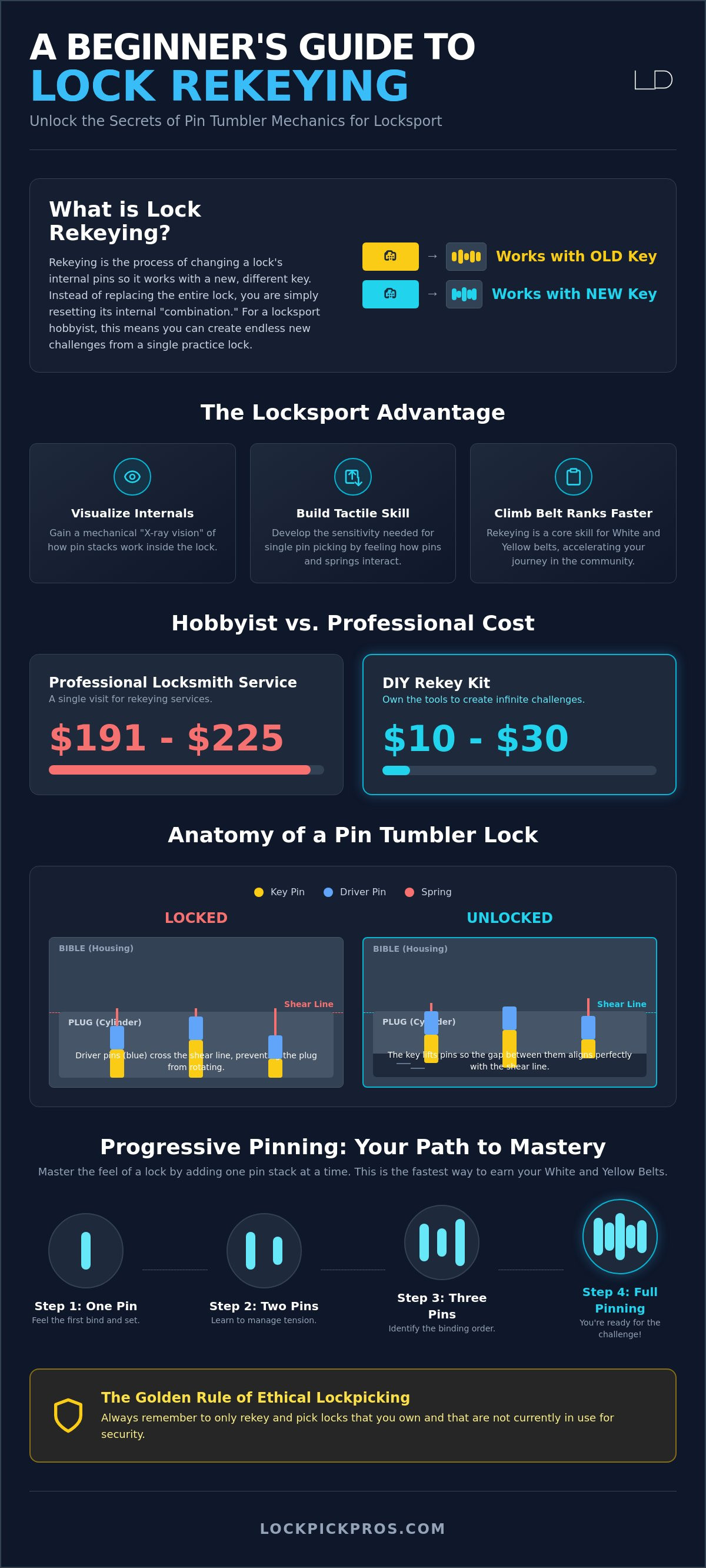
Rekeying is the process of changing the internal pins of a lock so it functions with a completely new key. Unlike replacing the entire hardware, you are simply resetting the "brain" of the device. This guide on lock rekeying for beginners focuses on how this skill transforms your understanding of security. Instead of viewing a lock as a solid block of metal, you begin to see it as a mechanical puzzle. To get started, you can find a technical overview of Rekeying on Wikipedia, which details the history and standard mechanics of this locksmithing staple.
Ethical lockpickers start their journey here because it allows them to understand the "enemy" from the inside out. When you rekey a lock, you manually place every pin and spring. This hands-on interaction builds the tactile sensitivity required for single pin picking (SPP). You aren't just guessing where the pins are; you have already seen them. You know their heights. You know how the springs feel when they compress. This internal knowledge is what turns a trainee into a precision picker.
In 2026, the locksport community views rekeying as a core requirement for those following the Lock Picking Belt Levels Explained guide. Mastering the internal mechanics early ensures you don't hit a wall when you encounter advanced security pins later. It provides a "ranking reference" that helps you visualize the shear line during every practice session.
Hobbyist vs. Professional Rekeying
Professional locksmith visits often cost between $191 and $225 for a standard home service. By contrast, a DIY rekey kit typically costs between $10 and $30. For a hobbyist, this isn't just about saving money; it's about building a practice lab. You can take one lock and turn it into a hundred different challenges. Always remember the golden rule of ethical lockpicking: only rekey and pick locks that you own and that are not currently in use for security.
The Role of Rekeying in the Belt System
Rekeying helps you earn your White and Yellow belts significantly faster. By using a tool like The Trainee 2.0, you can practice "progressive pinning." This means starting with just one pin stack to master the feel, then adding more as your confidence grows. This method is the most efficient way to prepare for the Black Belt Challenge. It allows you to simulate higher-tier difficulty levels by mixing and matching pin lengths and types within a single practice cylinder.
The Anatomy of a Pin Tumbler: How Rekeying Works Under the Hood
To master lock rekeying for beginners, you have to look past the brass and steel. You need to visualize the five or six vertical chambers that hold the secret to every open. Each chamber contains a "pin stack." This stack consists of a spring, a driver pin, and a key pin. Together, they create the mechanical logic of the lock. When you understand how these three parts interact, you stop guessing and start calculating your moves.
The Bible is the upper part of the lock housing. It holds the springs and driver pins in place. Below it sits the Plug. This is the inner cylinder where you insert the key. When the lock is closed, the driver pins bridge the gap between the Bible and the Plug. This physical obstruction prevents rotation. Springs live at the very top of the Bible. They apply constant downward pressure. This pressure ensures that without a key, the driver pins are always forced down into the plug, keeping the lock secure.
Understanding these tolerances is much easier when you can feel the subtle clicks of the pins against the shear line using a high-quality carbon fiber pick set. This tactile feedback is essential for both rekeying and picking.
Key Pins vs. Driver Pins
Key pins are the bottom pins. They come in various lengths to match the "bitting" or cuts on a key. When you insert the correct key, it lifts these pins just enough so their tops align perfectly with the shear line. Driver pins are the top pins. In basic locks, these are simple cylinders. In higher-tier locksport challenges, you'll find security pins like spools or serrated pins. These are designed to catch on the shear line and give "false sets." This is where the challenge of the sport truly begins.
The Physics of the Shear Line
The shear line is the physical boundary between the rotating plug and the fixed housing. Think of it as the ultimate goal for both rekeying and picking. During a rekey, you must match the key pin height to the key's cut perfectly. If you choose a key pin that is too long, the driver pin will stay pushed down into the plug. This is called "under-setting." If the pin is too short, the key pin itself crosses the shear line and enters the Bible. This is "over-setting." In both cases, the plug is jammed. Mastering this alignment is the first step toward understanding how to manipulate these pins with a pick later on.
Rekeying vs. Replacing: Choosing the Right Path for Your Skills
For most homeowners, rekeying is a matter of security or moving into a new property. In Texas, for example, landlords are legally required to rekey locks within seven days of a new tenant moving in. However, in the world of locksport, lock rekeying for beginners serves a different purpose. It is the most cost-effective way to reset your practice lab. While a professional locksmith visit can cost between $191 and $225 on average, a DIY rekey kit usually stays within the $10 to $30 range. This massive price gap allows you to invest your budget into better tools rather than redundant hardware.
The real value of rekeying lies in key control and skill progression. When you replace a lock, you throw away a perfectly good mechanism. When you rekey, you keep the high-quality housing and simply update the internal logic. This ensures that only you have access to your practice cylinders. As you advance, you will eventually hit a "skill ceiling" where standard consumer locks no longer challenge you. At that point, you should stop rekeying basic cylinders and move toward high-security locks with sidebars or magnetic elements. To handle those advanced challenges, you will want to graduate from basic pinning tweezers to professional gear like the Carbon Fiber Gen 2 Pro Series.
When to Rekey Your Practice Locks
Muscle memory is the enemy of true skill. If you pick the same lock with the same bitting every day, you aren't learning to feel the pins; you're just memorizing a sequence. Rekeying allows you to change the bitting frequently, forcing your hands to stay sharp. You can also create progressive locks. Start with a single pin stack to master the basics, then move up to a full six-pin configuration. This is also a great time to fix a "crunchy" lock. Often, a lock that feels difficult to pick just has old, compressed springs or debris in the chambers. A quick teardown and rekey can make an old lock feel brand new.
The Hardware Comparison
Standard retail kits for brands like Schlage or Kwikset are fine for home utility, but hobbyists often prefer custom locksport pinning kits. These kits include a wider variety of pin lengths and security pins. If you are looking for the ideal starting point, The Trainee 2.0 offers a rekeyable platform specifically built for learning internal mechanics. Before you start, evaluate the lock's condition. If the plug is heavily wiggling or the Bible is cracked, the hardware is too worn to be worth the effort. In those cases, a full replacement is the better choice for your practice sessions.
Your First Rekey: A Practical Step-by-Step Guide for Hobbyists
Transitioning from picking to lock rekeying for beginners is a major milestone in your locksport journey. It's the moment you stop working against the lock and start working with it. Before you touch a single pin, you need a clean, well-lit workspace. Small components like springs and pins are notorious for vanishing into carpets or cluttered desks. You'll need a dedicated Pinning Tray, pinning tweezers, and a plug follower to ensure a smooth operation.
Essential Beginner Tools
A proper pinning tray is not optional. It features specific grooves designed to hold your pin stacks in the correct order. If you lose track of which pin goes in which chamber, your bitting map is useless. The Plug Follower is your most critical safety tool. As you slide the plug out of the housing, the follower takes its place. This keeps the high-tension springs and driver pins trapped safely inside the Bible. Without a follower, you'll face a "gutted lock" disaster where internal parts explode into the empty housing. For a clear, visual learning experience, The Trainee 2.0 offers a transparent body that lets you see exactly how the follower interacts with the pins.
The rekeying process begins by removing the C-clip or tailpiece from the back of the cylinder. Insert the current working key and rotate the plug about 45 degrees. This angle prevents the pins from falling into the gaps at the bottom of the keyway. Slowly push the plug out using your follower, maintaining constant contact between the two parts. Once the plug is free, you can swap out the old key pins for new ones that match your new key's bitting. Each pin must sit perfectly flush with the top of the plug when the key is inserted. This alignment confirms you've successfully mapped the shear line.
Common Beginner Pitfalls
The "Spring Launch" is a rite of passage every trainee fears. If you move the follower too quickly or at the wrong angle, a spring can send a driver pin flying across the room. Always keep a steady, firm grip on the assembly. Another frequent error is the "wrong-way follower." You must ensure the pin chambers in the plug align perfectly with the chambers in the Bible during re-entry. If you accidentally trap a pin and "brick" the lock, you can often save it by using padlock shims to bypass the caught pin and reset the plug.
Always follow the Golden Rule: never snap the lock back together without testing the key first. Keep the plug slightly extended or use a shim to verify the key turns freely. Once that C-clip is back on, a simple mistake becomes a much harder fix. Precision is everything in this sport.
Ready to handle your pins with professional accuracy? Upgrade your bench with the Carbon Fiber Gen 2 Pro Series for the feedback you need to master advanced cylinders.
Leveling Up: From Rekeying Basics to the Black Belt Challenge
Mastering lock rekeying for beginners is the ultimate power move for your locksport career. You've moved from just poking at pins to understanding exactly how they interact with the shear line. Now, it's time to put that knowledge to the test with Single Pin Picking (SPP). Since you know the heights and positions of the pins you just installed, you can visualize the stack as you apply tension. This isn't cheating; it's calibration. It builds the mental model you'll need when you eventually face "blind" locks where you have no idea what's inside. You've essentially turned your practice cylinder into a custom trainer.
We want to see your progress in action. Our "Share-to-Earn" loop is designed to reward your dedication to the craft. When you post your "picks-in-action" or gutting videos on social media, you earn equipment discounts and community recognition. This loop keeps you motivated to move from your initial White Belt all the way to the elite Black Belt tier in 2026. Every belt you earn is a badge of honor. It shows the community that you've put in the hours to master both the pick and the pinning tweezers.
The Black Belt Challenge
The free "Black Belt Challenge" is more than just a list of difficult locks. It's a community-driven mastery program that guides you through every technical hurdle in the sport. In higher-tier rankings, you won't just be asked to pick a lock. You'll be required to "gut" it on camera to prove the internal components are standard and unmodified. Your rekeying knowledge is directly tested during this process. If you can't safely disassemble and reassemble a high-security cylinder, you can't claim the rank. Join the challenge today and start tracking your 2026 roadmap toward locksport excellence.
Community Bounty and Engagement
We've established a community bounty for creators who hit social reach goals with their gutting and rekeying content. To film a proper verification video, ensure your camera has a clear, continuous view of the lock at all times. You must show the lock being picked, then immediately gut it to display the pin stacks and any security pins present. This transparency is the gold standard of the locksport world. It proves your skill is genuine. Once you've mastered the internal mechanics of lock rekeying for beginners, check out What to Learn After Single Pin Picking to see what advanced challenges await you next on your journey.
Master Your Mechanics and Claim Your Belt
You've unlocked the secrets behind the shear line. Mastering lock rekeying for beginners is the bridge between random picking and calculated mastery. You now know how to map bitting, handle pin stacks with precision, and reset your own practice lab without breaking the bank. This foundational skill doesn't just save you hardware costs; it prepares you for the rigorous gutting requirements of the higher belt ranks.
Our ethical locksport community approved methods align with the 2026 Belt Ranking Roadmap to ensure you're always progressing toward that elite Black Belt status. Using precision-engineered pinning trays and professional tools ensures your springs stay where they belong. The sport is about precision and knowledge. Your journey through the ranks is just beginning. Keep practicing, stay ethical, and we'll see you at the top of the leaderboard.
Join the Black Belt Challenge and Start Your Journey Today!
Common Questions About Lock Rekeying
Is lock rekeying difficult for a complete beginner?
Rekeying is a manageable skill for any beginner who approaches it with patience and steady hands. The process is more about following a logical sequence than brute force. While handling tiny springs can feel intimidating at first, using a practice lock allows you to learn without the pressure of "bricking" a lock you rely on for daily security.
What tools are absolutely necessary for a first-time rekey?
You absolutely need a plug follower, pinning tweezers, and a dedicated pinning tray. The follower keeps the driver pins from exploding out of the Bible while the tray ensures your pin stacks stay in the correct order. Without these three essentials, you risk a "gutted lock" disaster that can be very difficult to fix for a trainee.
Can I rekey a lock without the original key?
You can rekey a lock without the original key, but you must be able to pick the lock open first. To remove the plug, the cylinder must be rotated to the 45 degree mark. If you don't have the key and can't pick it, you may need a specialized bypass tool or the assistance of a professional to reset the cylinder.
Is it cheaper to rekey a lock or buy a new one?
Rekeying is almost always the more affordable option compared to buying entirely new hardware. DIY rekey kits typically cost between $10 and $30, whereas high-quality deadbolts or entry sets can be significantly more expensive. For hobbyists, rekeying is the most efficient way to refresh a practice lab and create new challenges on a budget.
What happens if I lose a pin or a spring during the process?
Losing a small part is a common rite of passage in the locksport community. If a spring launches across the room, you will need a universal pinning kit or a spare parts bag to find a replacement. This is exactly why we emphasize using a pinning tray and working in a clean, well-lit area to catch parts before they vanish.
How do I know if my lock is compatible with a standard rekeying kit?
Compatibility depends on the lock's brand and keyway type. Most retail rekeying kits are designed for specific brands like Schlage or Kwikset. Before you start, check the name stamped on your key or the lock face. Hobbyists often prefer universal kits that provide a wide range of pin lengths to fit various common cylinders found in the sport.
Is rekeying my own house locks legal in the US?
It is perfectly legal to rekey locks that you own in the United States. Ethical lockpickers always follow the rule of only working on locks they possess and that are not in active use for security. While some states like Texas have specific regulations for landlords, a private hobbyist is free to modify their own practice hardware for skill development.
How does rekeying help me become a better lockpicker?
Mastering lock rekeying for beginners gives you a mental map of the pin stacks you are trying to manipulate. By manually setting the pins and feeling the spring tension, you develop a better sense of where the shear line sits. This internal knowledge translates directly to better tactile feedback and faster open times when you are using your picks.