

Clear Practice Padlock vs. Cutaway: Which is Best for Your White Belt?
The transparent lock you see in every starter kit isn't just a novelty; it's a visual cypher designed to translate what you see into what you feel. You've likely felt that specific frustration of poking around inside a dark keyway, wondering if you're even touching a pin or just scraping the warding. It's intimidating to start picking "blind," and nobody wants to risk damaging a real door lock while they're still learning the basic mechanics of the sport.
Starting your locksport journey should be an exciting challenge, not a guessing game. This guide will show you exactly how a clear practice padlock accelerates your progress toward that first community rank and where it fits in your journey to becoming a master. We'll compare the immediate visual feedback of acrylic locks against the realistic tactile response of metal cutaways. You'll discover the best way to build your foundational skills; giving you the confidence to move from plastic trainers to real metal padlocks as you earn your White Belt and join the ranks of ethical pickers.
Key Takeaways
- Understand how transparent housing reveals the internal pin tumbler mechanism to help you visualize the shear line in real-time.
- Discover why a clear practice padlock is the foundational tool for identifying binding order and observing how pins set under tension.
- Learn the key differences between acrylic trainers and metal cutaways; balancing total visibility against realistic tactile feedback.
- Practice our two-step method to move from visual cues to pure tactile mastery; a vital skill for progressing through the locksport belt ranks.
- See how to join the Black Belt Challenge and use the Lockpick Pros ecosystem to track your journey from White Belt to Master.
Understanding the Clear Practice Padlock as a Training Aid
Starting your locksport journey can feel like trying to solve a puzzle in a pitch-black room. A clear practice padlock changes that immediately by replacing guesswork with visual certainty. It consists of a transparent acrylic housing that reveals the inner workings of a Pin tumbler lock in real-time. For many in our community, this is the tool that provides the "Aha!" moment. It aligns your mental model of how pins move with the physical resistance you feel in your hands. Ethical lockpickers use these trainers to build a solid foundation, ensuring they understand the "why" before they start wrestling with the "how" of traditional metal locks. This is why the visual trainer is a staple of White Belt community standards; it's the first step in proving you understand the mechanics.
The Anatomy of a Transparent Training Lock
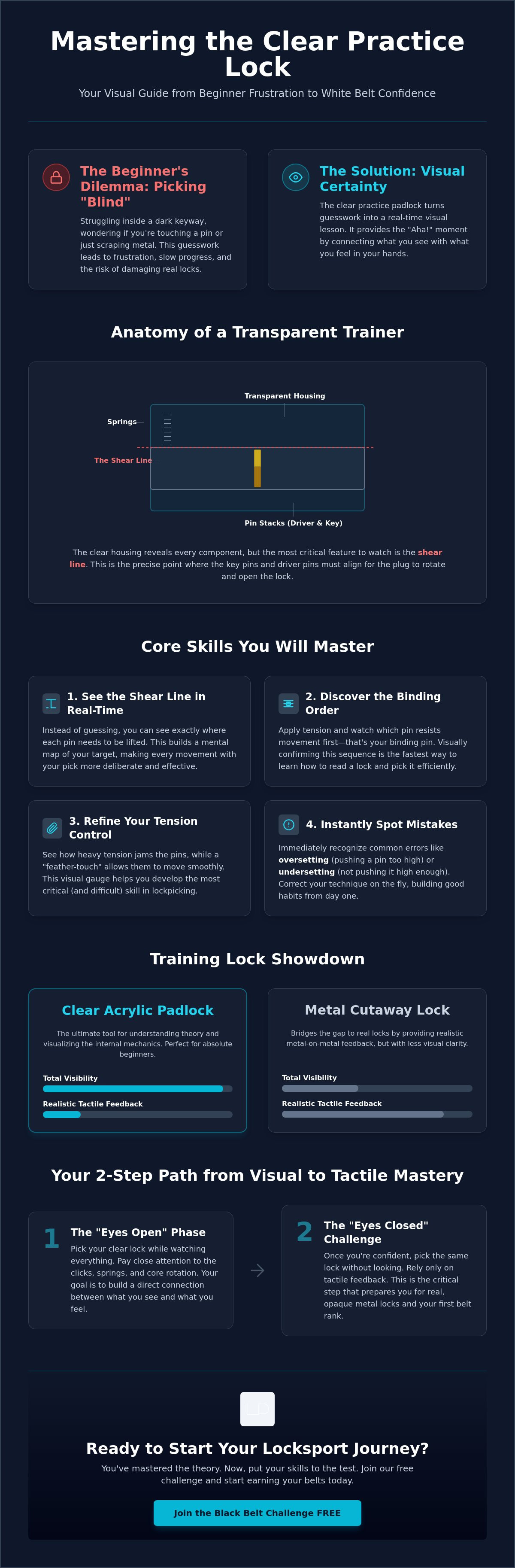
Inside the clear shell, you'll find the same core components as a standard padlock, but without the mystery. You can see the springs, the driver pins, and the key pins sitting in their stacks. The most critical feature to identify is the shear line; the precise point where the gap between the plug and the housing allows the lock to turn. By watching how your pick lifts each pin stack, you can visualize the core rotation and see exactly how the plug interacts with the shackle. This visibility is why sets like The Trainee 2.0 often include these transparent locks to jumpstart the learning process. You'll see how the springs compress and how the driver pins must clear the plug's edge to allow movement.
Why Visual Learning is Essential for Beginners
The Mechanics of Transparency: Visualizing Pin Tumbler Feedback
Watching the binding order unfold in real-time is the fastest way to build your internal logic for locksport. While a standard lock hides its secrets, a clear practice padlock allows you to witness the physical reality of manufacturing imperfections. No lock is perfectly machined. When you apply tension, one pin will always bind against the cylinder wall before the others. Seeing this "binding pin" helps you understand why some pins feel stiff while others feel springy. It's the difference between a pin that is resting at the bottom of the chamber and one that is caught at the shear line, ready to be set. This visual aid removes the mystery of why certain pins must be picked in a specific sequence.
Identifying the Binding Pin
Using a hook pick to probe the pins while watching their movement through the acrylic housing provides immediate feedback. You'll notice that as you apply tension, the binding pin resists being moved. Once you lift it to the shear line, you can actually see it "click" into place and stay there. This visual confirmation is vital for beginners who often struggle to distinguish between a set pin and a pin that is simply stuck. You can even begin to visualize counter-rotation; a subtle movement where the core turns slightly backward as you probe advanced security pins. This visual training ensures you aren't just poking around, but are making deliberate, calculated moves to set each stack.
Tension Control Training
The most common mistake for White Belts is using too much force. A clear practice padlock serves as a visual gauge for your tension wrench pressure. You can see how heavy tension jams the pins, making them impossible to move without bending your tools. By practicing "feather-touch" tensioning, you'll see the pins move smoothly and set with minimal effort. To refine your physical technique, you should learn how to hold lock picks correctly to ensure you aren't dampening the feedback from the pins. This calibration is essential because acrylic has a different coefficient of friction than the brass or steel found in a Master Lock. It's slicker and more forgiving; making it a perfect low-stress environment for your first few picks.
Organizations like The Open Organisation Of Lockpickers emphasize that understanding these mechanics is the first step toward ethical mastery. Once you've mastered the visual cues of the binding order, you'll be ready for more challenging hardware. If you feel like you've got the hang of the basics, you might want to consider upgrading to a professional carbon fiber series pick set to get even better feedback from your practice sessions. Moving from visual confirmation to tactile feel is the natural progression of every successful hobbyist.
Comparison: Clear Acrylic vs. Metal Cutaway Training Locks
Deciding between a clear practice padlock and a metal cutaway is your first real fork in the road as a hobbyist. Both tools are designed to pull back the curtain on the pin tumbler mechanism, but they do it in different ways. Acrylic locks are essentially X-ray machines for your picks. They offer 360-degree visibility, which is perfect for those first 48 hours when you're still trying to understand how a key actually works. Metal cutaways take a different approach. These are real brass or steel locks with a precision-machined "window" that exposes the pin stacks. You get a smaller view, but the structural experience is identical to the locks you'll find on a real door.
The feedback gap is where the science of the sport really kicks in. Because acrylic is a polymer, it tends to dampen the vibrations of the pins. Metal resonates. When a pin sets in a cutaway, you'll hear and feel a distinct "click" that just doesn't happen in plastic. As you dive into the hidden world of competitive lockpicking, you'll realize that high-level picking is 90% feel. Metal cutaways are superior for calibrating your hands to those tiny physical signals. They allow you to transition from "see-picking" to "feel-picking" without the frustration of moving directly to a completely blind lock.
Durability and Tolerances
Acrylic is a soft material. Over time, the internal chambers can wear down, leading to a "mushy" feeling that makes it harder to distinguish between pins. Metal cutaways maintain their structural integrity much longer, offering the tight tolerances required for professional-level skill development. If you want a balanced start, using a kit like The Trainee 2.0 provides the foundational visual work you need while including tools that can handle the transition to metal. It's about building a toolkit that grows with your skill level.
Feedback Fidelity
Sound plays a massive role in the "Aha!" moment. Metal locks resonate, giving you a clear auditory confirmation when a pin sets. Acrylic tends to absorb that sound, which can be a disadvantage when you're aiming for a Yellow Belt rank. At that level, you'll be picking locks without any windows or transparent shells. For a deeper dive into making this choice, check out our guide on how to choose your first practice lock. It covers the specific hardware that fits your current skill level and helps you avoid the common pitfalls of beginner gear selection.
From Visual to Tactile: Using Your Practice Lock to Level Up
Transitioning from a clear practice padlock to real hardware is the first true test of your skills. The goal isn't just to open the lock; it's to understand exactly why it opened. Start by picking your transparent trainer while watching the pins set at the shear line. Once you can open it consistently in under thirty seconds, you're ready to remove the visual training wheels. This progression ensures you aren't just guessing, but are building a repeatable method for every lock you encounter in the sport.
The "Eyes-Closed" Method
This technique builds the essential bridge between what you saw and what your pick "tells" your hand. Close your eyes and try to navigate the keyway by feel alone. You'll need to develop muscle memory for pin spacing and depth. Can you feel the difference between the first and fourth pin without looking? If you're struggling to locate the stacks, our guide on Single Pin Picking for Beginners can help you refine your approach. Mastering this by feel is what prepares you for the "blind" metal locks you'll face in the community rankings.
After you've conquered the clear lock by feel, it's time to introduce a real metal padlock like the Master Lock #3. This is the classic entry point for the White Belt rank. It has standard pins and offers generous feedback. Once you've picked your first real lock, record your "pick-in-action." This video is your ticket to your first community rank and proves you've moved beyond basic training aids. Sharing your success is a huge part of locksport culture, and it's the first step toward the Black Belt Challenge.
Troubleshooting Common Beginner Mistakes
Avoid the temptation to "rake" your clear lock just to see it open. Raking is often too easy on acrylic and can lead to sloppy habits that won't work on more advanced security pins. Focus on Single Pin Picking (SPP) as your gold standard. Watch the acrylic shell carefully as you apply torque. If you see the plastic flexing or bowing, you're applying too much tension. This visual cue is a unique benefit of the clear practice padlock that helps you calibrate your pressure before moving to rigid metal locks that won't show you when you're over-tensioning.
To get the most sensitive feedback during this transition, we recommend using a professional carbon fiber series pick set. The increased rigidity helps you "feel" the pins through the handle, making it much easier to tell when a pin has successfully reached the shear line. Building these habits early will save you hours of frustration as you move into the intermediate belt tiers.
Beyond the Transparent Shell: Starting Your Black Belt Challenge
Your journey with the clear practice padlock has provided the visual foundation needed to understand internal mechanics. Now, it's time to step into the larger world of locksport. This isn't just a casual hobby; it's a journey of mastery where every successful open brings you closer to that prestigious Black Belt rank. At Lockpick Pros, we've built an ecosystem that supports your progression from your first click to your final high-security challenge. The transparent trainer was your starting line, but the real sport happens when you apply those lessons to the metal locks found in the community rankings.
Before you advance, it's vital to commit to the ethical lockpicking pledge. True locksport enthusiasts only pick locks they own or have explicit permission to pick. We never use our skills on locks that are in use for security purposes. This responsibility is what defines our community. As you move toward more complex hardware, you'll find that entry-level tools might struggle with tighter tolerances. Upgrading your kit to the Gen 2 Pro Series offers the precision and feedback necessary to tackle the security pins found in higher-ranked locks. These professional-grade picks translate the subtle vibrations of the pins directly to your hand, allowing for a higher level of control.
The Share-to-Earn Community Loop
We believe your progress should be celebrated and rewarded. Once you've recorded your White Belt submission using the techniques we've discussed, share your "pick-in-action" content on social media. This is the heart of our share-to-earn loop. By tagging us and using community hashtags, you can earn exclusive rewards and discounts on your next set of tools. We even offer a community bounty for reaching specific social reach goals. It's a fantastic way to connect with other hobbyists in the LPU and Reddit communities while funding your next hardware upgrade. Your success inspires others to start their own clear practice padlock training.
Your Next Tier: The Yellow Belt Roadmap
Your next challenge awaits in the Yellow Belt tier. We recommend starting with locks like the Abus 64TI/30 or the Master Lock 140. These locks introduce you to tighter tolerances and occasionally even security pins that require more advanced tensioning. To handle these restricted keyways, precision tools like the Expansion Series become essential. These picks are designed for thinner profiles where standard beginner tools might get stuck. Ready to make it official? Join the Black Belt Challenge for Free and start tracking your journey today. Your first rank is just a click away.
Master the Mechanics and Earn Your Rank
The path from a curious beginner to a seasoned locksport hobbyist starts with understanding exactly what's happening inside the keyway. You've learned that a clear practice padlock is your most valuable asset for building a mental map of the pin stacks and shear line. While acrylic trainers provide that initial "Aha!" moment, metal cutaways and standard padlocks are where you'll refine the tactile feedback needed for higher belt ranks. Transitioning between these tools is the fastest way to develop the muscle memory that defines an expert picker.
Lockpick Pros is trusted by the ethical lockpicking community to provide equipment that is precision-engineered for locksport progression. We stand behind our gear with a 100% satisfaction guarantee on all Pro Series tools. Don't let the mystery of the mechanism hold you back. It's time to take the next step in your hobby and start submitting your picks for community recognition. Join the Black Belt Challenge and Get Your Trainee 2.0 Set today. We're excited to see you earn your first belt!
Frequently Asked Questions
Is a clear practice padlock good for learning lockpicking?
A clear practice padlock is an excellent tool for beginners because it provides immediate visual confirmation of how the pin tumbler mechanism works. It allows you to see the shear line and understand the relationship between the key pins and driver pins in real-time. By watching the pins move as you apply tension, you can build a strong mental model that makes transitioning to non-transparent locks much easier and less frustrating.
Can I pick a real lock after practicing on a clear one?
You can certainly pick a real lock after using a transparent trainer, but you'll need to adapt to the lack of visual feedback. Real locks are made of brass or steel and don't allow you to see the pins. The best strategy is to practice with your eyes closed on the clear lock first. This helps you translate the visual cues you've learned into tactile sensations before moving to a Master Lock #3.
What is the best lock pick set to use with a clear padlock?
The best choice for a clear practice padlock is a comprehensive beginner set like The Trainee 2.0. These kits usually include a variety of hooks and tension wrenches that fit the wider keyways found in acrylic locks. As you progress toward higher belt ranks, you might upgrade to carbon fiber picks for better feedback, but a standard high-quality steel set is perfect for mastering the fundamentals on your first practice lock.
Do clear practice locks break easily?
Clear practice locks are made of acrylic, which is significantly softer and more brittle than the brass or steel used in real padlocks. If you apply heavy tension or force your picks, the plastic housing can crack or the pin chambers can wear down. They are designed for educational visualization rather than heavy-duty picking. Treat them with a "feather-touch" to ensure they last through your entire White Belt training phase.
What belt rank can I achieve with a clear practice padlock?
A clear practice padlock is the primary tool for earning your White Belt rank in the locksport community. This rank is all about demonstrating that you understand the basic mechanics of how a lock opens. To move to the Yellow Belt and beyond, you'll need to successfully pick non-transparent metal locks. The clear lock serves as your foundational training aid before you move into the more challenging tiers of the ranking system.
Why can’t I feel the "click" in my clear practice lock?
You won't feel a sharp "click" in an acrylic lock because the plastic material absorbs vibrations and sound much more than metal does. This is known as the feedback gap. In a brass lock, the metal-on-metal contact creates a distinct snap when a pin sets. In a clear lock, you have to rely on your eyes to see the pin reach the shear line instead of waiting for an auditory cue.
Are clear practice locks legal to own?
In most regions, owning a clear practice padlock and lockpicking tools is perfectly legal for hobbyists and ethical lockpickers. However, laws vary by state and country, so it's your responsibility to check your local regulations. At Lockpick Pros, we advocate for the two rules of locksport: never pick a lock you don't own, and never pick a lock that is in use. Always keep your hobby legal and ethical.
Should I buy a clear lock or a cutaway lock first?
Most beginners should start with a clear lock to learn the basic theory and pin behavior. Once you understand the "why" behind picking, a metal cutaway lock is the perfect second step. Cutaways offer a realistic tactile feel and better feedback while still providing a small window to verify your progress. Using both tools sequentially creates the smoothest path from a curious novice to a confident White Belt picker.