

Serrated Pin Picking Techniques: The Locksport Guide to Defeating False Clicks
What if that satisfying click you just felt was actually a clever trap designed to keep you from your next belt? For many hobbyists stepping up from basic security, refining your serrated pin picking techniques is the only way to get past the gatekeepers that turn a fun session into a mess of overset pins. We've all felt that specific frustration when a lock seems ready to turn, but you've actually lost your binding order to a series of tiny, deceptive ridges.
You're going to master the jiggle test and precise tension control to finally move past those false clicks and conquer your Green and Blue belt locks. This guide covers how to develop the professional feel for security pins so you can stop oversetting and start earning your next rank in the locksport community. It's time to turn those clicks from obstacles into roadmaps for your success as an ethical picker.
Key Takeaways
- Understand the difference between driver and key pin serrations to identify exactly where your pick is catching.
- Implement professional serrated pin picking techniques like the jiggle test to confirm a pin is truly set at the shear line.
- Learn why these pins don't provide counter-rotation, making light tension and auditory feedback your most important tools.
- Use the controlled drop method to fix overset pins without resetting the entire lock, saving time on difficult Green and Blue belt challenges.
- Identify why carbon fiber handles and specific hook profiles are essential for feeling the tiny ledges inside high-security cylinders.
What are Serrated Pins? The Locksport Diagnostic
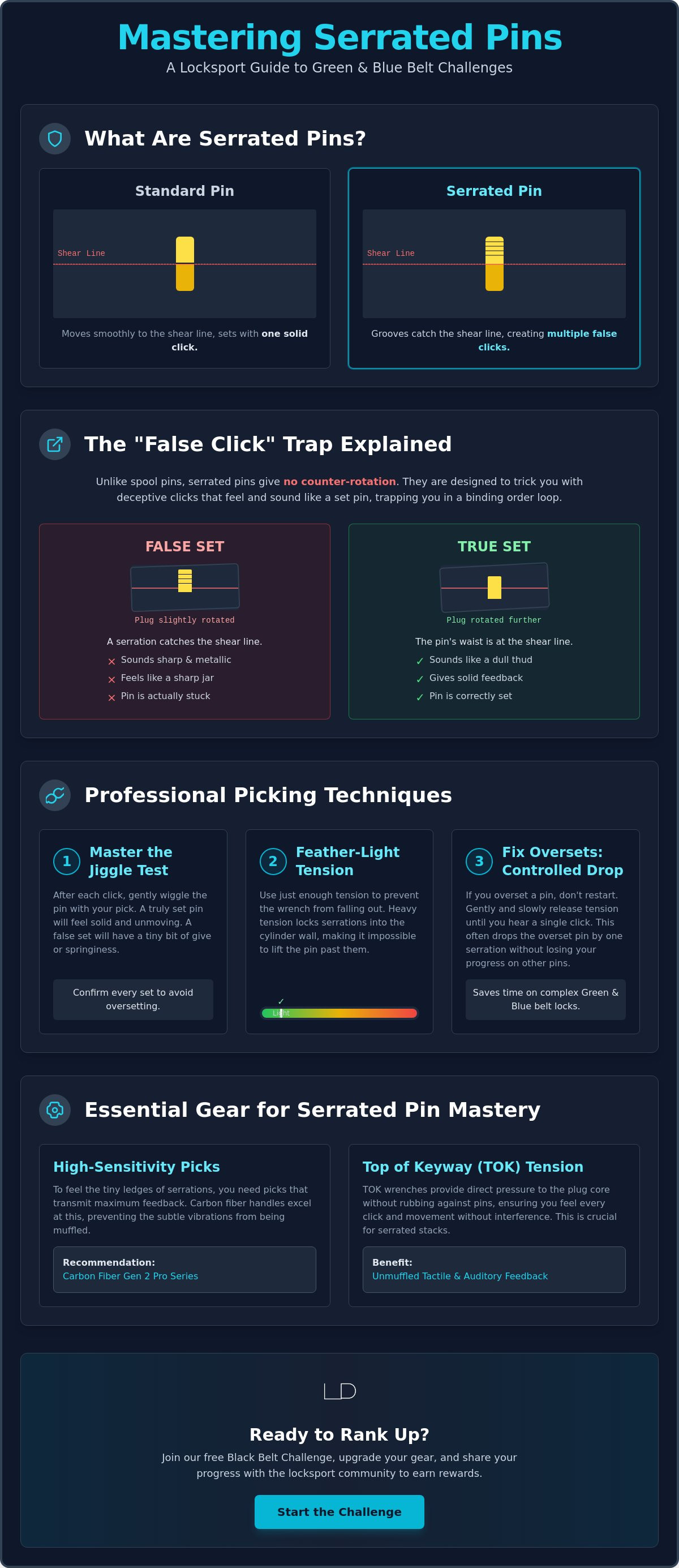
You've likely mastered the basics of standard pin stacks and you're ready to move up the ranks. Welcome to the world of security pins. Serrated pins are driver or key pins featuring small, horizontal grooves cut into their sides. These grooves act like tiny speed bumps for your pick. While a standard Pin tumbler lock relies on smooth surfaces to reach the shear line, these serrations are specifically engineered to trap the plug and trick the picker.
The most common hurdle you'll face is the "False Click." This phenomenon occurs when a groove passes the shear line and the plug rotates just a fraction of a millimeter. It sounds and feels like a successful set, but the pin is actually stuck in a serration. Developing effective serrated pin picking techniques starts with recognizing this deceptive feedback. As ethical lockpickers, we always remember the golden rules: only pick locks you own and never pick a lock that is currently in use. You'll start seeing these pins regularly as you transition into Orange and Green belt locks, where the challenge shifts from simple mechanics to sensory precision.
How to Tell if a Lock Has Security Pins
Identifying these pins early saves you a lot of frustration. When you apply light tension and lift a pin, listen for a "crunchy" or "gritty" sensation. A standard pin will move smoothly until it hits the shear line and sets with one solid click. In contrast, a serrated pin will give you multiple, smaller clicks as each groove passes. You can find a deeper dive into these sensations in our Locksport Diagnostic Guide. If the feedback feels like you're dragging a pick over a file, you're likely dealing with serrations. Use your serrated pin picking techniques to test each click carefully rather than assuming the first sound is the final set.
The Anatomy of a Serrated Stack
The layout of the pin stack determines how much work you have ahead of you. Most locks use serrated driver pins, which are the top pins that interact with the spring. However, some high-security locks also use serrated key pins. These are especially difficult because if you lift the pin too high, the serrations on the key pin will catch the shear line from below, causing a massive overset. The number of grooves on the pin directly correlates to the number of false clicks you'll encounter. Usually, the spring provides the resistance that forces these grooves to bite into the cylinder wall. Understanding this tension is the first step toward mastering the jiggle test in later sections.
The Mechanics of the False Click: Why Serrated Pins Bind
The physics of a serrated pin revolve around a series of tiny ledges. When you apply tension, the plug rotates until the edge of a pin hits the cylinder wall. With a standard pin, this happens exactly at the shear line. With a serrated pin, any one of those horizontal grooves can catch that ledge first. This is the physical trap. The pin isn't set; it's just snagged. Unlike spool pins, which provide distinct counter-rotation as you lift them, serrated pins offer no such warning. They simply click and stay put. This makes serrated pin picking techniques significantly more dependent on your ability to read subtle tension changes rather than waiting for the plug to move backward.
You'll often fall into the binding order trap because a single pin can bind multiple times. You might click pin three, then pin five, then pin three again as it drops into its next serration. This cycle repeats until the actual shear line is reached. If you use heavy tension, you're making this process impossible. High pressure locks that tiny serration into the ledge with so much force that you can't move the pin without potentially bending your tools. Lightening your touch is the only way to allow the pin to slide past these traps.
Tension Management for Serrated Stacks
The "Light as a Feather" rule is your best friend here. You should use just enough pressure to keep your tension wrench from falling out of the lock. This minimal force allows the pins to move past the serrations without getting permanently jammed. For the best feedback, many in the locksport community prefer Top of Keyway (TOK) tension. TOK wrenches don't rub against the bottom of the plug, which prevents the muffling of the vibrations you need to feel. If you're struggling to feel those tiny clicks, upgrading to tools with high-sensitivity handles, like the Carbon Fiber Gen 2 Pro Series, can make a massive difference in your success rate.
Audio vs. Tactile Feedback
Mastering these pins requires you to use both your ears and your fingertips. A hollow false click usually sounds sharper and more metallic, whereas a solid set often has a duller, deeper thud. You'll feel the false click as a sharp jar through the pick handle, but a true set often results in a tiny bit of extra movement in the tension wrench. In the context of serrations, a false set is the slight rotation of the plug when a serration catches the shear line, mimicking a complete set. Learning to distinguish these signals is what separates a beginner from a Blue belt picker. Practice listening to the lock as much as you feel it, and you'll soon start to recognize the pattern of a true set.
Master the Jiggle Test: A Step-by-Step Technique
While auditory feedback is great, tactile confirmation is what actually gets you through a Blue belt lock. The Jiggle Test is the gold standard for verifying a set pin in high-security locks. It's the most effective of all serrated pin picking techniques because it removes the guesswork from those deceptive false clicks we discussed earlier. Instead of guessing if a pin is set, you're going to prove it with your pick.
Start by locating your current binding pin. Apply just enough pressure to hear or feel exactly one click of movement. Once that click happens, stop immediately. Now, gently tap the pin with the tip of your pick while maintaining your tension. You aren't trying to lift it further yet; you're simply feeling for how much "play" or room the pin has to move. Analyzing this movement tells you everything you need to know about where that pin sits in relation to the shear line.
Interpreting the Jiggle
Your pick will tell you one of three things when you tap that pin. A "Dead" pin won't move at all. It feels like you're pushing against a solid wall. This is your current binder, and it needs to be moved until it clicks. A "Jiggling" pin is what you're looking for. It will move slightly between the shear line, feeling loose but restricted. This pin is officially SET. Finally, a "Springy" pin pushes back with clear spring tension. This pin is not yet binding in the current order, so leave it alone. If you try to force a springy pin, you'll likely overset the stack and have to start over.
The Progressive Click Method
When working with serrations, greed is your enemy. You should only ever aim for ONE click at a time. Trying to skip serrations by pushing a pin deep into the stack is the fastest way to lose your progress. If you feel the lock getting "mushy" or you lose all feedback, it's time to reset. Gently let off your tension wrench just enough to hear the pins drop, then start your binding order from the beginning. Mastering serrated pin picking techniques requires this level of patience. Maintaining your place in the sequence is easier when you treat every click as a milestone. By moving through the stack one ridge at a time, you ensure that every pin is properly seated before moving to the next binder.
Troubleshooting: Oversetting and Hybrid Stacks
"I keep oversetting the pins and losing all my progress." If you've said this, you're officially part of the locksport community. Oversetting is the primary obstacle when practicing serrated pin picking techniques. It happens because you're searching for that final "click" and accidentally push the pin past the shear line. Most beginners think they have to reset the whole lock when this happens, but there's a better way. The "Controlled Drop" is a pro-level move where you pulse your tension wrench just enough to let the overset pin fall back down without dropping the rest of your set pins. It takes a delicate touch, but it's faster than starting from scratch.
You also need to watch out for serrated key pins. These are devious because they trap the shear line from the bottom. If you lift a serrated key pin too high, those tiny ridges catch the plug, making it feel like you've made progress when you've actually created a dead end. If you find that your key no longer fits the lock after an aggressive picking session, you've likely deformed these tiny serrations. Always remember: less is more. For the best tactile feedback to avoid these traps, we recommend using the Carbon Fiber Gen 2 Pro Series picks, which transmit vibrations directly to your fingertips.
Defeating the American Lock 1100
The American Lock 1100 is a legendary Green belt challenge because it uses a hybrid stack of both serrated and spool pins. This creates the "Ghost Opening" mystery. You might actually have the lock picked, but because the core spring is so heavy and you're using light tension for the serrations, the plug doesn't turn. If you've performed the jiggle test on every pin and they all feel set, try applying heavy tension. You might find the lock was already open. For a deeper dive into this specific challenge, check out our American Lock 1100 Green Belt Guide.
Common Mistakes to Avoid
Success with serrated pin picking techniques often comes down to what you *don't* do. Avoid these common pitfalls to speed up your progression:
- Using thick picks: Tools that are too thick for the keyway dampen the vibrations you need to hear and feel.
- Ignoring master pins: If you're picking a rekeyed lock, tiny master wafers can act like extra serrations, creating confusing "mini-clicks."
- Over-lifting: Many pickers try to force a pin to click. If it's not moving with light pressure, it's not the binder.
Focus on the feedback. If the lock feels "mushy," you've likely overset a pin or are fighting a spool. Lighten your tension, listen for the drop, and try again with a focus on one click at a time.
Essential Gear for Serrated Pin Mastery
Mastering serrated pin picking techniques requires more than just patience; it requires tools that speak to you. In the world of high-security locks, feedback is everything. Standard plastic or rubber handles often absorb the tiny vibrations caused by a serrated pin hitting the shear line. Carbon fiber handles are the gold standard because they transmit these micro-vibrations directly to your hand. This clarity allows you to distinguish between a false click and a solid set with much higher accuracy. When you can feel the difference, your success rate on difficult cylinders will skyrocket.
Your choice of hook profile also plays a vital role in your success. A "Flat Hook" provides a stable platform for lifting serrated pins, reducing the chance of your pick slipping off the ledge. While "Round Hooks" are excellent for navigating standard pins, they can often slide off the narrow grooves of a serrated driver. To truly feel the "crunch" of security pins, move away from clear acrylic locks. While clear locks are perfect for White belt beginners, they lack the realistic friction of metal. A metal cutaway practice lock provides the authentic tactile feedback you need to graduate to Green and Blue belt challenges. Top of Keyway (TOK) pry bars are the final piece of the puzzle. They provide a clear view of the pins and prevent the wrench from binding against the lock body, which is essential for precise tension control.
Recommended Pro Series Tools
If you're serious about your progression, the Carbon Fiber Gen 2 Pro Series is engineered specifically for maximum tactile feedback. These picks are thin enough to navigate tight warding while remaining rigid enough to pulse the tension. For those dealing with narrow European keyways, the Pro Series Expansion offers the specialized profiles needed to reach high-set pins without oversetting the binders in front. High-yield steel provides the springiness required for advanced serrated pin picking techniques, allowing the tool to snap back into shape after every click. This durability ensures your kit lasts through hundreds of intense practice sessions as you climb the ranks.
Join the Black Belt Challenge
Ready to show off your skills? Join our Black Belt Challenge for free and start tracking your journey through the official belt ranks. This isn't just about picking locks; it's about joining a community of passionate, ethical hobbyists. As you hit new tiers, upgrade your kit to match your growing expertise. We love seeing your progress. Share your "picks-in-action" content on social media to earn exclusive rewards and recognition. We even have a community bounty for those who hit social reach goals with their progress videos. Start your journey today, refine your skills, and earn your place among the pros.
Take the Next Step in Your Locksport Journey
You now have the blueprint to defeat one of the most deceptive security features in the hobby. Success comes down to trusting your senses, using the jiggle test to verify every click, and maintaining that "light as a feather" tension. By refining your serrated pin picking techniques, you've moved past the frustration of false clicks and toward actual skill mastery. These skills are exactly what you need to conquer Green and Blue belt locks and continue your sequential belt-tier progression. Every click brings you closer to that next rank.
Precision is your greatest ally. High-quality tools are essential for the vibration transmission required to feel those tiny ledges. Our gear is used by LPU community members who demand precision carbon fiber feedback to tackle high-security cylinders. It's time to stop guessing and start feeling the lock. Ready to level up? Join the Free Black Belt Challenge and upgrade your gear with professional tools today!
Keep practicing, stay ethical, and enjoy the satisfying sound of that final turn. We can't wait to see your picks-in-action videos as you earn your next rank. Your journey to Black Belt mastery starts with the very next pin you set.
Frequently Asked Questions
How can I tell if a pin is serrated or just a spool?
Serrated pins provide a "crunchy" or gritty feedback with multiple tiny clicks as you lift them. Unlike spool pins, which force the plug to rotate backward in a movement called counter-rotation, serrated pins simply click and stay put. If you feel a series of sharp, metallic jars without the plug turning against your tension, you're likely working against serrations. Use your serrated pin picking techniques to test each click carefully.
Why do I hear so many clicks but the lock won’t open?
You're hearing "false clicks" caused by the grooves of the pin catching the shear line. Each groove sounds like a successful set, but the pin is actually trapped halfway. This is a common trap in intermediate belt ranks designed to trick you into thinking the pin is finished. You must continue lifting the pin one click at a time and use the jiggle test to confirm the true set.
What is the best tension for picking serrated pins?
Light tension is the most effective way to navigate these security features. Heavy pressure binds the serrations against the cylinder wall so tightly that the pin cannot move at all. You want just enough force to keep your tension wrench from falling out of the keyway. This minimal pressure allows the pin to slide past the grooves rather than getting jammed in a permanent false set.
Can I pick serrated pins with a beginner lock pick set?
You can pick them with a beginner set, but it's a significant challenge for your tactile senses. Beginner tools are often thicker and have plastic handles that dampen the subtle vibrations you need to feel. As you move toward Green and Blue belt locks, upgrading your kit to include carbon fiber handles will provide the sensitivity required to master advanced serrated pin picking techniques.
What is the "jiggle test" in lockpicking?
The jiggle test is a diagnostic technique used to verify if a pin is truly set at the shear line. After you feel a click, gently tap the pin with your pick under light tension. If the pin moves slightly with a bit of "play," it is set. If it feels solid or "dead," it is still binding and needs to be lifted to the next click.
Do I need a special pick to defeat serrated pins?
You don't need a specialized tool, but your pick profile makes a difference. A flat hook provides a more stable surface to lift the pin without slipping off the narrow, horizontal serrations. Picks made of high-yield steel are also better for the pulsing tension moves used to fix oversets. These professional tools provide the rigidity needed to move the pin past each individual ridge.
Is it possible to overset a serrated pin?
Oversetting is the most common mistake pickers make when dealing with serrated stacks. If you push a pin too far, a lower serration or the key pin itself can catch the shear line from below. This creates a "mushy" feeling in the lock and prevents the plug from turning. If this happens, try a controlled drop by slightly pulsing your tension to let the pin fall.
Why is the American Lock 1100 so hard to pick?
The American Lock 1100 is difficult because it combines serrated pins and spools with a very strong internal spring. The serrations hide the feedback from the spools, and the heavy spring can make you think the lock is still shut even after it's picked. Once you think all pins are jiggling, apply heavy tension to check if you've achieved a "ghost opening."