

Building a Progressive Lock Picking Set: The 2026 Locksport Roadmap
That massive 50-piece "master" kit you saw online might actually be the biggest obstacle between you and your first open. Most beginners feel overwhelmed by a sea of metal, only to realize half those tools will never touch a keyway. You want to feel the satisfying click of a shackle, not the frustration of a tool that doesn't fit. Building a progressive lock picking set isn't about owning the most picks; it's about owning the right tools for your current skill level. We know the sting of buying gear that becomes obsolete before you've even mastered a spool pin.
We believe every ethical picker deserves a clear path to mastery without the gear-induced headaches. This guide provides your 2026 locksport roadmap to help you transition from a curious trainee to a confident hobbyist. You'll learn how to select tools that grow with you, from foundational hooks to professional carbon fiber series. We're diving into the community belt ranks, showing you exactly which locks to tackle and how to handle security pins like a pro. Get ready to join a community of pickers who value precision over guesswork.
Key Takeaways
- Learn the dual-system strategy for building a progressive lock picking set by syncing your tool precision with evolving hardware difficulty.
- Follow the 1-to-5 pin roadmap using standard Kwikset and Schlage cylinders to build a solid foundation before you attempt blind picking.
- Understand when to transition from durable Trainee 2.0 picks to the high-performance Carbon Fiber Gen 2 Pro Series for better feedback.
- Master the intermediate plateau by learning to identify security pins like spools and mushrooms while using the "false set" to your advantage.
- Discover how to record your first successful open and join the Black Belt Challenge to earn community rank and exclusive rewards.
What is a Progressive Lock Picking Set?
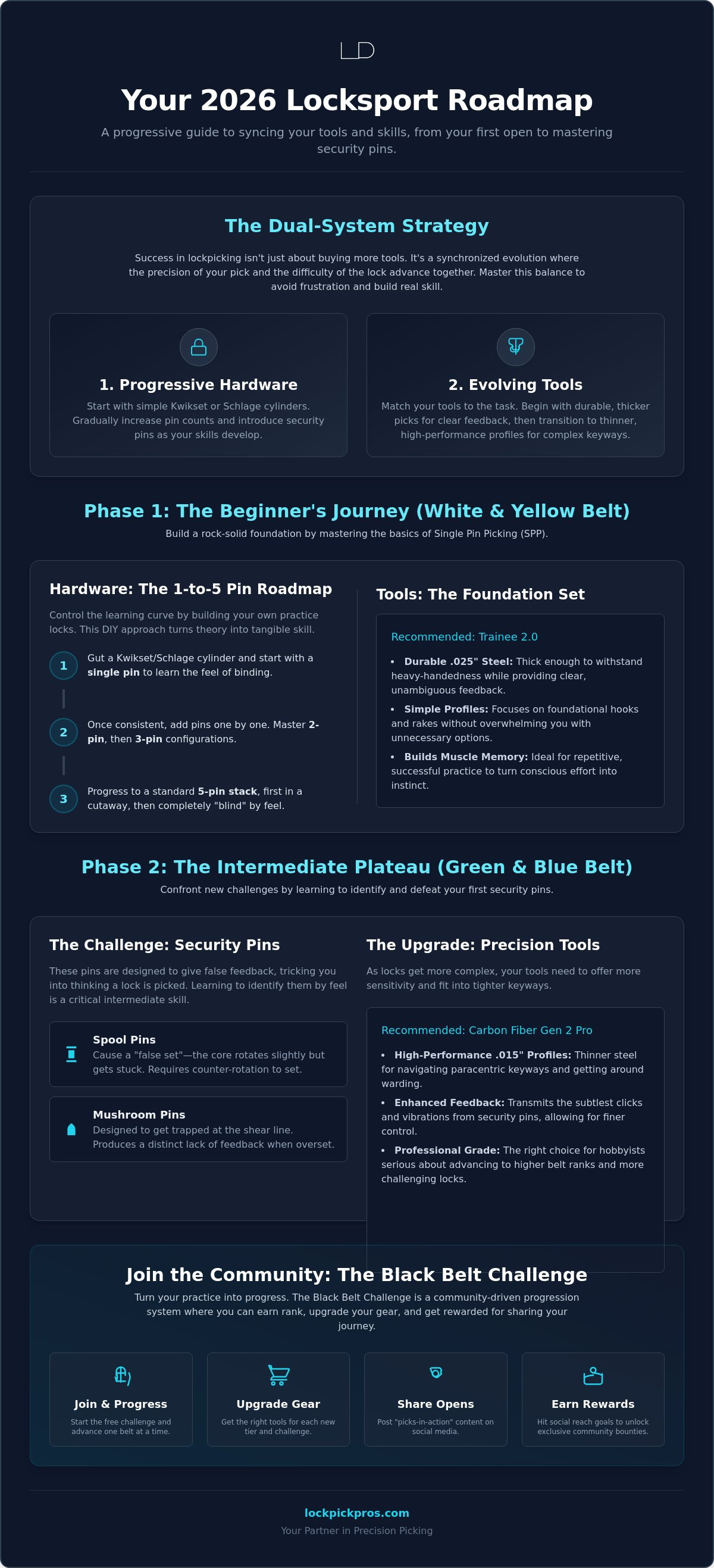
Building a progressive lock picking set is about more than just buying a random assortment of steel. It's a dual-system approach that pairs specific practice locks with a matching tool kit. Most people make the mistake of buying a massive 30-piece set and a high-security padlock on day one. That's a fast track to frustration. A true progressive set grows with you. It's a synchronized evolution where the difficulty of the lock and the precision of the pick advance at the same rate.
The "progressive" concept refers to a structured learning path. You start by picking a lock with only one pin visible through a cutaway window. As you improve, you move to two pins, then three, eventually reaching a full six-pin cylinder picked completely by feel. The Locksport Belt Ranking system acts as your North Star here. It provides a standardized way to measure your growth, similar to martial arts. Because ethical lockpicking requires a dedicated practice environment, you should never pick locks that are in use or that you don't own. A progressive set gives you that controlled space to fail, learn, and eventually succeed.
The Philosophy of Incremental Difficulty
Jumping straight to a high-security lock is a recipe for disaster. You'll likely end up "picking by luck" rather than skill. By using incremental difficulty, you build precise muscle memory. Every "open" on a two-pin lock releases a hit of dopamine that keeps your motivation high. It's about repetitive, successful practice. This approach turns conscious effort into instinct, allowing you to feel the subtle difference between a binding pin and one that's already set. When you finally hit a plateau, you'll have the foundational skills to analyze why it's happening instead of just poking around blindly.
Tools vs. Hardware: The Two Halves of Your Set
Your set has two distinct halves. On the hardware side, you need cutaway locks and rekeyable cylinders. We usually recommend starting with Kwikset or Schlage cylinders because they're the gold standard for learning pin-tumbler basics. On the tool side, your journey begins with durable .025 inch steel picks like The Trainee 2.0. These are thick enough to survive the heavy-handedness of a beginner while providing clear feedback. As you reach intermediate belts, you'll transition to thinner .015 inch professional profiles to fit into tighter, more complex keyways. For a deeper dive into your first kit, check out our guide on How to Choose Your First Beginner Lock Pick Set.
Building Progressive Practice Locks: A DIY Guide
Building a progressive lock picking set requires more than just a pouch of tools; it needs a strategy for the locks themselves. You can't simply buy a high-security lock and hope for the best. Instead, you need to create a practice regimen that evolves. By sourcing your own cylinders and repinning them, you control the learning curve. This DIY approach bridges the gap between basic theory and the advanced feedback required for higher belt ranks.
Kwikset and Schlage cylinders are the gold standards for your first custom builds. They're widely available, easy to disassemble, and have standard pin sizes that make learning the basics straightforward. Start your journey with Single Pin Picking (SPP). While raking might get you a quick open on a cheap padlock, SPP is the only way to truly understand the internal mechanics. Your goal is to transition from transparent training locks, where you can see the shear line, to metal cutaways, and finally to "blind" cylinders where you rely entirely on tactile feedback.
Essential Tools for Lock Modification
You need the right gear to modify your practice locks without losing tiny parts. A Pinning Tray is non-negotiable for keeping your springs, drivers, and key pins organized. To avoid a "brick" event where the top pins fall into the plug, always use a follower when removing the core. Precision tweezers with notched tips are also essential for handling those microscopic components without dropping them into the wrong chamber. Don't skip these basics, or you'll spend more time hunting for springs on the floor than picking.
Step-by-Step: Repinning for White and Yellow Belts
Follow these steps to build your first progressive cylinder:
- Step 1: Gut the lock carefully and clean the chambers. Old cylinders often have grit that can mask the feedback you need to feel.
- Step 2: Start with a 1-pin setup. This allows you to find the "binding" feel of a single pin without the distraction of a full stack.
- Step 3: Gradually add pins one by one. Once you can open a 3-pin setup consistently, move to 4, then a standard 5-pin stack.
As you move toward blind picking, you'll need tools that offer more sensitivity. Upgrading to a Carbon Fiber Gen 2 Pro Series set will give you the refined feedback necessary to tackle these tighter tolerances as you progress toward your Green Belt.
The Tool Progression: From Trainee to Pro
Building a progressive lock picking set is a journey of refining your sense of touch. In the early stages, you need steel that can handle a bit of muscle. Most beginners naturally use too much tension and too much lifting force. That’s why Phase 1 of your roadmap focuses on .025 inch steel. These picks provide heavy, unmistakable feedback. They’re durable enough to survive the learning curve while you figure out the difference between a binding pin and the lock wall. You want tools that won't snap while you're still developing your "light touch."
As you move into Phase 2, your kit needs to expand. You'll start seeing "flat bars" for tension and a wider variety of hook profiles. This expansion isn't about having more shiny toys; it's about having the right reach for different bitting depths. Finally, Phase 3 brings you to the professional upgrade. This is where you switch to ultra-thin .020 or .015 inch picks. These are designed for tight, paracentric keyways that would trap a thicker beginner pick. These thinner gauges are essential for navigating the complex paths found in high-security locks.
One secret to this progression is handle material. While plastic handles are fine for starters, carbon fiber handles are a game changer for intermediate picking. Carbon fiber is incredibly stiff and lightweight. It acts like a conduit for vibrations. Instead of the handle absorbing the tiny clicks of a spool pin, the energy travels straight to your fingertips. This sensitivity is vital when you're hunting for that "false set" in a Green Belt lock. It turns a guessing game into a precise conversation with the pins.
White and Yellow Belt Essentials
You don't need a massive roll-up kit to earn your first few belts. In fact, a Short Hook and a Triple Peak Rake are the only two profiles you truly need to start. The Short Hook is your precision instrument for Single Pin Picking. The Triple Peak Rake helps you understand how pins reset under tension. Most trainees find Bottom of Keyway (BOK) tensioning easier to learn because it provides a stable platform for your pick to rest on. The Trainee 2.0 is the perfect starting point for this foundational stage.
Intermediate Upgrades for Orange and Green Belts
Once you hit the Orange belt level, the keyways get tighter and the pins get trickier. This is when you should introduce Top of Keyway (TOK) tensioning. TOK bars stay out of the way, giving your pick more room to maneuver in paracentric keyways. You'll also want to drop down to thinner .020 or .015 inch picks to navigate these narrow paths without getting stuck. For those ready to feel every microscopic movement of a security pin, the Carbon Fiber Gen 2 Pro Series offers the advanced feedback needed for these higher-tier challenges.
Mastering Security Pins: The Intermediate Plateau
Security pins are the gatekeepers of the intermediate ranks. If you've been building a progressive lock picking set, you’ve likely mastered standard pins and are ready for a real challenge. Security pins like spools, serrated, and mushroom pins are designed to trick your senses. They provide "false" feedback that makes you think a pin is set when it’s actually trapped below the shear line. Learning to decode these signals is what separates a trainee from a true hobbyist.
The most common sensation you’ll encounter is the "false set." This happens when the plug rotates significantly, but the lock doesn't open. It feels like a victory, but it's actually a trap set by a spool or mushroom pin. To overcome this, you must master counter-rotation. This is the secret to defeating security pins. As you lift the pin, the plug will actually try to turn back toward the locked position. You must allow this to happen without dropping the rest of your pin stack. It's a delicate dance of giving and taking pressure.
Progressive pinning is your best friend during this stage. Don't try to pick a lock with five spools immediately. Instead, take that Schlage cylinder we discussed earlier and pin it with four standard pins and just one spool. This isolated practice allows you to focus entirely on the unique feedback of that single security pin. Once you can feel that spool set every time, add a second one. This incremental approach prevents the "intermediate plateau" where pickers get stuck for weeks on a single difficult lock.
The Spool Pin Challenge
Spool pins are shaped like a thread spool, with a thin center and wide ends. When the thin part hits the shear line, the plug turns, creating that famous false set. If you push too hard, you’ll just get stuck. The trick is lightening your tension. You need just enough pressure to keep the other pins in place while allowing the spool to counter-rotate the plug. For a full breakdown of which locks feature these pins, check out our guide on Lock Picking Belt Levels Explained.
Serrated Pins and Micro-Clicks
Serrated pins are a different beast. They have multiple tiny grooves that catch on the shear line, producing "micro-clicks" that feel like a true set. If you're using heavy tension, you'll get stuck in these grooves. You need to distinguish between a "true set" and a serration click. A set pin has a specific springy feel when you "jiggle" it with your pick. If it feels rock solid, you're likely caught in a serration. You have to pulse your tension to let the pin move past each notch until it finally hits the shear line.
To feel these microscopic differences, you need tools with maximum sensitivity. High-quality gear makes all the difference when navigating these intermediate plateaus. You can find the precision you need by upgrading to the Carbon Fiber Gen 2 Pro Series.
Earn Your Rank: The Black Belt Challenge
Building a progressive lock picking set is a personal achievement, but the real magic happens when you step into the wider locksport community. Validation from your peers transforms a solitary hobby into a recognized skill. In the world of ethical picking, your rank is your reputation. Whether you’re aiming for a Yellow Belt or the prestigious Black Belt, community standards ensure that every "open" is earned through technique rather than luck. This shared journey is what makes locksport so addictive.
As you progress, you'll find that the Share-to-Earn loop is a powerful motivator. We believe in rewarding pickers who document their growth and help others learn. By sharing your "picks-in-action" content on social media, you aren't just showing off; you're contributing to the collective knowledge of the community. Plus, it’s a great way to earn rewards that help fund your next tool upgrade. Remember that with increased skill comes increased ethical responsibility. Always follow the golden rules: never pick a lock that is in use and only pick locks that you own or have explicit permission to pick.
Recording Your Progress
To advance through the higher belt ranks, you'll need to film your opens. A clear video is essential for proof. Start by showing the lock is fully functional with a key. Keep the lock in the frame at all times during the pick and the subsequent "gutting" process. Gutting the lock proves you haven't removed any pins to make it easier. We offer a community bounty for those who hit social reach goals with their picking videos. It’s our way of fostering engagement and celebrating your technical milestones.
Join the Black Belt Challenge
The roadmap from White to Black Belt is a marathon, not a sprint. Each tier requires a more refined approach and more specialized gear. You might start with the durable steel of the Trainee series, but you'll eventually need the surgical precision of the Carbon Fiber Gen 2 Pro Series to tackle high-security locks. Our free challenge roadmap guides you through every step of this evolution. You'll know exactly when to upgrade your tools and which locks to source next to keep your skills growing. Don’t wait for the "perfect" moment to start your journey. Join the Black Belt Challenge Today!
Take the Next Step in Your Locksport Journey
Mastering the art of locksport isn't about luck; it's about having a strategy. You've learned that building a progressive lock picking set requires a perfect balance between your practice cylinders and the precision of your tools. By starting with foundational .025 inch steel and moving toward thin profiles for security pins, you're setting yourself up for long-term success. Remember to use the 1-to-5 pin roadmap to avoid plateaus and keep your motivation high as you climb the belt ranks.
Success in the community comes from using gear you can trust. Our tools are used by community-ranked hobbyists who demand perfection. Every pick is precision-engineered for ethical locksport to ensure you get the most accurate feedback possible. We even offer a satisfaction guarantee on all Pro Series tools because we're committed to your growth as a picker.
Are you ready to feel that first professional-level open? Start Your Journey with the Carbon Fiber Gen 2 Pro Series today. The community is waiting to see your first gutting video. Keep picking, stay ethical, and we'll see you at the Black Belt level!
Frequently Asked Questions
Is building a progressive lock picking set legal?
As of July 2026, owning lock picking tools is legal in all 50 U.S. states if your intent is lawful. California Penal Code 466 was updated in January 2026 to emphasize that felonious intent is the primary factor for illegality. However, states like Mississippi and Ohio may view possession with more scrutiny. Always carry your tools with a clear purpose and keep your purchase receipts as proof of your hobbyist status.
Can I use a progressive set to pick locks on my own house?
You should never pick a lock that is currently in use, even if you own the house. Locksport ethics dictate that we only pick practice locks or hardware not relied upon for security. Picking a door lock can cause internal fatigue or mechanical failure, potentially leaving you locked out. Use your progressive set on dedicated cylinders mounted in a vice to keep your skills sharp and your home secure.
How long does it take to progress from a White Belt to a Green Belt?
Most hobbyists transition from White to Green belt within three to six months of regular practice. White and Yellow ranks are foundational and can be earned in just a few sessions. The jump to Orange and Green requires a deeper understanding of security pins and tighter keyways. Consistency is key; spending fifteen minutes a day is better than one long session once a week.
Do I really need carbon fiber picks for intermediate locks?
Carbon fiber handles aren't a strict requirement, but they offer a massive advantage when you hit the intermediate plateau. The material is much stiffer than standard plastic, meaning it doesn't dampen the vibrations from the pins. When you're hunting for a tiny click in a paracentric keyway, that extra sensitivity can be the difference between an open and a reset. It's a worthy investment for Green Belt challenges.
What is the difference between Single Pin Picking (SPP) and Raking?
Single Pin Picking (SPP) is the surgical method of setting one pin at a time, whereas raking is a faster, less precise technique. SPP is the essential skill when building a progressive lock picking set because it teaches you to feel the state of every individual pin. Raking might get a quick open on a basic Master Lock, but it won't help you defeat the security pins found in higher belt ranks.
What should I do if I 'brick' a lock while repinning it?
If you 'brick' a lock by dropping a pin into an empty chamber, don't panic. You can sometimes recover the cylinder by using a thin shim to depress the driver pin from the back of the plug. If the lock is completely seized, you might need to drill out the bottom of the jammed chamber to release the spring. It's a frustrating mistake, but it's a rite of passage for every developing picker.
Where can I find a list of locks mapped to their belt ranks?
The most comprehensive list of ranked locks is found in the LPU Belt Ranking system on Reddit or the LPU Discord. These community-led resources categorize locks into tiers based on their difficulty and the presence of security features. We use these same standards to map our practice hardware, ensuring your progression aligns with global locksport benchmarks. Always check the latest requirements before filming your belt advancement video.
Can I build a progressive set using only one lock cylinder?
You can absolutely build a progressive set using a single rekeyable cylinder. By starting with just one pin stack and adding more as you improve, you create a custom learning curve. This method is highly effective for building a progressive lock picking set on a budget. You can later swap standard driver pins for spools or serrated pins to keep the same hardware challenging as your skills reach the intermediate level.