

Car Door Opening Kit for Older Vehicles: The 2026 Locksport Guide to Automotive Entry
Did you know that while modern cars are becoming digital fortresses, the mechanical soul of a vintage ride offers one of the most rewarding challenges in the locksport world? Selecting the right car door opening kit for older vehicles isn't just about utility. It's about mastering a piece of automotive history without leaving a single scratch on that classic paint job or delicate glass. Whether you're a trainee looking to expand your skills or a seasoned picker eyeing a new challenge, older vehicles represent a tactile, mechanical puzzle that requires precision and the right set of bypass tools.
We know that starting this journey can feel intimidating. It's common to worry about the legalities of carrying lockout kits or feel confused about which tool fits a specific year and make. This guide is here to replace that anxiety with confidence. You'll learn exactly how these older lock mechanisms function and how to select a beginner-friendly kit to start your practice. We will explore the tools and techniques needed to move you toward automotive entry mastery while keeping your hobby ethical, legal, and damage-free.
Key Takeaways
- Learn why vehicles from the 1970s through the 1990s represent the perfect mechanical challenge for locksport hobbyists.
- Discover how to select a high-quality car door opening kit for older vehicles that prioritizes precision tools like air wedges over sheer piece count.
- Master the strategic choice between rapid linkage manipulation and the technical finesse of picking vintage wafer lock cylinders.
- Understand the step-by-step process of using non-marring wedges and internal lighting to protect classic paint and glass.
- Explore the benefits of upgrading to the Carbon Fiber Series for the superior strength and tactile feedback required for complex automotive bypasses.
Understanding Car Door Opening Kits for Older Vehicles
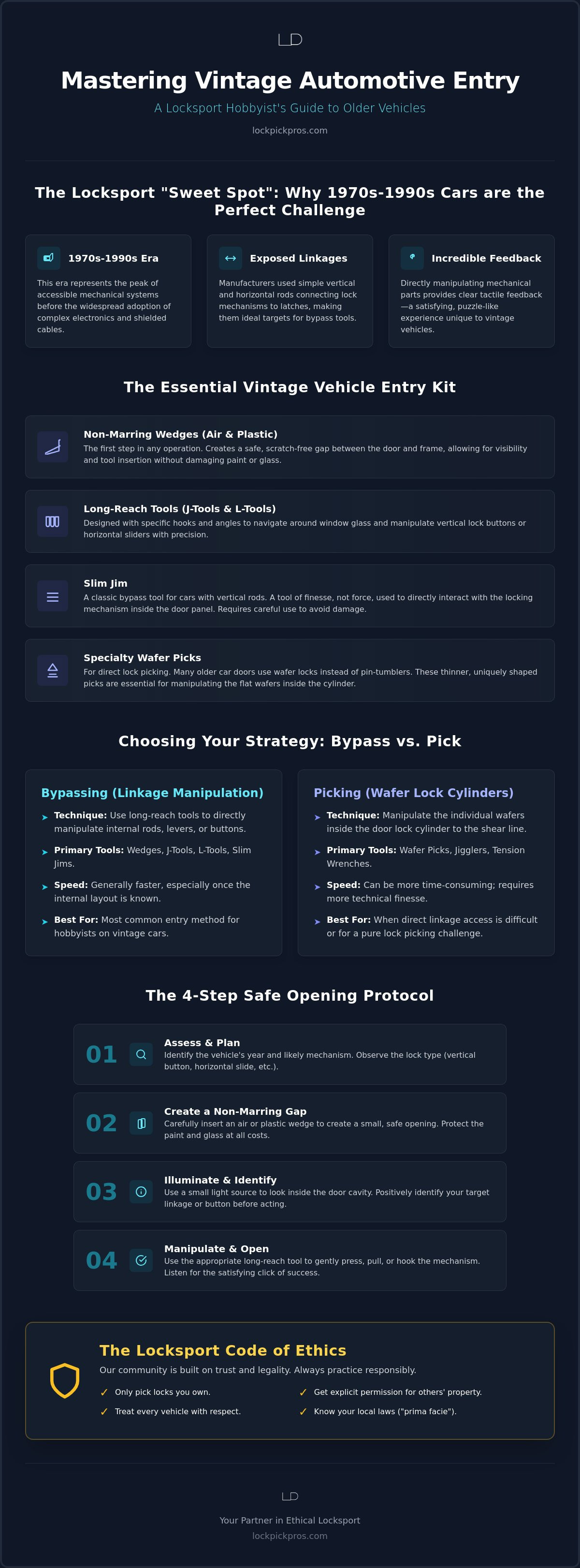
A car door opening kit for older vehicles is more than just a set of metal strips. It is a curated collection of bypass tools designed for non-destructive entry. In the world of locksport, we often focus on the pins inside a lock cylinder, but automotive entry takes the challenge to the entire door assembly. For hobbyists, vehicles manufactured in the 70s, 80s, and 90s are the absolute sweet spot. These rides feature exposed mechanical linkages that provide incredible tactile feedback through your tools. Mastering these techniques is a foundational skill. It is often associated with the Yellow Belt rank in our community progression. It's about understanding the "why" behind the "how" before you ever make a move.
During those three decades, car manufacturers relied on vertical and horizontal rods to connect the lock buttons to the latches. This is a far cry from the shielded cables or electronic systems found in cars today. When you use a classic tool like a Slim jim, you are interacting directly with the soul of the machine. You aren't just opening a door; you're solving a physical riddle hidden behind a steel panel. For many beginners, starting with a set like The Trainee 2.0 provides the necessary foundational tools to begin understanding these mechanical systems.
Mechanical Linkages vs. Electronic Actuators
The biggest difference you'll notice is the "feel." When you manipulate a physical door rod, you can sense the weight of the mechanism through your tool. It takes a delicate touch to hook a rod without snagging the weatherstripping or accidentally disconnecting a clip. Modern vehicles usually require air wedges to create a gap and long-reach tools to press an interior button. While that works, it lacks the surgical precision of a mechanical bypass. There is a unique satisfaction in feeling that manual latch click into place. It's a win for finesse over brute force. You are working with the car, not against it.
While mastering these mechanical connections is essential for vintage cars, modern automotive care often requires specialized electronic tools. For instance, a professional diagnoseverktøy for bilverksted is indispensable for troubleshooting the complex computer systems found in newer models.
The Ethics of Automotive Locksport
At Lockpick Pros, our community is built on a foundation of trust and legality. Ethical lockpicking means you only ever bypass or pick locks that you own or have explicit permission to open. This is especially important with a car door opening kit for older vehicles. Some states, like Ohio and Virginia, have "prima facie" laws. In these areas, possessing these tools can be seen as evidence of criminal intent if you don't have a clear, legal purpose. Always check your local regulations before carrying your kit. Ethical entry is about the sport and the skill. We treat every car with the respect a classic deserves.
Essential Tools in a Vintage Vehicle Entry Kit
When building a car door opening kit for older vehicles, it's easy to get distracted by massive sets filled with dozens of generic rods. Most of those are just filler. For vintage rides, you only need a handful of precision-engineered tools to get the job done right. The Slim Jim is the most famous example. It's perfect for cars with vertical rods, but you have to be careful. If you slide it too deep or with too much force, you can disconnect the lock linkage or damage the window tracks. It's a tool of finesse, not power. Knowing when to put the Slim Jim away is just as important as knowing how to use it.
You'll also need a reliable wedge. Whether you prefer a hard plastic wedge or an inflatable air wedge, the goal is to create a small, non-marring gap. This gap allows you to peer into the door cavity with a light to see what you're doing. Once you've identified your target, J-tools and L-tools come into play. These are designed to reach around the window glass to manipulate vertical lock buttons or horizontal sliders. According to standards promoted by the Associated Locksmiths of America (ALOA), using the correct tool for the specific lock type is essential for ethical, damage-free entry.
The Versatility of Bypass Tools
A standard kit often focuses on rod manipulation, but adding specialized Bypass Tools significantly extends your utility. Older vehicles are often susceptible to "shimming" and "jiggling" techniques because their mechanical tolerances have loosened over decades. If you're just starting to explore these systems, The Trainee 2.0 is an excellent starting point. It helps you build the mechanical understanding required before moving on to more complex automotive challenges. Shimming a latch is often faster than picking a cylinder, making it a favorite for ethical hobbyists.
Specialty Automotive Picks
Not every entry requires reaching inside the door. Many older vehicles use wafer locks rather than the pin-tumbler systems found in front doors. Wafer picks are thinner and shaped differently to interact with the flat wafers inside the cylinder. For specialized older cylinders, tools like the Honest Locksmith Kaba Tools provide the precision needed for a successful pick. High-quality handles are vital here. They translate the subtle vibrations of the wafers directly to your fingertips. For the ultimate in tactile feedback, consider the Carbon Fiber Series to elevate your automotive bypass game.
Bypassing vs. Picking: Choosing Your Strategy
Every hobbyist eventually faces a fork in the road. Do you choose the rapid speed of a bypass or the patient finesse of picking the cylinder? When you use a car door opening kit for older vehicles, your strategy depends on the specific puzzle the car presents. Bypassing is the go-to for speed because it ignores the lock cylinder to attack the internal mechanics. However, for a locksport enthusiast, picking the door lock is a true badge of honor. Older vehicles from the 1980s and 1990s are perfect for this because they lack the complex side-impact airbags that make modern doors risky to probe.
Before you make your first move, identify the lock type. Most vintage cars use wafer locks rather than the pin-tumbler systems found in residential deadbolts. While learning to safely unlock your car, you'll find that older domestic models often respond best to specific bypass tools, while imports might require more delicate cylinder work. Always choose the path that offers the least resistance and the lowest risk of damage to the vehicle's internal components.
Mastering the Wafer Lock
Wafer locks are a significant step up from the basic Master Lock #3 you mastered for your White Belt. That foundational lock features a 4-pin stack with all standard pins and no security pins. To open it, insert a tension wrench into the bottom of the keyway and apply constant medium tension. Use a short hook pick to probe the pins; when you find the binding one, lift it until it clicks at the shear line. Repeat this for all four pins until the core turns. Automotive wafer locks are different. They use flat metal plates instead of pins and lack security pins, but they require much lighter tension. To pick one, apply light pressure with a tension wrench and use a wafer pick or rake to gently vibrate the wafers until they align. If you push too hard, the wafers will bind and refuse to move.
Internal Linkage Manipulation
If you prefer the mechanical challenge of a bypass, you need to visualize what's happening behind the door panel. Linkage is the physical connection between the key cylinder and the latch mechanism. In many classic GM or Ford models, this system includes a bell crank that converts the circular motion of the key into a vertical or horizontal pull. A Slim Jim can be used to catch the "lazy pawl" or the rod itself to trigger the latch. Success requires a "hook and lift" motion that you can only master through practice and tactile sensitivity. It's a game of inches where feeling the resistance of a spring tells you everything you need to know.
Step-by-Step: Safely Opening an Older Vehicle
Using a car door opening kit for older vehicles requires a methodical approach. It is not about speed. It is about precision. Before you touch the car, you must have a plan. Follow these steps to ensure a successful, non-destructive entry every time. This process respects the machine and protects the vehicle's integrity while testing your technical skill.
- Step 1: Identify the vehicle year and lock type. Determine if the car uses a vertical linkage rod or a horizontal slider. A 1985 Chevrolet will have a very different internal layout than a 1994 Honda. Knowing the year helps you visualize the rod placement before you even open your kit.
- Step 2: Insert a non-marring wedge. Use a plastic or air wedge to create a small gap between the door frame and the body. Use a light to inspect the internal cavity. You need to see your target rod or pawl clearly to avoid "fishing" blindly.
- Step 3: Select the appropriate tool. Choose a rod or bypass tool based on the linkage direction. If the lock button moves up and down, a Slim Jim or a J-tool is often the right choice. For horizontal sliders, an L-tool might be necessary to reach around the glass.
- Step 4: Execute the manipulation. Apply steady, controlled pressure. You are looking for the specific resistance of the lock spring. When you hit the sweet spot, you will hear the distinct "click" of the latch disengaging.
- Step 5: Test the exterior handle. Always verify the lock is fully disengaged by testing the handle. If it is still stuck, reset and re-inspect. Never force the mechanism.
Avoiding Common Pitfalls
One of the biggest mistakes beginners make is "fishing" blindly inside the door. If you can't see the rod, don't move the tool. You risk snagging electrical wiring for power windows or disconnecting a linkage rod entirely. Stay away from the window tracks to prevent scratching the glass. If a tool feels stuck or requires heavy strength, stop immediately. You are likely hitting a structural component or weatherstripping. True mastery comes from finesse, not brute force. To get the best tactile response and avoid these errors, upgrade your kit with the Carbon Fiber Gen 2 Pro Series.
Skill Refinement and Practice
The best way to earn your community stripes is through consistent practice. Visit a local scrap yard and pick up a "practice door" from a 90s-era sedan. It is a low-stakes way to visualize the bell cranks and rods we discussed earlier. As you improve, document your progress. Sharing "picks-in-action" content on social media can earn you rewards within the Lockpick Pros community. Whether you are aiming for a Yellow Belt or preparing for the Black Belt Challenge, every successful entry brings you closer to automotive mastery. Keep it ethical, keep it legal, and keep practicing.
Selecting the Best Car Door Opening Kit for Your Needs
Choosing a car door opening kit for older vehicles is an exercise in restraint. Many kits on generic marketplaces brag about having 100 pieces, but most of that is filler. As you transition from beginner lockpicking on stationary practice locks to the dynamic world of automotive entry, your pick set selection strategy must shift toward precision. High-quality tools like the Carbon Fiber Series offer a massive advantage over standard steel. Carbon fiber provides incredible strength without the heavy bulk of traditional rods, allowing for a lighter touch. It also translates vibrations better, giving you the tactile feedback needed to feel a rod catch a latch or a pawl engage behind the door panel.
As you move through the belt ranks, your gear needs to reflect your growing expertise. Moving from Green to Blue belt ranks marks a shift from basic bypass to specialized technical entries. This is when you should look for a professional-grade carrying case. A good case doesn't just look sharp; it organizes your tools and protects the thin edges of your wafer picks from bending during transport. Portability is key for community meetups where you'll be showing off your skills on practice doors. You've spent time refining your craft, and your tools should reflect that dedication to the sport.
Top Kit Recommendations for 2026
For those just starting their automotive journey, we recommend a "Foundation Kit" that includes a high-quality air wedge and basic mechanical rods. This setup covers the basics for most domestic 90s rides and helps you build the muscle memory required for rod manipulation. If you are ready to push your skills further, the Gen 2 Pro Max Stealth Edition is the gold standard for advanced bypass enthusiasts. It features a slim profile and specialized coatings for smoother entry through tight weatherstripping. For the specialists, the HUK 8pcs Kaba Set is essential for tackling the unique cylinders found in classic European imports that require a different tactile approach than standard domestic wafer locks.
Join the Community: Share to Earn
Lockpick Pros is more than a shop; it is a community of passionate makers and problem solvers. We want to see your progress as you master each vehicle type. Our "share-to-earn" loop rewards you for being active and helping others learn the ropes. Record your successful automotive entries and share them on social media to inspire other hobbyists. When you hit social reach goals with your videos, you can claim a community bounty. This bounty provides exclusive tool upgrades and store rewards to help you reach the next belt level and refine your skills. Are you ready to take the next step in your journey? Join the Black Belt Challenge today!
Accelerate Your Journey to Automotive Mastery
Mastering the entry of a vintage ride is more than just a utility; it's a celebration of mechanical history. For enthusiasts who appreciate the intricate details of these machines, Diecast Cartel provides high-quality scale models that allow you to admire classic automotive design from every angle. You've learned that the key to success lies in finesse rather than force. By choosing a high-quality car door opening kit for older vehicles, you ensure that every entry is ethical, legal, and completely non-destructive. Remember to prioritize precision tools that offer superior tactile feedback. This sensitivity is what separates a trainee from an expert in the locksport world. As you move through the belt ranks, keep documenting your progress and sharing your "picks-in-action" with our passionate community.
Our Precision Carbon Fiber Tool Series is designed to grow with you. It offers the strength and sensitivity needed for complex automotive puzzles. Plus, our free skill-based rewards program means your dedication to the craft pays off with every social reach goal you hit. Are you ready to claim your place among the elite? It's time to put your skills to the test and earn your next belt rank.
Join the Black Belt Challenge & Upgrade Your Kit
We're excited to see your progress. Keep those picks moving and stay ethical out there!
Frequently Asked Questions
Is it legal to own a car door opening kit for older vehicles?
Owning a car door opening kit for older vehicles is legal in all 50 states for authorized purposes like working on your own car or professional locksmithing. However, it's important to know that states like Ohio, Virginia, Nevada, and Mississippi have "prima facie" laws. In these areas, possessing these tools can be evidence of criminal intent if you don't have a clear legal reason. Always check your local regulations to stay an ethical hobbyist.
Can a Slim Jim damage my older car?
A Slim Jim can definitely damage your vehicle if you use it with too much force or without a clear plan. It's easy to accidentally disconnect a door rod or snag electrical wiring for power windows if you are fishing blindly inside the door. The best way to avoid damage is to use a light and a wedge to see exactly what you're doing inside the door cavity before making a move.
What is the difference between a wafer lock and a pin tumbler lock?
Wafer locks use flat metal plates that must be aligned to a shear line, while pin tumbler locks use individual cylindrical pins and springs. Most older automotive door locks use wafer systems because they are thinner and more durable for exterior environments. You'll find that wafer locks require much lighter tension and offer a mushier feedback compared to the distinct clicks of a standard padlock or deadbolt.
Will these tools work on cars with power locks?
These tools work on cars with power locks, but you must be extra cautious of the internal wiring. Power lock actuators add more components to the door cavity, making it more crowded than a fully manual setup. If you're using a car door opening kit for older vehicles, always identify where the electrical harnesses are located to avoid snagging them with your rods or bypass tools during the entry process.
How do I know if I have a vertical or horizontal linkage?
You can identify the linkage type by looking at the interior lock button. If the button moves up and down near the window, you have a vertical linkage system. If you see a slider on the door handle assembly that moves side to side, you're dealing with a horizontal linkage. Knowing this tells you whether to use a vertical hook and lift motion or a horizontal pull with your bypass tools.
Do I need an air wedge for older cars?
An air wedge isn't strictly necessary for every older car, but it's highly recommended for better visibility. While you can sometimes slide a tool past the weatherstripping, a wedge creates a non-marring gap that allows you to use a light to see the rods. This visibility is the difference between a successful bypass and a frustrating afternoon of blind fishing inside the door panel with your tools.
What is the best beginner tool for automotive locksport?
Jiggler keys are the best beginner-friendly tool for automotive locksport. They are easy to use and have a high success rate on older domestic vehicles like Fords and Chevrolets. If you prefer mechanical bypass, a basic set of J-tools and L-tools will give you the foundational experience needed to understand internal door mechanics. These tools help you build the tactile sensitivity required for more advanced vehicle locksmith tools.
How can I earn rewards for showing my lockpicking progress?
You can earn rewards through our share-to-earn loop by documenting your successful entries. Record your picks-in-action and share them on social media to hit community reach goals. Once you reach these milestones, you can claim exclusive discounts and tool upgrades to help you progress through the belt ranks. It's a great way to stay motivated and get rewarded for your skill refinement within our ethical locksport community.