

How to Choose Your First Practice Lock: The 2026 Locksport Beginner’s Guide
Your front door is the absolute worst place to learn lockpicking. It is a common mistake that leads to jammed cylinders and expensive locksmith calls, yet many new hobbyists still struggle with how to choose your first practice lock. Selecting the right hardware is the vital first step in your journey from a curious White Belt to a seasoned locksport pro. You need a tool that builds genuine tactile feedback rather than a "visual reliance" on clear plastic shells that do not represent real-world security.
We understand that technical jargon like spool pins and counter-rotation can feel overwhelming at first. You are likely looking for a successful first "open" without the fear of damaging anything functional. This guide provides a clear look at the 2026 community standards for training locks, including why sets like the Trainee 2.0 are considered the gold standard for beginners. We will help you master the internal mechanics of a pin tumbler system so you can start earning your community belt ranks with confidence and precision.
Key Takeaways
- Understand the Golden Rules of locksport and why dedicated training tools are essential for ethical, non-destructive skill building.
- Compare clear, cutaway, and progressive cylinders to understand how to choose your first practice lock based on your specific learning style.
- Use the updated 2026 belt ranking framework to select hardware that provides the perfect level of challenge for your current tier.
- Learn the technical "Binding Order" principle to identify the specific pin stack resisting movement and achieve your first successful click.
- Step into the Black Belt Challenge to join a global community of pickers and earn rewards for sharing your "picks-in-action" progress.
The Foundation of Locksport: Why Your First Practice Lock Matters
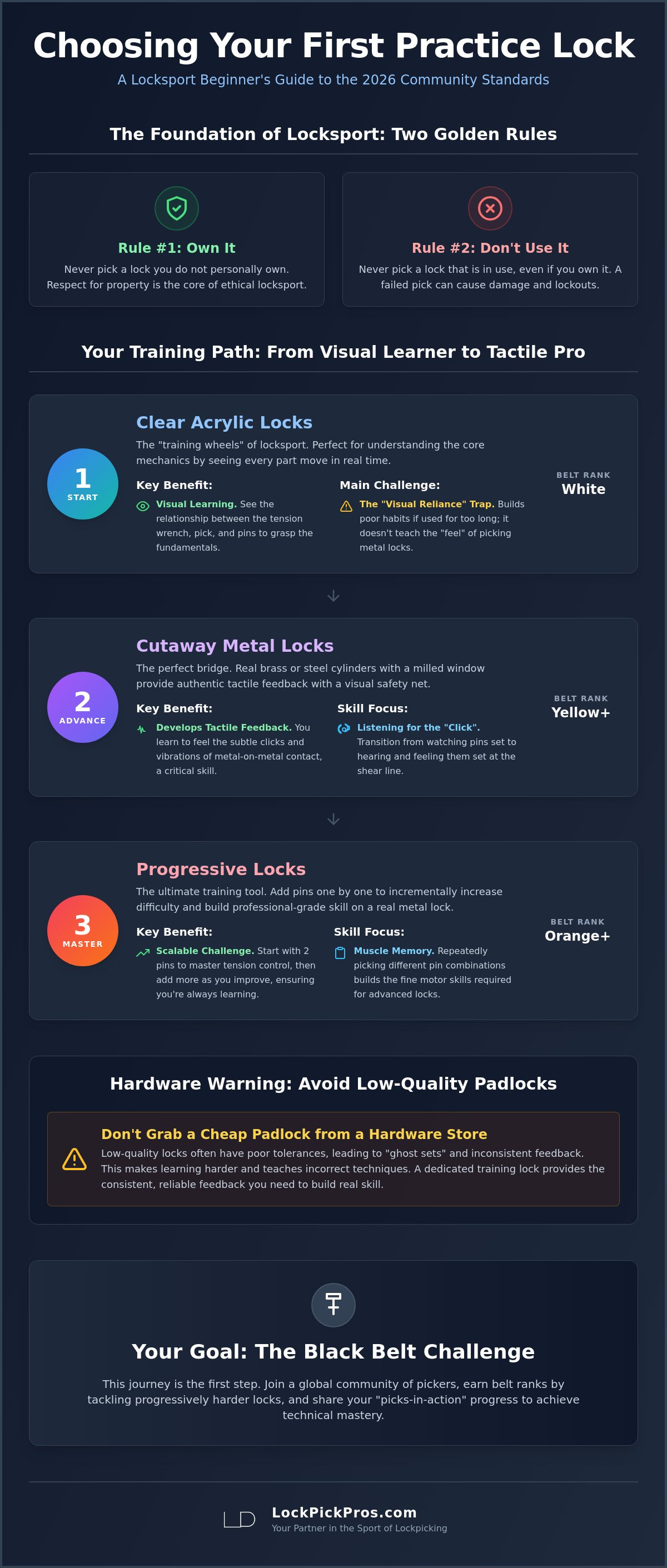
A practice lock is more than just a piece of metal. It is your gateway into a global community of ethical hobbyists. Unlike the deadbolt on your front door, a dedicated practice lock is a training tool designed for non-destructive skill building. It allows you to repeat the same movements until they become muscle memory. Understanding The Foundation of Locksport means respecting the craft and the security it protects. This is why we follow two Golden Rules: never pick a lock you don't own; and never pick a lock that is currently in use. Breaking these rules isn't just unethical; it's a quick way to find yourself with a broken keyway and a massive repair bill.
The psychological impact of your first successful "open" is massive. It's the moment the hobby clicks. However, if you start with a lock that is too difficult or poorly made, that excitement turns into frustration. Learning how to choose your first practice lock involves finding a balance between challenge and reward. You want a tool that teaches you tactile feedback. This is the subtle sensation of pins moving inside the cylinder. Beginners often fall into the trap of "visual reliance" by only using clear locks. While clear locks are great for understanding mechanics, they don't help you develop the "feel" required for higher belt ranks.
Practice Locks vs. Hardware Store Padlocks
It's tempting to grab a cheap padlock from a local hardware store. Don't do it. Low-quality "China specials" often have such poor tolerances that they actually make learning harder. You might encounter "ghost sets," where pins set themselves simply because the manufacturing is so loose. This doesn't teach you anything. A real training tool like The Trainee 2.0 provides consistent feedback. To appreciate the difference between mass-produced items and quality craftsmanship, you can learn more about Dover Jewelry and Pawn Exchange, where decades of experience help identify truly valuable items. Before you buy, you should also understand what is in a beginner lock pick set to ensure your tools match your training hardware.
The Ethical Hobbyist Mindset
Locksport is a legitimate, competitive sport. It's about precision and logic. Your first practice lock is the beginning of a ranking journey. You aren't just trying to get the door open. You are listening for "the click." That sound represents a successful single pin pick (SPP). By focusing on the internal mechanics rather than just the result, you build the foundational skills needed to move from White Belt to the advanced tiers of the community. This mindset transforms a simple puzzle into a lifelong pursuit of technical mastery.
Clear, Cutaway, or Progressive: Choosing Your Training Path
Once you understand the ethics of the sport, the next hurdle is selecting your hardware. Deciding how to choose your first practice lock depends entirely on your learning style. Some pickers need to see the internal components move to grasp the logic. Others prefer to dive straight into the "blind" feel of a standard cylinder. In the 2026 locksport landscape, the most successful students use a tiered approach. They start with visual aids and quickly transition to tactile feedback to avoid forming bad habits. This progression ensures you aren't just memorizing a specific lock, but actually learning the physics of the mechanism.
Clear Acrylic Locks: The Visual Breakthrough
Clear acrylic locks are the "training wheels" of the hobby. These tools feature a standard 5-pin stack consisting only of standard pins. You won't find any complex security pins like spools or serrated drivers here. Their primary value lies in teaching you the relationship between the tension wrench and the shear line. By watching the pins move, you learn the technical mechanics of lock picking in real time. You see exactly how much pressure is required to bind a plug and how the pins behave when they're overset. We recommend The Trainee 2.0 as the ideal White Belt starter. It provides the visual clarity needed for that first dopamine hit of a successful open. Just remember that plastic is a teacher, not a permanent home. It lacks the vibration and "crunch" of real metal.
Cutaway and Progressive Metal Locks
If you want to earn your Yellow or Orange belt, you must move to metal. Cutaway locks are the perfect bridge. They are real brass or steel cylinders with a small window milled into the side. You get the authentic feedback of metal-on-metal contact while still having a visual safety net if you get stuck. Progressive locks take this a step further. These allow you to "pin up" the lock yourself. You can start with a simple 2-pin configuration to master tension, then slowly add pins until you're picking a full 6-pin stack. This pin-by-pin difficulty increase is the fastest way to build professional-grade skill. Metal bodies transmit the subtle clicks and drops that plastic simply absorbs. As you begin to feel these nuances, you might consider upgrading to a carbon fiber gen 2 pro series set to maximize the feedback coming through your pick handle.
Mapping Your Progress: The 2026 Belt Ranking Difficulty Guide
Picking up a new hobby is exciting. However, jumping straight into a high-security deadbolt is a recipe for burnout. The locksport community solves this through a structured hierarchy. By following the lock picking belt levels explained framework, you can match your practice hardware to your current skill level. This systematic approach is the secret to steady improvement. When you're figuring out how to choose your first practice lock, think of it as selecting your first opponent in a tournament. You want a challenge you can actually overcome. Adopting a "one belt at a time" philosophy ensures you build the muscle memory needed for advanced tiers without getting overwhelmed.
White and Yellow Belt: The Foundational Tiers
White Belt is where every legend starts. These locks usually feature 4 or 5 standard pins and wide keyways that give your tools plenty of room to move. The Master Lock #3 is the classic gatekeeper for this rank. Success here depends on understanding the shear line. The shear line is the critical point of success where the top and bottom pins align perfectly, allowing the plug to rotate freely. Once you've mastered this, Yellow Belt locks like the ABUS 64TI/30 introduce tighter tolerances. These require more precise tension and a lighter touch. Staying at these foundational levels until you feel confident prevents the bad habits that often plague self-taught pickers. It's about quality reps, not just quick opens.
Orange and Green Belt: Introducing Security Pins
Moving into Orange and Green tiers marks a major shift in your training. This is where you encounter spool and serrated pins designed to trick you. When picking a spool pin, you will likely experience a "false set." This happens when the plug rotates slightly, making it feel like the lock is open when it is actually trapped by the pin's shape. Navigating these traps requires a deeper understanding of the physics involved. The MIT Guide to Lock Picking provides an excellent technical breakdown of these mechanical interactions. Because these locks provide much more subtle feedback, high-performance tools become a necessity. Upgrading to the Carbon Fiber Gen 2 Pro Series ensures that every tiny vibration from a security pin reaches your fingertips. Focus on mastering these "crunchy" sensations before moving on. A solid Orange Belt performance is the true test of an emerging locksport pro.
Technical Deep Dive: Pin Stacks, Tension, and Tool Selection
Approaching a new cylinder requires a tactical mindset. When you learn how to choose your first practice lock, you are also choosing your first mechanical conversation. Don't just jam a pick into the keyway. Start by inserting your pick without any tension. Count the pins. Feel the springs. This initial reconnaissance helps you understand the spacing before the real work begins. Once you apply tension, your goal is to find the "Binding Order." Because no lock is manufactured perfectly, one pin will always rub against the cylinder wall harder than the others. That is your first target. Setting pins out of order often leads to "oversetting," where the pin is pushed too high and deadlocks the plug.
Tension is the most difficult skill to master. For standard pins found in White Belt locks, you can often use "heavy" tension, similar to the pressure you would use to hold a piece of paper against a wall. However, as you progress to security pins, you must lighten your touch. If you press too hard on a spool pin, it won't be able to "counter-rotate" to its set position. You'll simply get stuck. Matching your pick profile to the keyway is equally vital. Short hooks are perfect for wide, open keyways. If the keyway is "paracentric" or curvy, you will need a deep hook to reach around the warding and lift high-set pins without disturbing the ones in front.
Mastering Tension and Feedback
Choosing between Top of Keyway (TOK) and Bottom of Keyway (BOK) tensioning can change your entire experience. TOK tensioning is generally preferred by pros because it leaves the entire bottom of the keyway open for your pick. To probe a 5-pin stack effectively, insert a medium hook all the way to the back. Use a "Jiggle Test" on each pin. If a pin is springy, it is not binding. If it feels solid and rigid, it is your current binder. Give it a gentle lift until you feel a distinct click. If the pin becomes springy again but sits higher than before, you have successfully set it at the shear line.
Tier-Specific Tool Recommendations
Your tools must evolve alongside your locks. For the White Belt phase, the entry-level hooks and rakes found in The Trainee 2.0 are more than enough to handle wide tolerances. As you move into intermediate tiers, you need thinner profiles for single pin picking (SPP) in tight spaces. For those tackling high-security challenges with complex warding, specialty kits like the Pro Series Expansion provide the reach and precision necessary for success. To ensure you are getting the most tactile feedback possible from every pin, we recommend upgrading to the Carbon Fiber Gen 2 Pro Series picks.
Beyond the First Click: Join the Black Belt Challenge
The first click of a cylinder is an undeniable rush. However, many beginners find themselves wondering where to go after that initial success. Without a clear path, the excitement of the hobby can fade into a pile of unused padlocks. This is why we developed the Black Belt Challenge. It serves as the ultimate roadmap for hobbyists, turning a solitary activity into a structured journey toward technical mastery. By following this framework, you always know which skill to practice next and which hardware to tackle to move up the ranks.
When you were initially researching how to choose your first practice lock, you were likely looking for a simple starting point. The Black Belt Challenge provides that foundation while offering a "Share-to-Earn" loop to keep you motivated. This system rewards your dedication to the craft. As you master each tier, you share your progress with the community to earn rewards. We even feature a community bounty for pickers who hit specific social reach milestones. This fosters a high level of engagement and helps build a global network of skilled, ethical hobbyists who support one another.
The Share-to-Earn Roadmap
Documenting your progress is a vital part of the locksport experience. To earn your community stripes, you must follow specific verification standards. For White and Yellow belts, a high-quality photo of the picked lock with the plug turned is usually sufficient. As you reach the intermediate and advanced tiers, video evidence becomes the standard. You will need to film the entire process of picking and "gutting" the lock to prove the open was a result of skill rather than luck. Sharing these "picks-in-action" on platforms like Reddit or Instagram does more than just earn you rewards; it builds your reputation. In the world of locksport, being known as an "ethical lockpicker" is the highest honor you can achieve.
Your Next Step in the Journey
Every expert was once a beginner who refused to quit. If you are still deciding how to choose your first practice lock, our final recommendation is to keep it simple. Start with a dedicated White Belt cylinder and a set of foundational picks. This approach ensures you develop the correct "feel" for the pins without the frustration of over-complicated security features. Mastering these basics is the only way to prepare for the technical challenges of the higher tiers.
Join the Black Belt Challenge today for free and start earning your first community rank. As your skills sharpen, your tools should too. For those who have mastered the basics and are ready for professional-grade gear, we recommend the Gen 2 Pro Max Stealth Edition. This set is designed to handle the tight tolerances and complex keyways of advanced security locks. Join the challenge, master the craft, and start your climb to the Black Belt rank today.
Take Your First Step Toward Locksport Mastery
You now have the roadmap for a successful locksport career. From understanding the difference between clear training wheels and metal cylinders to mastering the binding order, you're ready to pick. You know that learning how to choose your first practice lock is about aligning your hardware with the community-vetted belt ranking roadmap. This structured approach ensures you build genuine skill without the frustration of poor-quality hardware or "ghost sets" that hinder your technical growth.
The journey doesn't stop at the first click. By joining the Black Belt Challenge, you gain access to a supportive community of ethical hobbyists. You can document your progress, share your "picks-in-action" content, and even earn Share-to-Earn rewards for your social engagement. We provide the precision carbon fiber tools for ethical hobbyists that you need to feel every subtle vibration of a setting pin.
Join the Black Belt Challenge and upgrade your kit to start earning your stripes today. Your first White Belt open is just the beginning of a lifelong pursuit of technical mastery. We're excited to see your first successful open!
Frequently Asked Questions
Should I start with a clear practice lock or a metal cutaway?
You should start with a clear acrylic lock to witness the internal mechanics in action before transitioning to a metal cutaway. Clear locks are the best visual aid for understanding the shear line and how pins behave. Once you've achieved your first few opens, a metal cutaway provides the realistic, crunchy feedback that plastic simply cannot replicate, bridging the gap to real-world hardware.
Can I use a real padlock from a hardware store for practice?
It's possible to use off-the-shelf padlocks, but they often hinder early learning due to poor manufacturing tolerances. Many beginners struggle with how to choose your first practice lock because they think any lock will do. Cheap hardware store locks can have "ghost sets" where pins set themselves; this doesn't help you build the precise tactile skills required for higher belt ranks. For a contrast in quality, you can explore Master Anahtar Sistemleri ve Endüstriyel Kilit Üretimi to see how high-precision industrial locks from Ay Kilit are engineered.
What is the "belt ranking" system in lockpicking?
The belt ranking system is a nine-tier progression framework used by the locksport community to categorize lock difficulty. Much like martial arts, you start at White Belt and work your way up to Black Belt. Each tier requires you to pick specific locks with increasing complexity, such as tighter keyways or security pins, providing a clear roadmap for your skill development.
Do I need a vice to hold my practice lock?
You don't need a vice for your very first open, but it becomes essential as you move into the Yellow and Orange belt tiers. A vice stabilizes the lock, allowing you to focus entirely on the subtle feedback traveling through your pick and tension wrench. It also mimics the stationary position of a lock installed in a door, which is vital for building professional muscle memory.
How long does it take to learn to pick your first practice lock?
When learning how to choose your first practice lock, remember that most beginners can pick their first transparent model in about 10 to 20 minutes. Transitioning from a clear model to a standard metal padlock usually takes a few hours of practice. This time allows your brain to stop relying on your eyes and start trusting the tactile sensations and clicks coming from the internal pin stacks.
What are security pins, and when should I start practicing with them?
Security pins are specially shaped pins like spools or serrated drivers designed to make picking more difficult by creating "false sets." You should begin practicing with these once you can pick standard 5-pin locks consistently. This usually happens at the Orange Belt level, where you'll need precision tools to navigate the counter-rotation required to set these tricky components correctly.
Is it legal to own and use practice locks at home?
Owning lockpicking tools is legal in all 50 states as of July 2026, provided your intent is ethical and legal. Most states have statutes clarifying that possession is legal if there's no criminal intent. However, states like Mississippi, Nevada, Ohio, and Virginia have "prima facie" evidence laws as of April 2024. In these areas, possession can be considered evidence of intent if you're suspected of a crime, so always keep your hobby at home.
What happens if I overset a pin in my practice lock?
An overset pin occurs when you push a bottom pin past the shear line, causing it to jam the plug and prevent rotation. You'll know a pin is overset if it feels completely rigid and your other pins stop giving feedback. To fix this, you must release tension and let all the pins drop; this resets the lock so you can start your binding order again.