

Best Lock Picks for Master Lock Padlocks: The 2026 White Belt Guide
Why does the most famous padlock in the world often become the biggest source of frustration for new hobbyists? You've likely picked up a Master Lock #3 or #140 expecting an easy win, only to find yourself struggling with tools that bend or provide zero feedback. It's a common hurdle, but the truth is that finding the best lock picks for Master Lock padlock success is more about quality than quantity.
We understand the annoyance of buying a massive 50-piece kit only to realize you only need two or three reliable tools to get the job done. This guide promises to clear the confusion by showing you the precise tools and techniques needed to defeat common Master Lock padlocks and start your journey through the locksport belt ranks. We will walk through the essential difference between raking and single pin picking (SPP), recommend a foundational starter kit like The Trainee 2.0, and set you on the path toward your first official White Belt ranking.
Key Takeaways
- Master Locks like the #3 are the gold standard for White Belt practice because their wide tolerances provide clear feedback for new hobbyists.
- Avoid 50-piece "filler" kits and prioritize quality tools by selecting the best lock picks for Master Lock padlock success, such as the Triple Peak rake and Short Hook.
- Learn why raking is great for quick opens while Single Pin Picking (SPP) is the essential skill needed to climb the community belt ranks.
- Get step-by-step instructions for defeating the Master Lock #140 to prepare for your jump from White Belt to Yellow Belt.
- Discover how to record your successful "open" and join our free Black Belt Challenge to start earning rewards for your progress.
Why Master Lock Padlocks are the Perfect Starting Point for Locksport
Master Locks are the undisputed gateway to the world of locksport. For decades, models like the Master Lock #3 have served as the quintessential "White Belt" challenge for thousands of pickers. This ranking isn't just a label; it's the entry-level milestone for every newcomer in the community. It's where you learn the foundational mechanics of how a plug rotates and how pins set under pressure. Because Master Lock designs these for mass production rather than high-security environments, they have wide internal tolerances. These tolerances are a gift to the beginner. They provide loud, clear feedback that higher-security locks often muffle or hide entirely.
The history of lock picking shows that while tools have evolved, the basic pin-tumbler design remains a classic puzzle. For hobbyists in 2026, the Master Lock #1, #3, and #5 are the most common practice targets. They are reliable, affordable, and incredibly satisfying to pop open for the first time. Starting here builds the muscle memory you'll need for more advanced tiers later on. You'll quickly learn that the best lock picks for Master Lock padlock success are the ones that let you feel every small movement inside the core.
The Anatomy of a Master Lock Pin Tumbler
Most of these padlocks feature a standard four or five-pin stack. When you use the best lock picks for Master Lock padlock success, you'll feel the pins moving against the internal spring tension. This tension is quite forgiving. You aren't fighting complex security pins like spools or serrated pins yet. Instead, you'll encounter what pickers call a "mushy" feel. This happens because the components aren't perfectly machined. It creates a larger "binding" window, making it easier to identify which pin to lift first. Identifying that first binding pin is the "Aha!" moment every locksport enthusiast remembers. The springs are heavy enough to let you know you're touching a pin, but light enough to let you set it without much force.
Ethical Standards for New Hobbyists
Before you insert your first tension wrench, you must understand the "Two Golden Rules" of our community. First, never pick a lock you don't own or have explicit permission to pick. Second, never pick a lock that is currently in use or protecting property. If you accidentally damage a lock you rely on, you're stuck with a door or gate you can't open. We focus on ethical lockpicking for hobbyists to ensure this remains a respected and legal sport. For those starting their journey, The Trainee 2.0 kit provides the perfect platform to practice these standards safely. By following these rules, you help foster a community built on skill and integrity rather than illicit activity.
Essential Tools: Raking vs. Single Pin Picking (SPP) for Master Locks
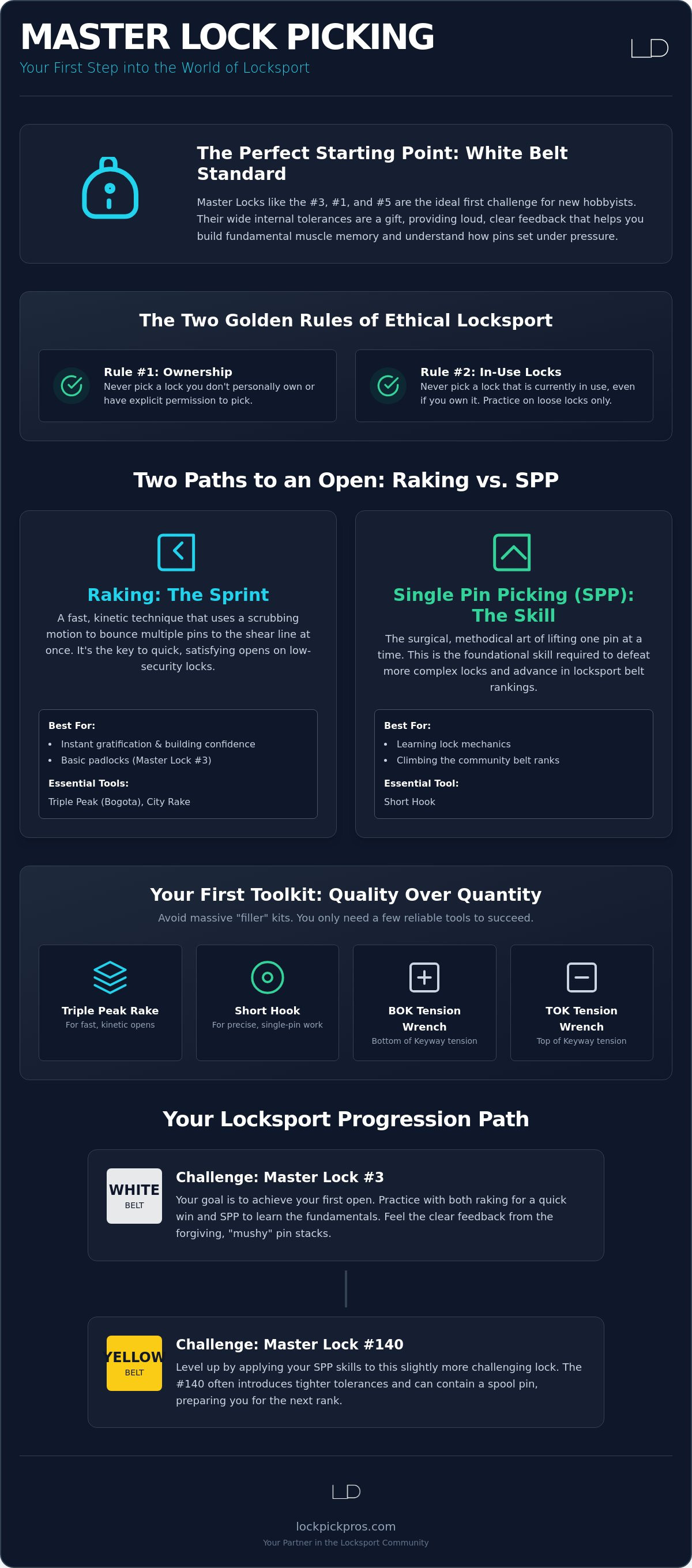
Picking your first lock is a rite of passage for every new hobbyist. To get that shackle to pop, you need to choose between two primary styles: raking and single pin picking (SPP). Raking is often called the "low-skill" method because it uses kinetic energy to bounce pins into place. It's incredibly fast on basic padlocks and provides that instant gratification every beginner craves. SPP is the surgical approach where you lift one pin at a time. This is the fundamental skill you'll need to earn higher belt ranks in the locksport community. The best lock picks for Master Lock padlock sets always include a variety of both rakes and hooks to handle different scenarios.
You really need both a rake and a hook in your starter kit. A rake gives you the quick win, while the hook teaches you the technical side of the sport. Understanding how pin tumbler locks work is easier when you can visualize the internal components and manipulate them individually. Don't forget about your tension wrenches; they are half the battle. Most beginners start with bottom of keyway (BOK) tension. However, top of keyway (TOK) tension often provides more room for your tools and clearer feedback. Identifying the best lock picks for Master Lock padlock tasks means knowing when to switch from a rake to a hook as the lock difficulty increases.
The Best Rakes for Master Lock Padlocks
The City Rake is a staple for a reason. Its jagged profile mimics the peaks and valleys of a standard key, making it perfect for the Master Lock #3. Another heavy hitter is the Bogota, or Triple Peak. It's widely considered the king of low-security opens because its three humps can manipulate multiple pins simultaneously. To use these, apply light tension and use a gentle "scrubbing" motion. You aren't trying to force the pins. You're just encouraging them to find the shear line through consistent, light vibration.
Mastering the Standard Hook for SPP
Once you move to the Master Lock 140, raking becomes less reliable. This is where a medium hook shines. It's the most versatile tool in any set. You'll use it to probe each pin individually to find the one that is binding. You're looking for a distinct "click" that signals a pin has reached the shear line. Feedback is the series of vibrations felt through the pick that communicates the state of the pins inside the lock. If you want to feel every tiny movement with professional precision, consider upgrading to the Carbon Fiber Gen 2 Pro Series for maximum sensitivity. Identifying these sensations is how you transition from a lucky beginner to a skilled hobbyist.
Matching Tools to Models: From the #3 to the #140
Your choice of tools must match the lock's internal personality. Identifying the best lock picks for Master Lock padlock success depends entirely on which model you're holding. The classic Master Lock #3 is the ultimate White Belt target. It's a four-pin tumbler with wide tolerances and a gritty feel. For this lock, you want tools that can handle a bit of muscle. On the other hand, the Master Lock 141 offers a different experience. It's an aluminum-bodied variant. The feedback is often sharper and more distinct than the steel-cased #3. Both are perfect for beginners using The Trainee 2.0 kit.
As you progress, the challenge evolves. Before you start practicing on your own collection, always verify the legality of lock picking in your state. This ensures you're staying within the bounds of our ethical community. Once you're ready, you'll find that the best lock picks for Master Lock padlock models aren't always the ones you expect. Some respond better to a quick scrub, while others demand a patient, pin-by-pin approach. Matching the right pick to the specific keyway is how you move from a curious beginner to a ranked hobbyist.
Defeating the Master Lock #3 (White Belt)
The #3 is famous for its "mushy" core. To beat it, you'll need a Triple Peak Rake or a Short Hook. Unlike higher-security locks, these gritty cores often require heavy tension. Start by applying firm pressure with your tension wrench. Insert your Triple Peak Rake and use a light scrubbing motion for about 5 seconds. If the shackle doesn't pop, immediately switch to Single Pin Picking (SPP) with your Short Hook. This "rake-then-hook" combo is a classic locksport tactic. It clears the easy pins first, leaving only one or two for you to set manually.
Stepping Up to the Master Lock 140 (Yellow Belt)
The Master Lock 140 is your gateway to the Yellow Belt. This lock introduces spool pins. These are security pins designed to catch at the shear line and prevent the plug from turning. When you encounter a spool, the lock will enter a "False Set." The plug will turn slightly, but the lock won't open. You'll need the Carbon Fiber Gen 2 Pro Series to feel the subtle counter-rotation required to defeat these. Identifying a false set is a major milestone. It means you're no longer just guessing; you're actually communicating with the lock's internal mechanics.
Selecting Your First Kit: Quality Over Quantity
Most newcomers start their locksport journey by ordering a massive 50-piece kit from a random online marketplace. They assume more picks equals more opens. It's a trap. These sets are stuffed with "filler" tools that you'll never use on a Master Lock or any other practice target. You don't need twenty different rakes to start. You need the best lock picks for Master Lock padlock success, which usually boils down to the "Big Three" essentials. Focus on a Short Hook, a Triple Peak, and a City Rake. These three tools will handle 90 percent of the locks you'll encounter in your first few months. Much like how tactical hobbyists explore AEG Airsoft Rifles at Socom Tactical Airsoft to find high-performance gear that avoids the "filler" trap, locksport enthusiasts must prioritize quality components from the start.
Steel quality is the hidden factor that separates a hobbyist from a frustrated beginner. Look for 301 High Yield steel or professional-grade Carbon Fiber. High-quality steel is thinner yet significantly stronger than the pot metal found in cheap sets. It transmits vibrations from the pins directly to your fingertips. If your pick is thick and clunky, it will dampen the "talk" of the lock. If you want a deep dive into the specifics, learn what is in a beginner lock pick set that actually provides results. Choosing the best lock picks for Master Lock padlock practice means investing in tools that help you learn, not just tools that fill a case.
The Trainee 2.0: Designed for Master Locks
The Trainee 2.0 is specifically engineered for this White Belt progression. It includes a transparent practice lock that perfectly mirrors the four-pin stack of a standard Master Lock #3. This allows you to see the pins move while you feel the feedback through the pick. Handle ergonomics are also critical here. Cheap picks are often just flat pieces of metal that dig into your fingers. The Trainee 2.0 uses comfortable, textured grips. This prevents hand fatigue during long practice sessions when you're chasing that first elusive "open."
Avoiding the "Amazon Special" Trap
Avoid the "Amazon Special" trap at all costs. These budget picks use brittle steel and often arrive with sharp, unpolished edges. These jagged edges "bite" into the lock core, masking the true feedback you need to feel. If you already bought a budget set, you can use high-grit sandpaper to smooth out the profiles. However, precision-engineered tools lead to much faster belt progression. Smooth picks glide over pins. Brittle ones snap inside the lock. If you're ready to skip the junk and feel every pin with surgical precision, upgrade to our Carbon Fiber Gen 2 Pro Series today.
Join the Lockpick Pros Black Belt Challenge
The journey from a curious trainee to a master picker is a path of precision and patience. At Lockpick Pros, we've designed the Black Belt Challenge to be your official roadmap through the ranks. This isn't just a guide; it's a community-driven quest where you earn your stripes by demonstrating real, ethical skill. Once you've selected the best lock picks for Master Lock padlock success, your first goal is the White Belt. This rank signifies you've mastered the fundamentals and can successfully open a common padlock using the techniques we've discussed. It's the foundational step every hobbyist takes before moving to more complex security pins.
Recording your first open is a pivotal moment. It transforms a solo practice session into a verified achievement. By capturing your progress on video, you join a global network of hobbyists who value transparency and ethical practice. The challenge is designed to push your boundaries while providing the support of experienced mentors. Finding the best lock picks for Master Lock padlock use is your ticket to entry. However, your dedication is what will carry you toward that eventual Black Belt. We're here to cheer you on at every click of the pins.
This journey of skill acquisition and moving through defined levels is a hallmark of many technical pursuits. For those who enjoy the precision of locksport and are looking for similar structured growth in other fields, TradingPRO provides a robust multi-asset infrastructure with account tiers designed to support users as they advance from rookie to pro.
Your White Belt Roadmap
Earning your first rank is a straightforward three-step process designed to build confidence. Follow these steps to get started:
- Step 1: Select a high-quality lock pick set for beginners to ensure you have the right feedback and durability.
- Step 2: Set up your camera and pick a Master Lock #3 from start to finish. Ensure the lock is clearly visible and show it functioning with the key after the open.
- Step 3: Submit your footage to our community portal to receive your first digital belt rank and official recognition.
The Share-to-Earn Community Bounty
We believe in rewarding those who help grow the sport. Our Share-to-Earn loop allows you to earn points and exclusive rewards just by posting your progress. Use the hashtag #LockpickProsChallenge when you share your "picks-in-action" content on social media. This isn't just about showing off; it's about inspiring other newcomers to pick up the hobby. We also offer a monthly community bounty for the most helpful mentor posts. If you share a tip that helps another picker hit their next belt, you'll earn points toward discounts on advanced gear. Hitting community social reach goals unlocks store-wide bounties for everyone. It's a collective effort to advance the sport of ethical lockpicking. Are you ready to start your journey? Join the Black Belt Challenge for Free today!
Your Path to the Black Belt Starts Now
Mastering the Master Lock #3 is more than just a quick open; it's the moment you learn to listen to the lock. By focusing on the "Big Three" tools and understanding the difference between raking and Single Pin Picking, you've already bypassed the biggest hurdles facing new pickers. Choosing the best lock picks for Master Lock padlock success ensures you spend your time developing real skill rather than fighting low-quality tools. You now have the roadmap to progress from White Belt basics to the spool pins of the Yellow Belt.
Our gear is used by thousands of ethical hobbyists who demand precision 301 High Yield Steel for every pick. When you invest in your skills today, you also get free access to the Black Belt Challenge included with your purchase. This community roadmap is designed to guide you from your very first shackle pop to advanced high-security mastery. Don't let poor quality equipment hold back your progression. Start your White Belt journey with our professional series today!
You've got the knowledge. Now, it's time to get the tools and start picking. We can't wait to see your first White Belt verification video in our community!
Frequently Asked Questions
Are lock picks legal to own for picking my own Master Locks?
Yes, owning tools for locksport is legal in most US states as long as there's no felonious intent. Statutes like California's Penal Code § 466, updated in October 2025, specifically target illegal use rather than possession for hobbyists. Always verify your local laws to stay compliant. Following the community's ethical standards ensures you're practicing the sport responsibly while building your skills.
Which Master Lock is the easiest for a absolute beginner to pick?
The Master Lock #3 is widely considered the easiest starting point for any new hobbyist. It features a simple four-pin stack with very wide internal tolerances. These loose internals provide loud, clear feedback that helps you learn the basics of pin manipulation. It's the standard entry-level challenge for earning your first White Belt rank in the locksport community.
Do I need a special tool for Master Lock 140 security pins?
You don't need specialty tools, but a high-feedback hook is essential for navigating the spool pins. The 140 creates a false set that requires you to feel for counter-rotation. Identifying the best lock picks for Master Lock padlock sets often involves choosing tools with thinner profiles. These allow you to probe the pins without over-setting the standard pins surrounding the security ones.
Can I pick a Master Lock with a paperclip or bobby pin?
It's possible but extremely difficult and not recommended for learning the sport properly. Improvised tools lack the precision and strength of professional picks. They often bend or snap before you can feel any real feedback from the pins. If you want to actually learn the mechanics and progress through the belt ranks, you'll need a dedicated set of precision-engineered tools.
What is the difference between a hook pick and a rake?
A hook pick is designed to lift one pin at a time, while a rake manipulates multiple pins simultaneously. Raking is a "low-skill, high-speed" method for quick opens on simple locks. Hook picking, or Single Pin Picking, is a more technical skill. It's the foundational technique you'll need to defeat high-security locks as you advance toward your higher belt rankings.
How long does it take to learn to pick a Master Lock #3?
Most beginners can get their first "open" on a Master Lock #3 within 15 to 30 minutes of practice. The learning curve is short because the internal tolerances are very forgiving. Once you understand how to apply tension and lift the pins, the shackle will pop relatively quickly. Consistent practice will help you reduce that time to just a few seconds.
Why does my lock pick feel stuck inside the Master Lock keyway?
Your pick is likely caught on a pin or wedged due to excessive tension. Many beginners apply too much force, which locks the pins in place and traps the tool. Try easing off your tension wrench and gently tilting the pick to free it. Selecting the best lock picks for Master Lock padlock keyways ensures you have a tool with the right thickness to navigate these gritty internals.
What tension wrench should I use for a Master Lock padlock?
A standard "L-shaped" tension wrench used at the bottom of the keyway is perfect for most Master Locks. This is known as BOK tension and is the easiest method for beginners to learn. As you move to smaller locks or those with security pins, you might prefer top of keyway (TOK) tension. This provides more room for your pick and offers clearer feedback from the pins.