

Beginner Lock Pick Set with Practice Locks: The 2026 Locksport Entry Guide
Most people think lockpicking is about what happens inside the door, but for a newcomer in 2026, it's actually about what happens inside your head. You've likely felt the frustration of staring at a dozen different metal tools and wondering which one actually opens a door. It's common to fear wasting money on a low-quality kit that bends before you ever hear a satisfying click. Choosing the right beginner lock pick set with practice locks is the difference between starting a lifelong hobby and ending up with a drawer full of useless scrap.
We understand that starting your locksport journey can feel intimidating. You want to understand the internal mechanics of a pin tumbler without the constant guesswork. This guide is designed to help you master the fundamentals and earn your very first belt in the community ranking system. We'll show you exactly which tools provide the best feedback and how to use training locks to develop your tactile "x-ray vision." We'll cover everything from pick selection to your first successful open; ensuring you join the ranks of ethical hobbyists with confidence and precision.
Key Takeaways
- Learn how a curated beginner lock pick set with practice locks bridges the gap between theoretical mechanics and the tactile feedback required for your first successful open.
- Identify the specific roles of the short hook for precision picking and the triple peak rake for speed to build a versatile foundational skill set.
- Understand the difference between transparent acrylic locks for visual learning and metal cutaway locks for a more realistic, friction-based practice experience.
- Master the fundamental "binding pin" principle by applying light tension to navigate your first pin tumbler stack with confidence.
- Discover the path to the Black Belt Challenge, where you can join our community ranking system and share your progress to earn exclusive rewards.
What is a Beginner Lock Pick Set with Practice Locks?
A beginner lock pick set with practice locks is your gateway into the fascinating world of locksport. It isn't just a collection of random tools; it's a curated ecosystem designed to teach you the mechanics of security. For many, the first question is simply: What is lock picking? At its core, it's the art of opening a lock by manipulating its internal components without the original key. In 2026, the hobby has evolved. We've moved away from the flimsy, "bendy" steel of the past. Today's trainee starts with high-yield steel and ergonomic handles that provide the precision needed for a clean open.
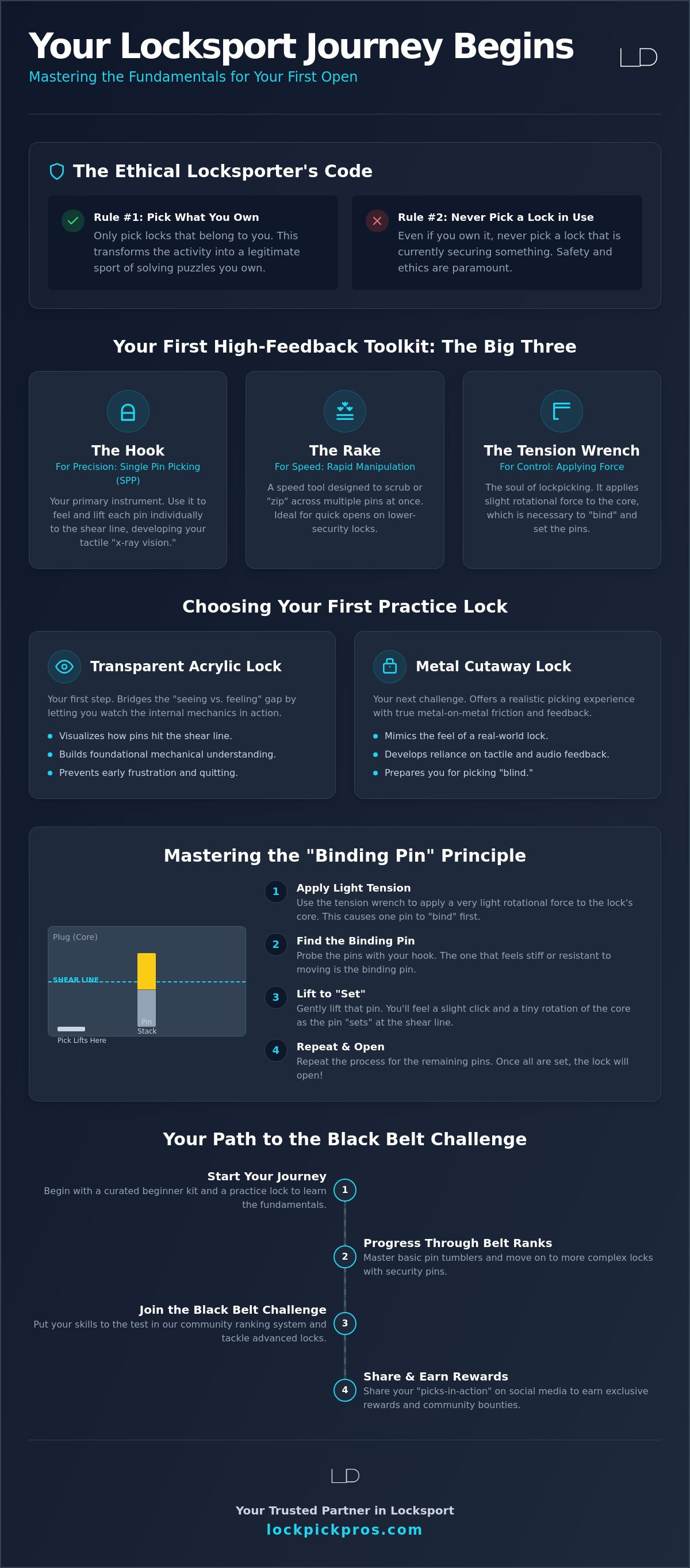
The foundation of this hobby is Ethical Lockpicking. We follow two strict rules: only pick locks you own, and never pick a lock that is in use. By sticking to these principles, you join a global community of hobbyists who view every lock as a puzzle to be solved rather than a barrier to be broken. This mindset transforms the activity from a clandestine skill into a legitimate sport of mastery.
The "Seeing" vs. "Feeling" Gap
Your brain isn't naturally wired to understand what's happening inside a dark metal cylinder. This is where the practice lock becomes essential. It bridges the gap between theory and tactile reality. Beginners often struggle because they can't visualize the pins moving. A practice lock provides that vital visual confirmation. Once your eyes see the pin hit the shear line, your hands begin to "memorize" the sensation. This visual feedback prevents the frustration that causes many newcomers to quit early. Eventually, you'll move from these transparent models to "blind" picking, where you rely entirely on your sense of touch.
Foundational Tools for the Trainee
You don't need a massive roll of fifty tools to start. A quality starter kit focuses on the "Big Three" components:
- The Hook: Used for Single Pin Picking (SPP), allowing you to lift pins one by one.
- The Rake: A speed tool designed to manipulate multiple pins at once to find a quick open.
- The Tension Wrench: The most important tool; it applies the rotational force needed to bind the pins.
Quality is paramount here. Cheap imitation sets use low-grade metal that absorbs the "feedback" you need to feel. If your pick is bending, you can't feel the pin set. We recommend starting with The Trainee 2.0. It's designed specifically to provide the durability and feedback necessary for those pursuing their first belt rank. Investing in a proper beginner lock pick set with practice locks ensures you spend your time learning, not fighting your tools.
Essential Components of a Quality Starter Kit
Building your first kit is about quality over quantity. A beginner lock pick set with practice locks should focus on high-feedback materials that let you "hear" with your fingertips. While it's tempting to buy a massive 50-piece set, most pros only use three or four tools for the vast majority of their opens. In 2026, the industry has shifted toward thinner, stronger steels that transmit every tiny vibration from the pins directly to your hand. This feedback is what transforms a random guess into a calculated skill.
Hook Picks vs. Raking Tools
The Short Hook is your precision instrument. It's the primary tool for Single Pin Picking (SPP), which is the core skill of locksport. You'll use it to lift one pin at a time, feeling for that distinct "set" as the pin reaches the shear line. On the other hand, the Triple Peak Rake is your speed tool. It uses a "scrubbing" or "zipping" motion to manipulate multiple pins simultaneously. This often provides the instant gratification of a quick open on lower-security locks. Understanding these differences is a key part of vulnerability testing of locks, as it shows how different bypass methods exploit various mechanical weaknesses. Learning when to switch from a rake to a hook is your first step toward true mastery.
The Importance of Tension Control
Tension is the soul of lockpicking. Beginners often focus on the pick, but the tension wrench does the heavy lifting. You'll encounter Bottom of Keyway (BOK) and Top of Keyway (TOK) styles. BOK is standard for most trainees, while TOK offers more room for your pick to move, which is essential as you move into tighter keyways. Having at least three different thicknesses is crucial. If your wrench is too thin, it wiggles and dampens the feedback. If it's too thick, it simply won't fit. Correct tensioning is what lets you feel the binding pin. Without that specific pressure, the pins will just fall back down, leaving you stuck at the starting line.
Don't let your tools rattle around in a junk drawer. Precision picks are thin and can bend if they aren't stored correctly. A dedicated carrying case keeps your hooks and rakes organized and protects the fine tips from damage. As you progress from your first beginner lock pick set with practice locks, you might find yourself looking for even higher levels of sensitivity. For those ready to step up their game, the Carbon Fiber Pro Series offers unmatched feedback for advanced skill refinement.
Choosing Your First Practice Lock: Clear vs. Cutaway
When you unbox a beginner lock pick set with practice locks, the first thing that catches your eye is likely the transparent padlock. It's a striking tool that demystifies the entire process. In the growing locksport community, these clear locks are considered the "X-ray" vision of a trainee. They allow you to see the shear line and understand exactly how your pick interacts with each pin. However, there's a significant difference between seeing a lock open and feeling it open. While acrylic is great for learning the basics, metal cutaway locks offer a much more realistic experience.
Metal cutaway locks bridge the gap by providing a viewing window while maintaining the metal-on-metal friction of a real lock. This friction is essential for developing your tactile sensitivity. If you want to push your skills further, progressive practice locks are the next logical step. These are standard metal locks that start with just two or three pins, allowing you to master the "feel" of a binding pin before moving up to a full six-pin stack. Progressive locks are far more durable than acrylic models, which can eventually crack or wear down after heavy use. Most serious hobbyists use acrylic for the first ten minutes and then spend the next ten hours on metal cutaways.
The White Belt Roadmap
Your journey begins with the White Belt. This is the entry rank where you demonstrate an understanding of the basic pin tumbler mechanism. Using a clear padlock, you'll identify the core components: the plug that rotates, the key pins and driver pins, the springs that provide tension, and the "bible" that houses the entire stack. Once you've successfully picked this first lock, you're officially on the path. You can check out Lock Picking Belt Levels Explained to see how this first win sets the stage for the rest of your career as a hobbyist.
Moving to Security Pins
As you advance toward Yellow and Orange belts, standard pins aren't enough. You'll encounter spool and serrated pins. These security pins are designed to trick you into thinking a pin is set when it isn't, a state known as a "false set." A cutaway lock is incredibly helpful here. It lets you see the spool pin getting caught on the shear line, teaching you how to counter-rotate the plug to set it properly. This visual confirmation is the best way to train your hands for the more complex challenges found in higher belt tiers. By the time you reach the Orange belt, your reliance on the viewing window will fade, replaced by a sharp sense of feedback.
Step-by-Step: Picking Your First Practice Lock
It's time to move from theory to action. You've unboxed your beginner lock pick set with practice locks, and the clear acrylic cylinder is waiting on your desk. This is the moment where your tactile "x-ray vision" begins to develop. Most practice locks feature a standard five-pin stack with no security pins, making them the perfect playground for your first few successful opens. Don't rush. The goal isn't just to turn the plug; it's to understand exactly why it turned.
- Apply Tension: Insert your Bottom of Keyway (BOK) wrench into the wide part of the keyway. Apply a feather-light rotational force. If your finger is turning white, you're pressing too hard.
- Find the Binder: Insert your hook and gently touch each pin. Most will feel springy. One will feel stiff or "stuck." This is the binding pin, the one currently stopping the plug from turning.
- Set the Pin: Gently lift that binding pin. You're looking for a tiny "click" sound and a slight movement in the tension wrench. In your clear lock, you'll see the gap between the pins align with the shear line.
- Repeat: Once the first pin is set, a new pin will start to bind. Find it and repeat the process until all five pins are aligned.
The Single Pin Picking (SPP) Method
In the locksport community, SPP is the gold standard of skill. A common "Mentor" secret is that you should never force a pin. If a pin won't move, you're likely applying too much tension, which "locks" the pin in place. If you accidentally push a pin too high, it's called an overset. The driver pin and key pin both end up above the shear line, preventing the lock from opening. If this happens, don't panic. Simply release your tension slightly to let the pins drop and start the sequence again. Developing this light touch is what separates a trainee from an expert.
Recommended Pick Choice for Beginners
While your kit might have several tools, the Short Hook is your best friend for your first 50 opens. It provides the most direct feedback and allows for precise placement on individual pins. It's tempting to use a rake to "zip" the lock open in seconds, but raking teaches you very little about the internal mechanics. Focus on the feedback instead. Listen for the metallic clicks and feel the vibrations traveling through the handle. As your sensitivity improves, you'll want tools that transmit these signals even more clearly. For hobbyists ready to upgrade their tactile experience, the Carbon Fiber Gen 2 Pro Series offers the professional-grade feedback needed for advanced ranking.
Advancing Your Skills: The Black Belt Challenge
You've felt the click. You've seen the plug turn. Now that you've mastered the basics with your beginner lock pick set with practice locks, you're standing at the edge of a much larger world. Locksport isn't just a solo activity; it's a global community of thousands who share your passion for mechanical puzzles. Much like how PYQKosh helps students master Indian competitive exams by organizing previous year questions into a structured roadmap, we at Lockpick Pros offer a comprehensive guide for your entire journey through the belt ranking system, from your first white belt open to the prestigious black belt rank.
Our Black Belt Challenge is a free, structured path designed to take you from a curious trainee to a master picker. This program is built on a "share-to-earn" loop that rewards your progression. When you hit a new milestone or defeat a challenging cylinder, share your "picks-in-action" content on social media. This helps grow the community and earns you rewards toward your next tool upgrade. We even offer a community bounty for hitting specific social reach goals. It's a way to foster engagement and ensure that every ethical lockpicker has the support they need to keep improving.
The Next Tier: Pro Series Expansion
Transitioning from basic tools to professional equipment is a rite of passage. Once you reach the Green Belt level, your hands will be ready for more sensitive feedback. This is the perfect time to upgrade to the Carbon Fiber Gen 2 Pro Series. These picks offer unmatched vibration transmission, letting you feel the microscopic difference between a set pin and a security pin trap. As you move into high-security cylinders, adding the Pro Series Expansion set ensures you have the specialized profiles needed for tight keyways and complex bitting. Professional tools are more than just a purchase; they're a reward for the skill refinement you've achieved.
Join the Ethical Locksport Movement
As you advance, remember the foundation of our sport. We are ethical lockpickers, not "lock breakers." This means adhering to the "Two Rules" at all times: never pick a lock you don't own, and never pick a lock that is currently in use. These rules protect the integrity of the hobby and ensure we remain a respected community of puzzle solvers. Your beginner lock pick set with practice locks was just the start of this journey. Now, it's time to test your limits and see how far your focus can take you.
Are you ready to earn your next rank and join a community of experts? Join the Black Belt Challenge for free today. We'll provide the guidance, the ranking system, and the community support you need to reach the top. Every master was once a trainee who didn't give up. Welcome to the team, and happy picking.
Start Your Journey to Black Belt Mastery
You've discovered how the right tools bridge the gap between seeing and feeling. By starting with a quality beginner lock pick set with practice locks, you've built a foundation based on precision and feedback rather than guesswork. You now understand the critical role of tension control and the importance of mastering the single pin picking method. We've helped over 50,000 customers start their hobby with our 2026 precision-engineered tools, ensuring every trainee has the best possible start in this rewarding sport.
Our community is Ethical Locksport Approved, focusing on the challenge of the puzzle and the growth of the individual. Whether you're aiming for your white belt or already looking toward the black belt rank, the right equipment makes all the difference. Don't settle for low-quality imitations that dampen your progress and hide the feedback you need to succeed. Shop our Beginner Lock Pick Sets and join the Black Belt Challenge! We're excited to see your first successful open and watch you climb the ranks. Welcome to the community.
Frequently Asked Questions
Is it legal to own a lock pick set with practice locks?
Yes, it's legal to own these tools in all 50 states as of July 2026. The law focuses entirely on your intent. Owning a beginner lock pick set with practice locks for the purpose of locksport or hobby picking is a protected activity. However, you should be aware of local nuances. California Penal Code 466 was updated in January 2026 to continue emphasizing that felonious intent is the key factor for any possession charge. In states like Mississippi or Ohio, possession can be viewed with more scrutiny in suspicious circumstances, so it's best to keep your practice at home.
How long does it take for a beginner to pick their first lock?
Most beginners can open their first transparent practice lock in about 10 to 20 minutes. This initial success is a great way to build confidence and understand how the pins align at the shear line. Moving from a clear lock to a standard metal padlock usually takes a few hours of dedicated practice. The timeline depends on how quickly you develop the "light touch" required to feel the binding pins without oversetting them.
Can I use a beginner lock pick set on my front door if I get locked out?
No, you should never use your beginner lock pick set with practice locks on a lock that is in use. This is one of the two core rules of ethical locksport. Picking a lock that you rely on for security can cause internal damage. If you're locked out or have a faulty mechanism, you can explore UPVC Door Gearbox Replacement with professional locksmiths like Key Qualities to ensure your hardware is repaired without compromising your home's security.
What is the difference between a clear lock and a cutaway lock?
Clear locks are made of acrylic and offer a full view of the springs and pins, making them perfect for your first few minutes of learning. Cutaway locks are actual metal locks with a portion of the side milled away. These provide a much more realistic metal-on-metal friction while still allowing you to see the pins. While clear locks are great for theory, cutaway locks are the superior tool for training your hands to recognize the feedback of a real lock.
Do I need a special set to earn a White Belt in the locksport community?
You don't need a specialized kit to earn your White Belt. A standard starter set with a basic hook and tension wrench is all that's required to defeat the entry-level locks on the ranking list. The White Belt is designed to be an accessible starting point for any new trainee. It's a way to demonstrate that you understand the fundamental mechanics of a pin tumbler lock and are ready to begin the journey toward more complex challenges.
Why are carbon fiber lock picks better than standard steel?
Carbon fiber handles offer significantly better vibration transmission than standard plastic or rubber grips. This increased sensitivity allows you to feel the microscopic "clicks" and movements of the pins much more clearly. As you move past the trainee stage, this enhanced feedback becomes vital for identifying security pins like spools or serrations. They are also incredibly lightweight, which reduces hand fatigue during long practice sessions as you refine your skills.
What happens if I break a pick inside a practice lock?
If a pick breaks, don't panic. You can usually remove the broken fragment using a specialized extractor tool or by tapping the lock against a hard surface. Breaking a pick is almost always a sign that you're applying too much tension or trying to force a pin that isn't binding. Use it as a valuable lesson to lighten your touch. Most hobbyists break at least one pick early on; it's simply a part of the learning process in locksport.
How many practice locks should I start with?
Starting with two or three different locks is the best way to build a versatile skill set. A transparent lock helps you visualize the internal mechanics, while a metal cutaway or a progressive lock with fewer pins helps you develop tactile sensitivity. Having a small variety prevents you from simply "memorizing" the biting of a single lock. This ensures you're learning the actual mechanics of picking rather than just solving one specific puzzle.