

How to Defeat Spool Pins: Mastering Counter-Rotation in 2026
The moment you hit a false set isn't a sign of failure; it's the gateway to becoming a true locksport technician. You've probably felt that sudden, deep rotation of the plug and thought you were seconds away from an open, only to find yourself stuck. Learning how to defeat spool pins is the most significant milestone in any picker's journey. It marks the transition from basic raking to the precise, intentional movements required for high-security locks.
We know how it feels to lose your progress. Dropping previously set pins while wrestling with a spool is a rite of passage that can test anyone's patience. In this guide, you'll learn to identify exactly what the lock is telling you through the tension wrench. We'll master the delicate dance of counter-rotation together. By understanding the physics of these security pins and refining your tension control, you'll gain the confidence to tackle Orange and Green belt challenges with consistent success.
Key Takeaways
- Identify spool pins by their narrow center "waist" and learn why they cause the characteristic deep false set in intermediate locks.
- Master the delicate dance of counter-rotation to learn how to defeat spool pins while maintaining control over the pin stack.
- Correct common mistakes like heavy tension and oversetting to ensure you don't drop your progress during a pick.
- Build a clear roadmap for your locksport journey by progressing from the Master Lock 140 to the legendary American Lock 1100.
- Gain the technical "feel" for the shear line that's required to earn your higher belt rankings and join the expert community.
What are Spool Pins and Why Do They Exist?
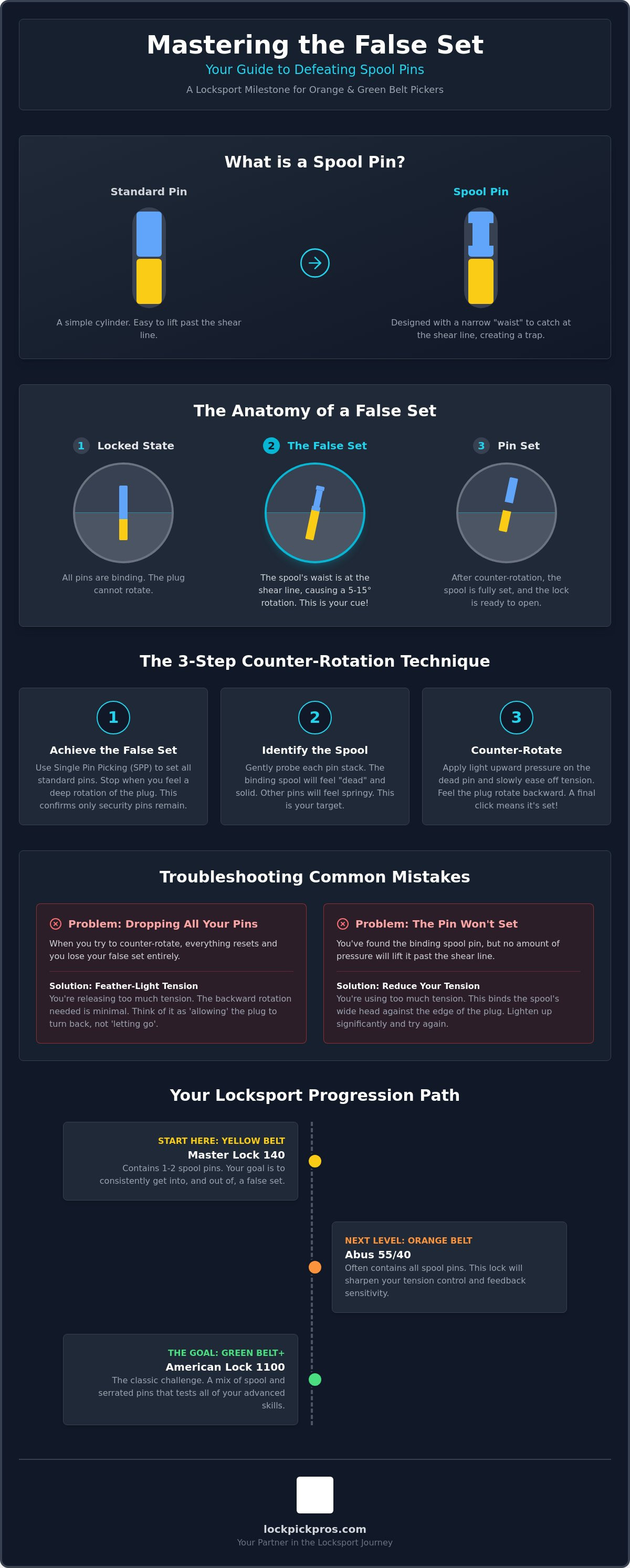
A spool pin is a specialized security driver pin that looks exactly like its namesake: a sewing spool. It features a narrow center, often called the "waist," and wider "heads" at the top and bottom. Lock manufacturers include these to stop low-skill attacks like raking or bumping. When you lift a spool pin, the wide head catches on the shear line, tricking you into thinking the pin is set. Understanding What are Spool Pins and how they interact with the plug is your first step toward mastering intermediate locks. While standard pins are simple cylinders, spools are designed to be traps for the unwary picker.
The mechanics are straightforward but effective. Because the center of the pin is thinner than the rest of the stack, the plug can rotate slightly even when the pin hasn't reached the shear line. This slight rotation creates a "false set." Standard raking techniques almost always fail here because the rake can't provide the delicate feedback needed to navigate the pin's waist. To succeed, you must use Single Pin Picking (SPP). Learning how to defeat spool pins requires a shift from speed to extreme precision. You'll need high-quality tools like those found in The Trainee 2.0 set to feel the subtle movements inside the keyway.
Anatomy of a Spool: Driver vs. Key Pins
In most locksport challenges, the key pins remain standard cylinders. The security magic happens in the driver pins, which sit above the key pins and the springs. When you apply tension and lift a spool, the narrow waist enters the gap between the plug and the housing. This allows the plug to turn, but the wide top of the spool prevents the lock from opening. You'll encounter this frequently in Yellow belt locks like the Master Lock 140. As you progress to Orange belt locks, such as the Abus 55/40, the feedback becomes sharper and more demanding. Learning to visualize this interaction is vital for your growth as an ethical picker.
The 'False Set' Explained
A false set is a specific sensation where the plug rotates significantly, usually between 5 and 15 degrees. It feels like a "click," and your tension wrench will move noticeably. Many beginners mistake this for an open, but the lock remains stubbornly closed. Don't be discouraged. A false set is actually excellent news. It confirms that you've successfully navigated all the standard pins in the stack. It's the ultimate diagnostic tool. Once you're in a false set, you can map the lock by probing the remaining pins to find which ones offer the counter-rotation needed to finish the pick.
How to Identify a Spool Pin During Picking
Identifying a spool pin is like solving a tactile puzzle through your fingertips. The process begins with Diagnostic Step 1: entering the false set. You must first find and set every standard pin in the stack. Once the plug rotates those few degrees we discussed earlier, the lock is effectively telling you that only security pins remain. If you're struggling to reach this state, it usually means a standard pin is still binding. Learning how to defeat spool pins requires patience during this initial setup phase. Once the plug shifts, your diagnostic work truly begins.
Diagnostic Step 2 involves a light, systematic probe of every pin stack with your hook pick. In a false set environment, you'll encounter two types of feedback: springy pins and dead pins. A springy pin is either already set at the shear line or is not yet binding. It will bounce back when touched. A dead pin feels rock solid and resists any movement. This is often the "binder" you're looking for. When you apply upward pressure to a dead pin, look for the "twitch" in your tension wrench. This is the fundamental theory behind The Counter-Rotation Technique, where the pin physically forces the plug to turn back toward the locked position as the wider head tries to clear the shear line.
The Diagnostic Probe Technique
To feel these subtle movements, you must master how to hold lock picks correctly for maximum sensitivity. Use a light grip, similar to holding a fine pen. This allows the vibrations from the pin to travel through the pick handle into your hand. If you feel the plug trying to rotate backwards against your tension wrench, you've found a spool. Differentiating this from a serrated pin is crucial; a spool will give you a smooth, continuous push back, while serrated pins offer multiple, tiny clicks. For a deeper dive into these differences, check out our guide on how to tell if a lock has security pins. Using a professional set like the Carbon Fiber Gen 2 Pro Series can significantly amplify this feedback.
Mapping the Lock
Successful hobbyists use mental mapping to track the lock's internal state. Take the Master Lock 140 as a classic training example. It typically features one standard pin, often in position one, and three spools. By identifying which pin is standard, you can quickly set it to enter the false set and then focus entirely on the remaining spools. The order of operations matters. If you try to pick the spools before the standard pins are set, you'll likely get no feedback at all. Learning how to defeat spool pins is a sequence of events: find the standard, enter the false set, map the spools, and then listen for that counter-rotation.
Step-by-Step: The Counter-Rotation Technique
Mastering the counter-rotation dance is what separates a trainee from a serious hobbyist. Once you've successfully entered the false set, the lock is primed for the final stage. Learning how to defeat spool pins isn't a matter of forcing the pin up; it's about negotiating with the plug to let the pin pass. This is a tactile conversation between your pick and your tension wrench. Follow these steps to execute a perfect open:
- Enter the False Set: Set all standard pins until you feel that distinctive rotation of the plug.
- Find the Binding Spool: Probe each stack. When you hit a spool, pushing up will cause your tension wrench to move backwards against your finger.
- Ease Off Tension: This is the most critical moment. Gradually reduce your finger pressure. You want just enough tension to keep the wrench from falling out.
- Apply Upward Pick Pressure: While the plug rotates back, continue pushing the pin. You are essentially letting the pin "push" the plug out of its own way.
- The 'Click': As the wide head of the spool clears the shear line, the plug will snap forward into a deeper false set or, if it was the last pin, a full open.
Mastering Float Tension
Modern pros often use "float tension" to maintain total control. This involves using two tension wrenches or an incredibly light "feather touch" to manage the back-rotation. If you apply too much tension, the pin won't move. Too little, and everything you've set will drop. High-performance tools like the Carbon Fiber Gen 2 Pro Series are game changers here. The carbon fiber construction transmits the vibration of the spool's shoulder hitting the shear line much more clearly than standard steel. This feedback helps you stop easing tension at the exact millisecond the pin sets, preventing "The Drop" of previously set pins. It's the most reliable way to learn how to defeat spool pins in high-tolerance locks.
The 'Jiggle Test' for Spools
After you feel the click, perform a "jiggle test" to confirm the set. A properly set spool will have a tiny amount of springy movement. If it feels rock hard, it's either still binding or you've pushed it too far. Recognizing an "overset" is a vital skill. If the plug returns to a neutral position instead of a false set, you've likely dropped a pin or overset the spool into the lock's bible. Don't panic. Lightly pulse your tension to see if the overset pin drops back into place without resetting the entire stack. This level of finesse is exactly what you need to level up your belt rank and join the expert community.
Troubleshooting: Why You're Dropping Pins
Dropping pins is the most frustrating part of the learning curve. You finally get that deep false set, you feel the counter-rotation, and then you hear that disheartening click-clack as half your progress resets. It's a common hurdle when learning how to defeat spool pins. Most of the time, the issue isn't your pick placement; it's your tension control. You aren't just picking a lock; you're managing a delicate physical equilibrium.
The #1 mistake is using static, heavy tension. If your finger is a lead weight on the wrench, the plug cannot rotate backwards. You're effectively fighting the lock's attempt to help you. The #2 mistake is oversetting. If you push a spool too hard, you'll drive the driver pin entirely into the bible. This causes the key pin to cross the shear line and creates a "dead" feeling that forces a total reset. You'll know it's an overset if the plug loses its springy feel and becomes rock solid.
Sometimes you'll encounter what hobbyists call "Mendeleev's Ghost." This is the phenomenon where setting one spool causes another previously set pin to drop. It's often due to the plug's physical shift during counter-rotation. To recover, try controlled pulsing. Instead of letting go completely, lightly flutter your tension pressure. This often allows an overset pin to drop back into place without losing the whole stack. It's a skill that takes time to develop, but it's essential for consistent success.
Tension-to-Pick Ratio
Visualize your hands as a scale. There's a delicate balance required here. While heavy tension helps with standard pins, it's the absolute enemy of the spool. You need to develop a feel for the specific feedback of different security pins. For example, serrated pin picking techniques rely on identifying multiple tiny clicks. Spools demand a smooth, singular negotiation. If you apply 10 units of force with your pick, you must reduce your tension to allow the plug to move accordingly. It's a 1:1 relationship that requires total focus.
Tool Selection for Spools
Your tools play a massive role in your success. A deep hook is often necessary to reach high-set spool pins tucked behind low-set standard pins. Pick thickness also matters. In tight European keyways like Abus, a standard 0.025 inch pick might bind against the warding. Switching to a 0.015 inch pick can give you the room you need to maneuver. If you've mastered the basics with The Trainee 2.0, it's time to graduate. Moving to the Expansion Series provides the specialized profiles needed for security pin mastery. For the ultimate feedback, we recommend upgrading to the Carbon Fiber Gen 2 Pro Series to feel every subtle movement of the pin stack.
Next Steps: Progression and the Black Belt Challenge
Mastering the mechanics of security pins is just the beginning of your journey. Now that you understand how to defeat spool pins through counter-rotation, your next task is to apply that knowledge to increasingly difficult locks. The locksport community uses a standardized belt ranking system to help you track this growth. Moving from a basic padlock to a high-security cylinder is a rewarding process. It requires both technical skill and the right equipment to maintain clear feedback as tolerances get tighter.
The road to mastery typically begins with the Master Lock 140. This is a classic Yellow belt lock that provides large, forgiving feedback. Once you can open it consistently, you'll move toward the "final boss" of intermediate picking: the American Lock 1100. This Green belt icon is legendary because it mixes spool pins with serrated pins. It demands perfect tension control. If you can navigate an 1100, you've officially moved beyond the trainee phase and into the expert-level ranks of the community.
Target Locks for Spool Practice
To build your skills, you should follow a logical progression. Each of these locks offers a unique lesson in pin feedback and tension management. Start with these community favorites:
- Yellow Belt: Master Lock 140 or a Brinks Brass Padlock. These have fewer security pins and wide keyways.
- Orange Belt: Abus 55/40 or Master Lock 150. These feature tighter tolerances and more aggressive spool shapes.
- Green Belt: American Lock 1100. This lock is the gold standard for testing your ability to distinguish between different security pin types. Read our guide on how to pick American Lock 1100 to prepare for this challenge.
As you tackle these tougher locks, the material of your tools becomes vital. Standard steel picks often dampen the subtle vibrations of a spool pin clearing the shear line. Professional-grade tools, like the Carbon Fiber Gen 2 Pro Series, are designed specifically to amplify this feedback. The rigidity of carbon fiber ensures that every tiny movement of the pin is transmitted directly to your fingertips.
Join the Locksport Community
Lockpicking is more than just a solitary puzzle; it's a thriving sport. We encourage all ethical pickers to document their progress through our "Share-to-Earn" loop. When you land your first successful open on a spool-heavy lock, film your "Pick-in-Action" and share it with the community. You can earn rewards and gear by hitting social reach goals through our Community Bounty program. This is a great way to connect with other hobbyists and upgrade your kit as you level up.
Are you ready to commit to the path of mastery? Join the Black Belt Challenge for Free today. You'll receive a structured roadmap that guides you through every belt rank. You can claim your Trainee status immediately and start earning your way toward the elite Black Belt tier. The community is waiting to welcome you.
Master Your Next Belt Rank
You've now unlocked the secrets of the false set. By viewing this state as a diagnostic roadmap rather than a roadblock, you're ready to conquer Orange and Green belt locks. Remember that counter-rotation is a conversation. It's about feeling the lock's feedback and responding with the perfect tension-to-pick ratio. Mastering how to defeat spool pins is the defining moment in your transition from a trainee to a skilled hobbyist.
Join the community of over 10,000 ethical hobbyists who've already refined their technique. Our precision-engineered Carbon Fiber series is designed to give you the tactical edge needed for high-security locks. When you begin, you'll receive the Official 2026 Belt Ranking Roadmap to guide your journey to the top. Take the Black Belt Challenge and Level Up Your Skills today. We can't wait to see your success stories and social media highlights. Keep practicing and stay focused on the sport.
Frequently Asked Questions
What is the difference between a spool pin and a serrated pin?
Spool pins feature a single narrow waist that catches at the shear line, while serrated pins have multiple small grooves along their length. When picking, a spool provides a deep false set and strong counter-rotation feedback. Serrated pins offer multiple tiny, deceptive clicks that feel like a set but aren't. Understanding these tactile differences is essential for your progression through the belt ranks.
Why does the lock turn a little bit but not open?
This sensation means you've successfully entered a false set. The narrow center of a spool pin has allowed the plug to rotate, but the wider head of the driver pin is still caught at the shear line. It's a sign of progress rather than failure. You've cleared the standard pins, and now you must find the specific spool causing the bind to finish the open.
Can I rake a lock that has spool pins?
Raking is extremely ineffective against spool pins because the narrow waist is specifically designed to trap a moving rake. While you might get lucky on a low-tolerance lock, Single Pin Picking (SPP) is the only reliable way to learn how to defeat spool pins. SPP allows you to feel the counter-rotation and negotiate each pin stack individually with precision.
Why do my other pins fall down when I pick a spool?
Pins drop because the plug must rotate backwards to allow the spool's wider head to clear the shear line. This backward movement reduces the frictional force holding other set pins in place. It's a common part of the conversation with the lock. Using a light touch and pulsing your tension can help minimize these drops as you navigate the stack.
How much tension should I use for spool pins?
You should use very light tension, often called feather touch, when dealing with spools. If your tension is too heavy, the pin cannot force the plug to rotate backwards, and you'll likely overset the pin or bend your tool. The goal is to provide just enough resistance to feel the plug twitch when you probe the binding spool stack.
What are the best practice locks for learning spool pins?
The Master Lock 140 is the gold standard for Yellow belt beginners. For those ready to level up, the Abus 55/40 offers sharper feedback for Orange belt practice. Finally, the American Lock 1100 is the ultimate Green belt challenge. These locks are widely recognized by the community as the best tools for learning how to defeat spool pins and mastering counter-rotation.
Is it legal to practice picking locks with security pins at home?
Practicing on locks you own in a legal setting is legal in the vast majority of U.S. jurisdictions. Legality almost always depends on your intent. While twelve states require locksmith licenses for professional work, hobbyist practice is protected by laws that focus on criminal intent. Always follow the ethical code of the locksport community: never pick a lock you don't own or one that is in use.
Do I need special tools like a dimple pick to defeat spools?
You don't need specialty tools like dimple picks for standard pin tumbler locks. A high-quality hook pick and a standard tension wrench are all you need to conquer spools. Dimple picks are specialized tools designed for locks where the pins are oriented on the side of the key. For most security pin practice, a standard professional set is perfectly sufficient.