

How to Use a Hook Pick: Mastering Single Pin Picking (SPP) for Locksport
What if the secret to mastering beginner lockpicking isn't about brute force, but the subtle dance between your tension wrench and a precision tool? It's normal to feel frustrated when you're constantly oversetting pins or losing that vital tactile feedback. Learning how to use a hook pick correctly is the definitive moment you transition from "raking and hoping" to intentional Single Pin Picking (SPP). This skill is the essential foundation for advancing through the community belt ranks and earning your place among ethical hobbyists.
In this guide; we'll show you how to navigate practice locks with surgical accuracy. We promise to teach you the technical mastery required to conquer your first White Belt lock and eventually take on our Black Belt Challenge. We'll cover everything from pick set selection to the "binding order" concept; ensuring you develop a comfortable grip that prevents hand fatigue and sets you on the path to becoming a locksport pro.
Key Takeaways
- Understand why Single Pin Picking (SPP) is the foundational skill for every ethical locksport enthusiast aiming for higher belt ranks.
- Learn exactly how to use a hook pick with the "Pencil Grip" to increase tactile feedback and eliminate hand fatigue.
- Discover how to match your tool selection to specific lock difficulties, using kits like The Trainee 2.0 for White Belt success.
- Master the "mapping" technique to identify pin stacks and binding order with precision before you set a single pin.
- Explore the path to the Black Belt Challenge and learn how to earn rewards by sharing your progress with the community.
Hook Pick Fundamentals: The Gateway to Single Pin Picking (SPP)
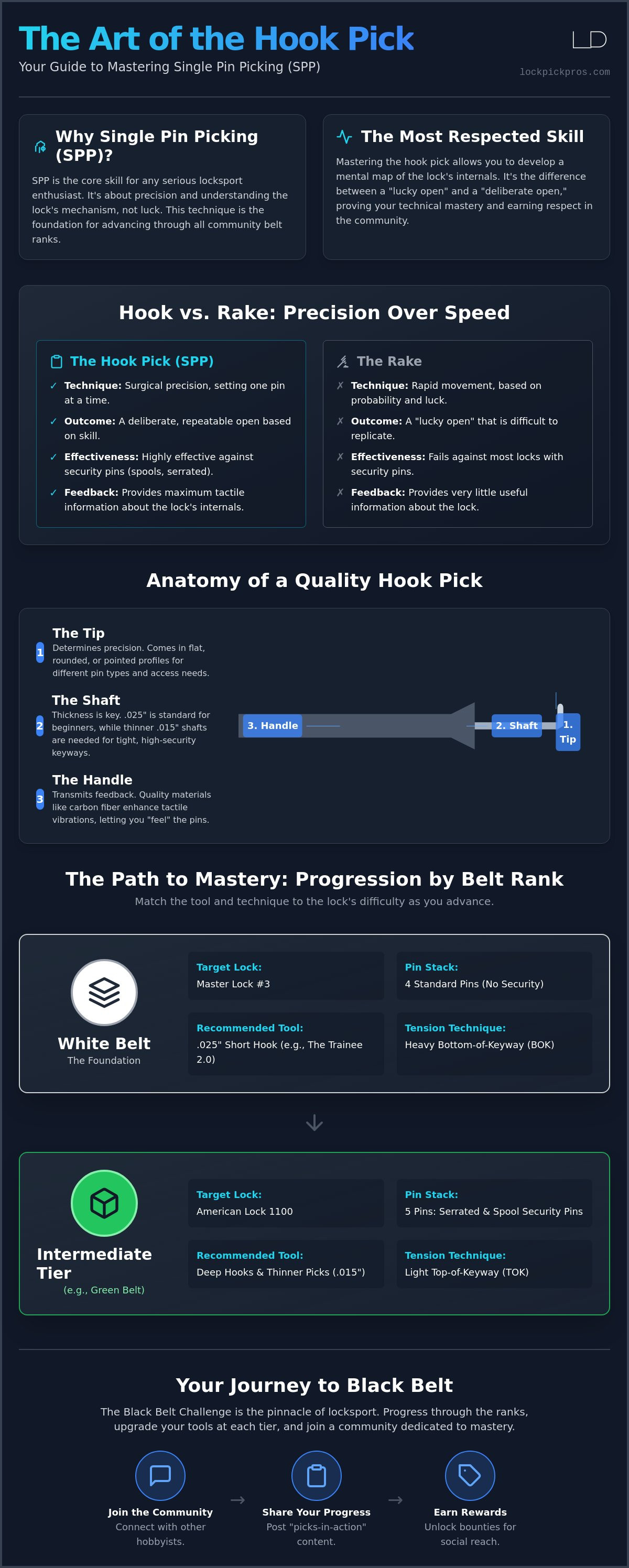
Think of the hook pick as the surgeon's scalpel of the locksport world. While bypass tools or rakes might get a lock open through speed or brute force; the hook offers surgical precision. Mastering this tool is the primary requirement for Single Pin Picking (SPP). This technique involves identifying, lifting, and setting one individual pin at a time until the core turns. It's the most respected skill in our community and the only way to truly understand what's happening inside a cylinder.
Every ethical lockpicker starts with a hook. It's the essential tool for earning your White Belt. As you progress, your ability to interpret the feedback through the pick will define your success. Learning how to use a hook pick isn't just about the physical movement. It's about developing a mental map of the lock's internals. Without this skill, you'll hit a wall as soon as you encounter anything more complex than a basic hardware store padlock.
Hook vs. Rake: Precision over Speed
Raking is often about probability. You move a tool quickly across the pins, hoping they all hit the shear line at the same moment. It's often called a "lucky open." While raking is fast, it fails miserably on locks with security pins like spools or serrated drivers. SPP is about technical mastery. You learn the "binding order," which is the specific sequence the pins must be set in. The "deliberate open" achieved through a hook pick provides a level of satisfaction that luck simply can't match. It proves you understand the mechanism rather than just beating it.
Anatomy of a Quality Hook Pick
Understanding your tool is the first step toward mastery. A hook consists of three main parts: the tip, the shaft, and the handle. Tips come in various shapes. Flat tips provide a stable surface for lifting, while rounded tips allow you to glide between pins without snagging. Pointed tips are reserved for the most technical, deep-set pins that require extreme accuracy.
Shaft thickness is equally vital. A standard .025 inch shaft is perfect for beginners using The Trainee 2.0 set because it's durable and fits most wide keyways. However, as you encounter high-security locks with tight or paracentric keyways, you'll need thinner .015 inch picks. Finally, consider the handle. Materials like carbon fiber in the Carbon Fiber Gen 2 Pro Series are designed to transmit subtle vibrations directly to your fingertips. This tactile feedback is your most valuable asset when learning how to use a hook pick effectively.
Selecting Your Tool: Hook Profiles for Every Belt Rank
Picking isn't a one-size-fits-all hobby. As you follow the Lock Picking Belt Levels Explained guide, you'll see that keyway complexity increases with every rank. The "warding," or those jagged metal ridges inside the lock, acts like an obstacle course for your tools. Learning how to use a hook pick effectively requires matching the tool's profile to the specific lock in your hand. For those just starting, The Trainee 2.0 offers the perfect foundational profiles for White Belt success.
The Short Hook: Your White Belt Workhorse
The short hook is the most versatile instrument for standard pin tumblers like the Master Lock #3. This foundational White Belt lock features a 4-pin stack consisting entirely of standard pins with no security features. To open it, follow these technical steps:
- Tension: Apply heavy Bottom-of-Keyway (BOK) tension. These locks are manufactured with loose tolerances and require firm pressure to bind the pins.
- Pick Choice: Use a .025" short hook from your beginner set.
- The Process: Insert the pick and find the first binding pin. Because there are no security pins, you'll feel a solid, singular click when each pin reaches the shear line. Lift each pin vertically until the plug rotates.
The short hook is the essential starting point for all SPP beginners because it provides the clearest feedback in open keyways.
Deep Hooks and Reach Tools for Intermediate Tiers
As you progress to intermediate tiers like the Green Belt, you'll encounter technical challenges like the American Lock 1100. This lock is a significant step up, featuring a 5-pin stack loaded with serrated pins and serrated spool security pins. Mastering how to use a hook pick on this model requires a different approach:
- Tension: Use feather-light Top-of-Keyway (TOK) tension. Heavy tension will cause the serrations to trap your pick, making it impossible to feel the shear line.
- Pick Choice: Reach for a deep hook from the Carbon Fiber Gen 2 Pro Series. The deep profile is necessary to navigate "high-low bitting" where a short pin is hidden behind a long one.
- The Process: Listen for tiny, multiple clicks as you move past serrations. When you hit a spool pin, the plug will enter a "false set" (slight rotation). Apply gentle upward pressure and look for "counter-rotation" (the plug moving backward) before the pin finally sets.
The increased sensitivity of carbon fiber tools is vital here. It allows you to distinguish between a serration click and the true shear line set, preventing the oversets that common in these advanced keyways.
Mastering the Grip: Ergonomics and Tactile Feedback
The most common mistake for those learning how to use a hook pick is the "death grip." When you can't feel what the pins are doing, your natural instinct is to squeeze the handle harder. This is counterproductive. Tightening your muscles actually dampens the subtle vibrations that travel from the pin, through the metal shaft, and into your hand. You want to hold your pick with just enough pressure to keep it steady; think of it like holding a fine paintbrush or a fountain pen.
To truly master Single Pin Picking, you must understand the "Fulcrum" effect. You aren't just shoving the pick up and down. Instead, you should use a pivot point to gain leverage. This pivot point can be your own finger resting against the lock face or even the bottom of the keyway itself. By using a fulcrum, you turn a clumsy pushing motion into a precise, controlled lift. This allows you to move pins by fractions of a millimeter, which is often the difference between a set pin and an overset one.
The Pencil Grip vs. The Modified Grip
The standard pencil grip is the gold standard for maximum sensitivity. Place the pick handle between your thumb and index finger, resting the shaft on your middle finger. This tripod position offers the best control for "counting" pins as you move through the lock. If you find yourself in a tight paracentric keyway, you might switch to a modified grip, where you choke up on the shaft for more direct leverage. To prevent hand fatigue during long practice sessions, remember to take frequent breaks. Shake your hands out every fifteen minutes to keep your muscles loose and your focus sharp.
Decoding the Language of Pins
Once you have a comfortable grip, you can start "reading" the lock. Every pin stack will tell you a story through tactile feedback. You'll encounter three main sensations:
- The Binding Pin: This pin feels stiff and resistant. Because of the tension you're applying, this pin is trapped between the plug and the housing. This is your target.
- The Set Pin: When you lift a binding pin to the shear line, you'll feel a distinct "click." You might also notice a tiny rotation in the plug. Once set, the pin should feel slightly loose or "mushy."
- The Springy Pin: If a pin moves easily and bounces back when you let go, it isn't binding. Leave it alone. Messing with springy pins is a fast track to oversetting and losing your progress.
For pickers using the Carbon Fiber Gen 2 Pro Series, these sensations are amplified. The high-tech handle material is specifically designed to transmit these tiny movements more clearly than traditional plastic or bare metal handles. Focus on these signals, and you'll find your way through any White Belt lock in no time.
The Hook Picking Process: A Step-by-Step SPP Guide
Ready to turn your technical knowledge into a successful open? Transitioning from a solid grip to the actual picking process requires patience and a light touch. The first step is always preparation. Insert your tension wrench and apply light, consistent pressure. For beginners, the most common hurdle is using too much tension, which binds every pin at once and masks the feedback you need to succeed. Think of it as applying just enough pressure to hold a piece of paper against a wall.
Once tension is set, enter the "mapping" phase. Before you try to set anything, glide your hook to the back of the lock and slowly pull it forward. Count each pin as you go. This exercise is the best way to learn how to use a hook pick because it builds your internal map of the keyway. You'll know exactly where pin four is located without having to guess. After mapping, you can begin the search for the first binding pin. Test each pin stack by giving it a tiny nudge. The one that feels stiff and refuses to budge is your target.
When you find that binder, apply steady vertical pressure. You're looking for a distinct "click" and a microscopic movement in the tension wrench. This signal tells you the pin has reached the shear line. Once it's set, don't keep pushing. Move on to the next pin and repeat the cycle. If you want to accelerate this learning curve, using high-quality tools like the Carbon Fiber Gen 2 Pro Series will help you hear and feel these clicks much more clearly.
Finding the Binding Order
In a perfect world, all pins would bind at the same time. In reality, tiny manufacturing imperfections mean every lock has a unique "binding order." One pin will always be slightly larger or the hole slightly off-center. This is why pins bind one at a time. Your job is to solve this sequence like a puzzle. Test each pin with a gentle tap; if it's springy, it's not the current binder. Only lift the pin that is actively resisting your pick.
Avoiding the Overset
The "overset" trap happens when you push a pin past the shear line, causing the key pin to bridge the gap and lock the plug. You'll recognize an overset by a mushy feel and a total loss of feedback from other pins. To verify a pin is properly set, use the "jiggle test." A set pin should have a tiny amount of "play" or jiggle because the driver pin is no longer resting on it. If it's rock solid or completely loose without any spring, you may need to reset and try again.
Levelling Up: Join the Black Belt Challenge
Now that you've grasped the fundamentals of how to use a hook pick, you're ready to join the ranks of thousands of other enthusiasts. Locksport is more than just a solitary hobby; it's a thriving community built on skill, ethics, and mutual support. Our "Black Belt Challenge" is the ultimate goal for any serious picker. It provides a structured path to mastery, taking you from a curious beginner to a technical expert capable of opening the world's most secure cylinders.
We believe in celebrating your progress through our "Share-to-Earn" loop. As you conquer new locks, record your "picks-in-action" and share them with the community on social media. Not only does this provide the video evidence required for higher belt ranks, but it also earns you exclusive rewards. We even offer a community bounty for hitting social reach goals. Your success helps inspire new pickers, and we want to reward you for helping grow the sport of ethical lockpicking.
Your Progression Roadmap
Every journey starts with that first "click." Earning your White Belt is about achieving your first SPP open on a basic padlock. As you move to Yellow and Orange belts, the difficulty increases. You'll encounter tighter keyways and the introduction of security pins. This is the perfect time to upgrade your kit. While The Trainee 2.0 is perfect for foundational work, moving toward Blue belt often requires the enhanced feedback of the Carbon Fiber Gen 2 Pro Series. For those ready to face high-security challenges, check out our guide on Mastering the Advanced Lock.
The Ethical Picker’s Pledge
As you refine your skills, remember that with great technical ability comes great responsibility. Mastering how to use a hook pick is just the first step on a path that leads all the way to Black Belt status. We uphold two golden rules: only pick locks you own and never pick locks that are currently in use. This commitment to ethics is what separates locksport hobbyists from anyone else. It ensures our community remains respected and legally secure.
If you ever feel stuck on a difficult bitting or a stubborn spool pin, don't hesitate to reach out. The Lockpick Pros community is full of mentors ready to offer tips and encouragement. We're all on this journey together, one pin at a time. Are you ready to earn your first rank? Join the Black Belt Challenge for Free Today!
Unlock Your Potential as an Ethical Picker
Mastering how to use a hook pick is the single most important milestone in your locksport career. You've learned how to identify binding order, decode tactile feedback, and avoid the common overset trap. These skills aren't just technical; they're your ticket to joining over 10,000 ethical hobbyists in our growing community. Our tools are precision-engineered for maximum tactile feedback; ensuring you feel every microscopic click as you progress through the LPU Belt Ranking system.
Whether you're chasing your first White Belt open or aiming for the elite tiers, the right equipment makes all the difference. Don't let a "death grip" hold you back from the satisfaction of a deliberate open. It's time to apply these techniques and start climbing the ranks today. Join the ranks of pickers who value precision and technical mastery over luck. We can't wait to see your "picks-in-action" as you conquer your next challenge.
Upgrade Your Skills with the Carbon Fiber Gen 2 Pro Series
Keep practicing, stay ethical, and enjoy every click along the way. We'll see you on the leaderboards!
Frequently Asked Questions
What is the difference between a short hook and a deep hook?
A short hook features a shallow curve designed for open keyways with plenty of room to maneuver. A deep hook has a much steeper, more pronounced reach to bypass low-set pins hidden behind high ones. You'll find the short hook is your best friend for most White Belt locks. As bitting gets more extreme in higher ranks, the deep hook becomes an essential tool for technical precision.
Can I use a hook pick on any type of lock?
Hook picks are the gold standard for pin tumbler locks, but they aren't universal tools. They won't work for dimple locks, which require specialized dimple picks, or for lever locks. Most locksport enthusiasts focus on pin tumblers first because they are widely available. Always identify the lock type before you start picking to ensure you're using the right tool for the mechanism you're facing.
Why do my hands cramp when I use a hook pick for too long?
Hand cramping is almost always caused by a "death grip" on the pick or tension wrench. When beginners struggle to feel feedback, they naturally squeeze harder, which damps vibrations and tires the muscles. Relax your grip and try the "Pencil Grip" for better ergonomics. Learning how to use a hook pick with a light touch will keep you picking comfortably for hours during long practice sessions.
How do I know if I have overset a pin with my hook?
You'll know a pin is overset if the plug feels "dead" and you lose tactile feedback from the rest of the stack. An overset pin is pushed too far into the housing, bridging the shear line and preventing rotation. Use the jiggle test to check your work. If a pin feels rock solid or completely mushy without any spring, it's likely overset and requires a full reset.
What is the best hook pick for a beginner starting their White Belt?
We recommend a standard .025 inch short hook for anyone starting their White Belt journey. This thickness is durable enough to handle the slightly heavier hand of a beginner without bending the metal. Our Trainee 2.0 kit features this exact profile to help you learn how to use a hook pick effectively. It's the perfect balance of strength and sensitivity for your first few successful opens.
How much tension should I use when single pin picking with a hook?
Use the lightest tension possible that still allows you to feel a pin bind. A great analogy is the pressure needed to hold a business card against a smooth wall without it falling. If you apply too much force, you'll bind multiple pins at once and mask the subtle clicks you need to hear. Start light and only increase tension if the pins feel too loose to bind.
Do I need different hooks for different belt ranks?
Your tool requirements will definitely change as you advance through the belt ranks. While a .025 inch hook is great for beginners, Blue Belt locks often have tight, paracentric keyways that require thinner .015 inch picks. You'll also want to explore different tip profiles to handle advanced security pins. Upgrading your kit at each tier ensures you always have the right precision tool for the specific challenge.
Is it better to use a hook pick or a rake for my first lock?
It's much better to use a hook pick if you want to actually learn the sport. Raking relies on speed and probability, which won't help you when you face high-security locks later. Single Pin Picking with a hook builds the foundational skills needed for the Black Belt Challenge. It's the difference between getting lucky and actually knowing how to solve the lock's internal puzzle with technical mastery.