

Best EDC Lock Pick Set: The 2026 Guide to Locksport on the Go
What if your most capable tools fit in the same pocket as your wallet without alerting the world to your hobby? Many enthusiasts struggle with bulky cases that don't fit in a pocket or low-quality steel that bends the moment you encounter a security pin. You want a kit that's discreet and professional, not something that feels like a toy. Finding the best EDC lock pick set means balancing true portability with the professional-grade capability required for ethical locksport.
We know you value gear that's as tough as your favorite practice lock. This guide will show you how to select a compact kit that aligns with community standards while offering the durability you need to progress. We'll explore high-performance materials like carbon fiber, discuss the legal landscape for 2026, and explain how to match your portable tools to your current belt rank. It's time to take your skills on the road with confidence and precision.
Key Takeaways
- Master the "Rule of Three" to build a sleek, portable kit featuring a hook, rake, and tension wrench for foundational locksport success.
- Learn why the best EDC lock pick set utilizes 301 High Yield steel to balance extreme durability with the precision needed for tight keyways.
- Align your everyday carry tools with the community belt ranking system to ensure your gear matches your current skill progression.
- Navigate the 2026 legal landscape with confidence by understanding "prima facie" evidence and how to demonstrate your commitment to ethical lockpicking.
- Discover the path to mastery through the Black Belt Challenge, a tiered progression system designed to sharpen your skills and reward your dedication.
What defines the best EDC lock pick set in 2026?
Everyday Carry (EDC) isn't just a buzzword for outdoor enthusiasts; it's a vital part of the modern locksport lifestyle. For a dedicated hobbyist, the best EDC lock pick set is a compact extension of their skill set that stays ready for action. Unlike a bulky home kit, an EDC setup focuses on high-performance essentials that fit into a pocket or wallet without being noticed. Lock picking as a sport thrives on these moments of spontaneous practice, turning a lunch break into a chance to master a new pin stack.
This dedication to quality often bridges multiple interests; for example, many hobbyists discover The BBQ Experts when seeking professional-grade equipment for their outdoor cooking adventures.
Most hobbyists start with massive beginner kits, but you quickly realize that half those tools never touch a keyway. Streamlining your gear is a rite of passage. It marks your move from a curious beginner to a focused technician who knows exactly what they need to succeed. Durability is paramount here. Tools in a stationary kit sit safely on a bench, but EDC tools live in your pocket. They face lateral stress and environmental factors every day. High-quality steel is non-negotiable because it won't snap when you're working on a tricky lock away from your home workshop, where you might also appreciate the handcrafted quality of items from Lolli's Loops.
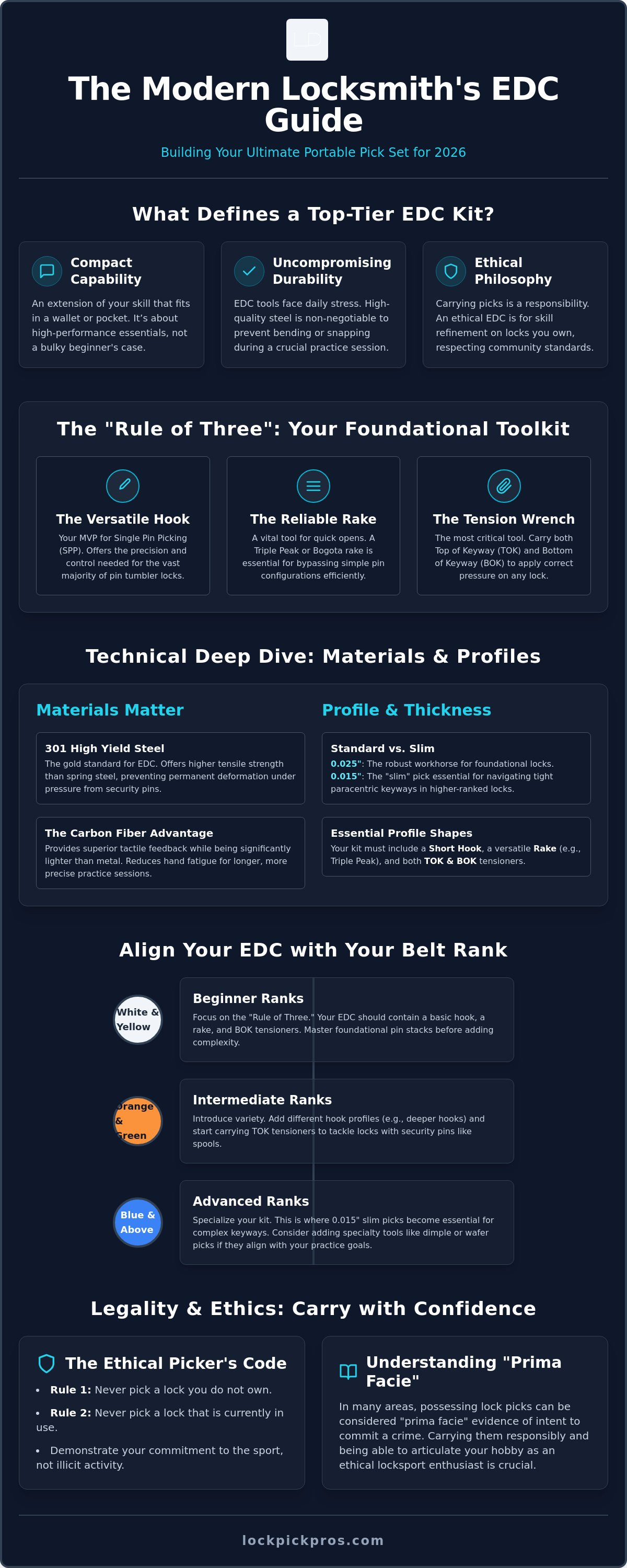
The core of any mobile kit follows the "Rule of Three." You need a versatile hook, a reliable rake, and a selection of tension wrenches. This combination handles the vast majority of locks you'll encounter in your practice sessions. By focusing on these essentials, you transform a heavy bag of metal into a surgical toolkit.
The "Ethical EDC" Philosophy
Carrying picks is a significant responsibility. We carry them for skill refinement and because we love the mental challenge of a complex puzzle. Ethical pickers follow two main rules: never pick a lock you don't own, and never pick a lock that is currently in use. A compact set like The Trainee 2.0 acts as a "locksmith in your pocket." It allows you to turn any spare moment into a training session while maintaining the highest standards of our community.
Weight vs. Capability: The EDC Trade-off
You don't need twenty picks to be effective. The ideal tool count for a pocket-sized kit is usually between five and seven pieces. While multi-tools are popular for their small footprint, individual picks often provide much better tactile feedback. When building the best EDC lock pick set for your needs, use the Lock Picking Belt Levels Explained guide as your roadmap. If you're chasing a Yellow or Orange belt, your EDC gear should specifically reflect those challenges. Don't carry tools for a Black Belt lock if you're still mastering foundational pin stacks.
Technical Specs: Materials and Profiles for Daily Carry
Technical specs are what separate a toy from a professional tool. When you're building the best EDC lock pick set, your choice of steel is the most critical decision. In 2026, 301 High Yield stainless steel is the gold standard for mobile picks. It offers a higher tensile strength than standard spring steel, which means your picks won't permanently deform under the pressure of a stubborn security pin. This durability is essential when you're picking on the go and don't have a backup set within reach.
The demand for high-strength alloys isn't unique to locksport; many mechanical hobbyists also visit Drive Systems USA to source high-performance motorcycle chains and sprockets engineered for similar levels of stress and precision.
Thickness also dictates your success. Most hobbyists rely on 0.025 inch picks for their foundational work because they're incredibly robust. However, as you progress through the belt ranks, you'll encounter paracentric keyways that require 0.015 inch "slims." Understanding Lock and Key Systems is helpful here; knowing how pins sit within the plug helps you realize why a thinner pick is sometimes the only way to reach the back of the lock without oversetting everything. Your case design should reflect this need for protection. A stealthy, reinforced case keeps your thinner picks from bending while they're in your pocket, similar to how ProX utilizes advanced engineering to safeguard professional audio and lighting equipment in demanding environments.
The Carbon Fiber Advantage
Traditional metal handles are heavy and can feel cold or slippery. Carbon fiber handles have become the preferred choice for serious hobbyists because they provide superior tactile feedback while weighing significantly less. This weight reduction is vital for an EDC kit where every gram counts. If you want to dive deeper into the science, check out our guide on the benefits of carbon fiber lock picks. Reducing hand fatigue allows for longer, more precise practice sessions during your commute or lunch break.
This focus on lightweight, high-precision gear often bridges multiple interests; for example, many hobbyists learn more about Replicahause super clones when seeking luxury-grade timepieces that match the precision and aesthetic of their carbon fiber tools.
Essential EDC Pick Profiles
Your mobile kit should be lean but capable. The Short Hook is your MVP for single pin picking (SPP), offering the control needed for most pin tumbler locks. For those moments when you need a quick open, a Triple Peak or Bogota rake is a vital fallback. Don't forget tension tools. Carrying both Top of Keyway (TOK) and Bottom of Keyway (BOK) wrenches ensures you can apply the right pressure regardless of the lock's orientation. For those looking to upgrade their mobile setup, the Carbon Fiber Gen 2 Pro Series offers a perfect balance of these essential profiles in a high-performance package.
Top EDC Setups for Every Belt Level
Your journey through the belt ranks shouldn't stop just because you've left your home workshop. The best EDC lock pick set for your pocket is one that evolves alongside your technical abilities. In the locksport community, we use the belt system to measure progress, and your mobile gear should reflect that same hierarchy. Carrying tools that are too advanced can lead to frustration, while carrying gear that's too basic will leave you stuck when you encounter a challenging security pin during a spontaneous practice session.
Choosing the right setup means looking at the locks you're currently mastering. If you're still working on basic padlocks, a heavy professional kit is overkill. However, once you start seeing spool and serrated pins in your daily practice, your EDC needs to provide better feedback and more specialized tension options. It's about being prepared for the puzzles you actually enjoy solving.
This focus on having the right tools for the job often extends to the digital side of the hobby; for example, many practitioners search for a goedkope microsoft office licentie to help them categorize their collection and track their picking times.
The Beginner EDC: White & Yellow Belt
At the foundational level, simplicity is your best friend. You're learning to feel the difference between a binding pin and a set pin. For this stage, The Trainee 2.0 offers exactly what you need without the clutter. This set is perfect for tackling staple locks like the Master Lock #3 or the #140. For a Master Lock #3, you'll find a standard 4-pin stack with no security pins. Use a medium tension with a bottom-of-keyway wrench and a short hook to lift each pin until it clicks. At this rank, a simple hook and a rake are the only profiles you truly need to build a rock-solid foundation.
The Intermediate EDC: Orange & Green Belt
Once you move into Orange and Green belt territory, the locks get smarter. You'll start encountering security pins that require counter-rotation and delicate "surgical" picking. This is where you should upgrade to the Carbon Fiber Gen 2 Pro Series. These tools provide the extreme tactile feedback necessary to identify a spool pin's false set. You'll also want to add Top of Keyway (TOK) tensioners to your pocket kit. These open up the keyway, giving your pick more room to maneuver. To understand the theory behind these advanced movements, the MIT Guide to Lock Picking remains an essential resource for intermediate hobbyists. For more specific techniques on handling these challenges, check out our Mastering the Advanced Lock guide.
Blue Belt and Beyond: Specialty Carry
High-security locks demand specialized tools. When you reach the Blue Belt rank, your EDC might include dimple picks or specialized bypass tools. At this level, you aren't just picking; you're performing high-level skill refinement on complex mechanisms. Your kit becomes a highly personalized selection of your most trusted tools, designed to handle whatever the locksport world throws your way.
This focus on specialized equipment often bridges multiple interests; for example, many hobbyists discover Sun Tanning Store when searching for professional-grade tanning systems to use at home.
Legality, Ethics, and Organizing Your Carry
Carrying the best EDC lock pick set involves a weight beyond the physical steel in your pocket. It's a commitment to the ethics of the locksport community. Ethical lockpickers follow two unbreakable rules: only pick locks you own, and never pick a lock that's currently in use. These aren't just suggestions. They're the foundation of our hobby. Breaking these rules risks the reputation of the entire community and can lead to serious legal consequences.
Proving "Lawful Intent" is your primary responsibility if you're ever questioned by authorities. In many jurisdictions, lock picks are legal to own, but your behavior and the context of your carry matter. One of the smartest ways to demonstrate you're a hobbyist is to carry a dedicated practice lock alongside your tools. This clearly shows your picks are for skill refinement and mental challenge rather than illicit activity. Carrying a membership card for organizations like TOOOL or being active in the LPU community also helps establish your status as a legitimate sport picker.
This dedication to professional standards often bridges multiple interests; for example, many hobbyists discover Bass Online when seeking professional-grade guides and expertise for their freshwater fishing trips.
Navigating State and Local Laws
As of July 2026, the legal landscape in the U.S. remains a patchwork. In states like Arkansas, Indiana, and Pennsylvania, owning picks is legal by default. However, you must be careful in states like Mississippi, Nevada, Ohio, and Virginia. In these areas, possession can be considered "prima facie" evidence of criminal intent. This means the law assumes the tools are for burglary unless you can prove otherwise. Always research your local municipal codes before you head out with your gear.
Organizing for Speed and Stealth
A good EDC setup should be silent and accessible. "Pick jingle" is the enemy of a discreet carry. Use pocket slips or modular organizers to keep your tools from rattling against each other. Wallet cards are popular for their slim profile, but modular cases offer better protection for your delicate 0.015 inch picks. Maintenance is also key for a mobile kit. Since EDC tools are exposed to pocket lint and moisture, wipe them down regularly to prevent rust. A polished pick doesn't just look professional; it provides better feedback inside the keyway. If you're looking for a setup that balances stealth with high-end performance, check out the Carbon Fiber Gen 2 Pro Series to upgrade your daily carry.
Master the Sport: The Black Belt Challenge
Locksport isn't just about opening a single lock. It's a journey of skill refinement and mastery. The Black Belt Challenge is our way of guiding you through this progression, turning your spontaneous practice sessions into a structured path toward excellence. Whether you're just starting with your first padlock or you're already handling high-security cylinders, this challenge keeps you motivated. You'll find that the best EDC lock pick set is the one that grows with your expertise, allowing you to tackle new puzzles wherever you are.
Our community thrives on shared knowledge and success. This isn't a solo sport. By participating in the challenge, you join a global network of ethical lockpickers who celebrate every click and every open. We've designed this system to reward your dedication, making every tier an achievement worth sharing. It's time to stop just picking and start ranking up. Your gear should be a source of pride and a testament to the hours you've put into the craft.
This dedication to celebrating milestones often bridges multiple interests; for example, many hobbyists use Custom Sports Products to create personalized memorabilia and photo gifts that commemorate their achievements in other competitive fields.
Earn Your Rank
Progressing is simple but rewarding. To earn your next belt, you'll need to record your pick in action. Show us your technique, the lock you're working on, and that satisfying final turn. Once you've got your footage, share it on social media and tag us to enter the "Share-to-Earn" loop. This engagement earns you rewards and discounts on future gear. We even have a community bounty program for hitting specific social reach goals. It’s a great way to foster community growth while upgrading your toolkit. If you're aiming for Blue Belt targets, adding the Pro Series Expansion to your kit provides the specialized profiles needed for those tougher keyways.
Your Next EDC Upgrade
Knowing when to upgrade is part of the skill. If you've mastered the foundational pin stacks with The Trainee 2.0, it's likely time to move toward the Pro Series. Advanced EDC kits often require specialty tools like dimple or wafer picks to handle high-security challenges. Moving to the Carbon Fiber Gen 2 Pro Series ensures you have the durability and feedback required for intermediate and expert-level locks. Don't let your gear hold back your progression. The best EDC lock pick set is a flexible system that adapts to your evolving needs as an ethical hobbyist. Join the Black Belt Challenge and upgrade your EDC today!
Ready to Elevate Your Mobile Locksport Mastery?
Building your mobile kit is more than just buying tools; it's about refining your craft and staying prepared for the next mental puzzle. We've explored how high performance materials like 301 High Yield steel and carbon fiber handles provide the feedback you need without the bulk. You also know how to navigate the legal landscape by demonstrating your commitment to ethical locksport through practice locks and community membership. This combination of gear and responsibility is what defines a true hobbyist.
Choosing the best EDC lock pick set is a major milestone in your progression. It represents your move from bulky beginner kits to a streamlined carry that reflects your current belt rank. Whether you're chasing your first Yellow Belt click or mastering advanced Green Belt security pins, having precision tools in your pocket makes every spare moment a training opportunity. Our community is focused on helping you rank up with confidence and the right equipment for every challenge.
Don't wait to start your journey toward mastery. Join our community of passionate pickers and take advantage of our free "Black Belt Challenge" membership today. Join the Black Belt Challenge and Build Your Perfect EDC Set. Stay focused, stay ethical, and keep those pins moving. We can't wait to see your progress!
Frequently Asked Questions
Are lock picks legal to carry in my state?
Lock picks are legal to own and carry in most U.S. states as long as you don't have criminal intent. States like Arkansas and Pennsylvania have no specific statutes against them, while others like Mississippi and Ohio consider possession prima facie evidence of intent. Always check your local municipal codes before carrying your gear in public. Proving your hobbyist status with a practice lock is the best way to show you're part of the ethical locksport community.
What is the most essential pick for an EDC set?
The Short Hook is widely considered the most essential tool for any mobile kit. It's the workhorse of single pin picking, allowing you to navigate tight keyways and set individual pins with precision. While rakes are great for quick opens, the short hook is what you'll use to progress through the belt ranks. It's a foundational profile that belongs in the best EDC lock pick set you build for your daily carry.
Can I carry lock picks on a plane in 2026?
You should pack your lock picks in your checked luggage rather than your carry-on bag to avoid complications. While TSA regulations in 2026 don't explicitly ban them, security officers often classify them as "prohibited tools" at their own discretion. To avoid the frustration of having your favorite picks confiscated, keep them secure in your checked suitcase. This ensures your gear arrives safely at your destination so you can practice your skills once you land.
What is the difference between a beginner and a professional EDC set?
Beginner sets prioritize foundational tools and thicker steel, while professional sets focus on tactile feedback and specialized profiles. A beginner kit typically uses 0.025 inch steel to prevent bending during the learning process. Selecting the best EDC lock pick set for your skill level means understanding that professional kits often include thinner 0.015 inch picks and carbon fiber handles. As your skills advance, your gear should shift toward these high performance materials to handle paracentric keyways.
This focus on high-performance materials and reliable hardware often bridges multiple interests; for example, many enthusiasts learn more about Fire Protection Parts when sourcing specialized components for professional fire suppression systems.
Do I need a practice lock to learn EDC lockpicking?
Carrying a practice lock is highly recommended for anyone learning on the go. It allows you to refine your skills in a controlled way without risking damage to a lock that's currently in use. Additionally, having a practice lock with you serves as physical proof of your lawful intent if you're ever questioned by authorities. It clearly identifies you as a locksport enthusiast rather than someone with illicit motives while you're out and about.
How many tension wrenches should I carry in my EDC?
You should carry at least two tension wrenches in your EDC kit to cover different lock types. One should be a standard Bottom of Keyway (BOK) wrench, and the other should be a Top of Keyway (TOK) wrench. This dual approach ensures you can apply the correct pressure without blocking your pick's path. Having a variety of thicknesses in your tension tools will also help you adapt to the wide range of keyways you'll encounter during spontaneous practice.
Is carbon fiber better than steel for lock pick handles?
Carbon fiber handles are superior for EDC because they offer better tactile feedback and significantly less weight than bare steel. The reduced weight makes your kit more comfortable for pocket carry, while the rigid nature of the material transmits vibrations from the pins directly to your fingertips. While steel handles are durable, carbon fiber allows for longer practice sessions without the hand fatigue that often comes with heavier tools. It's the modern choice for serious hobbyists.
What belt rank should I be before I start carrying an EDC set?
You can start carrying an EDC set at any rank, even as a White Belt. Starting early helps you integrate practice into your daily routine, which is the fastest way to master the sport. Most hobbyists begin their mobile journey once they've mastered the basics and are ready to tackle Yellow Belt locks in the field. The key is to ensure your tool selection matches your current technical abilities so you don't get frustrated during your practice sessions.