

Mastering the Feel: How Much Tension to Use in Lock Picking (2026 Guide)
What if the secret to opening a tough practice lock isn't how hard you pick, but how lightly you touch the tension wrench? Many new hobbyists start by putting far too much muscle into the plug. Learning exactly how much tension to use in lock picking is the single most important skill for any ethical lockpicker. Too much force leads to a nasty case of pick-warp or pins that refuse to stay set. It's frustrating when you can't feel the feedback you need to progress, especially when you're aiming for a new belt rank.
Every picker has been there, staring at a lock that won't budge while fingers go numb from over-gripping. Mastery isn't about a static weight. It's a dynamic conversation between the tool and the pins. This 2026 guide provides the exact pressure required to set pins without damaging high-yield stainless steel tools. You'll learn how to identify the "click," manage spool pins, and refine tactile senses. This article provides a clear path toward successful single pin picking and the next community belt rank.
Key Takeaways
- Understand how the tension wrench creates the necessary ledge at the shear line to keep pins set during single pin picking.
- Practice the weight of a penny rule to master light tension and prevent pins from dropping back into the plug.
- Learn exactly how much tension to use in lock picking to avoid pick-warp and protect your high-yield stainless steel tools.
- Discover how to handle security pins like spool and serrated pins through active tension manipulation and counter-rotation.
- Upgrade to carbon fiber handles to feel subtle pin vibrations and accelerate your progress through the community belt ranking system.
Understanding the Role of Tension in Locksport
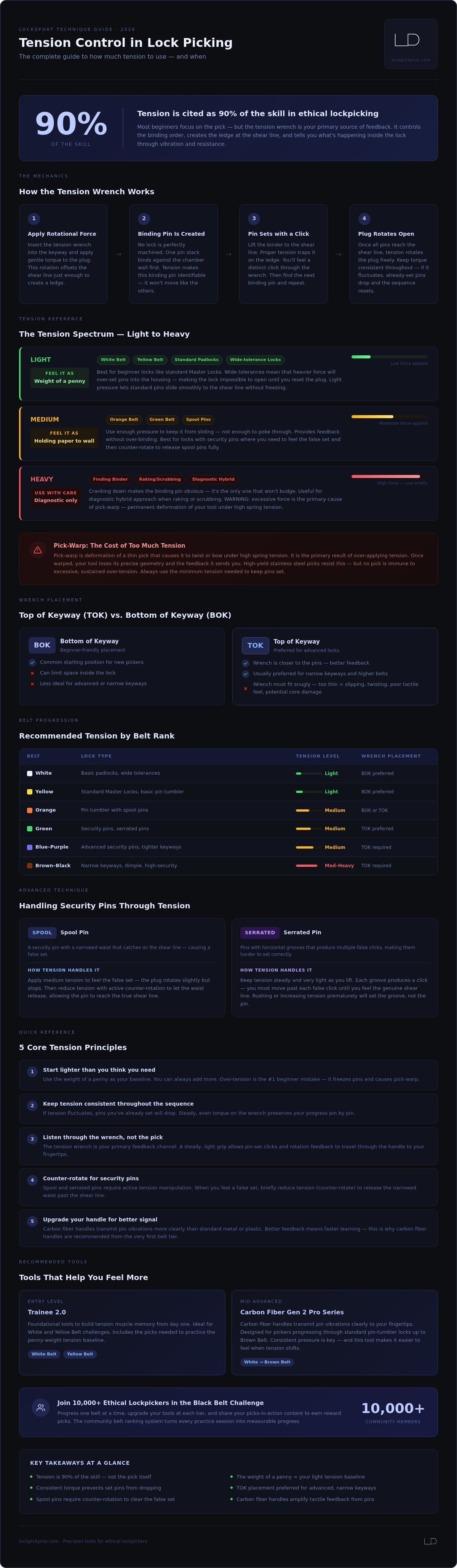
Many beginners think picking is all about the pick. It isn't. Tension is widely cited as 90% of the skill in ethical lockpicking. Knowing how much tension to use in lock picking determines whether you'll hear that satisfying click or just bend your tools. A tension wrench is the tool that controls the binding order of the pins. You use it to apply rotational force to the plug, which creates a tiny ledge at the shear line. Without this force, the pins you lift would simply fall back into the plug the moment you move your pick.
The Physics of the Shear Line
To understand lock picking mechanics and tension principles, you have to look at the tiny imperfections inside the lock. No lock is perfectly machined. When you apply rotational force, one pin stack binds against the side of its chamber before the others. This is the binding pin. Proper tension traps this pin at the shear line once it is lifted. However, if you apply too much force, you create so much friction that the pin won't move at all. You need to find the sweet spot where the pin can slide but still stay put once it hits the ledge.
Tension as a Communication Channel
Your tension wrench is your primary source of information. While your pick moves the pins, your wrench tells you what's happening inside. You'll feel a distinct click through the wrench when a pin reaches the shear line and sets. This feedback is subtle. It requires a steady hand and a light touch. If your grip is too tight, you'll mute these vibrations. Learning how much tension to use in lock picking involves trial and error, but high-quality tools make the process faster.
Using precision gear like the Carbon Fiber Gen 2 Pro Series can help because the handles are designed to transmit these vibrations clearly to your fingertips. Consistent pressure is key. If your tension fluctuates, the pins you've already set might drop, forcing you to start the sequence over. Focus on maintaining a gentle, even torque to keep that ledge secure while you hunt for the next binding pin. This steady approach is what separates a trainee from an expert-level picker.
The Weight of a Penny: Measuring Tension Levels
"Light" and "medium" are the most common instructions you'll hear in the locksport community. But what do they actually feel like? If you're wondering how much tension to use in lock picking, start with the weight of a penny. Place your wrench in the lock and let a single penny rest on the end of it. That tiny amount of force is often enough to set pins in many beginner locks. For medium tension, imagine you're holding a single piece of paper against a wall with your finger. You aren't trying to poke through the paper; you're just using enough pressure to keep it from sliding down.
Practice these baseline weights with the Trainee 2.0 kit. It includes the foundational tools you need to build this muscle memory from day one.
When to Use Light Tension
Light tension is your best friend for White Belt and Yellow Belt challenges. Basic padlocks, like standard Master Locks, have wide tolerances. If you push too hard, you'll likely over-set the pins into the housing. This makes the lock impossible to open until you reset the plug. Light pressure allows you to feel the subtle movement of standard pins as they reach the shear line. It keeps the pins from binding so tightly that they become frozen in place, allowing for much smoother feedback.
The Case for Heavy Tension
Determining how much tension to use in lock picking depends heavily on the state of the lock. Heavy tension isn't for every lock, but it has its place. You might use it to identify the very first binding pin in a stack. By cranking down on the wrench, the binder becomes obvious because it's the only one that won't budge. You can also use higher force during a diagnostic hybrid approach when raking or scrubbing. Just be careful. Excessive force is the primary cause of pick-warp, where your tool twists or bows permanently under the strain.
Top of Keyway (TOK) vs. Bottom of Keyway (BOK)
Where you place your wrench changes the effective torque and your visibility. Bottom of keyway (BOK) is common for beginners, but it can limit your space inside the lock. Top of keyway (TOK) tensioning is usually preferred for advanced locks and narrower keyways. It provides much better feedback because the wrench is closer to the pins. When using TOK, choose a wrench thickness that fits snugly in the gap. If it's too thin, it will slip or twist, ruining your tactile connection to the pins and potentially damaging the core.
For those moving toward higher belt ranks and looking to refine their feel, the Carbon Fiber Gen 2 Pro Series offers the precision needed to master these different tensioning styles with ease.
Practical Drills to Master Tension Feedback
Developing a sense for how much tension to use in lock picking requires patience. Mastering tension isn't a one-time lesson. It's about developing muscle memory through repetitive, focused practice. You need to move beyond theory and get your hands on the tools. A metal cutaway lock is an excellent resource here. It allows you to visually confirm exactly what your fingers are feeling as you apply torque. These drills help you transition from a Trainee level to a Pro level picker.
The Drop the Wrench test verifies if you are over-tensioning by checking if the tool falls freely from the plug when you release your finger pressure. If the wrench stays stuck in the keyway, you're likely creating too much friction. This friction mutes the feedback you need. It also puts unnecessary stress on your picks, which can lead to damage over time. A light touch is always better than a heavy hand.
The Progressive Loading Drill
Start with zero tension. Slowly increase the rotational force until you feel the first pin bind. This is the point where the pin is trapped between the plug and the housing. While holding this pressure, use your pick to pulse the tension. You should feel the springiness of the non-binding pins. If every pin feels rock-solid, you've applied too much force. Repeat this process on several different practice locks. Each one has varying tolerances. Learning these differences is key to understanding how much tension to use in lock picking.
The Click-and-Release Exercise
This exercise teaches you the exact threshold of tension for a specific lock. Apply enough pressure to set a pin. You'll feel that distinct click. Now, instead of moving to the next pin, slowly let off the pressure until you hear the pin drop back down. This helps you understand the minimum force needed to keep pins set. It's a vital skill for progressing through the belt ranking system.
If you can keep the pin set with very little pressure, you'll have more room to feel the feedback from the next binding pin. It prevents you from fighting the lock and your own tools. Using a high-quality set like the Carbon Fiber Gen 2 Pro Series makes these subtle changes much easier to detect. The carbon fiber handles act as a bridge between the pin and your fingertips. You'll start to recognize the difference between a pin that is truly set and one that is just stuck.
Troubleshooting Tension: Security Pins and Pick-Warp
Progressing through the belt ranks means facing smarter locks. Once you move past basic White Belt hardware, you'll encounter security pins. These are specifically designed to give you false feedback. Pins like spool pins or serrated pins require active tension manipulation rather than a static grip. You have to "listen" to the lock through the vibrations in your wrench. If you're unsure which security features are in your practice lock, refer to the Lock Picking Belt Levels Explained guide for a breakdown of pin difficulty by tier.
Mastering these advanced locks requires a deep understanding of how much tension to use in lock picking. It isn't just about weight; it's about timing. When a security pin engages, it changes the rules of the game. You'll need to adjust your pressure on the fly to accommodate the mechanical traps hidden inside the plug.
Managing Counter-Rotation
Spool pins are famous for creating a "false set." This happens when the narrow waist of the pin catches on the shear line. The plug turns slightly, making you think you've almost won. However, the lock won't open. When you find the spool pin and try to lift it, you'll feel counter-rotation. The tension wrench will push back against your finger. You must ease off your tension just enough to allow the pin's wider head to move past the shear line. This is a "two steps forward, one step back" rhythm. Be careful; if you let off too much pressure, all your previously set pins will drop back into the plug.
Identifying and Preventing Pick-Warp
Excessive tension is the primary cause of pick-warp, which is the permanent deformation of your tool. If your pick feels "stuck" or "spongy" while you're trying to lift a pin, you're likely pushing too hard against the wrench. Forcing a pin is usually a sign of incorrect tension, not a strong pin. While we use high-yield stainless steel in our picks to resist bending, even the strongest alloy can't survive brute force. Learning how much tension to use in lock picking helps you preserve your gear and get more life out of your set.
If you're ready to stop guessing and start feeling the true state of the pins, it's time to upgrade your feedback. A high-quality toolset is the best way to avoid pick-warp and conquer security pins. Get the Carbon Fiber Gen 2 Pro Series to start picking with professional-level precision.
Upgrading Your Feedback with Carbon Fiber Tools
The material of your pick handle isn't just about comfort or aesthetics. It acts as a transmitter for every tiny vibration occurring inside the lock. When a pin reaches the shear line, it sends a pulse through the pick. Traditional plastic or rubber handles often damp these signals, forcing you to use more force just to feel what's happening. Learning how much tension to use in lock picking is often a guessing game when your tools are too thick or made of dampening materials. A carbon fiber handle provides significantly higher feedback than these traditional materials, allowing you to sense the difference between a set pin and a binding pin with much higher clarity.
The Science of High-Feedback Materials
Carbon fiber is uniquely suited for locksport because of its high stiffness-to-weight ratio. Unlike plastic, which absorbs energy, carbon fiber transmits vibrations directly to your hand. This increased sensitivity changes how you approach a lock. Because you can feel more, you naturally reduce the amount of force you apply to the wrench. Understanding how much tension to use in lock picking becomes much easier when your tools aren't lying to you. This level of Skill Refinement is what allows pickers to move from struggling with basic padlocks to opening high-security cylinders with ease. Better equipment reduces the risk of pick-warp because you no longer need to rely on heavy, tool-damaging tension to get a reaction from the pins.
Your Path to the Black Belt
Precision tools are essential for those pursuing the Black Belt Challenge. As you move from White to Green belt and beyond, the tolerances in the locks become tighter. The Carbon Fiber Gen 2 Pro Series is engineered for maximum tactile sensitivity to support this journey. You aren't just buying a tool; you're joining a community of over 10,000 ethical lockpickers who share your passion for precision. These hobbyists are already climbing the ranks and refining their craft every day. High-quality gear ensures that your progress isn't limited by your equipment. It gives you the confidence to tackle narrow keyways and complex security pins without fear of tool failure.
Ready to feel the difference? Upgrade to the Carbon Fiber Gen 2 Pro Series today and take the next step toward your next belt rank.
Level Up Your Locksport Skills Today
Mastery over the plug isn't about strength; it's about sensitivity. By practicing the weight of a penny rule and mastering counter-rotation for security pins, you're building the muscle memory needed for higher belt ranks. Learning exactly how much tension to use in lock picking is the bridge between a stuck plug and a successful open. Every click you feel is a conversation with the lock, and the right tools make that dialogue crystal clear.
Precision gear is the secret weapon for over 10,000 ethical lockpickers in our community. Our tools feature precision engineered carbon fiber handles that turn subtle pin movements into unmistakable feedback. We stand by our quality with a lifetime warranty on all Pro Series tools, ensuring your kit survives every challenge on your journey to Black Belt. Don't let a lack of tactile feedback hold back your progression any longer.
Master your tension with the Carbon Fiber Gen 2 Pro Series and start feeling the difference in every lock you pick. We're excited to see you post your next belt achievement!
Frequently Asked Questions
How do I know if I am using too much tension?
You're using too much tension if the pins won't move at all or if your pick feels like it's going to bend. Use the "Drop the Wrench" test; if you release your finger and the wrench stays stuck in the lock, you're pressing too hard. This creates friction that stops pins from sliding. Learning how much tension to use in lock picking is about finding that sweet spot where pins bind but still move.
Can I use a homemade tension wrench for practice?
You can certainly use a homemade wrench, but it might limit your progress. Many hobbyists start with bent windshield wiper inserts. However, these often lack the precision thickness needed for advanced locks. Professional tension wrenches are designed with specific widths to fit snugly in the keyway. This snug fit provides much better tactile feedback and prevents the tool from slipping while you're trying to set a difficult pin. It's a foundational step in your skill progression.
What is the difference between TOK and BOK tension?
TOK stands for Top of Keyway, while BOK means Bottom of Keyway. BOK tensioning is common for beginners because it's easy to place the wrench. However, it often takes up valuable space in the keyway. TOK tensioning is preferred for advanced locks because it leaves the bottom of the keyway open for your pick. It also provides a more direct rotational force, giving you clearer feedback from the pins as they reach the shear line.
Why do my pins keep falling down when I pick them?
Pins usually fall back down because your tension is too light or inconsistent. If you don't maintain steady pressure, the tiny ledge at the shear line disappears, and gravity takes over. This is a common hurdle when learning how much tension to use in lock picking. Try to keep your torque steady as you move between pins. If you're using security pins, you might be experiencing counter-rotation that accidentally drops your previously set pins.
Do serrated pins require more or less tension?
Serrated pins generally require a light to medium touch with occasional heavy pulses. These pins have tiny grooves that create false clicks, making you think the pin is set when it isn't. You need enough tension to feel the difference between a shallow serration click and a true shear line set. Many pickers use a slightly heavier hand to find the binder and then lighten up to move past the serrations without over-setting.
How does a carbon fiber handle help with tension control?
A carbon fiber handle acts as a superior transmitter for vibrations. Unlike plastic or rubber, which can absorb energy, carbon fiber sends the feedback from the pins directly to your fingertips. This increased sensitivity allows you to feel exactly when a pin binds or sets. When you can feel more, you don't need to use as much physical force on the tension wrench. This prevents pick-warp and improves your overall accuracy during complex picks.
Will too much tension break my lock pick?
Yes, excessive tension is the leading cause of tool failure. When you apply too much torque, you create massive friction on the binding pin. If you try to force that pin upward, the pick will bend or snap. This is known as pick-warp. We use high-yield stainless steel in our Pro Series to resist this, but even the best tools have limits. Always trust the tactile feedback rather than using brute force to open the lock.
How do I join the Black Belt Challenge?
You can join the Black Belt Challenge by visiting our website and signing up for free. This program connects you with a community of over 10,000 ethical lockpickers. You'll progress through various belt ranks by sharing your progress on social media. As you climb the ranks, you can even earn reward picks for your dedication. It's a great way to stay motivated while you master the technical skills required for advanced locksport and skill refinement.