

Are Wafer Locks Secure? What Their Design Can, and Cannot, Protect Against
What if a lock works smoothly every day but offers less protection than you expect? That’s why asking “are wafer locks secure” needs more than a yes-or-no answer. Wafer locks use flat metal plates, called wafers, that align to let the plug turn. That explains how they work, but not how well a particular lock will hold up.
It’s easy to compare lock types and mistake basic function for overall security. The mechanism matters, but so do the lock’s condition, installation, and intended use. This article explains how wafer locks work, which factors affect their security, and how to assess one in context. You’ll also learn why a lock is only one part of an installation’s protection, so you can make a practical choice without relying on the lock type alone.
Key Takeaways
- “Are wafer locks secure” depends on the specific lock and what it needs to protect, not just the mechanism type.
- Assess construction, manufacturing quality, key control, lock condition, and installation.
- Compare wafer and pin-tumbler locks by application, documentation, installation, and maintenance rather than assuming one type is always safer.
- Before choosing a lock, identify the application, confirm the model, inspect the installation, and review the manufacturer’s documentation.
- For high-consequence security decisions, seek guidance from the manufacturer or a qualified security professional.
Are Wafer Locks Secure? Understanding Lock Design
A wafer lock uses flat metal plates, called wafers, instead of pin stacks to control whether its plug can turn. That describes the mechanism, not a security rating. So, are wafer locks secure? The answer depends on the particular lock, its intended use, and the protection needed in that setting.
How a wafer lock works at a high level
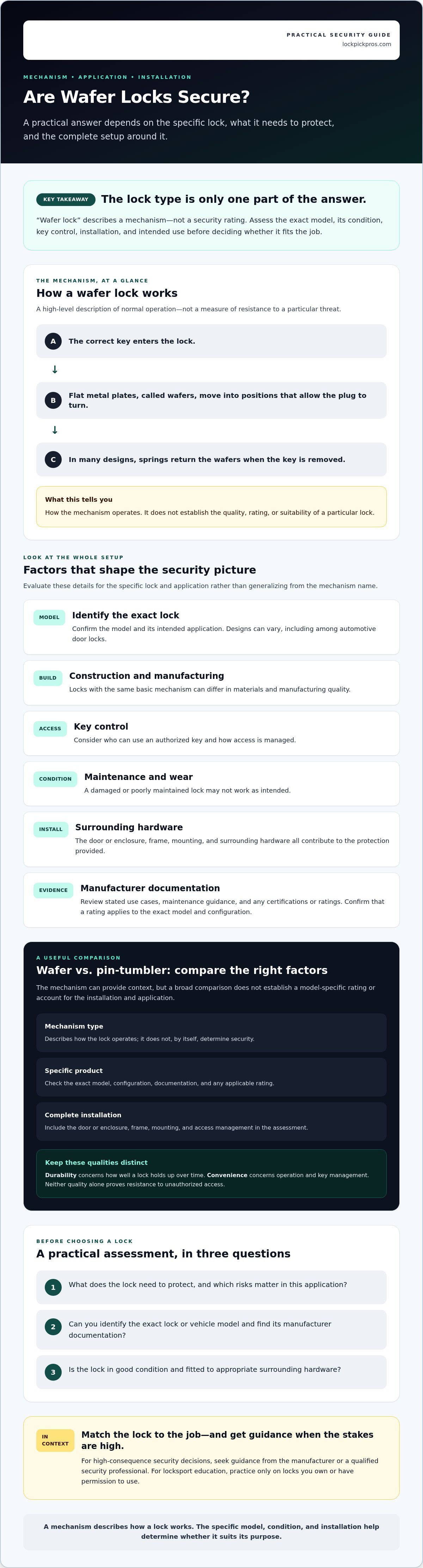
As the correct key enters the lock, it moves the wafers into positions that allow the plug to turn. The plug is the rotating part operated by the key. In many designs, springs return the wafers when the key is removed. For a foundational overview of this mechanism, see Wafer tumbler lock.
This describes normal operation, not how well a lock resists a particular threat. Locks with the same basic mechanism can differ in materials, manufacturing, and intended use. The category alone doesn’t establish a lock’s quality or rating.
Where readers may encounter wafer locks
Some automotive door locks use wafer mechanisms, though designs vary between vehicles. Don’t assume that every vehicle uses the same mechanism or that a wafer lock alone tells you how secure the vehicle is. Check the documentation for the specific vehicle and lock rather than drawing conclusions from the category name.
It also helps to consider the complete setup. A lock controls one point of access, while the door, enclosure, frame, and surrounding hardware contribute to the protection provided. A suitable lock can still be part of a weak installation, and its suitability depends on the job it was designed to do.
For a practical assessment, start with three questions:
- What does the lock need to protect, and which risks matter in this application?
- Can you identify the exact lock or vehicle model and find its manufacturer documentation?
- Is the lock fitted to appropriate surrounding hardware and in good condition?
These checks are more useful than treating “wafer lock” as a complete security verdict. The following sections cover factors beyond the mechanism and ways to compare lock types using information about the specific product and installation.
What affects wafer-lock security beyond the mechanism itself?
A lock’s security is part of a larger protective setup, not a property of its mechanism alone. Materials and manufacturing quality can affect how consistently it operates, while key control influences who can use an authorized key. Condition matters too: a damaged or poorly maintained lock may not work as intended. Investigate these factors for the specific model rather than assuming every wafer lock has the same strengths or weaknesses.
The lock is only one part of the security picture
Consider what surrounds the lock: the door or enclosure, its frame, how the lock is mounted, and how access is managed. A lock may suit its intended purpose, yet the complete setup can offer less protection if another part is weak or poorly matched. A stronger lock cannot compensate for every weakness around it.
Separate security from other useful qualities. Durability concerns how well a lock holds up over time; convenience concerns how easy it is for authorized users to operate and manage keys. Neither quality, by itself, proves resistance to unauthorized access. The right balance depends on what the lock is meant to secure and how it will be used.
Why the exact lock and application matter
Start by identifying the lock model and its intended application. Then check the manufacturer’s documentation for stated use cases, maintenance guidance, and any certifications or ratings. Confirm that a rating applies to the exact model and configuration you’re considering. Without that detail, broad comparisons between wafer locks can be misleading.
Educational explanations sometimes compare wafer-tumbler and pin-tumbler designs in terms of how easier to pick one may be than the other. That comparison can provide context about the mechanisms, but it doesn’t establish a model-specific rating or account for the door, mounting, or application. Verify any claim about a particular lock’s resistance against reliable documentation for that product.
So, are wafer locks secure enough for a particular job? Assess the exact lock, its condition, key control, and complete installation against the protection needed. For locksport education, keep practice controlled and limited to locks you own or have permission to use. If you’re comparing standard pin-tumbler locks for ethical practice, the Carbon Fiber Gen 2 Pro Series is one option to review; it is not presented as a wafer-lock tool.
Are wafer locks less secure than pin-tumbler locks? Compare the right factors
It’s tempting to rank locks by type, but that shortcut can mislead. The mechanism alone can’t tell you whether a particular door, enclosure, or vehicle installation offers enough protection. To answer “are wafer locks secure” usefully, compare specific locks designed for similar uses, then consider their documentation, condition, and installation.
What a fair lock comparison should include
Look for manufacturer information about the exact model, including its intended application and any stated certifications or ratings. A certification can show that a product was assessed against a defined standard when the documentation identifies that standard and model. Marketing language may describe intended benefits, but it isn’t the same as independent certification. If comparable documentation isn’t available for both locks, don’t guess which performs better.
The table offers questions to guide a comparison. It doesn’t assign a universal security rank to either mechanism.
| Factor | Wafer lock | Pin-tumbler lock | What to verify |
|---|---|---|---|
| Mechanism | Uses flat wafers that align with the correct key. | Uses pairs of pins that align with the correct key. | Confirm the mechanism in the exact product documentation. |
| Intended application | May be used in applications such as some automotive door locks. | Used in a range of lock applications. | Check that the model is intended for the use you have in mind. |
| Documentation | Ratings and specifications vary by product. | Ratings and specifications also vary by product. | Compare documented standards for the exact models, not category labels. |
| Installation | Protection depends partly on the door, enclosure, and mounting. | The same surrounding factors apply. | Assess the complete installation, not only the lock. |
| Condition and maintenance | Wear or damage may affect operation. | Wear or damage may affect operation. | Review manufacturer guidance and inspect the lock’s condition. |
Locksport practice and real-world security
Locksport practice can build mechanical understanding and tactile skill. It isn’t a security certification, and opening a practice lock doesn’t prove that another model is secure or insecure. Practice only on locks you own or have permission to use, and don’t practice on a lock that’s in use.
For ethical practice with standard pin-tumbler locks, you can review the Carbon Fiber Gen 2 Pro Series. It’s a locksport option for that mechanism, not a wafer-lock tool or a measure of either lock type’s real-world security.
How to assess whether a wafer lock suits your needs
A lock’s category can start your research, but it can’t settle the decision. To assess whether a wafer lock fits a particular job, review the product information and the complete access point without taking the lock apart or trying to test it. Use this checklist:
- Identify the application. Decide what the lock protects and what matters most: controlled access, everyday convenience, or limiting the consequences of unauthorized entry. Consider what could happen if access is delayed or someone gains access without permission.
- Confirm the exact lock model. Find the model name or number in the product or vehicle documentation. Don’t assume that two locks described as wafer locks share the same construction, rating, or intended use.
- Review the installation visually. Consider the door or enclosure, frame, mounting, and surrounding hardware as well as the lock. Check available maintenance records or manufacturer guidance for signs that the lock may need attention. A lock’s category alone isn’t a reason to replace it.
- Check the manufacturer’s documentation. Look for stated applications, limitations, maintenance advice, and any certifications or ratings. Confirm that those details apply to the exact model and configuration.
Questions to ask before choosing or keeping a wafer lock
Does the manufacturer describe this model for the application? Is it fitted appropriately to the surrounding hardware and maintained according to its documentation? What would be the impact of delayed access or unauthorized access? Clear answers help you evaluate the complete access point instead of judging it by lock type alone.
When to seek product-specific guidance
If a rating or intended use is unclear, ask the manufacturer for documentation specific to the model. For property or safety decisions with serious consequences, consult a qualified security professional who can assess the application and installation. Online locksport demonstrations can explain mechanical principles, but they don’t certify a lock or establish how secure a real installation is.
The question “are wafer locks secure enough for this use?” calls for evidence about the exact product and the protection needed. If you’re also building mechanical skills, keep locksport practice separate from security evaluation and use only locks you own or have permission to practice on. For standard pin-tumbler locksport practice, review the Carbon Fiber Gen 2 Pro Series set; it isn’t presented as a tool for wafer locks.
Next Steps: Choosing Security and Ethical Practices
The practical answer to “are wafer locks secure” depends on the specific lock, its intended use, condition, and installation. A lock type by itself can’t confirm that an access point offers the protection you need. For a real security decision, rely on model-specific manufacturer information or advice from a qualified security professional, especially when unauthorized access could have serious consequences.
Choose practice equipment for the lock type you are studying
A wafer lock uses flat metal plates, or wafers, instead of pins, and requires equipment suited to that mechanism for locksport practice. Don’t assume that a pick set for standard pin-tumbler locks is suitable for a wafer lock. Match the equipment to the mechanism you’re learning, and practice only on locks you own or have explicit permission to use.
Beginner lock-pick-set guidance can help new hobbyists choose equipment for foundational practice. The first step is to match the practice lock and tools to the same lock type. Check the product description for its intended use, and ask the manufacturer if that information is unclear.
A responsible next step for ethical locksport
Keep learning about lock mechanics separate from attempts to access anything without permission. Locksport is a skill-building hobby: use a dedicated practice lock that is yours or one you’re authorized to use, and don’t treat a successful practice session as proof of a lock’s real-world security. Build skills gradually and responsibly.
For standard pin-tumbler locksport practice, review the Carbon Fiber Gen 2 Pro Series. It’s an option for appropriate pin-tumbler practice, not a tool designed for wafer locks.
Use this quick checklist:
- Identify what the lock protects and the consequences of unauthorized access or delayed entry.
- Confirm the exact model and its intended application in manufacturer documentation.
- Consider the full access point, including the door or enclosure, mounting, surrounding hardware, and lock condition.
- Ask the manufacturer about unclear specifications, ratings, or limitations.
- Seek qualified advice when the property or safety consequences are significant.
This approach keeps the decision grounded in the specific lock and its use, while ethical, permission-based practice supports steady progress in locksport.
Make Your Next Lock Decision With Confidence
Are wafer locks secure? It depends on the specific lock, its intended use, condition, and installation. Check manufacturer information or seek qualified advice for real security decisions. For locksport, practice only on locks you own or have permission to use.
Ready to build your locksport skills? Explore Lockpick Pros’ beginner lockpick sets and practice locks to find equipment suited to ethical, permission-based practice.
For standard pin-tumbler locksport practice, explore the Carbon Fiber Gen 2 Pro Series. It’s not a wafer-lock tool. Choose equipment for the mechanism you’re studying and practice responsibly.
Frequently Asked Questions
Are wafer locks secure enough for a car door?
A wafer lock may be suitable for a particular car door, but the lock type alone can’t confirm the vehicle’s security. Vehicle designs and lock models differ, so check the documentation for the specific vehicle and lock. Consider the lock’s condition and how it fits into the vehicle’s overall access protection. For concerns about a specific vehicle, ask its manufacturer or a qualified security professional.
Are wafer locks less secure than pin-tumbler locks?
Not as a universal rule. A fair comparison requires specific models with similar intended uses and reliable, comparable documentation. Mechanism type is only one factor; ratings, materials, installation, condition, and surrounding hardware also matter. If you’re asking “are wafer locks secure” compared with pin-tumbler locks, look for product-specific evidence rather than assuming one category always provides greater protection.
What is the difference between a wafer lock and a pin-tumbler lock?
A wafer lock uses flat metal plates, called wafers, that move into position as the correct key is inserted. A pin-tumbler lock uses pairs of pins that align with the key’s cuts. Both mechanisms are operated by a key, but their internal components differ. This distinction helps identify what kind of lock you’re assessing; it doesn’t, by itself, establish a product’s security rating.
Can a wafer lock be used for a front door?
Whether a wafer lock is appropriate for a front door depends on the exact product, its documented intended use, and the complete door installation. Don’t choose one based only on its mechanism category. Check the manufacturer’s specifications and any applicable ratings, and consider the door, frame, mounting, and surrounding hardware. For a front door protecting property or people, seek qualified, product-specific security advice.
Do all wafer locks have the same level of security?
No. Wafer locks can differ by model, construction, intended application, condition, and documented performance. The category name doesn’t tell you whether a particular lock has been tested or rated for a specific use. Check the exact model’s manufacturer documentation, including any stated limitations or certifications, and confirm that the information applies to the configuration you’re considering.
What should I check before choosing a wafer lock?
First, identify what the lock needs to protect and the consequences of unauthorized access or delayed entry. Confirm the model and intended application, review manufacturer documentation, and assess the lock’s condition and installation. Consider the door or enclosure, mounting, and surrounding hardware too. If the use case, rating, or limitations are unclear, ask the manufacturer for details or consult a qualified security professional.
Are wafer locks used in automotive locks?
Yes, wafer locks are used in some automotive door locks, but designs vary across vehicles. Don’t assume that every vehicle uses this mechanism or that the lock type alone describes the vehicle’s security. To identify a particular lock, refer to the vehicle’s documentation or ask its manufacturer. Any security judgment should account for the specific lock and the wider vehicle setup.