

Do You Need a License to Buy Lock Picks? U.S. Rules Explained
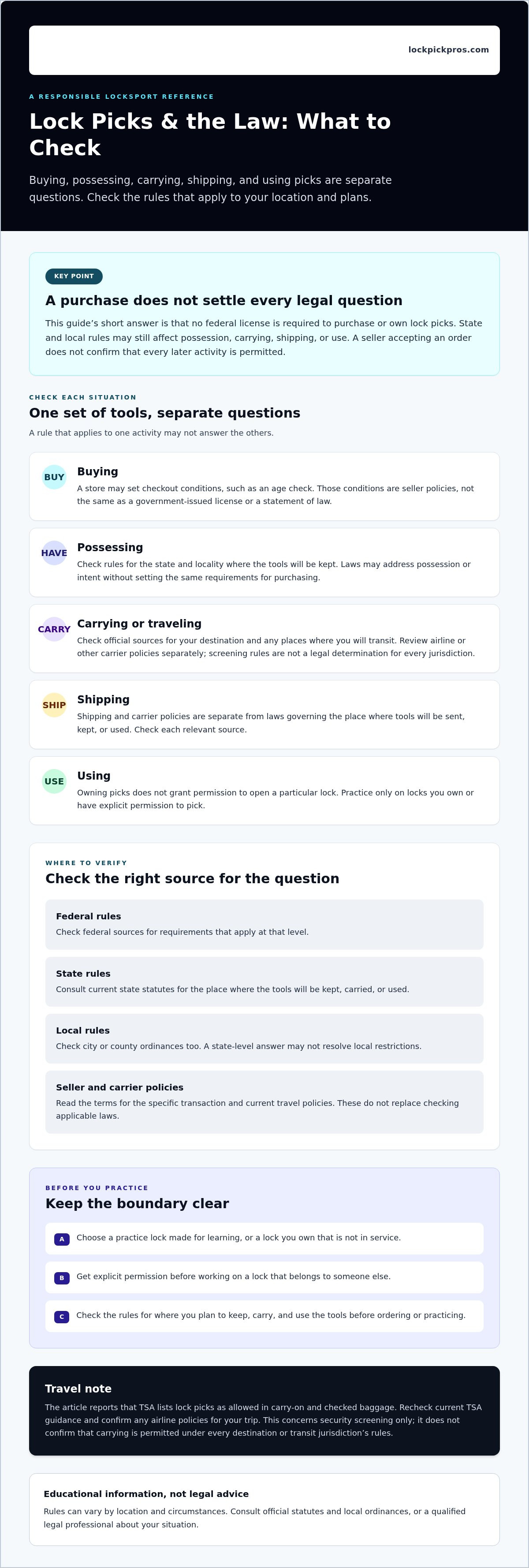
If you’re asking, “do you need a license to buy lock picks,” the short answer is that no federal license is required to purchase or own them. But state and local rules may affect possession, carrying, or use, so that answer alone may not tell you what’s allowed where you live.
Buying tools, having them in your possession, transporting them, and using them are distinct situations. Rules can vary by location, and intent and circumstances may matter. Before you order a set or try locksport, check the rules that apply to your plans.
This guide explains what to verify before buying, carrying, or practicing. It covers how to check current state statutes and local ordinances, and how to practice responsibly on locks you own or have explicit permission to pick. This is educational information, not legal advice. Consult official sources or a qualified legal professional about your situation.
Key Takeaways
- For “do you need a license to buy lock picks,” check current rules for your state and city rather than assuming purchase rules cover every situation.
- Buying, possessing, carrying, shipping, and using lock picks can raise separate questions. Verify each one that applies to you.
- Use official statutes and local ordinances to check legal requirements. Seller policies and carrier rules are separate.
- Practice only on locks you own or have explicit permission to pick. Practice locks made for learning can provide a clear place to start.
- Before ordering a beginner set, check the rules where you’ll keep and use the tools, then choose equipment that fits your learning goals.
Do you need a license for lock picks in the U.S.?
There isn’t a safe one-line answer for every U.S. location. Whether you need a license to buy lock picks depends on what a relevant law means by “license” and which rules apply where you live. A seller accepting your order doesn’t confirm that possession, carrying, shipping, or use is allowed under every applicable rule. Check current requirements for the specific state and locality before ordering or practicing.
Quick distinction: A seller’s checkout requirements govern its transaction. Applicable laws and rules govern what you may do with the tools. Meeting one doesn’t automatically satisfy the other.
What does a lockpick license mean?
A government-issued license is different from a seller’s checkout policy. A store might set its own purchase conditions, such as an age check, but those aren’t the same as a government license. Seller policies can differ, so read the terms for the particular transaction rather than treating one store’s process as a statement of the law.
Locksmith credentials and a hobbyist’s purchase are separate questions. A jurisdiction may define or regulate locksmith work in ways that don’t apply neatly to recreational locksport. Check official local sources for definitions and requirements relevant to your activity. Buying tools never grants permission to open a lock. Practice only on locks you own or have explicit permission to pick.
Why the answer depends on location and circumstances
Check federal, state, and local sources separately. A rule in one state may not apply elsewhere, and a state-level answer may not resolve city or county restrictions. Laws may address possession or intent without setting the same requirements for purchasing. Shipping and carrier policies are separate matters, too. They don’t replace checking the law where the tools will be sent, kept, or used.
For background, Lock picking as a hobby provides an overview that includes discussion of U.S. legal status. Use it as context, not as a substitute for current primary sources. If you’re considering a specialty tool after checking applicable rules, review the product details for this dimple-pick set. A product listing does not establish legal permission.
This section offers general educational information, not personalized legal advice. For a specific situation, consult official statutes and local ordinances, or speak with a qualified legal professional. Checking first helps keep locksport focused on skill, permission, and responsible practice.
Buying, possessing, carrying, and using lock picks are different legal questions
One decision doesn’t answer every legal question. Buying a set is a transaction with a seller. Possessing it means having the tools where you live or practice. Carrying them means taking them with you, while using them means applying them to a lock. Rules may treat these situations differently, so check current requirements for the places where the tools will be kept, carried, and used.
Lawful ownership of lock picks does not establish permission to open a particular lock. Treat each action as its own question. A completed purchase doesn’t settle the rules for later possession, travel, or practice.
Does owning a set mean you can use it on any lock?
No. Ethical locksport means practicing only on locks you own or have explicit permission to work on. Picking a lock without permission falls outside that boundary, regardless of which tools you own or how you acquired them. Ownership alone also doesn’t determine intent or resolve a legal question. For a responsible start, choose a practice lock designed for learning, or use a lock you own that isn’t in service.
Once your practice boundaries are clear, choose tools suited to your learning goals. For standard pin-tumbler locks, a lockpick set for practice may be one option to consider.
What should you check before carrying or traveling with picks?
Before a trip, check official sources for your destination and any places where you’ll transit. Look for rules about possessing or carrying lock picks, and check current airline or other carrier policies separately. A carrier’s screening decision isn’t the same as a legal determination under state or local law.
The TSA’s page on carrying lock picks lists the item as allowed in both carry-on and checked baggage. Recheck current TSA guidance before flying, and confirm any airline policies that apply to your trip. This information concerns security screening only; it doesn’t confirm that possession or carrying is permitted under every destination or transit jurisdiction’s rules.
Shipping is a separate question. Check the rules that apply where the package is sent, as well as the seller’s and carrier’s current policies. Don’t treat a purchase confirmation as proof that transport or possession is permitted.
How to verify lockpick laws in your state and city
To answer “do you need a license to buy lock picks” for your situation, identify the jurisdiction connected to each step: where you’ll place the order, keep the tools, travel with them, and practice. A state statute, city ordinance, seller checkout policy, and carrier rule are different sources. One won’t automatically answer the others.
A practical checklist for checking local rules
Use this sequence before ordering or practicing:
- Identify the locations. Write down your state and city or county, plus the place where you plan to practice. If you expect to travel with the tools, include your destination and transit locations.
- Search official legal sources. Start with the state legislature’s website for statutes, then check official city or county government websites for ordinances. Search terms may include “lock pick,” “picklock,” “tension wrench,” and related tool names. Read the surrounding text, not just a search-result excerpt.
- Check whether the text is current. Look for effective dates, amendments, and the version in force. Confirm that the provision addresses the specific question, such as purchase, possession, transport, or use.
- Keep other policies separate. Review the seller’s terms for the transaction and consult relevant carrier guidance for shipping or travel. Those policies aren’t substitutes for statutes or local ordinances.
For example, a rule about possession doesn’t necessarily answer a question about shipping or using tools. Don’t infer a nationwide standard from one city or state. Any jurisdiction-specific example should be checked against current primary sources.
How to handle unclear or conflicting information
Give priority to current official sources over forum posts, informal summaries, or search snippets. If two sources appear to conflict, note the exact jurisdiction, the wording of each source, and the action you’re asking about. A focused question is easier to verify than a broad search for whether lock picks are “legal.”
If the language is unclear or your circumstances raise an individual concern, consult a qualified attorney familiar with the relevant jurisdiction. This article provides general educational information, not personalized legal advice. Careful checking helps keep ethical locksport focused on permission-based practice and skill progression.
How beginners can practice locksport responsibly
Locksport is a skill-building hobby based on practice, patience, and respect for other people’s property. Set a clear boundary before choosing tools: work only on locks you own or have explicit permission to handle. A beginner set is equipment for learning. It isn’t proof of authorization, a professional qualification, or permission to open any lock.
Choose a practice setting with clear permission
A dedicated practice lock gives you a clear place to learn without affecting a lock that’s in use. You can also practice on a lock you own and have removed from service. If someone else owns the lock, get explicit permission before handling it, even for a quick demonstration. If ownership or authorization is uncertain, stop and ask first.
Keep practice separate from locks that protect a home, vehicle, workplace, or personal belongings. Unauthorized entry isn’t ethical locksport. A belt ranking system can give hobbyists a structured way to track progress, but ranks don’t change the permission needed to work on a lock.
Choose beginner equipment for learning, not access
A basic set may include a pick and a tension wrench. The pick makes contact with parts inside a practice lock; the wrench applies rotational force and can help the learner feel feedback. These are tool roles, not instructions for opening a lock. Specialty categories such as dimple picks are equipment for particular lock types, not a signal of permission or legal status.
For tool-selection basics, look for the sibling guide How to Choose Your First Beginner Lock Pick Set, and see What is in a Beginner Lock Pick Set? for an overview of common equipment. A great beginner option to review from Lockpick Pros is The Trainee 2.0 starter set. Match any tool choice to a dedicated practice lock and your learning goals.
If you’re comparing equipment for continued locksport practice, explore the Carbon Fiber Gen 2 Pro Series by Lockpick Pros. Check applicable rules first, and keep practice permission-based at every stage.
What to do before you order your first lock pick set
Make the purchase the last step, not the first. If you’re asking “do you need a license to buy lock picks,” begin by identifying the rules where you live and plan to practice. Then decide which lock you’re authorized to work on and choose beginner-appropriate tools for that purpose. A product listing or completed order doesn’t establish that possession or use is permitted where you are.
A simple pre-purchase checklist
- Identify the relevant locations. Note your state and city or county, where the tools will be kept, and where you expect to practice. If you plan to travel or ship tools, check those circumstances separately.
- Verify current rules. Consult official state legislative sources and relevant local government sources. Check the current text and any amendments, and make sure it addresses your question, such as purchase, possession, transport, or use. If the wording or its application remains unclear, seek qualified legal advice.
- Choose an authorized practice lock. A dedicated practice lock or one you own and have removed from service provides a clear starting point. Get explicit permission before handling anyone else’s lock.
- Select and store suitable tools. Choose beginner-appropriate equipment for learning, and store it responsibly. Recheck applicable rules if your location or plans change.
This order keeps tool selection in perspective. The right set can support practice, but it can’t replace permission, resolve unclear legal requirements, or qualify someone for professional work.
Continue learning with clear ethical boundaries
Progress comes from patient practice, respect for other people’s property, and clear permission boundaries. The Lock Picking Belt Levels Explained article can offer optional context on structured skill progression through the belt ranking system. A rank describes a learning journey; it doesn’t grant permission to work on a lock.
Once you’ve checked the rules and chosen an authorized practice lock, the Carbon Fiber Gen 2 Pro Series is one product option to consider for locksport practice. Review the product details to decide whether it fits your learning needs. It doesn’t resolve legal requirements.
Explore the Carbon Fiber Gen 2 Pro Series when you’re ready to compare a set for ethical, permission-based practice.
Check the rules, then take your next locksport step
Before ordering, check current rules for your location. Remember that buying, possessing, carrying, and using picks are separate questions. Practice only on locks you own or have explicit permission to work on. A set is equipment, not authorization to open a lock.
The free Black Belt Challenge offers an email sequence for progressing through the ranks and earning reward picks. Sharing picks-in-action content using Lockpick Pros tools can contribute toward the challenge’s $5,000 bounty for reaching its social reach goal.
Lockpick Pros offers equipment for ethical locksport and practice. Once you’ve checked the rules and chosen an authorized practice lock, compare the Carbon Fiber Gen 2 Pro Series as a tool option. Keep learning, practice with permission, and enjoy the journey toward Black Belt.
Frequently Asked Questions
Is a license required to buy lock picks in the United States?
Whether a license is required to buy lock picks depends on the rules that apply to your location; this article doesn’t establish one rule for every U.S. jurisdiction. Check current state statutes and local ordinances before ordering. A seller’s checkout or age-verification policy is a private purchase condition, not necessarily a government licensing requirement. This is general information, not legal advice, and doesn’t guarantee a purchase is lawful in every circumstance.
Can anyone buy lock picks online?
Not necessarily. Seller requirements and applicable laws can differ. Before ordering, read the seller’s terms and verify current rules for where you live and where the tools will be delivered or kept. Don’t assume another seller’s checkout process applies to your purchase. Even if an order is accepted, buying picks doesn’t give you permission to use them on another person’s property.
Is it legal to own lock picks if you are not a locksmith?
There isn’t a reliable nationwide answer for every person and location. Check current rules where you live, including how they address possession and the circumstances involved. Hobbyist locksport and professional credentials are separate questions; owning tools doesn’t establish professional qualifications. Practice only on locks you own or have explicit permission to work on. Seek qualified local legal advice if your situation is unclear.
Can you carry lock picks in your car or while traveling?
Don’t assume rules for keeping picks at home also apply to carrying or travel. Check current official sources for your starting point, destination, and any jurisdictions you’ll pass through. Review airline, shipping, or other carrier policies separately, since they don’t replace local legal requirements. Don’t conceal tools to avoid scrutiny. If you can’t verify their status for a trip, leave them at home until you can.
What happens if you are found with lock picks?
Any consequences depend on the applicable law and the specific circumstances, so a general article can’t predict an outcome. Possession, intent, and alleged conduct may raise distinct questions under the relevant jurisdiction’s rules. Don’t assume that owning tools alone resolves how a situation will be assessed. If you’re dealing with an actual incident, speak with a qualified local attorney rather than relying on general information.
Do you need permission to practice lockpicking on a lock?
Yes. A dedicated practice lock is a straightforward way to learn without involving property that’s in use or belongs to someone else. Ethical locksport means respecting other people’s property and avoiding unauthorized entry. Permission doesn’t replace applicable local legal requirements, so check those rules too. Keep practice focused on learning, not access.
Are lock picks legal in every state?
This article can’t establish the current rule for every state or locality, so don’t assume the law is uniform across the country. Consult current primary legal sources for the state and city or county involved. Check rules relevant to buying, possessing, carrying, and practicing, since one answer may not settle every question. Don’t automatically apply a rule from one state somewhere else.