

Are Lock Picks Legal? U.S. Laws & Ethical Locksport Guide
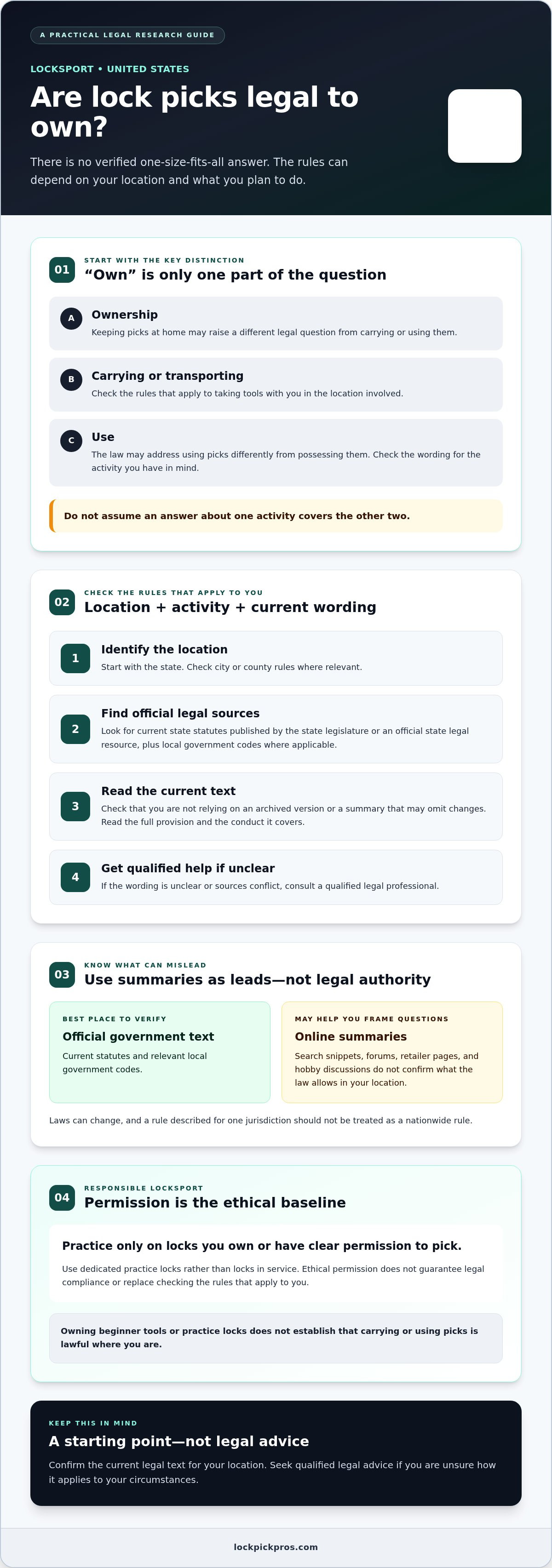
If you’re asking, “are lock picks legal to own,” the answer isn’t the same for every U.S. location or situation. Before buying a set, it helps to separate three questions: whether you can own the tools, carry or transport them, and use them. The rules that apply may depend on where you are and what you plan to do.
This guide explains what to check in current state and local rules, how to find official legal sources, and why general online summaries may not answer your specific question. Use it as a starting point for research, not as a substitute for checking the rules in your jurisdiction or getting qualified legal advice.
Locksport can be a rewarding skill-based hobby when practiced ethically. Practice only on locks you own or have clear permission to pick, and use dedicated practice locks rather than locks in service. The sections ahead cover practical legal research steps and responsible ways to approach the hobby.
Key Takeaways
- There’s no verified one-size-fits-all answer to “are lock picks legal to own”; check current rules for your state and, where relevant, your locality.
- Ownership, carrying, and use are separate questions. Look for the wording that applies to each activity rather than assuming one answer covers all three.
- Use official government sources to find the relevant codes and read the current text. If it’s unclear how a rule applies, consult a qualified legal professional.
- Permission to pick a lock is an ethical baseline, not a guarantee of legal compliance. Practice only on locks you own or have clear permission to use.
- Beginner tools and practice locks can support skill-building, but owning them doesn’t establish that carrying or using picks is lawful where you are.
Are lock picks legal to own in the United States? Start with the jurisdiction
There isn’t a verified nationwide answer to are lock picks legal to own. The answer depends on the rules that apply where you are and the activity you have in mind. Check current state statutes and, where relevant, local ordinances before buying, carrying, or using lock picks.
Why one nationwide answer can mislead
Legal wording and requirements can differ by jurisdiction. A general article can’t determine how a rule applies to your circumstances, so don’t assume a rule discussed online applies in your state or city. Start with official government sources, such as current statutes published by a state legislature or a local government code. If the wording is unclear, consult a qualified legal professional.
Lockpicking is also practiced as a skill-based hobby. For background on the hobby of locksport, see this general overview. For legal requirements, rely on current official sources. A product page, hobby guide, or community discussion can’t confirm what the law allows where you are.
What the word “own” leaves unanswered
“Own” may not describe the situation you’re concerned about. You might be asking whether you can keep picks at home, take them with you, or use them on a particular lock. Those are distinct questions, and the relevant law may depend on location, circumstances, and purpose. Check each activity separately rather than assuming permission for one covers all the others.
Ownership, carrying, and use are separate legal questions, so verify the rules for each in your jurisdiction. Practicing on a lock you own or have clear permission to pick is a responsible locksport baseline. It is not a legal guarantee or a replacement for checking applicable rules.
Specialist practice equipment, such as a Kaba dimple-pick set, may be relevant to hobby practice. Buying or owning a tool doesn’t establish that carrying or using it is lawful in your location.
Legal-information notice: This article provides general information, not legal advice. Laws and local rules can change. Confirm the current text through official sources for your location, and seek qualified legal advice if you’re unsure how it applies to you.
How lock-pick laws can differ by state, locality, and circumstances
Once you’ve identified the location, check the exact legal wording. Statutes may address tools, possession, or intended use in different ways. A phrase in one state’s law shouldn’t be treated as a nationwide rule, and an online summary may leave out important details or changes.
State law and local ordinances are separate layers to check. A local rule may apply in some places, but don’t assume one exists everywhere. To answer are lock picks legal to own in your area, find current official text that covers your specific location and situation.
Which official sources should readers check?
Start with current state statutes published by the state legislature or another official state government legal resource. Then check the relevant city or county government code where applicable. Confirm that you’re reading the current text, not an archived version or a summary that may omit amendments.
Search snippets, forums, retailer pages, and hobby discussions can help you identify questions to investigate, but they aren’t legal authority. If sources conflict or the wording is unclear, ask a qualified legal professional rather than relying on an assumption.
When intent or circumstances may matter
Some laws may make intent or surrounding circumstances relevant, but that can’t be assumed for every state. Check the current statute and context. Read the actual provision to see what conduct it covers and what elements it requires. Don’t assume a rule described for one jurisdiction, including a claim about California, applies elsewhere.
Context may raise questions that a simple ownership search won’t answer. Check whether the law distinguishes possession from carrying or use, and whether it addresses the purpose for possessing a tool. Avoid relying on broad claims about what could lead to an arrest, charge, or particular outcome. Those questions require jurisdiction-specific legal analysis.
- Identify the location: Check the state and the city or county involved.
- Find official text: Use current state statutes and local government codes where applicable.
- Read the full provision: Review definitions, conditions, and related sections instead of relying on a search excerpt.
- Confirm uncertainty: Seek qualified legal guidance if the rule or its application isn’t clear.
Check your state and locality, then read the current official text before deciding what ownership, carrying, or use may mean for you. For authorized hobby practice, choose equipment suited to the locksport skills you want to develop. For example, this standard pin-tumbler practice pick set is one product option. Equipment supports practice; it doesn’t establish legal compliance.
Does owning lock picks differ from carrying or using them?
“Are lock picks legal to own?” is only one part of the question. Keeping tools at home, taking them with you, and using them on a lock describe different situations. The rules and relevant legal questions can vary by location, so don’t assume an answer about one situation automatically applies to another.
| Situation | What it means | What to verify |
|---|---|---|
| Ownership | You own the tools, whether or not you’re using them. | Check how current law in your jurisdiction addresses owning or possessing lock picks. |
| Possession or carrying | You have the tools with you, such as while traveling or carrying them in public. | Check applicable state and local rules before carrying them. Verify transport-related requirements in every jurisdiction involved. |
| Use | You attempt to pick a lock, whether for practice or another purpose. | Check the rules that apply to the location, the lock, and the circumstances of use. |
This comparison is a prompt for legal research, not a statement that any action is lawful or unlawful. Consult current official sources for your location.
Ownership, possession, and transport are different questions
In everyday terms, ownership means having a tool as your property; possession means having it in your control; transport means taking it from one place to another. Laws may use these words in specific ways, so check the wording that applies where you are. If a trip crosses state or local boundaries, research each relevant location instead of assuming the rules stay the same.
Permission and lawful practice
For ethical locksport, practice only on locks you own or have clear permission to pick. Don’t treat a lock that’s installed and in service as practice equipment. A hobby, a professional role, or possession of practice locks may help explain someone’s purpose, but none should be treated as proof of legal status or intent by itself.
Permission is an ethical baseline, not a legal guarantee. It doesn’t replace checking the law that applies to the tools, the lock, and the location. Keep those questions separate, and pause before carrying or using picks if you haven’t confirmed the relevant rules.
How to check whether lock picks are legal where you live
Use a source-first process instead of relying on a broad summary. The key question isn’t just whether lock picks are legal to own, but how current rules apply to your location and the activity you’re considering. Research can help you find relevant wording, but it can’t guarantee compliance or predict how a law will apply to your circumstances.
A practical official-source checklist
- Identify the location. Write down the state and the city or county involved. If you’re checking rules for travel, list each jurisdiction on your route or at your destination.
- Search official government sources. Look for current state statutes on a state legislature’s website or another official state legal resource. Check local government codes where applicable. Don’t assume every locality has a separate rule.
- Read the current text. Confirm that the source covers the right jurisdiction. Check its publication or update information, and look for later amendments or related sections that affect how the provision should be read. A search-result snippet may not show the full context.
- Write down the exact question. Are you asking about ownership, possession at home, carrying, transport, or use? Review rules relevant to that activity instead of treating them as interchangeable.
- Confirm anything unclear. If you can’t tell whether a provision applies, or official sources appear inconsistent, seek qualified legal advice before acting.
Keep a record of the official pages you checked and when you reviewed them. That makes it easier to revisit the source if the law changes or your circumstances do. Repeat the check before traveling, crossing jurisdictional boundaries, or changing how you plan to carry or use the tools.
When general online guidance is not enough
Online articles and hobby discussions can point you toward useful questions, but they can’t provide reliable personal legal advice. A rule’s meaning may depend on exact wording and facts specific to you. If you need advice about a particular situation, contact a qualified legal professional in the relevant jurisdiction. Following a checklist is a research step, not a promise that your plans comply with every applicable rule.
After checking the legal questions separately, you can research equipment for authorized practice. The Carbon Fiber Gen 2 Pro Series pick set is one option for practicing on standard pin-tumbler locks you own or have permission to pick. Choosing practice tools doesn’t establish legal compliance, so keep the two decisions distinct.
Practice ethical locksport and choose tools for authorized practice
Locksport is a skill-based hobby built around careful practice and respect for property. Keep your learning to locks you own or have clear permission to pick. A practice lock gives you a dedicated way to develop technique without targeting a lock that’s installed and in active use.
Build a responsible locksport routine
Set clear boundaries for every practice session: use only an authorized lock, keep tools with your practice equipment, and stop if ownership or permission is uncertain. These habits help distinguish locksport practice from attempts to open locks without authorization.
The community’s belt ranking system offers a way to track skill progression. Read the lock picking belt levels guide to see how hobbyists progress through the ranks. Belt progress reflects community learning, not legal certification. Earning a rank doesn’t confirm that owning, carrying, or using tools complies with local law.
New hobbyists can also consider the free Black Belt Challenge as a community learning path. It doesn’t provide legal approval or replace checking the rules that apply to you. Before participating, keep practice within ethical boundaries and confirm that your planned activity is permitted where you live.
Choose equipment for practice, not as proof of compliance
Beginner tools and practice locks are learning equipment. They can help you focus on controlled movement and tactile feedback, but buying or carrying them doesn’t establish that any particular activity is lawful. Product choice and legal research are separate steps.
Before acquiring, carrying, or using picks, check current official rules for your state and, where relevant, your locality. Recheck before travel or a change in circumstances. If a rule is unclear or your question concerns a specific situation, seek advice from a qualified legal professional.
If you’re ready to explore equipment for authorized locksport practice, take a look at the Carbon Fiber Gen 2 Pro Series. It’s an optional pick-set choice for practice, not a guarantee of legal compliance. Keep the core rule in view: pick only locks you own or have clear permission to use.
Start Your Locksport Practice With Care
So, are lock picks legal to own? There’s no verified answer that applies everywhere. Check current official sources for your state and locality, and treat owning, carrying, and using picks as separate questions. Rules and circumstances can differ, so revisit your research before travel or a change in how you plan to use your tools.
Ethical practice starts with locks you own or have clear permission to pick. Practice locks and beginner tools can help build skill, but they don’t prove that owning or carrying picks complies with local law. Keep legal research separate from equipment selection, and seek qualified advice if you’re unsure how a rule applies to you.
Ready to choose equipment for authorized locksport practice? Explore the Carbon Fiber Gen 2 Pro Series as an option for practicing on locks you’re authorized to pick.
Check your local rules, practice responsibly, and enjoy building your locksport skills one step at a time.
Frequently Asked Questions
Is it legal to own lock picks in every U.S. state?
There’s no verified universal answer to whether are lock picks legal to own applies in every state. Laws and relevant circumstances can vary by jurisdiction, so check current official state statutes and applicable local rules where you live. If the wording is unclear or you’re asking about a specific situation, consult a qualified legal professional rather than relying on a general online summary.
Can you carry lock picks in your car?
Don’t assume that rules about owning lock picks also answer whether you can carry or transport them in a car. The available information doesn’t establish verified state-by-state guidance, and applicable rules may depend on location and circumstances. Before carrying a set, check current official sources for your state and locality. Check again before travelling across jurisdictional boundaries, since the rules may differ.
Can you own lock picks if you are not a locksmith?
Your occupation alone doesn’t provide a complete answer to a legal question about lock picks. Check the current rules for your jurisdiction and the circumstances involved. If you’re practicing locksport, use locks you own or have clear permission to pick. A hobby, job, or purchase of tools isn’t legal advice, and none should be treated as proof that a particular action complies with local rules.
Does owning lock picks mean you have criminal intent?
Ownership alone shouldn’t be presented as proof of either lawful or unlawful intent. The legal meaning of possession, intent, and surrounding circumstances depends on the law that applies and the verified facts. Don’t rely on a broad statement about another state as an answer for your situation. Check the current statute for your location, and consult qualified legal counsel if you need advice about a specific concern.
Are lock picks legal to use on your own locks?
Practicing only on locks you own is a responsible locksport boundary, but it doesn’t replace checking current local law. Rules may address possession, use, or circumstances differently. Confirm official requirements for your state and locality before practicing. If you don’t own the lock, get clear permission before working on it. Don’t treat ownership of a lock as a guarantee that every related activity is lawful.
What should you do if you are unsure about local lock-pick laws?
Pin down the question first: are you checking ownership, carrying, transport, or use? Search current official state sources and local government codes where applicable. Confirm that each source covers your jurisdiction and check whether its text has been updated. Forums and retailer pages can’t replace official legal sources. If the wording remains unclear or you need advice about your situation, speak with a qualified legal professional.