

Is There a Lockpicking Community? Join Locksport in 2026
If you’ve wondered, “is there a lockpicking community,” the answer is yes. Locksport enthusiasts connect online to ask questions, share progress, and discuss belt rankings. Places to explore include the r/lockpicking subreddit and the Lock Pickers United Discord server.
It’s understandable to feel unsure about joining. Lockpicking can be misunderstood, and beginners may wonder whether they’ll fit in or what’s appropriate to share. Locksport centers on ethical practice, respect for other people’s property, and learning with locks you own or have permission to pick. You don’t need advanced skills to participate.
This guide covers where hobbyists gather, how conversations and belt progression work, and how to take a first step at your own pace. You’ll also learn about the nine belt levels, community expectations, and ways to share your practice respectfully. Whether you prefer to read quietly before posting or join a discussion right away, there’s room to build your skills one step at a time.
Key Takeaways
- Yes, there is a lockpicking community. Locksport hobbyists connect to learn, practice ethically, and share progress.
- Explore discussion forums, social platforms, video communities, and ranking resources such as Reddit and LPUBelts to find a format that suits you.
- Use belt rankings as a guide to skill progression, while treating community feedback as a complement to your own practice.
- Start responsibly: read community rules, practice only on locks you own or have explicit permission to use, and ask questions respectfully.
- The optional Black Belt Challenge offers a structured progression, an email sequence, and conditional rewards tied to sharing progress.
Is there a lockpicking community? What locksport brings people together
Yes. People who enjoy locksport connect to practice, learn, and share their progress. The community isn’t one single club or voice. It includes online discussions, shared ranking resources, and peer connections where available. People take part in different ways, from quietly following discussions to posting questions or milestones.
Locksport is recreational lockpicking practiced ethically, using locks you own or have explicit permission to pick. That boundary is central to the hobby. The Locksport overview offers additional background on the activity and its community. For a beginner, the goal isn’t to prove expertise. It’s to approach the skill as a mechanical puzzle and respect the rules of the spaces where hobbyists gather.
What does a lockpicking community do?
Hobbyists exchange learning resources, discuss their practice, and encourage steady skill development. Some communities also use a belt ranking system to give progression a shared structure. Rank criteria can help participants choose an appropriate next challenge. Resources and group norms vary, so check each space’s guidance rather than assuming one forum or ranking system speaks for every lockpicker.
Participation can be as simple as reading a discussion, asking how a term is used, or sharing what you learned from an authorized practice lock. Some people prefer text conversations; others learn from demonstrations or ranking references. The common thread is respectful exchange, not a particular platform or level of skill.
Is locksport only for experienced pickers?
No. Curiosity and responsible practice are enough to begin learning. You can start by reading a community’s rules, following discussions, and noting how members describe their practice. When you’re ready, ask a focused question or share a small learning milestone. Advanced skills aren’t an entry requirement, and progress doesn’t need to follow anyone else’s schedule.
Keep the ethical boundary clear as you participate: practice only on locks you own or have explicit permission to use. Don’t present a lock as yours to pick if you can’t confirm that permission. A considerate first contribution might describe a practice goal or ask about community terminology without overstating your experience.
A locksport community gives independent practice a place for conversation and shared learning, while leaving room for beginners to observe before joining in. Start by learning the norms, choose authorized practice, and take part at a pace that feels comfortable.
Where do lockpickers connect online and share their progress?
Locksport conversations take different forms, so you don’t need to join one particular space. Discussion forums support questions and longer exchanges. Social platforms make it easy to share short progress updates, while video communities let members explain ideas visually. Ranking resources serve a different purpose: they help hobbyists compare practice locks and understand how a belt progression is organized. Reddit and LPUBelts are examples to explore, not endorsements or guarantees of current activity.
How to find an online locksport group that fits
Search platform communities for “locksport” or related terms, then read recent posts before joining in. Look for clear rules, active moderation, useful beginner guidance, and respectful answers to basic questions. Check whether members emphasize permission and responsible practice. A group that promotes unauthorized entry or dismisses consent is not a suitable place to learn. Online search directories and community hubs can help surface these options. Review each group directly instead of treating a listing as an endorsement.
When comparing spaces, ask yourself:
- Are the rules easy to find and understand?
- Do beginners receive constructive replies?
- Do members keep discussion focused on authorized practice?
- Can you participate comfortably by reading before posting?
What can beginners share with the community?
Start with a question about terminology, a reflection on what you’re learning, or a milestone from practicing on a lock you own or have explicit permission to use. You don’t need a dramatic success story. A clear account of what felt confusing and what you tried can invite helpful feedback while keeping the focus on skill development.
Keep posts considerate and privacy-aware. Don’t reveal details about someone else’s security, identify a private lock, or demonstrate access without permission. If belt progression interests you, Lock Picking Belt Levels Explained can help you understand the framework before discussing a goal with other hobbyists.
Some pickers find it useful to practice independently with suitable equipment before sharing a milestone. For standard pin-tumbler practice, the Carbon Fiber Gen 2 Pro Series pick set from Lockpick Pros is one option to consider as you build your skills.
How does the locksport community support practice and skill progression?
Community feedback can help you interpret a practice session, find learning resources, and notice progress you might overlook. It works best alongside independent practice, not as a replacement for it. After practicing with a lock you own or have permission to use, jot down what you observed: which movements felt controlled, where feedback was unclear, and what you want to focus on next time. These notes make it easier to ask specific questions and track your progress.
How belt ranking gives practice a shared structure
In some locksport communities, colored belt ranks offer a framework for progressing through locks of increasing complexity. The lists and criteria are specific to each community, not universal rules for every picker. LPUBelts and the r/lockpicking belt ranking wiki are useful references to compare. Check their current guidance before setting a goal. For a plain-language overview, look for Lock Picking Belt Levels Explained.
A rank can give your practice direction, but it doesn’t set a deadline. Advancement depends on continued practice and the criteria used by the community you’re participating in. There’s no guaranteed timeline, and taking longer to develop a skill is part of learning, not a reason to feel out of place. Organizations such as The Open Organisation Of Lockpickers (TOOOL) also provide a point of reference for people interested in locks and lockpicking.
Why tactile feedback and patient practice matter
Locksport is a hands-on hobby. During authorized practice, notice how a tool moves and what sensations you can distinguish instead of treating each session as a race to finish. Practice locks give you a controlled setting to build familiarity and repeat a challenge without involving a lock in use. This makes it easier to notice small changes in your technique and describe them accurately when asking for feedback.
- Record one thing that felt clearer than during your previous session.
- Note a question you want to ask rather than guessing at an explanation.
- Choose a modest next goal based on your current practice, not someone else’s pace.
If you’re comparing tools for standard pin-tumbler practice, the Carbon Fiber Gen 2 Pro Series pick set is one option to review. For help planning a first setup, consult a beginner lock pick set guide alongside the belt-level overview. Steady practice, careful observation, and constructive conversation can turn solo sessions into a clearer path forward.
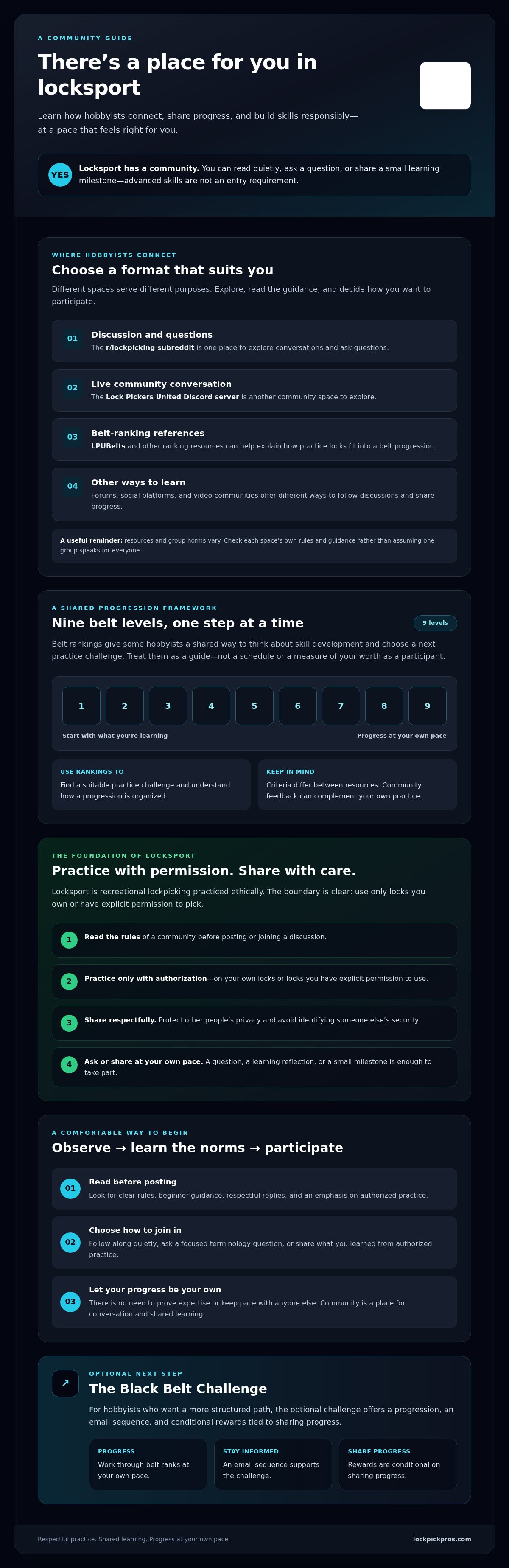
How can you join a lockpicking community responsibly as a beginner?
If you’re asking, “is there a lockpicking community” you can join without advanced skills, start small and let responsible participation lead. You don’t need a rank or a polished post to take part. A thoughtful question and a clear commitment to ethical practice are enough.
- Read the community rules. Check how the group handles questions, demonstrations, and progress posts. Follow its norms, and ask a moderator if anything is unclear.
- Choose authorized practice. Practice only on locks you own or have explicit permission to use. A practice lock is a better learning choice than a lock that’s in service or belongs to someone else.
- Ask respectfully. Give enough context for others to understand your question, and be open to guidance. Don’t treat online advice as a substitute for permission or local legal guidance. Check applicable rules where you live if you’re uncertain.
- Share progress with care. Describe what you’re learning, but protect other people’s privacy. Don’t post sensitive access information, identify someone else’s lock, or demonstrate access without permission.
What should you know before posting or joining?
A quick review of the rules can help you avoid accidental missteps. Notice whether the community sets expectations for posts, images, or demonstrations, and keep your contributions within those boundaries. Use dedicated practice locks rather than locks in use. If a question involves permission, privacy, or local requirements, pause and get the right guidance instead of relying on comments from strangers.
For your first post, keep it simple: ask about a term you’ve encountered, share a reflection from authorized practice, or describe a learning goal. Reading and observing before contributing is also a meaningful first step.
What tools help a beginner take part?
Tools aren’t required to join a discussion. If you want to practice between conversations, a basic setup with a practice lock and beginner picks can give you a focused way to learn at your own pace. The Trainee 2.0 beginner pick set is an optional starting point. Choose equipment that fits your practice goals, not because you feel pressure to buy before participating.
Community learning works best when it stays grounded in consent, privacy, and patience. To review a standard pin-tumbler option for ethical practice, explore the Carbon Fiber Gen 2 Pro Series.
How the Black Belt Challenge gives community-minded practice a next step
If you want a structured way to keep progressing, the Black Belt Challenge is an optional route that connects belt-by-belt practice with an email sequence and social sharing. Join free, work toward the next rank at your own pace, and share eligible picks-in-action content using Lockpick Pros tools. The challenge can give your practice a shared direction, but it isn’t required to take part in locksport.
How the challenge connects practice, progress, and sharing
The path is straightforward: join free, progress one belt at a time, share eligible progress, and continue learning. Reward picks may be available when participants meet the challenge’s stated requirements, so review the current terms before taking part. Rewards aren’t automatic.
Lockpick Pros also describes a $5,000 bounty tied to reaching a social-reach goal. The bounty isn’t guaranteed, and eligibility depends on meeting the applicable conditions. Check the current reach goal and participation terms before creating or sharing content. Share only practice you’re authorized to show, and protect private security information.
Ready to add structure to your practice? Consider joining the free Black Belt Challenge, then set a manageable goal and progress at your own pace. Sharing can mark a learning milestone, but it doesn’t guarantee a reward, the bounty, or a particular result.
Choosing tools as your skills develop
Your tool preferences may change as your practice goals develop and you work with different locks intended for authorized practice. For standard pin-tumbler practice, the Carbon Fiber Gen 2 Pro Series is one option to consider. Choose tools for your current learning goals, not because you feel pressure to advance faster.
For a standard pin-tumbler practice setup, explore the Carbon Fiber Gen 2 Pro Series as you plan your next step.
Take Your Next Locksport Step
So, is there a lockpicking community? Yes. Locksport connects people through online discussion, shared learning, and skill progression, but no single group represents every picker. Start by finding a space whose rules and ethical expectations suit you.
Keep the essentials in view: practice only on locks you own or have explicit permission to use, protect other people’s privacy, and check local requirements if you’re unsure. Belt rankings can help give practice direction, while your progress depends on your own practice and the criteria of the community you choose to follow.
The Black Belt Challenge offers an optional structure for continuing that journey, with reward picks tied to participation requirements. You can take part at your own pace and choose what to share. For a standard pin-tumbler practice setup, explore the Carbon Fiber Gen 2 Pro Series.
Start with one authorized practice lock, one question, or one small goal. Every careful step counts, and there’s room to grow in locksport. Explore Lockpick Pros’ beginner lockpick sets and practice locks to find equipment for your ethical practice.
Frequently Asked Questions
Is there a lockpicking community for beginners?
Yes. Beginners can join locksport communities without advanced skills. Look for spaces with clear rules and constructive responses to beginner questions. You can start by reading discussions, learning common terms, and asking a focused question. Practice only on locks you own or have explicit permission to use.
Where can I find a lockpicking community online?
Online locksport discussions appear in forums, social platforms, video communities, and ranking resources. Reddit is one place to look for discussion, while LPUBelts is a resource for exploring ranked locks. Neither represents every picker, and activity or moderation can change. Review recent posts, group rules, beginner guidance, and ethical expectations before deciding whether a space suits you.
Can beginners join a locksport community without owning lockpicks?
Yes. You can read discussions, learn locksport terminology, and ask respectful questions without owning tools. Lockpicks aren’t an entry requirement for participating in a conversation. If you later decide to practice, choose a practice lock and use it only if you own it or have explicit permission to use it. Check a community’s posting rules before sharing questions or observations.
How do lockpicking belt rankings work?
In some locksport communities, colored belts mark progression through locks of increasing complexity. Ranking systems set criteria for each level, and exact requirements depend on the community maintaining them. The commonly used sequence runs from White through Yellow, Orange, Green, Blue, Purple, Brown, Red, and Black. Check the current rules and eligible-lock lists for the ranking system you plan to follow.
Is lockpicking a legal hobby?
Rules about lockpicking tools and their use can vary by location, so don’t assume a general online answer applies to your circumstances. Check applicable local rules or seek qualified local guidance if you’re unsure. Regardless of location, keep practice ethical: pick only locks you own or have explicit permission to use. Access to a lock does not mean you have permission to practice on it.
How can I participate in a lockpicking community responsibly?
Read the community rules before posting, use authorized practice locks, and ask questions respectfully. Share learning notes or milestones without revealing another person’s security details or sensitive access information. Follow the group’s guidance for demonstrations and images, and avoid showing access you don’t have permission to demonstrate. If local rules are unclear, check them independently rather than relying on a discussion thread as legal advice.
What is the Black Belt Challenge?
The Black Belt Challenge is an optional Lockpick Pros program that connects belt progression with an email sequence and social sharing. Participants may earn reward picks by progressing and sharing eligible progress, subject to the challenge’s requirements. Lockpick Pros states that more than 10,000 ethical lockpickers have joined. Review the latest details to understand participation and reward terms before joining.