

Lockpicking Challenges for Intermediate Users: Mastering Security Pins and Feedback in 2026
The intermediate plateau isn't a lack of strength; it's a sensory disconnect between your fingers and the pins. Many hobbyists hit a wall when they encounter their first spool or serrated pin, leading to common lockpicking challenges for intermediate users like losing a hard-earned false set or accidentally resetting the entire plug. It's incredibly frustrating to feel like you're flying blind when the lock starts fighting back with subtle counter-rotation.
We know the struggle of dealing with pick-warp from over-tensioning thin keyways or falling into a security pin trap. You're ready to move beyond basic sets and earn your Orange or Green belt rank. This guide provides the expert tactile feedback techniques you need to master the "conversation" inside the core. You'll learn how to successfully pick high-security favorites like the American Lock 1100 and the Master Lock 410 LOTO by refining your tool selection and sensory awareness. We're diving into the specific mechanics of counter-rotation so you can stop guessing and start feeling every click.
Key Takeaways
- Identify the critical shift in precision required to move from basic locks to professional-grade hardware.
- Understand the mechanics of counter-rotation to navigate the most common lockpicking challenges for intermediate users.
- Switch to carbon fiber handles to stop dampening feedback and start feeling the subtle clicks of serrated drivers.
- Implement progressive pinning drills using a pinning tray to master complex security features one pin at a time.
- Enter the Black Belt Challenge to turn your practice into rank progression and earn reward picks for your dedication.
Overcoming the Intermediate Lockpicking Plateau
Hitting a wall after opening basic padlocks is incredibly common. You might have breezed through standard pin-tumbler cylinders, but high-precision tolerances change the game entirely. Standard raking and heavy-handed single pin picking fail because tighter manufacturing tolerances leave zero room for error. This is where lockpicking challenges for intermediate users truly begin, forcing a complete shift in how you perceive internal feedback.
Developing a soft touch with your tension wrench is the single most important adjustment at this stage. Heavy tension binds pins so tightly that you cannot feel the difference between a solid shelf and a security trap. It can also cause pick-warp, bending your tools inside narrow keyways. Moving away from clear plastic locks to a metal cutaway lock introduces authentic friction. Clear locks are great for visualizing the core, but they do not replicate the true tactile feedback of brass and steel rubbing together. Historically, understanding these subtle mechanical variances has been treated as an essential skill for locksmithing and high-level locksport alike.
The Orange and Green Belt Milestone
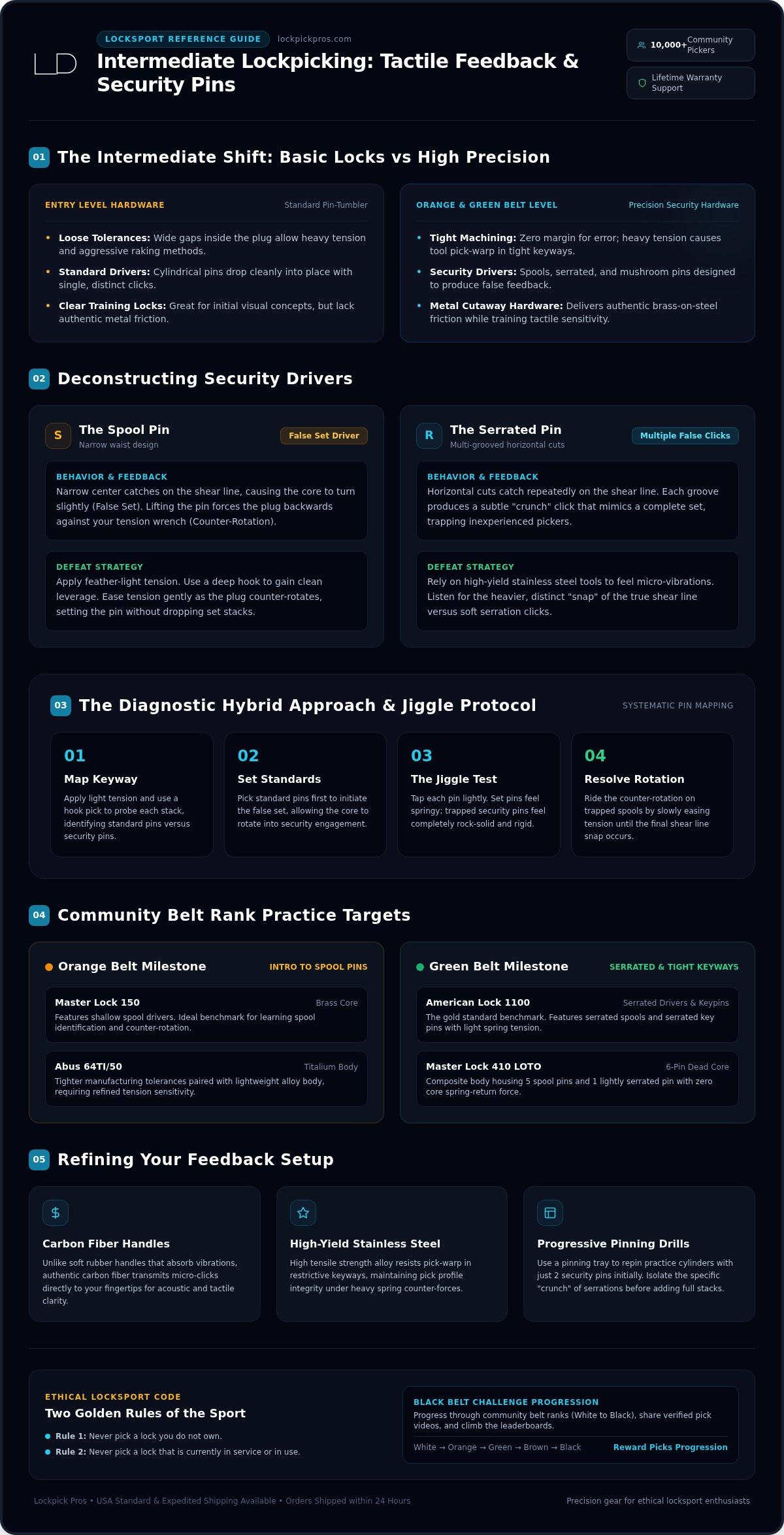
In the community belt ranking system, reaching the Orange and Green belt tiers marks your entry into true locksport mastery. Overcoming these lockpicking challenges for intermediate users requires you to identify and bypass security pins consistently. Locks like the Master Lock 150 and the aluminum-bodied Abus 64TI/50 are classic milestones at this level. These padlocks contain spool pins that trigger false sets, requiring you to use a diagnostic hybrid approach. You apply light tension, use a hook to map out which pins are standard, and then systematically isolate the security drivers without dropping everything you have already set.
Ethical Locksport and the Hobbyist Code
As your skills advance, keeping the ethical code of locksport front and center is vital. Ethical hobbyists follow two unshakeable golden rules: never pick a lock you don't own, and never pick a lock that is currently in use. This discipline keeps the sport legal, safe, and respected. The community thrives on shared challenges, where pickers trade tips on difficult keyways and celebrate rank milestones together. Climbing the ranks is a journey best taken with a supportive community of over 10,000 like-minded enthusiasts who value precision, patience, and legal sportsmanship.
Defeating Security Pins: Spools, Serrated, and Mushroom Drivers
Security pins turn a simple mechanical device into a high-stakes puzzle. These components are designed specifically to provide deceptive feedback, making them the primary lockpicking challenges for intermediate users. You might find yourself in a false set, which is when the plug rotates significantly but the lock doesn't open. This happens because the narrow waist of a spool or mushroom pin has caught on the shear line. Counter-rotation is the plug turning against your tension during a false set as you attempt to lift that trapped pin. It feels like the lock is trying to undo your progress, but it's actually the key to success.
To navigate these traps, you must master the Jiggle Test. A set pin will have a tiny amount of springy movement when tapped. A trapped security pin feels rock solid and won't budge until you address the counter-rotation. Learning this distinction is a major step in your locksport journey. As noted in the classic MIT Guide to Lock Picking, understanding the physics of these mechanical defects allows you to exploit them. If you're struggling to feel these movements, upgrading to a set like the Carbon Fiber Gen 2 Pro Series can provide the clarity you need to progress.
Mastering the Spool Pin Counter-Rotation
When you feel the plug push back against your tension wrench, don't panic. You need to ease your tension slightly to let the pin move, but keep just enough pressure to prevent dropping previously set pins. Slowly lift the spool with your pick. You'll feel the plug rotate backwards before it finally clicks into place. A deep hook is often your best pick choice here. It gives you the reach needed to set high-lift spools without disturbing the pins in front of them.
The Serrated Pin Challenge
Serrated pins are among the most frustrating lockpicking challenges for intermediate users because they offer multiple fake clicks. Each serration feels like a success, but it's just another trap. You need high-yield stainless steel picks to feel the micro-vibrations that distinguish a serration from a true set. If you're stuck, use a pinning tray to perform progressive pinning drills. Start with just two serrated pins in the core. This isolation helps you learn the specific "crunch" of a serration versus the solid "snap" of the shear line. Mastering this feedback is how you bridge the gap to advanced ranks.
Refining Your Feedback: The Science of Carbon Fiber Handles
Mastering lockpicking challenges for intermediate users requires a sensory upgrade. When you're dealing with standard pins, almost any tool will work. But once you start hunting for that specific "crunch" of a serrated pin, your tools must become an extension of your nervous system. Vibrations travel from the pin stack, through the pick shaft, and into the handle. Traditional plastic or rubber handles are designed for comfort, not communication; they act as shock absorbers that dampen the very signals you need to hear. Carbon fiber handles are different because their rigid structure transmits vibrations directly to your fingertips without the signal loss found in softer materials.
Material strength also plays a huge role in preventing pick-warp. When you apply pressure to a stubborn security pin, a low-quality pick might bow or twist inside the keyway. This deformation steals your tactile feedback and makes the lock impossible to "read." By using high-yield stainless steel, you ensure the pick stays rigid, allowing every micro-movement of the pins to reach your hand. Even historical resources like the CIA Lock Picking Field Manual emphasize the importance of using high-quality materials to achieve a successful open under pressure. Our handles are engineered to transmit up to 3x more vibration than plastic, giving you a massive advantage when navigating complex cores.
Why Feedback is the Intermediate's Best Friend
As you move toward Blue belt ranks, your success depends on detecting counter-rotation. To maximize this, hold your pick with a light "pencil grip" to ensure the handle has maximum contact with your skin. This increases the surface area available to receive vibrations. If you're curious about the material science, check out our guide on The Benefits of Carbon Fiber Lock Picks to see how we've pushed the boundaries of locksport technology. Learning to "listen" with your hands is what separates a trainee from an expert.
Tool Spotlight: Carbon Fiber Gen 2 Pro Series
The Carbon Fiber Gen 2 Pro Series is engineered specifically for these challenges. It features real carbon fiber handles and high-yield stainless steel shafts. For paracentric keyways that are too tight for standard tools, the thin .015 inch profile picks in this set allow you to navigate restrictive wards without losing sensitivity. It's the precision bridge you need to move past the intermediate plateau and tackle high-tolerance locks. Upgrade your feedback with the Carbon Fiber Gen 2 Pro Series today and start feeling what you've been missing.
Strategic Practice Drills for Intermediate Mastery
Practice doesn't just make perfect; it makes permanent. To overcome the most stubborn lockpicking challenges for intermediate users, you need a structured routine that isolates specific sensations. Blind picking is one of the best ways to build this mental map. By closing your eyes, you remove the visual distraction of the lock body and force your brain to interpret the vibrations coming through your pick handle. This develops the tactile memory required for locks where you can't see the pins, which is nearly every real-world scenario you'll encounter in the sport.
Navigating paracentric keyways is another hurdle you'll face as you climb the belt ranks. These restrictive warding patterns are designed to block your tools and limit your movement. You'll need to learn how to "snake" your pick through the warding without applying vertical pressure that causes pick-warp. It's a delicate dance of positioning that requires a thin pick profile and a lot of patience to avoid deforming your tools against the steel walls of the keyway.
Step-by-Step Progressive Pinning Guide
Progressive pinning is the gold standard for learning security drivers. Start by gutting a practice lock and using a pinning tray to organize the springs and pins. Reassemble the lock with only two pins: one standard and one spool. This allows you to isolate the feeling of counter-rotation without other pins confusing the feedback. Once you can open it five times in a row, add a third pin. Gradually work your way up to a full 6-pin stack with mixed drivers like serrated and mushroom pins. Record your "feedback notes" for each lock. Writing down which pin binds first and how the plug reacts helps you build a reliable mental map of the mechanism.
Tension Control Exercises
Your tension wrench is your most important diagnostic tool. Intermediate pickers often struggle with over-tensioning, which leads to pick-warp and masked feedback. Experiment with switching between Top of Keyway (TOK) and Bottom of Keyway (BOK) tools. TOK usually provides more room for your pick and cleaner feedback in tight keyways. For high-security locks, practice the "float tension" technique. This involves using two tension tools to precisely control the plug rotation during counter-rotation, preventing you from dropping set pins. If you're ready to take your practice to the next level, buy the Carbon Fiber Gen 2 Pro Series to ensure your tools are as precise as your technique.
Earn Your Rank: The Black Belt Challenge
Progression isn't just a personal victory. It's a badge of honor in the locksport community. Once you've started overcoming lockpicking challenges for intermediate users, you're ready to prove your skills on the global stage. The Black Belt Challenge is our way of turning your dedication into rewards. By joining over 10,000 ethical hobbyists, you aren't just picking locks; you're building a reputation for precision and integrity. We believe in rewarding your dedication to the craft, which is why we created a share-to-earn loop that turns your social media posts into professional gear.
Participating is simple. As you climb from one belt rank to the next, post your picks in action on social media using your Lockpick Pros tools. This share-to-earn loop lets you earn reward picks for each tier you achieve. It also feeds into our massive community goal: a $5,000 bounty for hitting our collective social reach target. The Carbon Fiber Gen 2 Pro Series is the perfect companion for this journey. Its high-yield stainless steel and vibration-transmitting handles give you the edge needed to document clean, successful opens on high-security hardware.
Climbing the Ranks from Orange to Black
To move beyond the intermediate stage, you must document your progress. Community verification often requires clear photos or videos of you picking and gutting a lock to prove no shortcuts were taken. This process builds your ethical reputation and ensures every rank is earned through pure skill. Engaging in these social media challenges connects you with mentors who can help you refine your technique. If you're looking for a deeper look at the hurdles ahead, read our guide on Mastering the Advanced Lock. Conquering these lockpicking challenges for intermediate users is exactly what prepares you for the high-tolerance cylinders found in the upper belt tiers.
Join the Elite Ethical Lockpickers
The Black Belt Challenge isn't just a competition; it's a roadmap to mastery. Every milestone you hit brings you closer to the elite ranks of the locksport world. From earning free reward picks to competing for the grand prize bounty, the incentives are designed to keep you motivated. We provide the precision tools, but your patience and ethics are what will carry you to the finish line. Don't let your progress stall on a difficult keyway. Start your journey today with the Carbon Fiber Gen 2 Pro Series and join the challenge!
Master the Click and Earn Your Belt
Mastering the transition from foundational picking to advanced locksport is about shifting your focus from force to feeling. You've learned how to identify counter-rotation, defeat deceptive spool pins, and use material science to amplify the vibrations in your hands. These lockpicking challenges for intermediate users are the final hurdles before you reach the elite ranks. By refining your tactile feedback with carbon fiber tools and sticking to a disciplined practice routine, you're setting yourself up for success in the Black Belt Challenge.
Precision tools are the bridge to that next rank. Our gear is precision-engineered for ethical locksport and comes with a lifetime warranty to support your journey for years to come. Plus, we know you're eager to start practicing; that's why every order ships from the USA within 24 hours. Don't let a dampened signal hold you back from the Green or Blue belt rank you've worked so hard to reach.
Upgrade to the Carbon Fiber Gen 2 Pro Series and Master Security Pins today. Your next open is just one clear click away. We're excited to see your progress in the community!
Frequently Asked Questions
What is the hardest lock for an intermediate user to pick?
The American Lock 1100 or Master Lock 410 LOTO are often cited as the "final boss" for this stage. They feature high-tolerance cores and mixed security pin stacks. Picking these requires a precise diagnostic hybrid approach to manage serrations and spools simultaneously. Successfully opening these padlocks is a major milestone that usually signals you're ready to move beyond common lockpicking challenges for intermediate users and pursue higher belt ranks.
How do I know if my lock has spool pins or serrated pins?
You'll identify them through distinct tactile feedback. Spool pins trigger a false set where the plug rotates significantly but doesn't open. When you lift them, you'll feel counter-rotation as the plug tries to turn back. Serrated pins feel "crunchy" and provide multiple tiny clicks as the serrations pass the shear line. Learning to distinguish these vibrations is essential for navigating the complex keyways found in Green and Blue belt locks.
Why do I keep dropping my set pins when picking spools?
Dropping pins usually happens during counter-rotation. When the spool pin's wide head needs to clear the shear line, the plug must rotate backward slightly. If your tension is too heavy or inconsistent, the other pins you've already set will fall back down into the core. You can prevent this by using light, controlled tension or a "float tension" technique with two wrenches to keep the plug stable during the reset.
Is it legal to own an advanced lock pick set in the United States?
Yes, owning lock picking tools is legal in most of the United States. Laws generally focus on criminal intent rather than mere possession. For example, California Penal Code § 466 clarifies that owning a pick set is not a crime on its own. We always advocate for the ethical hobbyist code: only pick locks you own and never pick a lock that is currently in use to stay within legal and community guidelines.
What is pick-warp and how can I avoid it?
Pick-warp is the permanent deformation or bowing of a pick shaft caused by excessive force. It often happens when you use too much tension in a paracentric keyway, forcing the pick to fight against both the pins and the warding. You can avoid this by using high-yield stainless steel tools and refining your "soft touch." If you feel the pick start to flex, ease your tension immediately to preserve your tool's integrity.
Do I need a special tension wrench for security pins?
While standard wrenches work, Top of Keyway (TOK) tools are highly recommended for security pins. TOK wrenches provide more room for your pick to move, which is vital when navigating the deep hooks required for spool pins. They also offer cleaner feedback because they don't bind against the lock body. Using the right tension tool helps you avoid common lockpicking challenges for intermediate users like accidental plug resets or muffled pin vibrations.
How does a carbon fiber handle improve my picking success rate?
Carbon fiber handles improve your success rate by transmitting vibrations that plastic handles absorb. Because carbon fiber is extremely rigid, it acts as a conductor for the micro-vibrations generated by serrated pins and counter-rotation. This clarity allows you to make faster, more accurate decisions inside the lock. When you can feel exactly what the pins are doing, you stop guessing and start picking with professional-level precision.
What is the best way to earn a Green Belt in lockpicking?
The most effective path is through structured practice and community engagement. Start by mastering locks like the Abus 72/40 or Master Lock 410 LOTO. You'll need to film a successful pick and gut of the lock to prove your skills for verification. Joining the Black Belt Challenge is a great way to stay motivated. Sharing your progress on social media helps you earn reward picks while you climb toward that elite status.