

Best Bottom of Keyway Tension Tools: The Complete 2026 Buyer Guide
Most failed picking attempts don't stem from poor pick placement; they happen because an ill-fitting tension wrench drags against the cylinder wall. If your wrench keeps slipping out during single pin picking, or pin one binds tightly against the plug, your rotational setup is working against you. Mastering the right bottom of keyway tension tools provides the exact blade fit needed to eliminate plug friction and transmit crisp tactile feedback.
Every picker knows the frustration of muffled movement when hunting for subtle spool pin counter-rotation. In this guide, you will learn how to choose and apply bottom of keyway tension tools to master rotational control on every lock cylinder. Discover how to match blade widths and tool thicknesses to different keyways, prevent plug pinching, and build the precision required to conquer higher belt ranking tiers.
Key Takeaways
- Learn how matching high-yield stainless steel bottom of keyway tension tools to cylinder width stops tool slippage and frees pin one.
- Discover the ideal blade thickness and flex specs needed to eliminate plug drag and preserve clear feedback.
- Identify exactly when bottom placement offers superior physical control compared to top of keyway setups on hand-held padlocks.
- Master featherlight torque adjustments to read spool pin counter-rotation accurately as you advance through belt tiers.
- Find out how upgrading your tension bars creates instant rotational control across restrictive, tightly warded cylinders.
What Are Bottom of Keyway Tension Tools and How Do They Work?
A bottom of keyway tension wrench seats at the base of the keyway, directly opposite the pin chambers. While picking picks lift pins to the correct height, the tensioner does the real heavy lifting. It applies controlled rotational torque to bind pin stacks along the shear line. High-quality bottom of keyway tension tools achieve this by gripping the lower warding ledge without rubbing against the outer lock housing. Proper placement prevents rotational slip without restricting pick travel inside the plug, ensuring your pick has a clear runway to manipulate each pin stack. Because the wrench sits firmly against the core, crisp tactile feedback transfers directly through the metal handle to your fingertips.
The Mechanical Role of a Tension Wrench in Single Pin Picking
Rotational force creates a tiny ledge between the plug and the lock housing. No lock cylinder is machined perfectly; microscopic imperfections dictate that pin chambers sit slightly off-center. When you apply turning pressure with a tension wrench, the pin chamber furthest from the center line binds first. Single pin picking relies on this sequential binding order. Correct turning pressure allows driver pins to catch cleanly above the shear line without oversetting the key pins below. You can study these core fundamentals through our guide on single pin picking basics.
Anatomy of Bottom of the Keyway Turning Tools
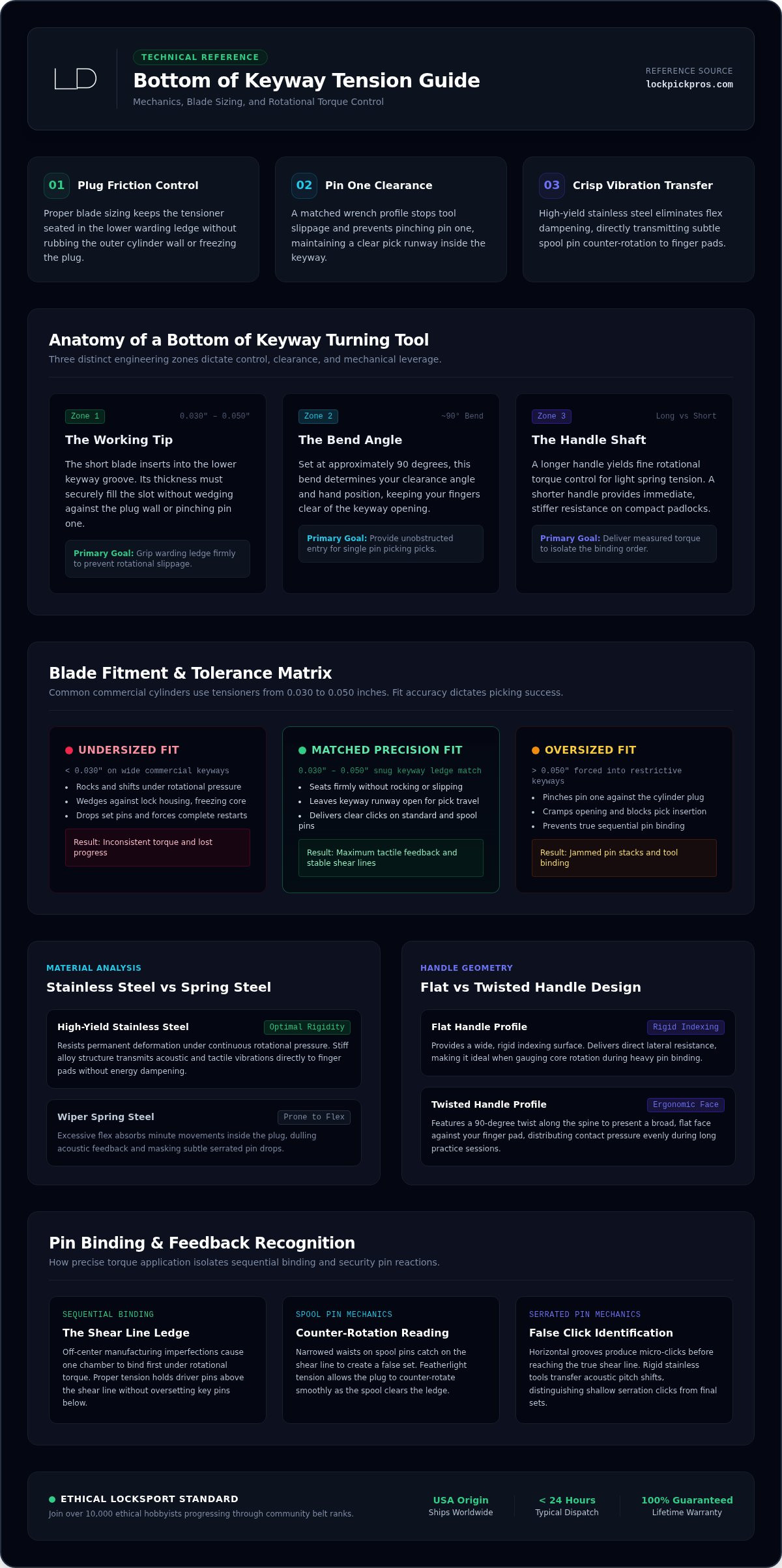
Standard bottom of keyway tension tools consist of three distinct functional zones that shape your picking experience:
- The working tip: The short blade inserts directly into the lower keyway groove. Its thickness must fill the slot without wedging against the cylinder plug wall.
- The bend angle: Usually set at roughly 90 degrees, this bend determines your hand positioning and clearance angle, keeping your fingers clear of the keyway entrance.
- The handle length: A longer handle provides fine rotational control, while a shorter shaft gives stiffer, immediate resistance when picking compact padlocks.
Even when you advance to specialty hardware like dimple locks using the The Lifesaver - 12 Piece Dimple Lockpick Set, mastering the base mechanics of torque application remains the bedrock of ethical locksport progression.
Essential Specs to Evaluate: Thickness, Width, and Flex
Blade thickness determines how securely the tool grips the bottom keyway ledge. Choosing the wrong size turns picking into an uphill battle. A loose fit causes the wrench to slip and drop set pins, forcing you to restart the stack. Conversely, a snug fit transmits crisp clicks when setting standard and spool pins. As outlined in the classic MIT Guide to Lock Picking, precise torque application directly governs shear line mechanics. Selecting quality bottom of keyway tension tools requires examining material rigidity, handle design, and profile dimensions.
Material Strength: High-Yield Stainless Steel vs Spring Steel
High-yield stainless steel resists permanent bending under continuous rotational pressure. Stiff materials transmit acoustic and tactile vibrations with minimal dampening. Cheap wiper spring steel tends to flex, which absorbs the delicate feedback needed to detect the drop of serrated pins. Rigidity ensures that every micro-movement inside the plug reaches your fingers instantly.
Twisted vs Flat Handles for Tactile Control
Handle geometry alters how your hand perceives core resistance:
- Flat handles: These offer a wide, rigid indexing surface. They deliver direct lateral resistance, making them ideal when testing core rotation during heavy binding.
- Twisted handles: These feature a 90-degree twist along the spine, presenting a flat face toward your finger pad. This design distributes surface contact evenly for extended picking comfort.
Pairing a stiff tension bar with responsive tools elevates your awareness. You can explore the benefits of carbon fiber lock picks to discover how handle rigidity amplifies feedback across tough cylinders.
Sizing Profiles: Avoiding Keyway Drag and Binding Pins
Tensioners ranging from 0.030 to 0.050 inches match common commercial cylinders. An undersized blade rocks within the keyway, causing it to wedge against the lock body and freeze the plug entirely. An oversized blade cramps the opening, pinching pin one or preventing pick entry. Proper width fills the bottom trench securely without touching the lowest keyway ward.
When you want dedicated turning bars engineered with zero flex to tackle pin-tumblers up to Brown belt, stepping up to the Carbon Fiber Gen 2 Pro Series ensures reliable rotational control on every attempt.
Bottom of Keyway vs Top of Keyway Tension: When to Choose BOK
Locksporters frequently debate whether bottom of the keyway (BOK) or top of the keyway (TOK) turning works best. While TOK opens maximum room inside the keyway for pick maneuverability, BOK provides unmatched physical stability for hand-held padlock picking. Placing your turning tool at the base creates an ergonomic ledge where your index finger naturally rests, anchoring the lock body inside your palm. Rather than popping out under variable finger pressure, a seated base tensioner stays put. Understanding both styles ensures you can tackle any lock cylinder design across different belt tiers without fighting your equipment.
Ideal Scenarios for Bottom of Keyway Tension Tools
Certain keyways favor bottom placement due to their open internal geometry. Practical field documents like the declassified CIA training manual highlight how basic turning tools provide reliable mechanical purchase during rapid entries. Bottom of keyway tension tools excel in these common situations:
- Wide keyway profiles: Common cylinders like Schlage SC1 or Master Lock laminated padlocks provide ample vertical space for both the tension tip and your pick shank.
- Hand-held picking: Stabilizing a loose padlock without a bench vise feels far more controlled when resting your index finger beneath the plug.
- Raking techniques: Kinetic attacks like scrubbing or zipping require aggressive, dynamic pick movement that quickly knocks top-mounted tensioners loose.
Common Pitfalls: Keyway Pinching and Accidental Pin Binding
The main hazard with bottom placement is accidental mechanical drag. Inserting the wrench tip too deeply into the core pushes the metal blade directly beneath the first pin stack. This pinches pin one between the wrench and the plug chamber, preventing it from lifting freely. If pin one feels seized solid while other pins remain loose, withdraw the blade slightly until it clears the chamber opening.
Excessive torque also causes the bottom blade to wedge between the rotating plug and the stationary cylinder shell. This friction mimics the resistance of a set pin, masking actual feedback. Ease your finger pressure until the core displays slight rotational play when touched with a pick tip. Verifying this light springiness keeps your feedback loop clean and stops unnecessary cylinder drag.
Buyer Selection Guide: Matching BOK Tensioners to Your Lock Tiers
Matching your tension wrench to the lock cylinder in front of you prevents slipped tools and deadened feedback. Follow this step-by-step checklist when selecting bottom of keyway tension tools for any practice cylinder:
- Identify warding restrictions: Check whether the keyway drops straight down or features protruding paracentric ledges.
- Select standard thickness for open padlocks: Use thicker bars on roomy cores to maximize contact area.
- Size down for curved profiles: Swap to slimmer blades as keyways narrow to maintain room for your pick shank.
- Verify pick clearance: Insert both your tension tool and hook pick before applying tension to confirm full vertical travel.
- Inspect tool edges: Ensure your wrench has deburred, smooth corners so it seats firmly without gouging soft brass.
White and Yellow Belt Locks: Wide Open Padlock Keyways
Entry-level padlocks feature generous keyways ideal for standard 0.040 to 0.050-inch tools. Wider blades fill the bottom shelf completely, creating positive core engagement. Firm turning force helps beginners learn how binding order feels in basic cylinders without the wrench twisting out of position. Review our breakdown on lock picking belt levels explained to track your progression across introductory practice locks.
Paracentric and Tight Keyways: Sizing Down Without Pick-Warp
Curved European keyway profiles present a different challenge. Forcing thick tools into restrictive cylinders crowds the keyway, causing pick-warp when you pivot slender hooks against tight warding. Slimmer bottom profiles preserve the open window you need to manipulate deep hooks cleanly. Featherlight rotational pressure becomes essential when feeling for spool pin counter-rotation, allowing the plug to ease backward smoothly without dropping your tool.
Pairing Tensioners with Specialty Tools and Dimple Sets
Standard pin-tumbler setups differ significantly from multi-axis cylinders. Specialized locks demand tailored turning profiles working alongside dedicated flag picks. If you want to expand your skills into high-security mechanisms, pair your setup with our 12-piece specialty pick collection to conquer dimple cylinders.
Ready to build absolute rotational precision across challenging cylinders? Grab the Carbon Fiber Gen 2 Pro Series to equip your kit with professional-grade turning bars today.
Upgrading Your Kit: Why Precision Tensioners Transform Your Picking
High-grade tensioners give instant confirmation when pins set along the shear line. Novice pickers often blame their pick profiles for missed opens, but seasoned locksport enthusiasts know that rotational control dictates success. Durable steel eliminates flex, ensuring featherlight pressure controls tricky security pins without springy rebound. Investing in specialized bottom of keyway tension tools changes picking from random guesswork into repeatable precision. When your tension bar fits snugly, you feel the subtle jump of spool pins recovering from a false set immediately. Upgrade your kit today with the Carbon Fiber Gen 2 Pro Series to experience that immediate tactile difference.
Building a Complete Tensioning Kit for Locksport Progression
Climbing through progressive belt tiers requires adaptable bench equipment. Relying on a single bent wiper insert limits your reach as tolerances tighten across higher security ratings. A well-rounded setup includes:
- Multiple blade thicknesses: Stocking varied blade gauges lets you match snug tolerances across Master Lock, American Lock, and tight European cylinders.
- A dedicated pinning tray: Pair your turning tools with an organized tray to track driver pins, key pins, and springs during gutting practice.
- A structured protective case: Secure storage prevents your turning bars from bending inside a bag, keeping working tips aligned at true right angles.
Equipping your kit with versatile bottom of keyway tension tools ensures you never face keyway drag or binding snags on difficult locks.
Joining the Free Black Belt Challenge
Step up your locksport journey by participating in our structured community challenge. The locksport path rewards steady practice, clean technique, and ethical guidelines. Through our free Black Belt Challenge, you can document your opens, submit picking videos, and earn reward picks as you conquer each official belt level and share your progress online. Connect with over 10,000 ethical pickers mastering their skills with Lockpick Pros tools, and take your seat among dedicated hobbyists advancing the craft together.
Master Rotational Control on Every Cylinder
Consistent picking success always begins at the core. Choosing the right bottom of keyway tension tools eliminates plug drag, prevents tool slippage, and delivers the crisp feedback you need to read tricky security pins. When you match blade thickness to the keyway profile, your pick glides freely without accidentally binding the first pin stack.
Take your locksport skills to the next level today. Upgrade your turning control with the Carbon Fiber Gen 2 Pro Series. Engineered with real carbon fiber handles and high-yield stainless steel, this setup provides rigid rotational feedback for every picking session. Every precision set comes backed by a lifetime warranty and is trusted by over 10,000 ethical lockpickers climbing the community belt ranks. With fast 24-hour dispatch directly from the United States, you can refine your bench technique and earn your next belt open with total confidence.
Frequently Asked Questions
What is the main difference between bottom of keyway and top of keyway tension?
Placement location and pick clearance represent the core differences between the two methods. Bottom of keyway tensioners rest at the base of the plug opposite the pin chambers, offering physical stability during hand-held picking. Top of keyway tools seat near pin one, leaving the entire lower keyway open for pick movement. While top tension suits complex warding, bottom tensioning provides a reliable grip for raking and wide padlock keyways.
How do I know if my bottom of keyway tension tool is binding pin one?
Pin one will feel completely frozen without giving any springy feedback when touched by your pick. This lockup happens when you insert your bottom of keyway tension tools too deeply into the core. The tip slides directly beneath pin chamber one, physically pinching the key pin against the cylinder wall. If pin one won't budge at all, withdraw your tension wrench a millimeter until the pin moves freely on its spring.
What thickness bottom of keyway tension tool should I buy first?
A thickness between 0.040 and 0.050 inches is the ideal starting point for standard locks. Most entry-level padlocks and North American cylinders feature wide keyways that accommodate this profile without wiggling. Starting with a thicker bar prevents the tool from wedging sideways or marring the brass keyway. As you encounter tighter locks, you can introduce 0.030-inch profiles to retain ample room for your pick shank.
Can I use bottom of keyway tension tools on locks with security pins?
Yes, you can successfully pick spools and serrated pins using bottom tension tools provided the keyway offers adequate vertical clearance. Security pins require reading subtle counter-rotation and set clicks. High-yield stainless steel bottom tensioners transmit these vibrations clearly to your fingers. You simply need to avoid pressing your finger too hard against the wrench, which lets the cylinder rotate backward smoothly when setting deep spools.
Why does my tension wrench keep slipping out of the keyway during picking?
Your tension wrench usually slips because the blade is too thin or the insertion depth is too shallow. An undersized tool twists diagonally inside the keyway slot rather than biting against the warding ledge. When you apply rotational force, the rounded corners cam out and drop your progress. Switch to a thicker blade that fits snugly into the bottom groove to establish a secure, non-slip grip.
Do bottom of keyway tension tools work on European paracentric cylinders?
They work on certain European locks, but tightly warded keyways often restrict pick movement. Paracentric keyways twist across the vertical center line, leaving very little room between the warding and the bottom edge. When using bottom of keyway tension tools in these cylinders, choose ultra-slim blades. If your pick cannot reach the pins without scraping the wrench, switching to a top-of-keyway bar will free up essential working room.
How much rotational force should I apply with a bottom of keyway tension wrench?
Apply only featherlight pressure, roughly equivalent to resting the weight of a coin on your finger. Heavy force binds pins so tightly against the cylinder housing that lifting them becomes impossible. Light tension lets individual pins bind one by one based on subtle manufacturing tolerances. Maintaining light pressure also keeps the tool from wedging tightly against the plug wall, preserving clean rotational feedback throughout your pick attempt.