

Automotive Locksmith Tools: A 2026 Guide to Vehicle Entry and Locksport
What if the precision picks you use for your favorite deadbolt are actually the fastest way to ruin a vehicle's ignition? It's a common realization for hobbyists making the jump into locksport's high-stakes automotive category. You've likely felt that mix of curiosity and hesitation when looking at a car door, wondering if your standard kit is enough. Selecting the right automotive locksmith tools is about more than just opening a door; it's about respecting the engineering behind wafer locks and avoiding costly mistakes. We know you want to push your skills further without the fear of bending a wafer or triggering a security alarm.
In this 2026 guide, you'll learn how to master the specialized tools and techniques required to ethically navigate advanced vehicle security systems. We're going to clear up the confusion between wafer and pin-tumbler tools once and for all. You'll discover how to identify the right picks for specific wafer designs and understand where vehicle locks sit in the community belt ranking system. By the end, you'll have the knowledge to build a portable, ethical auto-entry kit that's ready for any practice session.
Key Takeaways
- Learn why modern vehicles use wafer-based systems and how this shift dictates the specific tools you need for non-destructive entry.
- Discover how to select and master specialized automotive locksmith tools like wafer rakes and tension wrenches to avoid damaging delicate locks.
- Master the science of decoding, allowing you to move beyond simple picking and start creating working keys for advanced practice locks.
- Navigate the legal landscape of carrying entry tools by maintaining a clear, ethical focus on the locksport community standards.
- Build a professional-grade kit tailored to your belt rank, prioritizing essential wafer picks before investing in high-end electronic decoders.
Navigating the World of Automotive Locksmith Tools
Car doors aren't just bigger padlocks. If you try to open a 2026 sedan using the same techniques you used on your front door, you'll likely end up with a broken pick and a very expensive repair bill. Automotive locksmith tools are precision-engineered instruments designed for non-destructive entry and decoding. While residential locks usually rely on pin-tumblers, the automotive world has almost entirely shifted to wafer-based systems. This change requires a completely different mindset. You aren't just lifting pins; you're interacting with thin, spring-loaded plates that need a delicate touch.
In the locksport community, we prioritize finesse. Organizations like the ALOA Security Professionals Association set the bar for professional standards, but as hobbyists, our goal is the "clean open." Using force is a failure. We use specialized tools to understand the lock's internal state without leaving a trace. It's about outsmarting the security, not overpowering it.
Wafer Locks vs. Pin-Tumbler Systems
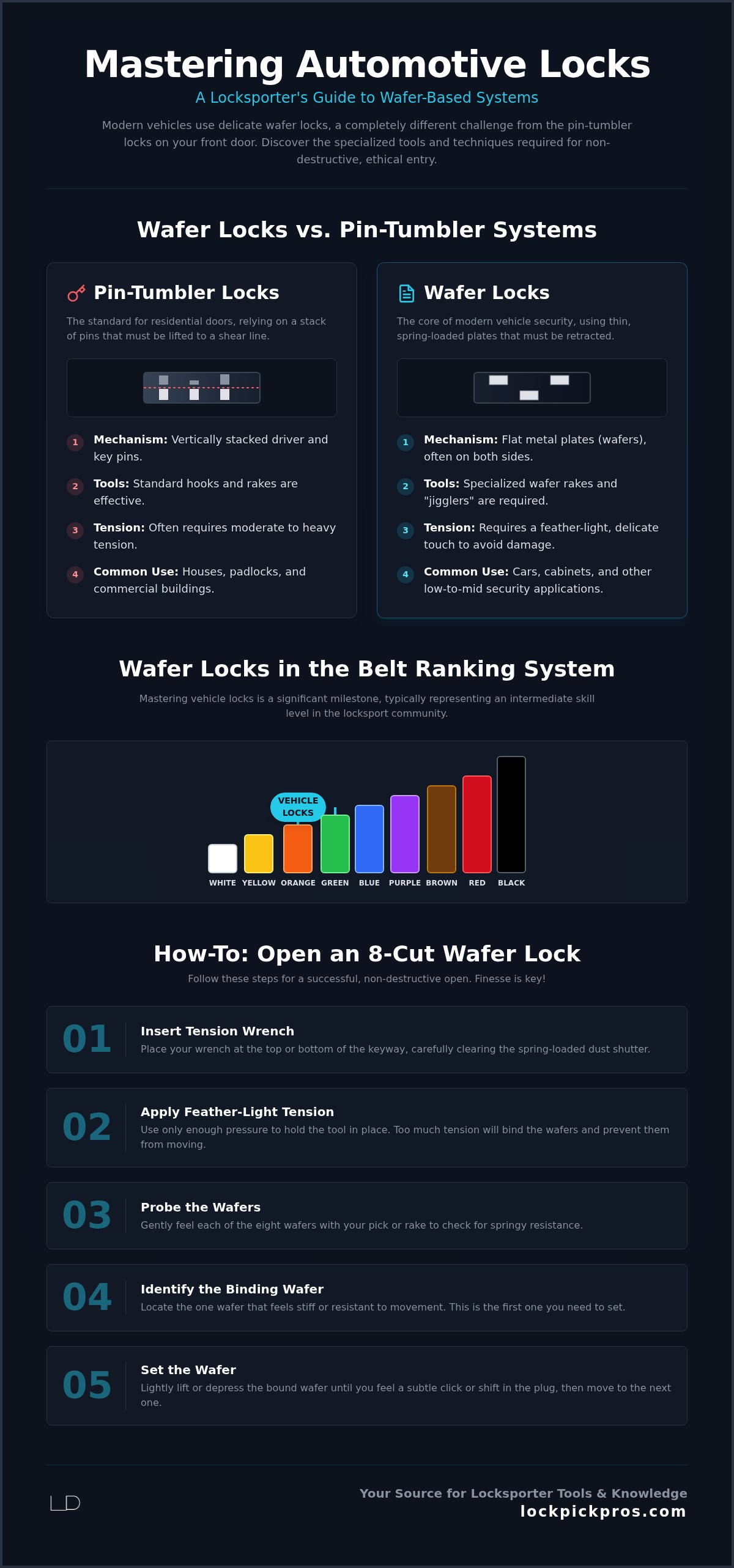
Understanding the internal mechanics of a wafer lock is your first step. Unlike pin-tumblers that move vertically in a stack, wafers are flat metal plates that retract into the plug when the correct key is inserted. Most car doors use double-sided wafers. This means your standard hook picks often fail because they can't reach the opposing side of the keyway effectively. In the auto-entry world, "jiggling" becomes a refined science. You'll often use specialized rakes or "jigglers" that mimic the biting of a key. Single pin picking (SPP) is still possible, but it requires tools that can navigate the cramped, often shuttered keyways of a vehicle.
Ranking Vehicle Locks in the Belt System
Where do these locks fit in your journey? Mastering vehicle entry is a major milestone in our Lock Picking Belt Levels Explained guide. Most common wafer locks map perfectly to the Orange and Green belt tiers. They provide a significant jump in difficulty from basic padlocks but aren't as intimidating as high-security dimple locks. If you're serious about progressing toward your Black Belt, you need to get comfortable with these systems. A great way to start is by setting up a practice station with a salvaged ignition cylinder. It's an affordable way to get hands-on experience with The Trainee 2.0 or similar entry-level automotive locksmith tools without risking your own daily driver.
Mastering Wafer Locks: The Core of Vehicle Entry
Transitioning from standard pin-tumbler locks to automotive systems feels like switching from a hammer to a scalpel. You need a specialized set of automotive locksmith tools that respect the delicate nature of wafer-based cylinders. While your standard hook might get you through a front door, car locks require tools that can interact with double-sided wafers without binding. It's a different game entirely. Once you understand the feedback, it's incredibly rewarding. This is a pivotal moment in your pick set selection journey as you move toward intermediate challenges.
For many in our community, The Trainee 2.0 kit serves as the perfect foundation for beginner lockpicking practice on these systems. Take the common Ford 8-cut (H75) wafer lock as a prime example. This lock features a stack of eight wafers that alternate sides within the keyway. Unlike the heavy brass pins in residential locks, these wafers are thin metal plates that are easily bent. When you start practicing, tension is your most important variable. If you apply heavy pressure, you'll pin the wafer against the housing so hard it won't move. Instead, use a feather-light touch. This level of precision is exactly what's taught in professional locksmith certification and training, and it's what separates a master hobbyist from a novice.
Follow these steps for a successful open on an 8-cut wafer cylinder:
- Insert your tension wrench into the top or bottom of the keyway, ensuring you clear the spring-loaded dust shutter.
- Apply just enough pressure to hold the wrench in place; think of it as the weight of a penny.
- Gently probe the eight wafers to feel for springy resistance.
- Identify the binding wafer. In these models, there are no security pins, but the wafers can "click" into false positions if the cylinder is worn.
- Lightly lift or depress the bound wafer until you feel a subtle shift in the plug.
Using Jiggler Keys and Try-Out Sets
Jiggler keys are a staple for any vehicle entry kit. These tools simulate various bitting patterns, acting as a "best guess" for the lock's internal code. The secret isn't just turning the key; it's the "vibration" technique. You gently rattle or bounce the jiggler while applying slight turning pressure. You're looking for that sweet spot where the wafers align with the shear line for just a fraction of a second. A 10-piece standard auto jiggler set is usually enough to cover most common domestic models found in practice stations.
Single Wafer Picking (SWP) Techniques
When jigglers don't work, it's time for Single Wafer Picking. Use a half-diamond or a small hook to manipulate each wafer individually. This is where you'll really appreciate high-quality gear. The feedback through Carbon Fiber Gen 2 Pro Series picks is unparalleled. It allows you to feel if a wafer is set or over-set. If you push a wafer too far, it will bind the cylinder. When this happens, you must slowly release tension until you hear a faint "click," indicating the over-set wafer has dropped back into position. If you're ready to feel the difference that professional-grade materials make, consider upgrading to the Carbon Fiber series to sharpen your tactile sensing.
Precision Decoding and Advanced Entry Tools
Opening a vehicle door is a thrill, but real mastery lies in decoding the cylinder. Decoding is the science of reading exact wafer or pin positions to determine bitting depths. This skill allows you to understand the lock's internal code; it lets you "see" the key without holding it. For the serious hobbyist, this is where automotive locksmith tools evolve into sophisticated diagnostic gear. It's the difference between a lucky open and a repeatable, professional result.
In the locksport community, we look toward professional standards to refine our craft. Organizations like the National Automotive Service Task Force (NASTF) ensure technical information remains high across the industry. By adopting a mindset of precision, you elevate your practice to a high-level technical challenge. Mastering bitting depths is a requirement for anyone aiming for the upper tiers of the belt system, as it requires a deep understanding of manufacturer-specific tolerances.
The Rise of 2-in-1 Picking and Decoding
The 2-in-1 tool has revolutionized how we approach vehicle locks. These instruments feature a built-in grid system that aligns with the wafers inside the keyway. As you pick each wafer, the external scale allows you to "read" the depth of that specific cut. It's a dual-purpose process: you pick the lock to the open position and simultaneously record the code. Because of the coordination required, these tools are generally considered Green Belt level and above. Regularly clean the tracks to prevent grit from giving false readings, and check that the tension arm hasn't bent out of alignment during a difficult pick.
Specialty Tools for Kaba and High-Security Systems
When you encounter high-security dimple systems like the Kaba Quattro S, standard picks are useless. These locks feature up to 22 pins arranged in four radial rows. The pin stack is notoriously difficult, often including serrated or spool security pins to thwart manipulation. For these Blue Belt challenges, you need specialized gear like the HUK High Quality 8pcs Kaba Lockpick Tools. These flag picks allow you to rotate and lift pins with extreme precision.
Follow these steps to navigate a high-security Kaba dimple cylinder:
- Apply light tension to avoid binding the security pins too early in the stack.
- Use a flag pick from your automotive locksmith tools kit to probe the four rows of pins, searching for the one that is binding.
- If you hit a spool pin, you'll feel counter-rotation; slowly reduce tension to let the pin set without dropping others.
- Systematically work through all 22 pin positions, checking each row until the plug rotates.
Ethical Guidelines and Legal Carrying of Auto Tools
Carrying automotive locksmith tools is a privilege that comes with a strict ethical burden. At Lockpick Pros, we live by a simple code: never pick a lock you don't own or have explicit, written permission to open. This isn't just about staying out of trouble; it's about protecting the reputation of the locksport community. When you're seen with specialized vehicle entry gear, people might make assumptions. It's your job to prove those assumptions wrong by acting as a responsible hobbyist at all times. We treat this as a technical sport, where the goal is mastery of a skill, not the illicit defeat of security.
In many regions, the mere possession of these tools can be viewed as "prima facie" evidence of criminal intent. This means the burden of proof often shifts to you to show why you have them. One of the best ways to demonstrate your status as a sport picker is by keeping your gear organized. Never carry picks loose in your pocket or glove box. Instead, use a dedicated carrying case. This shows that your tools are part of a curated kit for skill development, not a set of implements for a quick, clandestine bypass.
Proving Lawful Intent for Hobbyists
If you're traveling with your kit, always carry a few standalone practice locks with you. Having a salvaged ignition cylinder or a cutaway door lock in your bag provides immediate context for your automotive locksmith tools. It proves you're practicing a technical skill. Additionally, being an active member of communities like the LPU (Lockpickers United) or specific Reddit groups helps establish your identity as an ethical picker. If you're ever questioned, being able to show your belt rank progression or social media posts of your practice sessions can be a powerful way to prove your lawful intent and commitment to the sport.
The "Never Pick a Car in Use" Rule
There's one rule that every mentor in this sport will tell you: never pick a car that you rely on for transportation. It doesn't matter if it's your own vehicle. Automotive locks are surprisingly fragile. A single bent wafer or a snapped spring can brick your ignition; this leaves you with a massive towing bill and a dead car. Always stick to "junkyard" cylinders or practice locks mounted to a workbench. This allows you to push your limits and test new techniques without the risk of real-world consequences. For those moving into intermediate tiers, practicing on a variety of salvaged locks is the only way to truly master the feedback required for a clean open. Ready to build a kit that reflects your commitment to the sport? Check out our Carbon Fiber Gen 2 Pro Series for tools that match your professional ethics.
Curating Your Professional Automotive Tool Kit
Starting your journey in beginner lockpicking doesn't mean you need to buy every gadget on the market. In fact, over-complicating your gear early on can actually slow your progress. You need a foundation that prioritizes feel over automation. A smart pick set selection is one that mirrors your skill level. As you move through the belt ranks from White to Green, your focus should shift from simple raking to the precise manipulation of double-sided wafers. This is where your investment in quality automotive locksmith tools really pays off.
The Pro Series Expansion is designed exactly for this transition. It rounds out your capabilities without the clutter of luxury tools like expensive electronic decoders that do the work for you. In locksport, we want to earn the open ourselves. Stick to high-yield automotive locksmith tools and specialized tensioners that give you the feedback needed to outsmart the lock's security features.
The Intermediate Auto-Entry Setup
Once you've mastered basic practice locks, your setup needs to become more specialized. Pairing the Carbon Fiber Special with a dedicated set of wafer jigglers is the gold standard for intermediate auto-entry. The carbon fiber handles translate vibrations far better than plastic; this is vital when you're hunting for that subtle click in a car door. Don't forget a pinning tray. When you start rekeying salvaged cylinders to challenge your friends, you'll need a secure place for those tiny wafers and springs. A high-quality tension set for double-sided locks is the final piece to ensure you aren't blocking your own pick path.
Joining the Black Belt Challenge
The path to mastery is more fun with a crew. Our Black Belt Challenge is a free, community-driven program that rewards your progress. It's a simple share-to-earn loop. Document your automotive "picks-in-action" and share them on social media. Whether it's a clean open on a salvaged ignition or a successful decoding session, your progress helps the whole community. We've even set up a community bounty for hitting social reach goals. This helps you earn points toward specialty gear and high-tier tools. Progress one belt at a time, upgrade your kit at each rank, and show the world what an ethical lockpicker can do. Join the challenge today and start earning your way to the top!
Ready to Master the Vehicle Keyway?
You've seen how the shift from pin-tumblers to wafer systems changes the game for every ethical picker. Transitioning to automotive locksmith tools isn't just about adding new gear to your bag; it's about refining your tactile feedback and understanding manufacturer-specific bitting depths. By focusing on non-destructive entry and precise decoding, you aren't just opening doors. You're mastering a technical craft that sits at the very heart of high-tier locksport. Our specialized precision Carbon Fiber tools are designed to give you that expert-level feedback needed for these complex systems.
Remember to keep your practice ethical by sticking to salvaged cylinders and standalone stations. This protects your gear while you climb the belt ranks toward mastery. We're excited to see your "picks-in-action" content as you tackle these new challenges. Our free Black Belt Challenge is open for all skill levels, so there's never been a better time to start. Take the Black Belt Challenge and upgrade your automotive kit today! Your journey to the top of the locksport community starts with the right foundation. Happy picking!
Frequently Asked Questions
What are the most essential automotive locksmith tools for beginners?
Beginners should start with a set of wafer jigglers and a specialized tension kit. These tools allow you to learn the basic vibration techniques used on common domestic models. Adding a foundational kit like The Trainee 2.0 provides the essential picks needed to probe individual wafers. These automotive locksmith tools are more forgiving than professional decoders and help you build the necessary tactile sensitivity for the sport.
Can I pick a car lock with a standard lock pick set?
You generally can't use a standard residential kit for car locks effectively. While a small hook might work on some single-sided wafers, most modern vehicles use double-sided keyways that require specific profiles. Standard picks often lack the reach or the geometry to interact with wafers on both sides of the cylinder. Dedicated automotive locksmith tools are engineered to navigate these cramped spaces without binding the internal components.
Are automotive lock picks legal to own for hobbyists?
Ownership is legal in most jurisdictions, but your intent must remain ethical and sport-focused. In the locksport community, we carry tools alongside practice locks to demonstrate a legitimate hobbyist interest. Always check your local laws regarding "prima facie" evidence of intent. Carrying your kit in a professional case and maintaining a clear belt-ranking progression helps prove you're a student of the craft rather than a bad actor.
What is a Lishi tool and do I need one for locksport?
A Lishi tool is a 2-in-1 device that picks and decodes a lock simultaneously using a built-in grid scale. While they are incredibly powerful, they aren't strictly necessary for absolute beginners. In our community, using these tools is often considered a Green or Blue belt challenge. They're perfect for advanced hobbyists who want to master the science of bitting depths and manufacturer-specific tolerances.
What are wafer locks and why are they found in cars?
Wafer locks use flat metal plates called wafers instead of the cylindrical pins found in common padlocks. Manufacturers use them in vehicles because they're compact and handle road debris, ice, and dust better than pin-tumbler systems. Because the wafers are spring-loaded and move within the plug, they require a different picking style. This usually involves jigglers or refined single-wafer manipulation to find the shear line.
How do I avoid damaging a car lock while picking?
Light tension is the most effective way to prevent internal damage. Applying too much force can bend the thin metal wafers or snap the small springs that hold them in place. Always practice on salvaged cylinders rather than a vehicle you rely on for daily transport. If a wafer feels completely stuck, release tension and start over rather than trying to force it past the binding point.
What belt rank is required for automotive lockpicking?
Automotive picking typically enters the scene at the Orange or Green belt tiers. Basic wafer locks provide a solid step up from simple residential padlocks. As you progress toward Blue and Black belts, you'll encounter high-security "sidewinder" locks and complex laser-cut systems. These advanced ranks require specialized tools and a deep understanding of how to decode cylinders without having a working key present.
Is it possible to decode a car lock without a key?
Yes, it's entirely possible to decode a lock by reading the wafer heights with specialized tools. By using a 2-in-1 decoder, you can identify the exact depth of each cut in the keyway. This allows you to determine the lock's internal code and essentially "see" the key profile. It's a high-level skill that bridges the gap between simple picking and professional-grade technical mastery.