

Best Lock Pick for Tight Keyways: How to Choose in 2026
The thinnest pick isn’t automatically the best lock pick for tight keyways. If a profile rubs against the warding, it can crowd the keyway and make subtle feedback harder to feel. That frustration is familiar to locksport hobbyists who find that a standard pick feels too wide. A better choice balances profile thickness, shape, and handle feel rather than relying on one measurement.
This guide explains which profile characteristics matter in restricted keyways and how tactile feedback can help you compare tools during authorized practice. The Carbon Fiber Gen 2 - Pro Series has pick profiles 0.48 mm to 0.5 mm thick. The Pro Series Expansion adds 10 picks, including micro profiles, short rakes, and specialty picks. Both have real carbon-fiber handles, which transmit vibrations from pins to the picker. Compare the specifications with your practice goals, and use picks only on locks you own or have explicit permission to pick. Never pick a lock that is in use.
Key Takeaways
- Choose the best lock pick for tight keyways by comparing profile thickness, height, and length as separate measurements.
- Side contact inside a restricted keyway can affect tactile feedback, and fit can vary from lock to lock.
- Compare the Pro Series core set, the micro-profile Expansion, and the 26-pick Pro Max by their documented contents and specifications.
- Use a practical buying framework to match set contents and dimensions to your locksport practice goals.
- Keep practice ethical: pick only locks you own or have explicit authorization to use.
Why Tight Keyways Change the Lock Pick You Need
A tight keyway gives a pick less room to move because of its shape, internal warding, or both. The challenge isn’t simply that the opening looks narrow. A winding path or protruding ward can restrict where a tool can travel and how freely its tip can move. Keyways differ, so a profile that moves comfortably through one may rub against another.
That contact matters because locksport depends on touch as well as sight. A pick rubbing along the side can add friction that feels like resistance from a pin, making feedback harder to interpret. The best lock pick for tight keyways is not automatically the thinnest option. Fit depends on the particular lock’s internal geometry, the pick’s thickness and shape, and the picker’s control.
Restricted access describes how much room a tool has to move. It does not, by itself, describe a lock’s overall security level. Keyway shape is one factor in tool fit, while a lock’s difficulty can depend on other features too. A narrow-looking opening alone isn’t enough to judge how challenging a lock will be.
How keyway warding affects pick fit
Warding is the internal geometry that guides a key and limits movement through the keyway. In locksport practice, those surfaces can also constrain a pick’s path. If the pick repeatedly meets the sides, extra friction can mask subtle changes in pin feedback. This overview of lock picking techniques and tools provides useful background, but the feel of a particular keyway still depends on its own shape.
Think of fit as a relationship, not a universal measurement. A profile may move freely through one restricted path yet make unwanted side contact in another. During authorized practice, notice whether resistance seems to come from the lock’s components or from the tool pressing against the keyway. Don’t assume every narrow opening behaves alike.
Why thinner does not automatically mean better
Profile thickness measures the pick itself. Handle thickness describes the part held between the fingers, while profile shape includes the working end’s contours and dimensions. These are separate considerations. A slimmer profile may offer more clearance, but its shape still needs to suit the available path, and you need to be able to control it while reading tactile feedback.
Specialty profiles are intended for particular tool-and-lock contexts, not every restricted keyway. For instance, dimple lock picks are a distinct tool category, not a general substitute for standard pin-tumbler picks. Choosing by category and documented dimensions helps set realistic expectations: no profile promises fit across all locks.
For ethical locksport, compare the tool with your practice lock and pay attention to how its profile moves and feels. Pick only locks you own or have explicit authorization to use, and never pick a lock that is in use. That makes fit a useful selection criterion instead of a guess based on appearance alone.
Which Pick Features Matter Most in a Tight Keyway?
Compare a pick by its working profile, not by a single “thin” label. Thickness, height, and length describe different dimensions, and each can affect how the tool sits and moves. Measurements help you compare options on paper, but they can’t predict how a profile will feel in every keyway. The lock’s internal shape and your control still matter.
Use this specification check to keep the measurements straight:
- Thickness measures the pick profile’s material from side to side.
- Height describes the profile’s vertical dimension.
- Length describes the profile’s stated length, a separate measurement from height.
- Handle thickness refers to the part held in your fingers, not the working profile.
Specification snapshot: Gen 2 series profile thickness is 0.48 mm to 0.5 mm, profile height is 1 mm to 2 mm, and listed profile lengths differ by product. These dimensions describe the tools, not guaranteed compatibility with a lock.
Profile dimensions and controlled feedback
For the Carbon Fiber Gen 2 - Pro Series, the stated profile length is 38 mm. The Gen 2 Pro Max - Stealth Edition has a stated profile length of 40 mm. Those lengths should not be applied to the Pro Series Expansion, for which no profile length is specified here. Review each dimension separately, then consider how profile shape and side contact may affect your ability to read feedback.
Two picks with similar thickness can have different lengths and heights, and those differences may change how each profile moves in a particular keyway. Use specifications to narrow your choices, not as a promise that a pick will fit. For more context on lock picking tools and physical security, remember that tools are only one part of understanding a lock mechanism.
Handle comfort and material
All carbon-fiber pick handles are 2.5 mm thick. The handles are real carbon fiber, a material that transmits vibrations from pins to the picker. That can be useful when you’re paying close attention to tactile feedback. Handle thickness and material are separate from the working-profile dimensions, so don’t use one measurement as a substitute for another.
Comfort is personal. A handle that feels suitable in a short practice session may feel different over a longer one, so consider grip and control alongside profile specifications. The Carbon Fiber Gen 2 Pro Series pick set offers a defined starting point for comparing these features. Use it only on locks you own or have explicit authorization to practice on.
Pro Series, Expansion, or Pro Max: Which Fits Your Needs?
Choose by the kind of practice you want to support, not by the largest piece count. The Pro Series is a core set for building familiarity with a range of profiles. The Expansion adds specialist profile choices, while the Pro Max brings together a wider pick selection and Elite Series tensioners. Comparing their contents helps narrow the options, but no set promises a fit for every keyway.
| Set | Contents | Intended role | Confirmed specifications | Price |
|---|---|---|---|---|
| Carbon Fiber Gen 2 - Pro Series | 16 stainless-steel picks and 6 tensioners | Core set for developing a broad practice foundation | Profile thickness 0.48 mm to 0.5 mm; profile length 38 mm; profile height 1 mm to 2 mm | $119.97 USD |
| Pro Series Expansion | 10 picks, including micro profiles, short rakes, and specialty picks | Specialist-profile addition | Micro profiles, short rakes, and specialty picks | $94.97 USD |
| Gen 2 Pro Max - Stealth Edition | 26 stainless-steel picks, 6 Elite Series tensioners, and a carbon-fiber case with a magnetic close | Broader pick selection with Elite Series tensioners | Profile thickness 0.48 mm to 0.5 mm; profile length 40 mm; profile height 1 mm to 2 mm | $199.97 USD |
When a core set is the practical starting point
If you want a defined selection to learn with before adding specialist tools, the Carbon Fiber Gen 2 - Pro Series is the core-set option. Its hooks, rakes, and specialty profiles give you a range of tool types for practice, and the included tensioners let you compare which options feel manageable in your hands. The Carbon Fiber Gen 2 Pro Series set is a practical starting point for building familiarity with your tools.
Approach selection as a learning process. During authorized practice, note which profiles you reach for and which feel easiest to control. That experience can help you decide whether a core set meets your goals or whether a specialist addition would give you useful options.
When specialist profiles add useful choice
The Pro Series Expansion adds variety through micro profiles, short rakes, and specialty picks. Its stated contents make it an option if you already have a core selection and want more profile types to consider. The available specifications describe its contents, not particular dimensions or guaranteed fit.
The Gen 2 Pro Max - Stealth Edition offers a wider pick selection, Elite Series tensioners, and a magnetic-close carbon-fiber case. It may suit a picker who wants more options gathered in one set, while the Expansion may be a better match if your goal is to add specialist profiles to an existing selection. Neither is a universal winner. Compare what each set adds to your current practice tools and choose based on the profiles you want to explore. The Pro Series Expansion and Gen 2 Pro Max Stealth Edition serve different selection needs. Practice only on locks you own or have explicit authorization to use.
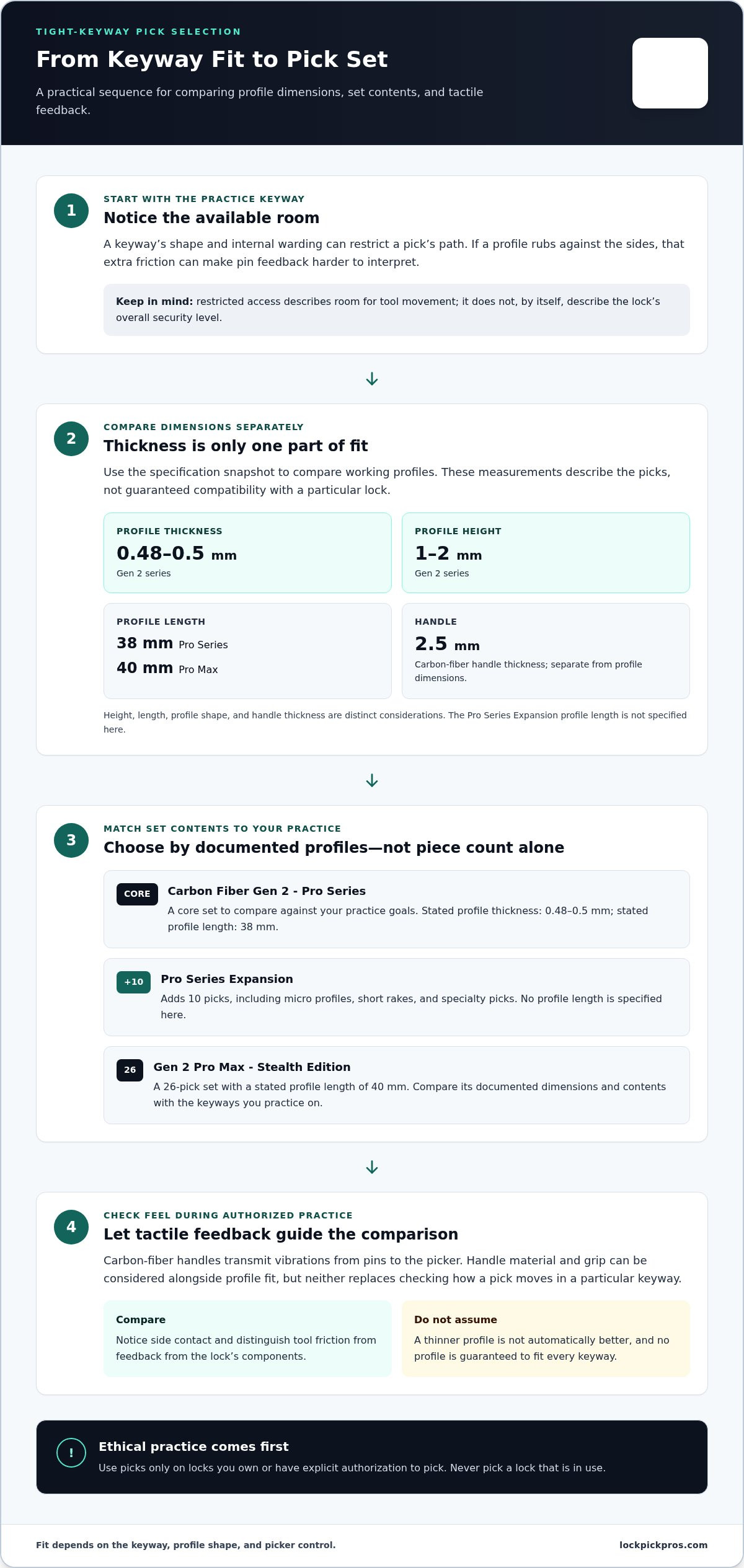
How to Choose a Tight-Keyway Pick Set for Ethical Practice
A useful set starts with a clear practice goal, not a promise that one slim profile will fit every lock. Use this four-part framework to compare tools, set realistic expectations, and build skill responsibly.
- Define your practice context. Decide whether you’re learning standard pin-tumbler fundamentals or exploring restricted keyways with locksport practice hardware. Use locks you own or have explicit authorization to pick, and never pick a lock that’s in use.
- Compare profile dimensions. Check thickness, height, and length as separate specifications. Compare those measurements with the keyways in your practice locks, but don’t treat a dimension as proof of compatibility. Feel also depends on the profile shape and your control.
- Review the set contents. A core set gives you a foundation for broad practice. Specialist profiles can add variety when restricted keyways are part of your learning goal. Count the included picks and tensioners, and consider whether the profiles match the practice you plan to do.
- Consider support and reassurance. Lockpick Pros picks and kits are backed by a lifetime warranty. The 30-day return / 100% satisfaction guarantee is another factor to consider when comparing a set with your needs.
Match the set to the practice goal
For foundational practice with standard pin-tumbler locks, a core set offers a defined starting selection. If your goal is to explore restricted keyways, specialist profiles add more options to compare during authorized practice. Neither choice replaces careful tool control: pay attention to how the pick moves and whether your handling lets you interpret tactile feedback. Choose for the skill you want to develop, not for a claim of universal fit.
That distinction keeps a purchase focused. A picker building fundamentals may value a core selection, while someone refining profile choice may prefer specialist variety. There’s no need to add tools before you have a practice purpose for them.
Check responsible use and purchase reassurance
Lockpicking is legal in most areas when tools aren’t used for illegal purposes, but laws vary by location. Use picks only on locks you own or have explicit authorization to practice on. Product contents and specifications help with comparison; responsible use and consistent control remain part of the practice.
Ready to compare a core option for your practice goals? Compare tight-keyway pick options and weigh the documented set contents against the locks you’re authorized to practice on.
Choose Your Tight-Keyway Set and Keep Building Locksport Skills
Let your next practice goal guide your choice. A set is a starting point for learning, not a promise that a pick will fit a particular lock. Consider whether you’re establishing a foundation, adding profile variety, or looking for a broader selection for your locksport progression.
A quick decision guide
- Core set: Consider this route if you want a foundation for learning your tools before adding specialist options.
- Expansion: Choose an add-on approach if you already have a core selection and want to explore more profile variety as your practice develops.
- Pro Max: Consider a broader set if you prefer a wider range of tools as your skills and practice goals grow.
There’s no single right pace. Start with the option that fits your current learning stage, then use practice sessions to notice which profiles you handle with the most control. Add tools with a specific learning goal in mind rather than expecting a larger set to solve every fit challenge.
Continue learning with a focused practice path
Build a simple progression: set a skill goal, practice consistently, record which tools you tried, and use those observations to shape your next step. Keep your locksport practice ethical by using only locks you own or have explicit authorization to use. Never pick a lock that is in use.
The free Black Belt Challenge gives ethical lockpickers a way to keep progressing. Joining starts an email sequence where participants move through belt ranks, earn reward picks, and share picks-in-action content using Lockpick Pros tools. Those posts contribute to the challenge’s $5,000 bounty tied to reaching its social reach goal. Join free, progress one belt at a time, build your tool selection as you advance, and share your progress on the path to black belt.
Join the free Black Belt Challenge and make your next practice milestone part of a community progression.
Ready to choose a core option for your practice journey? Choose the Carbon Fiber Gen 2 - Pro Series and keep building your locksport skills through thoughtful practice.
Build Your Next Locksport Practice Session
Turn tool selection into a steady learning habit. Keep a simple practice log: note which pick you used, how controlled it felt, and what you want to compare next time. Over several sessions, those observations can help you choose tools based on your own experience rather than appearance alone. The best lock pick for tight keyways is the one that supports careful, informed practice with the lock in front of you, not a promise of universal fit.
Set a focused goal for your next session, then give yourself time to notice how your tools feel. Progress in locksport comes from patience, curiosity, and respect for the ethical code. Practice only on locks you own or have explicit authorization to use, and never pick a lock that is in use.
Ready to choose a core set for your practice journey? Choose the Carbon Fiber Gen 2 - Pro Series and keep building your skills one thoughtful session at a time.
Frequently Asked Questions
What makes a lock pick suitable for a tight keyway?
A pick should suit the practice lock and be controllable without forcing it through the keyway. First identify the lock type and your practice objective, then compare the intended pick category and its listed specifications. Product details can narrow your options, but they can’t establish that a pick is compatible with a particular lock. Use dedicated practice hardware and stop if a tool requires force.
Is a thinner lock pick always better for narrow keyways?
No. A slimmer pick may provide more clearance, but that doesn’t necessarily make it easier to control or right for your practice. Pick shape and handling matter too. If you’re new to the hobby, choose a tool you can guide carefully, then build familiarity before trying additional profiles. Don’t treat thinness by itself as a measure of suitability or expected results.
Which Lockpick Pros set is designed with micro profiles?
The Pro Series Expansion includes micro profiles, short rakes, and specialty picks. It’s a specialist addition for pickers seeking more profile choices in their locksport practice. Consider your existing tools and learning goals when deciding whether that addition is useful. The product name or profile category alone can’t predict how a pick will fit a specific lock.
What is the profile thickness of the Carbon Fiber Gen 2 - Pro Series?
The Carbon Fiber Gen 2 - Pro Series profile thickness is 0.48 mm to 0.5 mm. That is a tool specification, not a promise about performance in a particular lock. Use the listed product information to distinguish the pick profile from other tool measurements when comparing options.
Can beginners use picks intended for tight keyways?
Yes. Beginners can learn with picks intended for restricted keyways by practicing patiently with suitable practice hardware. Lockpick Pros sets are designed for beginners as well as professionals, and every purchase includes access to the Lockpicking Bootcamp video series. Focus on learning the tools and their feel before deciding whether specialist profiles fit your ongoing practice goals.
Is it legal to own lock picks?
Lockpicking is legal in most areas when tools aren’t used for illegal purposes, but rules can vary by jurisdiction. Don’t assume that the rules where you live apply everywhere you travel. Before carrying picks across state or local boundaries, consult current official sources for the places involved. This general information isn’t legal advice; responsible hobbyists stay informed about applicable rules.