

Master Lock Padlock Difficulty Comparison: A Locksport Belt Guide
A familiar Master Lock can be a tougher practice challenge than its packaging suggests. For a useful Master Lock padlock difficulty comparison, look to community belt rankings rather than the manufacturer’s security rating, which measures resistance to destructive attacks, not picking difficulty.
If you’ve found conflicting opinions about basic models, you’re not alone. Belt rankings are community guides, and locks of the same model can feel different because of variations in tolerances and key bitting. The Lock Pickers United Belt Explorer and the r/lockpicking wiki offer a shared reference point, not a guarantee of how any one lock will behave.
This guide compares confirmed Master Lock examples by practice level, from White Belt models such as the #1 and #3 to the Yellow Belt 140/141 series, the Orange Belt 150, and the Green Belt 410 LOTO. You’ll see what each level generally asks of a picker and how to choose a suitable next challenge, without step-by-step picking instructions. Use the rankings to plan ethical practice on locks you own or have permission to work on, and treat each belt as a guide for steady progress.
Key Takeaways
- Use the Master Lock padlock difficulty comparison as a practice-selection guide, not a promise that every lock of a model will feel the same.
- Consult the belt-level chart to compare confirmed models and their general practice context without relying on manufacturer security ratings.
- Choose a next challenge by identifying your current level, checking the community ranking, and moving up one step at a time.
- Practice only on locks you own or have clear permission to use, and build your skills with ethical locksport habits.
- Video Bootcamp tutorials are included with every purchase as a learning resource for your practice path.
What a Master Lock Padlock Difficulty Comparison Can, and Cannot, Tell You
A Master Lock padlock difficulty comparison helps you choose a practice challenge that fits your current locksport experience. It organizes models by community belt references, giving you a useful starting point for progression. It can’t predict exactly how a particular lock will feel, and it isn’t a rating of how well that lock resists real-world attacks.
Think of a belt label as a shared practice marker, not a universal measurement. Two locks with the same model number can offer different experiences because of their condition and individual variation. Wear, use, and differences between individual locks may affect how they behave during practice. A model’s ranking is still useful, but it shouldn’t be treated as a promise that every example will feel identical.
Why brand reputation is not a belt ranking
A brand name alone doesn’t tell you where a lock belongs in locksport progression. Community rankings focus on picking difficulty, while claims about strength or resistance address a different question. Don’t use a broad brand reputation or a security label as evidence of belt placement. A named model needs a community reference to support its practice-level comparison.
How to read community difficulty labels
Belt labels are progression markers used by locksport communities to group practice locks by challenge. They help hobbyists choose a suitable next step, but they aren’t precise measurements shared by every ranking list. Community references can differ or be updated, so check which model and belt assignment a chart actually names. For background on the hobby and its techniques, see Lock picking techniques and locksport.
This guide compares only Master Lock models with supplied community belt references. For example, the Master Lock #3 is included as a White Belt reference. That label gives you context for selecting practice hardware; it doesn’t establish how every #3 will behave or make a claim about its resistance to forced entry. Keep picking difficulty and real-world security in separate categories.
The comparison is also limited to the lock types and rankings it covers. A padlock belt chart shouldn’t be assumed to classify other mechanisms. Dimple locks, for example, call for a separate practice context and equipment, such as specialized dimple lock picks. That distinction keeps the Master Lock comparison focused on its stated purpose: helping you select a padlock practice challenge by community reference, not teaching entry or bypass.
Use the chart as a guide, then let your own practice experience inform what comes next. Choose locks you own or have clear permission to use, and treat belt labels as a helpful map rather than a guarantee. With that scope in mind, the model-by-model examples can help you make a more informed practice choice.
How Locksport Rankings Compare Master Lock Practice Difficulty
A belt ranking reference turns community experience into a practical progression. It groups locks by the challenge they represent for locksport practice, helping hobbyists compare options and choose a reasonable next goal. The Master Lock padlock difficulty comparison in this guide uses model-specific community references, not step-by-step instructions for opening or bypassing locks.
A belt rank is a community practice benchmark, not a universal measurement of every lock or its security. It gives learners a common way to discuss progression, while leaving room for differences in individual locks and in how ranking lists are maintained.
What a belt level represents in practice
Belts provide a framework for ethical practice, from foundational challenges toward more demanding ones. Moving through the levels can help you set goals, reflect on your progress, and select practice hardware with a suitable degree of challenge. A rank doesn’t describe every feature of a lock, certify its overall security, or guarantee that each example will feel the same. The model assignments appear in the chart that follows.
Keep the label in its lane. A locksport rank concerns the community’s assessment of picking difficulty, not resistance to cutting, drilling, or other forms of attack. Research on smart-lock vulnerabilities can address separate security questions; for example, the USENIX technical-session page covers Vulnerabilities in Master Lock smart locks. That topic shouldn’t be treated as evidence for a padlock’s belt placement.
Why model-specific verification matters
Confirm the exact model and its assignment in current community references, such as the Lock Pickers United Belt Explorer and the r/lockpicking belt-ranking wiki. Don’t infer a rank from a brand name, appearance, or a similar model. If the references disagree, say so plainly and treat the placement as uncertain rather than presenting one label as settled.
Before using a ranking to choose your next practice lock, check these details:
- Model identity: Match the full model designation, not just the brand or product family.
- Reference: See whether a community list assigns that specific model a belt level.
- Agreement: If sources differ, note the variation and avoid implying a single definitive rank.
- Scope: Use the belt label to guide practice selection, not to draw conclusions about real-world security.
This approach makes the comparison more useful and fair. It also keeps model identification distinct from instruction: the chart is a reference for selecting locks to practice on ethically, not a guide to defeating them. Practice only with locks you own or have clear permission to use.
For standard pin-tumbler practice, a belt-appropriate tool choice can support a steady learning plan. The Carbon Fiber Gen 2 - Pro Series is one option for that practice category; the right equipment still depends on your goals and the lock you’re working with.
Master Lock Padlock Difficulty Comparison: Confirmed Belt-Level Examples
This Master Lock padlock difficulty comparison arranges named models by their community belt references, so you can scan for a practice challenge that fits your progression. The assignments below are community rankings, not manufacturer ratings or guarantees about how a particular lock will feel. Model names and belt placements should be checked against current community references before publication and whenever you use the chart.
The notes describe broad practice context only. They don’t explain how to open a lock, identify its internal components, or recommend bypass techniques. Where several models share a belt category, use the exact model designation rather than assuming that a similar-looking padlock has the same ranking.
Basic Master Lock examples for early progression
The Master Lock #3 is a White Belt reference, while the 140 is listed at Yellow Belt. That makes them useful starting points for comparing early stages in the community framework, not interchangeable locks or a promise that the 140 will feel the same to every picker. For standard pin-tumbler practice, a dedicated set such as the Carbon Fiber Gen 2 - Pro Series can support a belt-appropriate practice plan.
Community belt-reference chart
- White Belt | Master Lock #1, #3, #5, and #7. Community references place these models at the entry level, making them examples to consider when beginning a belt-based practice path.
- Yellow Belt | Master Lock 140/141 Series, 930, and Magnum. These community-listed models represent a step beyond the White Belt examples. Check the full model designation, especially when comparing products in a series.
- Orange Belt | Master Lock 150, 160, 570, and 1145-1165D. These are references for the next stage of the chart. Their shared belt label is a progression marker, not a claim that every model offers an identical experience.
- Green Belt | Master Lock 410 LOTO, 911, Pro Series, and 931. These examples sit at the Green Belt level in the supplied community references and can help experienced hobbyists plan a later practice step.
A more advanced reference: Master Lock 410 LOTO
The Master Lock 410 LOTO is a Green Belt example in the community rankings. In this comparison, its value is as a marker for practice planning: it shows where a named model appears in the progression, without suggesting a method for defeating it. Use it only as an ethical practice lock you own or have clear permission to work with.
Read each row as a place to begin your research, not a final verdict. Community references can change, and exact model identification matters. Confirm a listing if a model’s placement is uncertain, then choose a next challenge that feels like a sensible step for your current experience.
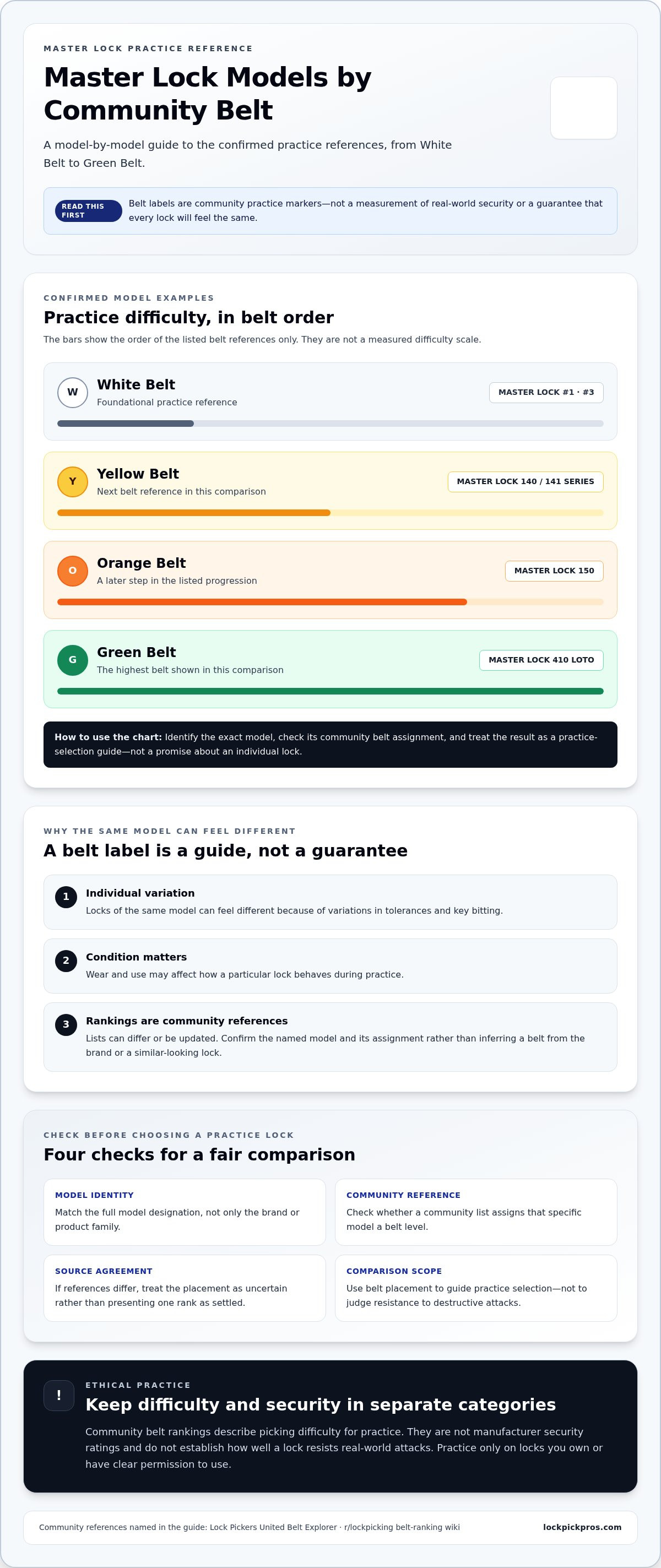
Choose Your Next Master Lock Practice Challenge by Belt Level
A good next lock should stretch your skills without turning practice into guesswork. Use the chart as a planning tool: start from your current belt or hands-on experience, identify a suitable community-ranked model, then choose a challenge one step beyond what feels familiar. A brand you recognize isn’t a reliable measure of how ready you are for a particular lock.
Match the next practice lock to your current experience
Follow a simple progression. If you’re new to belt rankings, use your practice history as a starting point. Compare the model and reference in the chart, then choose a modest increase in difficulty rather than leaping several levels. The Master Lock padlock difficulty comparison is there to help narrow your options, not to promise how a specific lock will behave.
- Identify your starting point. Note the belt level you’re working toward or the kinds of practice locks you’ve already spent time with.
- Check the exact model. Match its full designation to the community reference instead of relying on a similar appearance or series name.
- Choose one step onward. Select a manageable challenge, then allow time to learn from the experience before moving up again.
- Record what you observe. Keep notes on the model, condition, reference consulted, and how the practice session felt. Compare your observations with the ranking, without treating one session as a verdict on every lock of that model.
For developing hobbyists working with standard pin-tumbler practice, the Pro Series Expansion is an optional tool choice to consider as your practice needs change. Equipment can support a learning plan, but a higher-tier set alone doesn’t establish readiness for a more difficult lock.
Keep practice ethical and focused on learning
Keep your practice to locks you own or have explicit permission to use. Avoid testing skills on locks that are in service or belong to someone else without clear authorization. That boundary keeps locksport focused on learning, skill development, and respect for other people’s property.
The site FAQ notes that laws vary by location and that tools are lawful in most areas when they aren’t used for illegal purposes. That general statement isn’t a substitute for understanding the rules that apply where you live, so avoid relying on broad assumptions or state-specific claims without checking a reliable local source.
Use your notes to track progress, not to chase a guaranteed result. A community reference gives you a shared benchmark; your own practice record helps you decide whether to repeat a level or try the next one. Move at a steady pace, stay within ethical boundaries, and choose tools that suit the practice you actually plan to do.
For standard pin-tumbler practice, Explore the Carbon Fiber Gen 2 - Pro Series as an option for building a belt-appropriate practice setup.
Build an Ethical Locksport Practice Path with Lockpick Pros
Good locksport practice is built on patience, clear goals, and respect for ownership. Work only with locks you own or have explicit permission to use. A belt reference can help you plan what to practice next, while your notes help you notice progress over time. Keep the focus on learning and responsible hobby practice, not on testing locks that are in use.
Choose tools to support a steady practice routine
The Carbon Fiber Gen 2 - Pro Series is a tool option for standard pin-tumbler practice. It includes 16 stainless-steel picks and 6 tensioners. A set like this can support a consistent practice setup, but a belt label doesn’t guarantee compatibility with a specific lock or promise a particular result. Select practice hardware and tools for your own learning goals, then take time to build familiarity through ethical use.
Video Bootcamp tutorials are included with every purchase and can serve as a learning resource alongside independent practice. Use learning materials to support a routine: set a goal for each session, record which lock you worked with, and note what you learned. Observations can help you decide whether to stay with a current challenge or consider a next step. Progress may be gradual, and that’s a normal part of developing a careful, reliable hobby practice.
All picks and kits carry a lifetime warranty. For hobbyists seeking a standard pin-tumbler set to support ongoing practice, the Carbon Fiber Gen 2 - Pro Series offers a defined selection of picks and tensioners without tying the purchase to a promised belt result.
Continue belt-by-belt through the community
The free Black Belt Challenge is an optional way to follow belt progression and stay connected with the locksport community. Participants can share their progress and learn from community involvement as they continue their own practice path. Keep your posts and practice within ethical boundaries, and treat every belt as a milestone in a longer process of learning.
Choose a manageable goal, practice with permission, and return to the community references as your experience grows. A steady approach makes it easier to connect practice choices with your own progress while keeping the hobby responsible.
Explore the Carbon Fiber Gen 2 - Pro Series as a standard pin-tumbler tool option for your locksport practice.
Set Your Next Locksport Goal
Choose a practice goal that keeps you curious and gives you room to learn. The Master Lock padlock difficulty comparison can help you plan a next step, but your own steady, ethical practice is what shapes the experience. Keep working only with locks you own or have clear permission to use, and let community rankings guide your choices without treating them as guarantees.
For hobbyists building a standard pin-tumbler practice setup, the Carbon Fiber Gen 2 - Pro Series is manufactured in the USA and offers a focused tool option. Lockpick Pros also includes Video Bootcamp tutorials with every purchase, and all picks and kits carry a lifetime warranty.
Explore the Carbon Fiber Gen 2 - Pro Series as you plan your next practice session. Pick a manageable goal, stay curious, and keep progressing one challenge at a time.
Frequently Asked Questions
Is a Master Lock #3 always a White Belt lock?
No. The Master Lock #3 is a White Belt reference in the supplied community context, not a universal rule for every list or individual lock. Before choosing one for a practice session, check the current community reference and confirm the exact model. Condition can also affect the experience, so use the belt label to set expectations, then keep your own notes rather than treating it as a precise prediction.
Can I compare Master Lock models by brand alone?
No. The brand name doesn’t establish a model’s belt assignment or tell you how a particular example will feel in practice. Compare the full model name with a current locksport reference, especially when a product belongs to a numbered series. This Master Lock padlock difficulty comparison is meant to support ethical practice planning. It isn’t a measure of overall security and doesn’t explain how to open a lock.
How difficult is a Master Lock 140 compared with a Master Lock #3?
The supplied community context lists the #3 as White Belt and the 140 as Yellow Belt. That placement suggests the 140 is a step onward in the community’s practice progression, but it doesn’t mean every lock will feel harder in the same way. If you compare the models during separate practice sessions, note the exact model and your observations so one experience doesn’t stand in for all examples.
What belt level is a Master Lock 410 LOTO?
The Master Lock 410 LOTO is identified as a Green Belt reference in the supplied content context. Check its current assignment in a community ranking source before using that label to plan practice, since references may be updated. Treat Green Belt as a planning marker, not an instruction set. Keep practice limited to a lock you own or have clear permission to work with.
Can beginners use belt rankings to choose their next practice lock?
Yes. A beginner can use a community chart to get a sense of broad progression and select a manageable challenge. Start with a lock intended for practice that you own, or have explicit permission to use. For example, write down the exact model and the reference you consulted before a session. That makes it easier to compare your experience with the ranking without expecting identical results from every lock.
Is lockpicking legal in the United States?
Lockpick Pros’ FAQ says lockpicking is legal in most areas when tools aren’t used for illegal purposes. That general statement isn’t legal advice, and rules may vary by location and circumstances. Before practicing, check the law that applies where you live and use tools only for ethical locksport on locks you own or have permission to use. Don’t assume that a general answer settles every local situation.