

What Lock Should You Practice on After a Clear One? Choose Your Next Challenge
A clear lock can show you exactly how each pin moves, but that visual help can hide a key part of locksport: learning to read feedback through your pick and tension wrench. When you’re deciding what lock to practice on after a clear one, the best next step usually isn’t a harder mechanism. It’s a simple, opaque pin-tumbler lock that asks you to rely on feel.
That shift can feel confusing at first. Without visible pins, it’s harder to tell whether you’re making progress or simply moving the pick around. A gradual transition helps build tactile feedback and confidence without pushing you straight into advanced security features.
This guide will help you choose a suitable next practice lock, understand how to judge its difficulty, and follow a community-recognized belt progression. You’ll see how a metal cutaway or a basic opaque lock can bridge the gap, when to increase difficulty, and how belt rankings can help you select a sensible challenge. Practice only on locks you own or are authorized to use, and take the progression one step at a time.
Key Takeaways
- Choose what lock to practice on after a clear one by weighing how much visibility and tactile feedback you want in your next practice session.
- Compare clear, metal cutaway, and opaque locks to find a useful bridge between visual learning and practice guided by feel.
- Use a simple progression: review what you learned, change one practice variable, focus on feedback, then reflect before moving on.
- Match your tools to your practice goals, comfort, and the lock’s keyway; the Carbon Fiber Gen 2 - Pro Series is an option for standard pin-tumbler practice.
- Use community belt rankings as a reference for choosing a suitable next challenge, and practice only on locks you own or are authorized to use.
What a Clear Practice Lock Teaches, and What It Cannot Teach
A clear practice lock is a visual teaching aid: its transparent body lets you observe internal parts as you handle the tools. That view can make the relationship between tool movement and pin movement easier to understand. But watching a mechanism respond is not the same as interpreting its response by feel. A clear lock is a starting point, not a complete substitute for opaque practice.
The transition after clear-lock practice is about changing how you gather information, not immediately choosing a more complex mechanism. Keep the basic pin-tumbler format familiar while removing the visual cue. This gives you room to build tactile awareness before adding other challenges. If you're weighing what lock to practice on after a clear one, consider what the transparent body helped you learn, then look for a practice format that lets you apply those concepts by touch.
What visible feedback helps you notice
Through a clear body, you can observe parts moving in response to contact with a pick. That visual connection helps explain what is happening inside and gives context to the terms and techniques used in locksport. It can also make early practice less abstract: you see that tool movement has a physical response inside the lock.
Observation has limits, though. A visible pin moving doesn't tell you everything you would learn from changes in resistance or vibration. Those sensations travel through the pick and the tension wrench, the tool that applies rotational force to the plug and carries feedback back to your hand. For broader background on lock picking techniques and legality, consult the overview while keeping practice to locks you own or are authorized to use.
Why an opaque lock feels different
An opaque lock hides its internal components, but a standard pin-tumbler format keeps the mechanism familiar. With sight removed, attention shifts to tactile feedback: the pressure, movement, and vibration you can sense through the tools. At first, this information may seem subtle. That is a normal part of learning to read the mechanism by feel, not a sign that you have lost the understanding gained from a clear lock.
Give yourself time to notice patterns rather than expecting each attempt to provide an obvious answer. The goal at this stage is to connect sensations with the concepts you could previously see. As you practice, pay attention to which sensations are easy to recognize and which still need more observation. That distinction can help you choose a next practice format that suits your learning goals.
Why an Opaque Standard Pin-Tumbler Lock Is Usually the Next Practice Step
After a clear lock, a standard pin-tumbler practice lock with an opaque body is a measured next challenge. The pin-tumbler mechanism stays familiar, but you can no longer watch its internal parts respond. That shifts your attention to the information carried through the pick and tension wrench. The goal isn’t to make practice difficult all at once. It’s to learn how to recognize feedback without relying on sight.
Familiar mechanics make a more useful next challenge: you can focus on reading new tactile cues without also learning a different lock mechanism. That separation helps you identify what’s changing and gives you a steadier way to build confidence.
Choose familiar mechanics before added complexity
Change one factor at a time. Move from visible to opaque while keeping the basic pin-tumbler format, rather than immediately adding a different lock type or security features. A suitable practice lock depends on your experience and goals, so there isn’t one model that’s right for every beginner. Choose a straightforward example you can practice with consistently and ethically.
Locks with security pins introduce another source of feedback. A Spool pin, for example, has a narrowed waist that can catch at the shear line and create a false set. That can be a valuable challenge later, but it may distract from the first goal: learning to interpret familiar mechanics by feel. Keep your next step focused, then add complexity when you’re ready.
Recognize when to move beyond the first opaque lock
Use consistency, not speed, as your progress signal. Notice whether you can distinguish useful changes in resistance or movement across practice sessions. If those sensations are still hard to interpret, repeat the same learning stage instead of assuming you need a more advanced lock. Familiarity comes through deliberate practice, not a race to the next tier.
Once feedback feels more recognizable, consult a community belt ranking reference to help choose a suitable next difficulty. Rankings can provide a shared progression for locksport, while your own practice notes can show which skills still need work. Keep practice limited to locks you own or are authorized to use.
For standard pin-tumbler practice, the Carbon Fiber Gen 2 Pro Series includes 16 stainless-steel picks and 6 tensioners. It can be a practical tool set to consider as you move into opaque practice; all picks and kits have a lifetime warranty. Choose tools that suit the lock’s keyway and your comfort, then give yourself room to learn its feedback before adding another challenge.
Compare Clear, Cutaway, and Opaque Locks Before Choosing Your Next Practice Lock
Choosing what lock to practice on after a clear one comes down to the kind of feedback you want to work with. A clear acrylic lock makes internal movement visible. A metal cutaway lock keeps a metal body while exposing internal components. An opaque lock hides the mechanism, so practice depends on tactile feedback rather than sight. These formats can support different learning goals; they aren’t a required ladder that every picker must follow in order.
| Practice format | Visibility | Tactile realism | Useful learning role |
|---|---|---|---|
| Clear acrylic | Internal parts are visible | Limited by the clear training format | Observe how tool movement relates to pin movement |
| Metal cutaway | Internal components are exposed through a cutaway | Metal body preserves authentic friction | Connect visual observation with a more realistic feel |
| Opaque lock | Internal parts aren’t visible | Feedback comes through the tools | Practice interpreting the mechanism by touch |
Table note: Belt rankings can vary by community reference and lock configuration. Use them as a guide to compare difficulty, not as a guarantee that every example will feel the same.
Clear acrylic and metal cutaway locks
Clear acrylic is useful when you want to observe a mechanism directly. Its visibility can help explain what’s happening, but it also supplies information you won’t have with an opaque lock. A metal cutaway lock offers another teaching format: its side is milled away to expose components, while the metal body preserves authentic friction. Neither is a mandatory step. Choose based on whether visual reference still helps your learning.
A cutaway can be a useful bridge if you want to keep seeing the mechanism while experiencing a metal lock body. If the visual aid is no longer useful for your current goal, you may prefer to move straight to an opaque practice lock instead.
Opaque locks and progressive practice options
With opaque practice, compare locks by mechanism familiarity and added complexity, rather than by appearance alone. A familiar standard pin-tumbler format keeps the mechanism consistent while visibility changes. Later, you can add a new difficulty factor, such as security-pin complexity, once you’re comfortable noticing feedback by touch. Changing one factor at a time makes it easier to understand what a new challenge asks of you.
Progressive practice means choosing manageable increments, not rushing toward the hardest lock available. For a community reference, check the belt class and configuration of a practice lock before treating its ranking as a measure of difficulty. Keep sessions focused on learning, and practice only on locks you own or are authorized to use.
Build a Safe, Stepwise Practice Plan After Your Clear Lock
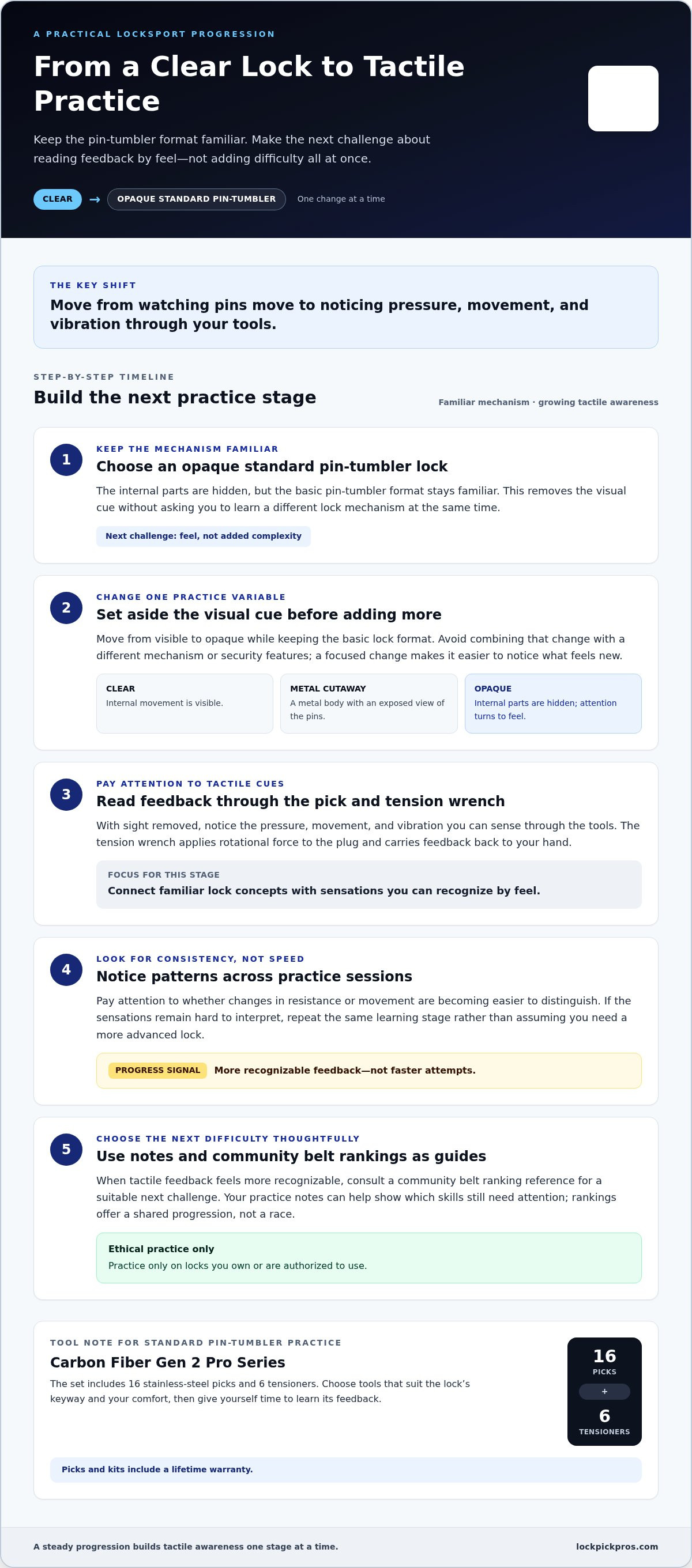
A simple routine can turn your next practice lock into a focused learning step. Before you begin, choose a dedicated practice lock that you own or are authorized to use. Keep the goal on noticing and recording feedback, not on speed or proving you can open a particular lock. Change one practice factor at a time so you can tell what each new experience is teaching you.
- Review. Recall what the clear lock helped you understand. Note which movements or sensations you could identify visually, and which still feel uncertain.
- Choose one change. Select a familiar practice format with one new demand, such as an opaque body. Avoid changing the lock type and adding advanced complexity in the same step.
- Practice with attention. Focus on small changes in resistance, movement, or vibration through the tools. Pause when you need to reset your attention; there’s no required time target.
- Reflect. After a session, record which cues you noticed, which were difficult to interpret, and what you want to focus on next time.
- Progress deliberately. Repeat the same difficulty if the feedback still feels unclear. Move to a new challenge when you can recognize useful cues more consistently.
Set a practice goal and track progress
Make the goal specific to learning: notice whether you can distinguish a change in resistance, rather than aiming to finish faster. Brief notes after each session can reveal patterns that are easy to miss in the moment. If a familiar lock still presents an unfamiliar sensation, stay with that format before changing mechanisms or adding security features. Use the lock picking belt levels explained progression guide as a reference for placing your next challenge within a community framework.
Keep the next challenge manageable and ethical
Jumping directly from a clear lock to an advanced mechanism can add several unknowns at once. Build confidence through a familiar format first, then choose another change when you’re ready. Keep all practice to locks you own or have permission to use.
The free Black Belt Challenge offers a belt-by-belt path, with an email sequence and reward picks for progressing and sharing your progress on social media using Lockpick Pros tools. Participants can post picks-in-action content toward the challenge’s $5,000 bounty for hitting its social reach goal. For standard pin-tumbler practice, the Carbon Fiber Gen 2 Pro Series is another tool option to consider as you build skills one deliberate challenge at a time.
Choose Practice Tools That Support Your Next Locksport Stage
Choose tools to match the practice lock, your comfort, and the skill you want to develop. A familiar standard pin-tumbler lock gives you a clear focus: learn to notice feedback without adding a different mechanism at the same time. Consider the keyway and whether the tools feel manageable in your hand. A broad kit isn’t automatically a better fit if a simpler setup supports your current practice goal.
When a standard pin-tumbler pick set fits the next step
The Carbon Fiber Gen 2 Pro Series is an option for standard pin-tumbler practice. Pick profiles and tensioners serve different roles, so consider how the lock’s keyway and your learning goal shape your tool choice. Practice locks are available as kit options, which can help you plan the equipment and practice format together.
If you’re comparing foundational equipment, a beginner pick-set option may also suit your stage. Think about what you want to learn before selecting a set. Keep the next challenge within the familiar pin-tumbler format, then explore specialist tools only when you’re ready to work with a different mechanism.
Use learning support and community progression
Community belt rankings can give your practice a shared progression. Use them to identify a next challenge that fits the skill you’re building, then track your own observations rather than relying on a rank alone to measure readiness. Consistent practice and thoughtful tool selection can help keep each new step manageable.
For standard pin-tumbler practice, choose equipment that fits your lock and feels comfortable to handle. Explore the Carbon Fiber Gen 2 Pro Series as one option for this stage, and keep building your locksport skills one focused practice goal at a time.
Make Your Next Practice Session Count
Your next step doesn’t need to be dramatic. Choose a practice goal you can observe, give yourself room to notice tactile feedback, and let that experience guide the challenge after it. That’s a practical way to decide what lock to practice on after a clear one without treating progress as a race. Keep your practice ethical and limited to locks you own or are authorized to use.
If a standard pin-tumbler lock fits your next stage, choose tools that suit its keyway and your comfort. Explore the Carbon Fiber Gen 2 Pro Series as an option for that practice. Every purchase includes Lockpicking Bootcamp video tutorials, all picks and kits have a lifetime warranty, and the 30-day return / 100% satisfaction guarantee applies.
Take the next step at your own pace. Each session can build the patience and feedback awareness that make locksport rewarding. Stay curious, practice responsibly, and keep progressing one challenge at a time.
Frequently Asked Questions
Can I move straight from a clear lock to an opaque practice lock?
Yes, an opaque standard pin-tumbler lock can be a sensible next step if the clear lock has helped you understand the basic mechanics. Without a view of the pins, feedback may be harder to interpret at first. Keep your first opaque practice sessions focused on noticing sensations rather than judging success by speed. Use a lock you own or are authorized to practice on, and add difficulty gradually.
Is a metal cutaway lock better than a clear practice lock?
Neither format is best for every learner. A clear lock lets you observe internal movement, while a metal cutaway lock has a metal body with part of the mechanism exposed. Both can help make lock mechanics easier to understand. If you want to practice without seeing pin movement, an opaque lock offers a different learning experience. Choose the format that fits the skill you want to focus on next.
What should I practice after learning the basics on a clear lock?
Consider a standard pin-tumbler practice lock with an opaque body before moving to security-pin complexity or a different mechanism. That choice changes how you receive feedback while keeping the basic format familiar. To decide what lock to practice on after a clear one, note which skills you want to build and use community belt rankings to compare relative difficulty. Treat rankings as a planning reference, not a universal measure.
Can a clear practice lock teach realistic tactile feedback?
A clear practice lock can help you connect visible component movement with the tools, but it can’t fully represent learning without visual cues. For example, you may understand what a pin does while still needing practice noticing subtle changes through your pick. Use an opaque practice lock to develop that skill over time. Differences between what you see and what you feel are a normal part of learning.
How do I know when I am ready for a harder practice lock?
Look for growing familiarity with your current practice challenge, not a particular time or attempt count. For example, consider whether you can recognize feedback patterns across sessions and describe what feels familiar or uncertain. If each session still feels unpredictable, repeat the same difficulty and keep notes. Move up when you’re ready to focus on a new challenge, and use belt rankings as a guide to relative difficulty.
Are belt rankings the same for every practice lock?
No. A belt classification is a community reference for a lock and its listed configuration, not a promise that every example will feel identical. Before choosing a practice lock, compare its exact model and configuration with current community listings. Differences in configuration can affect the challenge. Use rankings to plan a progression, then let the features of your own authorized practice lock guide your expectations.