

Single Pin Picking an ABUS Padlock: A Responsible Locksport Practice Guide
More tension won’t make an ABUS padlock easier to read. In single pin picking ABUS padlock practice, patience matters more than force: steady, light pressure helps you notice what the pins are telling you. It’s normal to wonder whether a particular model matches your skill level, or whether a stubborn pin means you need a different tool. Often, the next step is to pause, reset, and pay closer attention instead of pushing harder. Locksport rewards careful observation, and each practice session can teach you something even if the lock doesn’t open.
This guide will help you approach ABUS padlocks as ethical locksport practice. You’ll learn how to assess a model before choosing it, what to consider when tactile feedback feels uncertain, and how to shape a steady practice routine. We’ll also look at how belt rankings can help you think about skill progression and how to choose tools as learning aids, not promises of success. Keep practice to a lock you own or have explicit permission to use. With a thoughtful setup and a patient mindset, you can make each session a useful step in your locksport journey.
Key Takeaways
- Use model-specific information and your experience level to choose an ABUS practice challenge; don’t assume every model shares the same construction.
- In single pin picking ABUS padlock practice, treat tactile cues as information to observe, not automatic proof that a pin is set.
- Follow a responsible routine: practise only on a lock you own or have explicit permission to use, then reflect on what the feedback revealed.
- Choose tools to support learning, not to guarantee an opening. The Carbon Fiber Gen 2 - Pro Series includes 16 stainless-steel picks and 6 tensioners.
- Use belt rankings to guide your next practice step and build skill gradually rather than forcing progress.
What single pin picking means when practising with an ABUS padlock
Single pin picking is a locksport method for studying how an individual pin-tumbler mechanism responds to careful, controlled input. The learning goal isn’t simply to get an opening. It’s to notice differences in resistance and movement, then build a more accurate understanding of the particular practice lock. A cue is information to assess, not automatic proof that a pin is set or that the lock is ready to open.
For single pin picking ABUS padlock practice, start with a firm ethical boundary: work only on a padlock you own or have explicit permission to use for training. This is educational practice, not a way to open someone else’s lock. Keep practice hardware separate from locks in active use, and stop if you’re unsure whether you have permission. A lock’s brand name alone doesn’t tell you its mechanism or difficulty.
ABUS makes different padlock models, and their internal construction can vary. Don’t transfer assumptions from one model to another, including assumptions about pin count, security features, or how challenging it will feel. General background on lock picking can help explain the pin-tumbler concept, but use information for your specific model when deciding what it can teach you.
How single pin picking differs from broad beginner practice
Broad beginner demonstrations can introduce tool names and general lock concepts. Single pin picking narrows the focus to interpreting one lock’s individual responses rather than racing toward an opening. That slower approach helps you practise attention and control. The lock picking belt levels explained guide can also help put skill development in context: belt progression is about taking on suitable challenges, not treating every lock as interchangeable.
Check the exact ABUS padlock before drawing conclusions
Identify the model using its markings or product documentation before making claims about its construction or difficulty. If you’re comparing it with a belt level, use a cited community ranking that names that exact model. A ranking for one ABUS padlock isn’t evidence for another. Model-specific research keeps your expectations realistic and helps you choose a practice challenge that fits your current experience.
Before practice, note what you can verify:
- Model identification: Record the complete model name or number shown on the lock or its documentation.
- Mechanism information: Check whether reliable model-specific information identifies it as a pin-tumbler lock. Don’t assume that every padlock in the range uses the same design.
- Difficulty reference: Look for a community ranking that lists the exact model. If you can’t find one, describe the lock by its verified details rather than assigning a belt rank.
This careful start turns practice into a useful learning exercise. You’ll know what lock you’re studying, keep the activity within clear permission, and avoid mistaking a familiar brand for a guarantee of familiar feedback.
Tactile feedback in single pin picking: what beginners should learn to notice
For single pin picking ABUS padlock practice, think of touch as a source of information, not a verdict. The lock may feel different as you explore it, but one click, shift, or pause doesn’t prove a pin is set. Your goal is to observe patterns calmly and learn how the particular practice lock responds, rather than to force a result.
Tactile feedback is the small changes you can feel through a tool as a practice lock responds to gentle contact. It can include a change in resistance or a faint movement. Those sensations are subtle and can be easy to misread, especially when you’re new. Treat each one as a clue to consider, not a conclusion.
The shear line is the boundary between the plug, which turns, and the surrounding lock body. In a pin-tumbler lock, the pins must align at this boundary for the plug to rotate. Knowing the term gives you a simple reference point for learning, but touch alone can’t confirm exactly what is happening inside.
Separate useful feedback from force
Stay attentive and patient. Make small, controlled adjustments and notice whether resistance changes, stays steady, or becomes unclear. Applying more force can mask those differences and put unnecessary strain on your pick or practice lock. If a tool or lock binds unexpectedly, stop rather than pushing through. Pause, ease off, and reset the exercise before continuing.
Unclear sensations are a good reason to take a break, not to press harder. A useful session can end with an observation rather than an opening. Consistent, gentle practice helps you compare what you felt from one attempt to the next, while protecting your equipment from avoidable stress.
Build a vocabulary for practice notes
Start with everyday descriptions before adding technical terms. Write “light resistance,” “sudden stop,” or “small movement” first. If you later learn that a sensation corresponds to a pin binding or moving, add that term beside your original note. This keeps your record grounded in what you actually felt rather than what you assume happened.
After each practice session, record:
- The exact model marking or product name on your authorized practice lock.
- The conditions you can compare later, such as which tool you used and whether the lock felt consistent between attempts.
- Your observations in plain language, including anything that felt unclear or unexpectedly resistant.
- Whether you paused or stopped because the tool or lock began to bind.
These notes help reveal patterns over time and give you a useful starting point for a future guide to single pin picking basics. A carbon fiber handle transmits vibrations from pins to the picker, which can support close attention to feel. For a dedicated locksport kit, the Carbon Fiber Gen 2 Pro Series includes 16 stainless-steel picks and 6 tensioners; tools support practice but can’t guarantee a result with any particular padlock.
Why ABUS padlocks vary: how to choose an appropriate practice challenge
Choosing an ABUS padlock for locksport practice takes more than recognizing the brand. The right challenge depends on the exact model, what you already know, and whether you have permission to use that lock for practice. Brand alone cannot establish a padlock’s difficulty. Use model-specific information to set expectations, and treat anything you can’t verify as unknown rather than filling in the gaps with assumptions.
What to identify before choosing a practice lock
Start with the complete model marking on the lock, then compare it with product documentation or a reliable community ranking that names the same model. Keep confirmed details separate from guesses based on a lock’s size, shape, or appearance. This is a way to choose a suitable learning challenge, not to assess how to defeat a lock.
Use this quick comparison framework before selecting a practice lock:
What to identify
Why it matters
What remains model-dependent
Exact model name or number
It lets you compare like with like.
Internal construction and pin arrangement.
Reliable product information
It helps separate documented facts from visual guesses.
Whether a particular lock has security pins.
A community ranking for that exact model
It provides a reference for challenge level.
How the lock will feel to you, based on your experience and the individual practice lock.
Don’t assume every ABUS padlock uses the same mechanism, or that every model contains security pins. Even a ranking is a guide to expected challenge, not a promise that two examples will feel identical. If a source doesn’t identify your exact model, don’t assign it a belt rank based on a similar-looking lock.
When to use a dedicated practice lock instead
If the model is unclear, the lock is part of a door or container in active use, or you can’t establish permission, set it aside. Choose a lock intended for practice instead. Dedicated training hardware gives you a consistent object to study and helps protect useful property from wear caused by unsuitable practice. A beginner lock-pick set guide can offer helpful context when comparing equipment for locksport; match tools to your learning goals, not to assumptions about a brand.
For single pin picking ABUS padlock practice, a simple decision rule keeps the choice responsible: confirm the model, confirm authorization, and choose a challenge that fits your current experience. If any of those points is uncertain, use dedicated practice hardware and keep building your skills there.
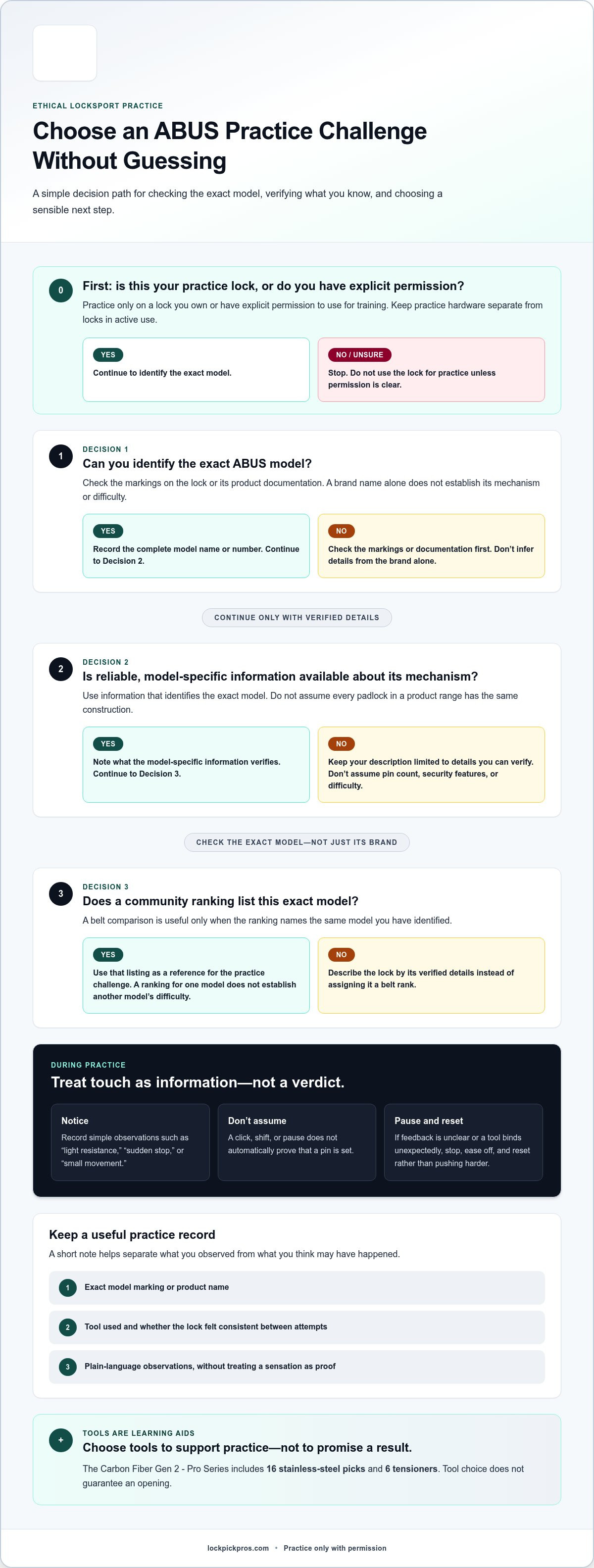
A responsible practice progression for learning single pin picking
A repeatable routine keeps locksport focused on learning, not rushing toward a result. Use it only with a lock you own or have explicit permission to use as training hardware. A safe practice routine begins with permission, follows a clear plan, and ends with notes about what you observed.
Set up a controlled practice session
Choose a stable setting where you can focus without rushing. Confirm the padlock isn’t securing property, and use a dedicated practice lock or an authorized spare. Keep your tools and notes together, and set a simple goal for the session, such as noticing whether your tactile observations are consistent. If anything about access or permission is unclear, don’t begin.
- Confirm permission. Make sure the lock is yours or that you have explicit authorization to use it for practice. Don’t practise on a lock that is securing a door, gate, container, or other property.
- Identify the model. Record the complete marking and consult reliable product information. If you plan to use a belt ranking as a reference, find one that names the exact model rather than relying on its brand or appearance.
- Prepare the session. Set the lock on a stable surface and choose a focused learning goal. Keep the session about observation and control, not speed or a promised opening.
- Pay attention to feedback. Notice whether sensations seem consistent or unclear. If the lock or tool binds unexpectedly, stop. Don’t increase force to push past it; pause and end or reset the exercise.
- Reflect afterward. Write down the model, tools used, what you noticed, and any questions. Distinguish direct observations from guesses so the next session starts with a useful record.
Review progress without rushing to a harder lock
Repeat the same practice challenge until you can describe your observations in similar terms across sessions. That doesn’t mean every attempt will feel identical; it means you’re building a clearer vocabulary and learning to notice when feedback changes. If you can’t explain what you felt, stay with the current practice setup instead of moving to a harder lock.
The belt ranking system can give your locksport progression structure, but a belt level is a community reference, not proof that every lock at that level will feel the same to every learner. Use the belt-level guide to understand the broader progression, then weigh that reference against your own experience and the exact model in front of you.
For a dedicated tool set to support authorized practice, consider the Carbon Fiber Gen 2 Pro Series for locksport practice. Choose tools that suit your learning goals, and remember that a set can’t guarantee a result with any particular padlock.
Choose practice tools that support ethical ABUS padlock training
The right tool set supports careful locksport practice, but it can’t guarantee success on any particular padlock. ABUS models can differ, so choose equipment for your learning goals and the information you have about the specific practice lock. Keep every session to a lock you own or have explicit permission to use.
Match tool choice to the practice goal
For focused single pin picking ABUS padlock practice, comfort and control matter more than having a tool for every possible situation. A handle that feels comfortable in your hand can help you concentrate on small changes in touch over a practice session. Tool choice is personal, and the right fit depends on your hands, experience, and the exercise you’re working on.
The Carbon Fiber Gen 2 - Pro Series includes 16 stainless-steel picks and 6 tensioners. Its carbon fiber handles are 2.5 mm thick, and the Pro Series profiles are 38 mm long. These are product details, not a promise that the tools fit or perform a particular way in an unspecified ABUS model. Use model information and authorized practice hardware to guide your setup.
A set can give you options for structured learning, but it doesn’t replace patient observation or careful tool handling. If a tool feels uncomfortable or the lock behaves unexpectedly, pause rather than adding force. Consistent practice with appropriate hardware is a better foundation than expecting a particular pick to open a particular lock.
Continue learning through responsible locksport
Locksports progression is built through steady practice, reflection, and community participation. The Black Belt Challenge is one option for following a belt-based learning path. Treat it as a way to engage with locksport and track your progress, not as a promise of opening a specific ABUS padlock. Keep each practice session authorized, and move forward when you can describe what you learned.
After choosing your practice goal and confirming that your training lock is appropriate, consider whether a focused set belongs in your toolkit. The Carbon Fiber Gen 2 - Pro Series has a lifetime warranty. Its 30-day return policy includes a 100% satisfaction guarantee.
Choose the Carbon Fiber Gen 2 Pro Series for ethical locksport practice, then build your skill one authorized practice session at a time.
Make your next practice session count
Let your next step be a deliberate one. Choose a training lock you’re authorized to practise on, set a small goal, and give yourself time to notice what changes from session to session. With single pin picking ABUS padlock practice, progress comes from steady attention and thoughtful reflection, not pressure to produce an opening. Keep learning at your own pace and build confidence one responsible session at a time.
For a tool set suited to ethical locksport practice, the Carbon Fiber Gen 2 - Pro Series includes 16 stainless-steel picks and 6 tensioners. All picks and kits carry a lifetime warranty, and the 30-day return policy includes a 100% satisfaction guarantee. These details support your tool choice, but no set can promise an opening on a particular lock.
Explore the Carbon Fiber Gen 2 - Pro Series and keep moving forward with curiosity, care, and respect for the locks you practise on.
Frequently Asked Questions
Can beginners learn single pin picking on an ABUS padlock?
Yes, beginners can learn through locksport practice, but the exact model matters, and not every ABUS padlock is equally suitable. For single pin picking ABUS padlock practice, choose a lock you own or have permission to use. If you can’t identify its model or construction, start with dedicated practice hardware instead. Set a modest learning goal, such as describing what felt consistent, and focus on patient observation rather than force or speed.
Are all ABUS padlocks pin-tumbler locks?
No. Don’t assume every ABUS padlock has the same internal design. The brand makes different models, and a lock’s appearance alone may not establish its mechanism or difficulty. Before discussing how a specific padlock is constructed, identify its exact model from the markings or product information. For example, a model number on the lock gives you a better starting point for research than its size or exterior shape. Practise only with permission.
How long does it take to learn single pin picking?
Learning time varies with the practice lock, the learner, and how regularly they practise. Lockpick Pros says most people can pick the company’s practice lock in 3-5 minutes. That figure is a reference for that practice lock, not a time promise for every person or an ABUS model. Use your own notes to track progress, such as whether you can describe the feedback more consistently across sessions.
Will practising with lock picks damage a padlock?
Lockpick Pros says tools won’t damage locks when used properly and recommends starting with practice locks or spare padlocks. For example, choose a spare that isn’t securing a gate or container, rather than practising on hardware in active use. Forcing tools or continuing through unexpected resistance can raise the risk of damage. Use only a lock you own or have permission to practise on, and stop if something feels wrong.
Is owning lock picks legal in the United States?
Lockpick Pros states that lockpicking is legal in most areas when tools aren’t used for illegal purposes. Rules can differ by location, so this general information isn’t a substitute for checking applicable local rules. Keep practice within authorized locksport activities, such as using your own training lock or one you have explicit permission to use. Never use picks to access someone else’s property without permission.
What should I do if a pick does not seem to give clear feedback?
Pause rather than applying more force. First, make sure you’re working with an authorized practice lock. Then take the pick out and describe the sensation in plain terms, such as “steady resistance” or “unclear movement,” instead of guessing what happened inside. If you’re still unsure, end that attempt and return to a dedicated practice lock or beginner instruction. A useful session can build observation without producing an opening.