

Lock Picking for Pen Testers: Ethical Assessment Guide
What if the most useful result of a lock assessment isn’t opening the lock, but documenting what the test revealed? Lock picking for penetration testers can help evaluate physical safeguards, but only when the work is explicitly authorized and focused on evidence rather than an entry demonstration. It’s natural to have questions about how to build skills responsibly and keep practice separate from assessment work.
This guide explores ways to review physical controls, choose an assessment method, and develop skills with practice-focused tools. For a community path alongside your practice, join the free Black Belt Challenge, progress through the belt ranks one step at a time, and share your practice along the way.
You’ll also find guidance on recording useful observations and describing assessment limits clearly. Use it to build steady, ethical habits that support better physical security decisions and continued skill development.
Key Takeaways
- Plan lock picking for penetration testers around written authorization, approved locations and methods, and clear stop conditions.
- Compare visual inspection, access-control review, approved test hardware, and specialist assessment by the evidence each can provide.
- Treat lock mechanism identification as a way to inform assessment scope, not as permission to test.
- Use a repeatable workflow to confirm scope, prepare safe practice, document observations, and review findings before reporting.
- Choose practice tools for their intended learning use and documented contents; the Carbon Fiber Gen 2 - Pro Series supports skill development, not guaranteed assessment results.
What Lock Picking Means in an Authorized Penetration Test
Lock picking for penetration testers is one possible way to examine a physical access control. The assessment value lies in what the work can establish about that control and how the result is recorded, not in an opening demonstration. For background on the broader subject, this overview of lock picking covers its history, mechanics, and ethical considerations.
An authorized lock assessment is a documented evaluation of specified locking controls, conducted only with explicit permission and within agreed limits. That definition makes the purpose clear: assess a named control and report relevant evidence, rather than treat access as the goal.
How lock-related testing fits physical security work
Observations about a designated entrance can complement findings about site procedures, visitor handling, or how access is managed. They give stakeholders another view of the physical controls that protect spaces and assets.
Keep the assessment objective specific. Network and application testing examine digital systems; a lock-focused review concerns physical access controls. Findings may inform a shared risk discussion, but conclusions should remain tied to the evidence gathered for each objective.
What a responsible engagement should establish first
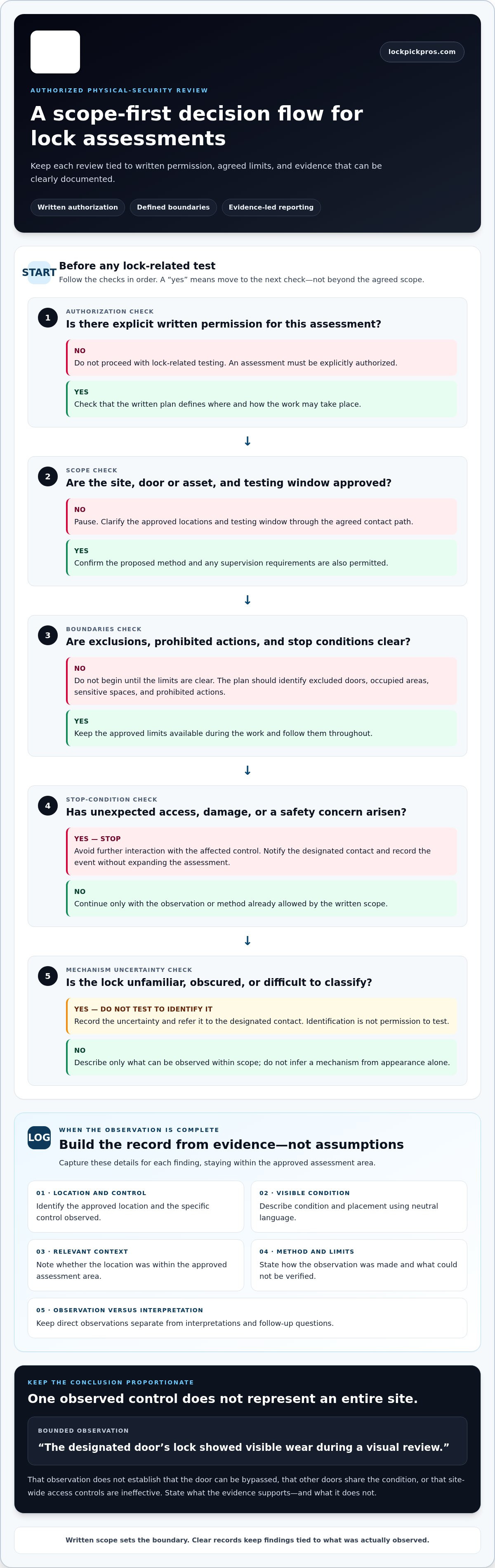
The written plan should make the practical limits easy to check during the work. Identify:
- Approved sites, doors, assets, and testing windows.
- Named contacts, communication channels, and escalation steps.
- Permitted assessment methods and any supervision requirements.
- Excluded doors, occupied areas, sensitive spaces, and prohibited actions.
- Stop conditions for unexpected access, damage, or safety concerns.
If an unexpected event or safety concern arises, stop, avoid further interaction with the affected control, and notify the designated contact. Record the event without expanding the assessment on the spot. A clear, prompt account helps stakeholders decide how to respond while keeping the work focused on the agreed objective.
Build familiarity away from operational targets with controlled practice hardware. For deliberate practice with suitable equipment, specialty dimple practice tools can support skill development. Tool familiarity doesn’t change the purpose or limits of an assessment.
Lock Mechanics and Assessment Limits Testers Should Understand
Lock picking for penetration testers starts with understanding what a lock is, not assuming what a tester may do to it. A pin tumbler lock uses pin components within the cylinder, while other designs rely on different internal mechanisms. Recognizing the broad category can help an assessor describe the hardware accurately and decide whether the planned review fits the approved scope.
Mechanism type helps shape assessment planning, but identifying a lock never grants authorization to test it. Permission still comes from the engagement’s written scope. If the lock, location, or proposed method falls outside that scope, stop and seek direction through the agreed contact path rather than treating identification as a reason to proceed.
Recognizing lock categories without treating identification as permission
A pin tumbler lock is one common category: pins sit within a cylinder and interact with a key. A wafer lock uses flat metal plates, called wafers, instead of pins. These high-level distinctions can help organize observations and flag when an assessor may be looking at a different mechanism than expected. They do not provide a basis for trying an opening method.
Some hardware may be unfamiliar, obscured, or difficult to classify from a visual review. Record that uncertainty plainly. Don’t infer a mechanism from appearance alone, and don’t test it just to identify it. Any hands-on activity must already be allowed by the written scope and the assessment plan; unfamiliar mechanisms should otherwise be documented and referred to the designated contact.
Separate lock observations from broader security conclusions
A lock-focused observation describes a specific control in a specific context. It cannot establish the security of an entire building or organization. One assessed door doesn’t represent every entrance, and a visible lock condition doesn’t explain how access is managed across the site. Keep conclusions proportionate to what was actually in scope and observed.
For each finding, capture useful context without expanding the test:
- Identify the approved location and the control observed.
- Describe visible condition and placement, using neutral language.
- Record relevant access-control context, such as whether the location was within the approved assessment area.
- Note the method and limits of the observation, including anything that could not be verified.
- Separate direct observations from interpretations or follow-up questions.
For example, “the designated door’s lock showed visible wear during a visual review” is a bounded observation. It doesn’t establish that the door can be bypassed, that other doors share the condition, or that site-wide access controls are ineffective. Clear uncertainty helps readers understand what the evidence supports and what it doesn’t.
Controlled practice can help assessors become familiar with tactile feedback away from operational targets. For that purpose, the Carbon Fiber Gen 2 - Pro Series includes 16 stainless-steel picks and 6 tensioners, and picks and kits carry a lifetime warranty. Practice builds familiarity, not authorization or a guaranteed assessment result.
Compare Physical Assessment Methods Before Choosing Tools
Choose a method based on the approved objective and the evidence the organization needs. For lock picking for penetration testers, that often means starting with non-invasive reviews and reserving hands-on work for owned practice locks or test hardware explicitly authorized for that purpose. A tool isn’t the starting point. The question is what the assessment needs to establish and what its scope allows.
Match the assessment method to the approved objective
Visual review can document observable condition, placement, and access-control context without manipulating a lock. A documented control review looks at procedures, key management, and access records. Controlled hands-on evaluation is a separate option, and belongs only on approved test hardware. A specialist assessment may be appropriate when the required evaluation falls beyond the team’s planned methods or experience.
Each approach produces different evidence. The comparison below can help set expectations before choosing tools:
| Method | Purpose | Evidence produced | Key limitation |
|---|---|---|---|
| Visual inspection | Record observable conditions and site context. | Notes on visible condition, placement, and observations. | Doesn’t verify internal operation or establish how other entrances perform. |
| Control review | Examine documented access procedures and records. | Relevant policies, records, and gaps between stated controls and available documentation. | Documents don’t necessarily confirm how a control behaves in practice. |
| Approved test hardware | Assess a specific mechanism under an explicitly authorized plan. | Observations tied to the named hardware, permitted method, and test conditions. | Results apply to the tested setup, not automatically to live doors or other locks. |
| Specialist assessment | Address a requirement that calls for specialized knowledge or methods. | A scoped assessment record from the agreed work. | Must still follow the same authorization, location, and method boundaries. |
Use the least intrusive method that can answer the approved question. If the objective is to review key-control procedures, inspecting records may be more relevant than handling a lock. If hands-on evaluation is authorized, keep it limited to the specified practice lock or test hardware. Don’t transfer a result from that setup to an untested live lock.
Choose practice tools for controlled skill development
Practice equipment supports learning in a controlled setting. It never grants permission to test a live lock. A purpose-selected set can help a picker build familiarity with tool handling and tactile feedback before any approved assessment, without promising a particular assessment outcome.
The Carbon Fiber Gen 2 Pro Series includes 16 stainless-steel picks and 6 tensioners. Its carbon-fiber handles are 2.5 mm thick; the profiles are 0.48-0.5 mm thick, 38 mm long, and 1-2 mm high. These specifications describe this set only. Picks and kits carry a lifetime warranty.
Before choosing a tool, check that its intended practice use fits your learning goals and that its documented contents suit your controlled setup. Keep training separate from assessment targets, then select the assessment method by scope and evidence needs, not by the tools already on hand.
Use a Safe, Repeatable Workflow for Lock-Related Testing
A repeatable process helps keep lock-related work tied to its approved purpose. For lock picking for penetration testers, the workflow should protect people and property while producing notes that another reviewer can understand. Written scope and documented stop conditions govern every assessment step.
Before testing: confirm authorization and prepare
Start with the paperwork and the setup, not the hardware. Confirm the current scope, named contacts, approved assets, testing window, and escalation path. Prepare a secure way to record observations, and keep identifying site or access details out of unsecured notes, screenshots, and reports.
- Review authorization. Confirm that written approval covers the planned activity, sites, assets, methods, and timing. Resolve gaps before starting.
- Confirm boundaries. Check excluded doors, occupied areas, sensitive spaces, prohibited actions, and the contact responsible for escalation.
- Verify the test target. Match the asset to the written scope. If the target is uncertain or differs from the approved description, pause and ask the designated contact for direction.
- Prepare controlled hardware. Before any hands-on activity, confirm that the practice lock or test hardware is specifically approved for the engagement. Set it up in a safe, controlled location, separate from live access points.
- Set up documentation. Use an approved storage method and a consistent record format for time, location reference, observation, action, outcome, and any deviation. Avoid recording credentials, key details, or sensitive access information unless the scope expressly requires it and the approved process protects it.
During and after testing: preserve evidence and stop appropriately
Follow the agreed activity as written. Don’t expand testing because a result is unexpected or a nearby control looks relevant. Stop if conditions depart from scope, or if unexpected access, damage, or a safety concern arises. Notify the named contact through the agreed escalation process and record the pause.
- Log each approved action. Record timestamps, the in-scope asset reference, what was done at a high level, the observed outcome, and who was notified if escalation occurred.
- Capture only necessary evidence. Use the least sensitive notes or images that support the finding. Store them in the approved location and don’t publish site identifiers or access details in unsecured records.
- Review before reporting. Check notes for accuracy, separate direct observations from interpretation, and state limitations or deviations. Share findings only through the agreed reporting path.
Build tactile familiarity away from operational targets. For controlled practice before an approved assessment, choose the Carbon Fiber Gen 2 Pro Series for practice, a set with 16 stainless-steel picks and 6 tensioners. Practice supports skill development; it doesn’t replace authorization or guarantee an assessment outcome.
Choose Practice Tools and Turn Assessment Results into Useful Findings
Good practice habits and clear reporting serve the same purpose: they keep conclusions grounded in what was actually learned or observed. For lock picking for penetration testers, choose tools for controlled skill development, then describe assessment results in terms that help the client make a decision. Neither a familiar tool nor one observed lock proves how every access point will perform.
Select a kit that supports controlled practice
Compare practice tools by intended learning use, contents, handling, and documented specifications. Start with the practice setup, not a live target. Ask what skills you want to build, what hardware you’ll use for controlled practice, and what information the product description provides. These checks help match a pick set to a learning goal without confusing practice with authorization.
The Carbon Fiber Gen 2 Pro Series is a practice and skill-development option. It includes 16 stainless-steel picks and 6 tensioners, with real carbon-fiber handles. Each purchase includes access to Lockpicking Bootcamp video tutorials, and the picks and kits carry a lifetime warranty. These details describe the set, not a promise that it will produce a particular result in an assessment.
Use practice hardware you own or that’s explicitly approved for the exercise. Keep practice separate from operational locks, and treat tactile familiarity as a skill to develop, not as a reason to expand an assessment. A suitable kit supports deliberate practice; permission and scope still govern any engagement activity.
Write findings that help a client act
A useful finding makes the path from evidence to action easy to follow. Organize each report entry around the specific control observed, what the evidence supports, why the issue may matter, and the boundaries of the agreed assessment. Keep observation distinct from interpretation. For example, note an observed condition first, then explain the potential impact without presenting an untested possibility as a confirmed weakness.
- Observed condition: Describe the in-scope control and relevant context in neutral, specific terms.
- Evidence: Reference the notes or approved records that support the observation, stored and shared through the agreed process.
- Potential impact: Explain the plausible consequence for the client’s stated security objective, without overstating certainty.
- Scope and limitations: State what was assessed, what wasn’t assessed, and any uncertainty that affects the conclusion.
- Practical next step: Recommend reviewing or improving the relevant control, such as its maintenance process, access procedures, or oversight, without publishing sensitive access details or exploit-like instructions.
Keep recommendations proportionate. A finding about one lock should not be framed as proof of a site-wide issue. Note when broader review would be needed, and give the client enough context to prioritize responsible follow-up.
Build skills on approved practice hardware, then report only what the evidence and scope support. Choose the Carbon Fiber Gen 2 Pro Series for controlled practice as you refine your assessment skills.
Build Your Next Practice Session Around Purpose
Bring the same discipline to practice that you bring to an approved assessment. Set a clear learning goal, use suitable practice hardware, and take time to notice what you can and can’t reliably observe. That habit strengthens more than familiarity with tools. It helps develop careful judgment, which matters whenever lock picking for penetration testers is part of a broader physical security review.
Keep a simple practice log. Note the setup, what you observed, and what you want to understand better next time. Over time, those notes can help you choose meaningful skill goals and explain your limits clearly. Progress comes from steady, ethical practice, not from treating a single result as proof of readiness for every situation.
Choose equipment that fits your controlled practice goals and supports your next stage of learning. Explore the Carbon Fiber Gen 2 - Pro Series for controlled practice, then keep building your skills with care and respect for the boundaries of every assessment.
Frequently Asked Questions
Is lock picking appropriate during a penetration test?
It can be, but only when the engagement explicitly authorizes the activity and defines the permitted target and method. Lock picking for penetration testers may be unnecessary if a visual or procedural review can answer the client’s question. For example, a test focused on key-control procedures may call for reviewing records rather than interacting with a lock. Choose the least intrusive method that can meet the approved objective.
Can beginners learn lock picking for physical security work?
Yes. Beginners can build foundational skills through locksport practice on locks they own or have permission to use. Start with a manageable practice setup and focus on patient, controlled handling rather than speed. The community belt ranking system can offer a gradual way to track progress. Skill learned in practice is not, by itself, approval or preparation for every professional assessment; each engagement has its own scope and requirements.
What should a penetration tester document before assessing a lock?
Record who approved the work, the approval’s validity period, the asset identifiers, the permitted activity, and the relevant testing window. Note the agreed contact and how to reach them if plans change. Also establish how evidence will be stored, who may access it, and how it will be handled after reporting. These details make the assessment easier to verify and help prevent sensitive site information from spreading unnecessarily.
Can lock-picking tools damage a lock?
They generally shouldn’t when used properly, but forcing a tool or working on an unsuitable lock can cause damage. Begin with a practice lock or spare padlock, not a lock that someone relies on for access. Stop if a tool binds, bends, or behaves unexpectedly. Don’t apply extra force to push through resistance. Controlled practice helps you notice handling issues without risking an operational lock.
Which tools should a penetration tester use for lock-related practice?
Choose practice hardware and a pick set that match your learning goals. Check the set’s listed contents and specifications, and consider whether the tools are comfortable to handle during controlled sessions. A practice lock keeps skill-building separate from live assessment targets. The Carbon Fiber Gen 2 Pro Series is one practice-oriented option; its documented product details can help you decide whether it fits your setup.
Do lock-picking laws vary by location?
Yes. Rules can vary by location and by the purpose for possessing or using tools. Lockpick Pros’ FAQ states that lockpicking is legal in most areas when tools aren’t used for illegal purposes, but that isn’t a substitute for checking the rules that apply where you are. Before transporting or using tools, review current requirements for the relevant location and keep authorization for any assessment clear and documented.