

How to Pick a Tubular Practice Lock: A Beginner-Friendly Guide
What if the best way to learn how to pick a tubular practice lock is to slow down, not push harder? If the circular layout and unfamiliar feel seem intimidating, that’s normal. Tubular locks typically arrange seven or eight pins around a central post, so their feedback differs from the standard pin-tumbler locks many beginners start with.
With authorized practice equipment, patience matters more than force. A careful session can help you recognize the lock’s basic construction, notice how your actions affect its feel, and avoid turning a learning attempt into a damaged practice lock.
This guide explains the basic parts and learning challenges of tubular locks, how to choose suitable practice hardware, and how to build a safe, repeatable routine through observation. You’ll also see how tubular-lock practice fits alongside the locksport belt ranking system: it’s a useful specialty challenge, not a direct step on the formal belt ladder. Start with the fundamentals, work at your own pace, and keep every practice session ethical.
Key Takeaways
- Learn how a tubular lock’s circular layout differs from familiar pin-tumbler practice locks before choosing how to study it.
- Understand how to pick a tubular practice lock by treating tactile feedback as information to observe, not a reason to apply more force.
- Match practice equipment to your learning goal, and make sure any specialty tools are intended for the lock type you’re studying.
- Build a repeatable practice routine: use only authorized training hardware, prepare your workspace, pause when unsure, and record what you notice.
- Explore tubular locks as a focused locksport challenge, then use the belt ranking system to choose a suitable next step in your broader progression.
What Is a Tubular Practice Lock, and Who Should Learn With One?
A tubular practice lock is training hardware for authorized locksport practice, built around a tubular keyway and a mechanism that differs from the familiar straight-keyway pin-tumbler format. It lets a learner study another lock design using equipment set aside for practice. This guide focuses on responsible learning and basic lock terminology, not on accessing locks without permission.
How Is a Tubular Lock Different From a Pin-Tumbler Lock?
The keyway is the opening where a key would enter. On a tubular lock, it appears round, often with a central post; on many familiar pin-tumbler locks, it has a narrow, vertical profile. The lock cylinder is the housing for the mechanism. In a tubular pin-tumbler design, the pin components are arranged around the central area rather than along a straight row. For an overview of this design, see the tubular pin tumbler lock.
These visible differences help identify the lock category, but appearance alone doesn’t tell you how a particular training lock will behave. Tubular locks and conventional pin-tumbler locks aren’t interchangeable learning subjects. A tool or approach associated with one type shouldn’t be assumed to suit the other. For example, dimple-lock pick tools are a separate specialty category, not evidence of tubular-lock compatibility.
This distinction is useful even before a practice session begins. Recognizing the keyway helps you name the mechanism you’re studying, choose relevant learning material, and avoid treating every cylinder as if it shared the same layout. A learner can also compare the visible form of a tubular practice lock with a familiar pin-tumbler practice lock without attempting to manipulate either one.
Is a Tubular Practice Lock Suitable for a First Locksport Session?
It can suit a beginner who is curious about specialty mechanisms, though the unfamiliar form may take time to understand. Newcomers who haven’t yet learned basic lock terminology may find it easier to first become comfortable identifying parts such as the keyway, cylinder, and plug. There’s no need to make tubular locks the first challenge in a locksport journey; they can be a later subject or a parallel area of interest.
Use only a lock you own or have explicit authorization to practice on. A lock that still serves a daily purpose isn’t a good training choice, since practice equipment should be separate from something another person depends on. Keep the learning goal educational: recognize the mechanism, learn its vocabulary, and understand where this specialty fits among other locksport topics.
If you’re exploring how to pick a tubular practice lock, start with identification and authorized training hardware before expecting familiarity with another lock type to transfer. Lockpick Pros supports ethical locksport hobbyists with equipment for their broader practice, while tubular-lock study remains a focused learning area that calls for lock-specific knowledge.
How Tubular Lock Mechanisms Create Distinct Tactile Feedback
In a tubular lock, internal pin components interact with the rotating plug inside the cylinder. Their movement and spring resistance contribute to what a learner feels through authorized practice equipment. The feedback is tactile information, not a command to apply more pressure. A light, steady sensation and an abrupt change are different observations, but neither one alone explains exactly what happened inside.
Patient feedback matters because it helps you notice changes without turning uncertainty into force. Treat each sensation as a clue to record, not a diagnosis. One brief change in resistance could have several explanations, and guessing at a cause can lead to unnecessary pressure. The aim is to build a more accurate sense of what the practice lock feels like over time.
What Can a Beginner Learn From the Lock’s Feedback?
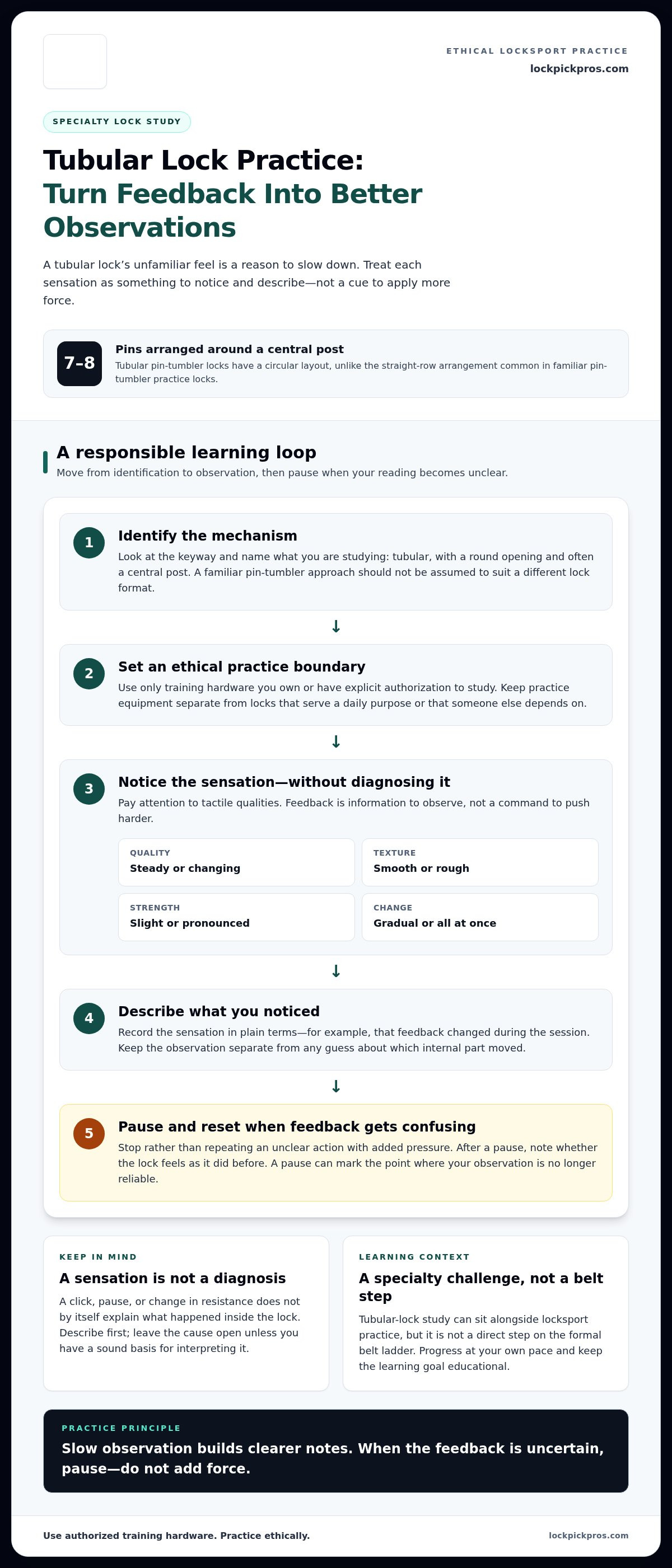
Pay attention to qualities you can describe: steady or changing, smooth or rough, slight or pronounced. You can also note whether the sensation appeared gradually or all at once. This gives you useful language for comparing observations later without claiming to know which internal part moved. Careful observation is different from forceful manipulation because it prioritizes noticing rather than overcoming resistance.
Keep the observation narrow. For example, record that the sensation changed during a session, then note whether it returned to its earlier feel after you paused. If the feedback becomes confusing, stop and reset your attention rather than repeating an unclear action with added pressure. A pause is useful information too: it marks the point where your observation is no longer reliable.
Why Can a Tubular Practice Lock Feel Difficult at First?
Unfamiliar geometry can make it harder to connect a hand movement with a particular sensation. Learners accustomed to other lock formats may find that their usual mental reference points don’t apply. That gap is normal. At first, the task may be less about interpreting a specific signal and more about noticing that the feedback differs from what you expected.
Practice-lock design and condition can also affect the feel. A change between sessions doesn’t automatically mean your technique changed; the training hardware itself may feel different. Avoid treating every click, pause, or increase in resistance as a definite message. Describe what you felt first, and leave the cause open unless you have a sound basis for interpreting it.
Slow progress is part of learning a new mechanism. If your notes show that you can distinguish consistent feedback from an unclear or abrupt change, that’s useful development even without a dramatic result. For broader locksport practice on other lock types, the Carbon Fiber Gen 2 Pro Series is a general equipment option, not a tubular-lock-specific tool. Keep the question of how to pick a tubular practice lock grounded in patient observation, not pressure.
Choosing Tubular Practice Equipment Without Guessing
Start with the skill you want to build, then choose equipment that supports that goal. Studying a tubular mechanism’s feel is different from developing general locksport skills or setting up repeatable practice. Treat those as separate needs rather than expecting one lock and one pick set to cover every learning task. Before choosing, write down what you want to learn and what you already have. That simple inventory helps prevent buying equipment based on appearance alone.
Separate the practice lock from the tool decision. The lock determines which mechanism you’ll study; the tool must be intended for that mechanism. Tubular locks need relevant specialty equipment, so don’t assume a standard pin-tumbler pick set will fit or function with them. Look for clear identification of the lock type and the intended use of any specialty tool. If those details don’t align, don’t treat a trial fit as a compatibility test.
- Mechanism study: Prioritize a clearly identified tubular practice lock, and set a goal such as learning its terminology or comparing its feel across sessions.
- Repeatable practice: Keep a consistent setup and record the lock and tool categories used, so your notes remain useful from one session to the next.
- General progression: Select separate equipment for broader locksport goals, rather than assuming specialty practice will replace foundational work.
What Should a Beginner Look for in Practice Hardware?
Choose hardware that’s clearly designated for practice and matches the subject you want to study. Check that its description identifies the mechanism, and keep any included instructions with the lock. These details make it easier to understand what you’re learning and to repeat the same setup later. Decide on the practice lock first; then consider the tool separately, instead of treating a kit label as proof that every component suits your goal.
Comfort and organization can also matter during a learning session, but they don’t establish mechanical compatibility. A neat storage arrangement, for example, can help you keep practice equipment distinct from tools used for other locksport tasks. For general pick-set selection, use the same principle: identify the kinds of locks you plan to study and make sure the equipment is described for those uses, without assuming it covers tubular locks.
When Does a General Locksport Pick Set Fit the Learning Path?
A general pick set fits when your goal is broader locksport practice on lock types it is intended for. It may support skill development outside tubular-lock study, but it should not be treated as a tubular-specific set. Keeping these roles separate gives each piece of equipment a clear purpose and helps you make a deliberate next choice as your interests change.
For broader locksport development, the Carbon Fiber Gen 2 Pro Series is a general equipment option, not a tubular-lock-specific tool. Choose it for the wider learning path, and select specialty equipment separately when studying tubular locks. This distinction keeps your setup tied to a real learning goal instead of guesswork.
A Responsible Practice Routine for Learning Tubular Locks
A useful session has a clear boundary: work only with a practice lock you own or are explicitly authorized to use. Set aside any lock that’s installed, in service, or outside that permission. Then prepare a calm workspace where the training lock and tools can rest securely. Good practice isn’t measured only by whether a lock turns. It also includes controlled handling, attention to feedback, and knowing when to stop.
Keep each session simple. Choose one learning goal, such as noting when the lock’s feel changes, and avoid changing equipment or conditions midway through. This makes your observations easier to compare later. If you’re tired, distracted, or unsure what a sensation means, take a break instead of repeating the same action with more force.
How Can You Make Practice More Consistent?
Use one authorized practice lock and a clear, uncluttered surface. After each attempt, write down what you noticed and what remains uncertain. A short note such as “the resistance felt different near the end” is more useful than guessing at a cause. Pause when feedback becomes difficult to interpret; attention and patience are part of the skill.
Use this checklist to keep a session responsible and repeatable:
- Confirm that the practice lock is yours or that you have explicit permission to use it.
- Prepare a stable workspace with enough light to see the lock and tools clearly.
- Choose one observation goal and begin with the equipment in a known, undamaged condition.
- Work gently, paying attention to changes in feel rather than trying to overcome resistance.
- Pause if feedback becomes unclear, then record what you noticed before deciding whether to continue.
- End the session if anything binds, bends, or behaves unexpectedly; check for visible damage and put the setup aside.
What Should You Do if the Lock or Tool Resists?
Stop. A stuck sensation is not a reason to push harder. Don’t force the lock or bend a tool in an attempt to continue. Look for visible damage without trying corrective manipulation. If the equipment no longer appears to be in its normal condition, end the session and keep it out of use until it can be assessed appropriately.
Returning to a neutral starting state means pausing, setting the tools down, and recording what happened. It doesn’t mean experimenting with extra pressure or trying an improvised adjustment. If resistance remains unexplained, leave the mechanism alone. Protecting the practice hardware is a better result than turning an unclear moment into damage.
For broader locksport practice beyond tubular mechanisms, consider the Carbon Fiber Gen 2 Pro Series as a general equipment option. It isn’t presented as tubular-specific equipment. Keep the same ethical boundary in every session, and treat careful notes and safe stops as real progress as you learn how to pick a tubular practice lock.
Where Tubular-Lock Practice Fits in Your Locksport Progression
Learning a tubular mechanism adds a specialty challenge to locksport, but it doesn’t replace the fundamentals or serve as a shortcut to expertise. Progress comes from building careful habits across different practice goals: understanding feedback, choosing suitable equipment, and knowing when a lock type calls for a different approach. Keep practice authorized, and treat each new mechanism as a chance to learn rather than a test of status.
The community belt ranking system gives many locksport learners a shared way to track progress through increasingly challenging locks. Tubular locks are often treated as a separate specialty rather than a direct belt milestone, so don’t assign a tubular model to a belt based on its appearance or format alone. Use the published belt-level guide for broader context, then choose the next challenge according to its community classification and the skills you’re ready to practice.
How Do Belt Levels Help Organize Locksport Practice?
Belts help organize progression, not define every possible locksport skill. A learner can work on a specialty mechanism while also building skills represented in the belt rankings. Treat the levels as a structured path: review the published guide, identify a suitable next challenge, and focus on the abilities that challenge is meant to develop.
That distinction is useful when deciding what to practice next. If tubular-lock study is helping you improve patience and observation, keep it as one part of your learning routine. For a belt goal, select a lock that appears in the ranking reference for the level you’re pursuing, rather than assuming success with one mechanism automatically qualifies you for another.
What Is a Practical Next Step After This Introduction?
Choose one learning goal at a time. Continue with equipment intended for the mechanism you’re studying, record what you learn, and keep every session within clear authorization. As your interests grow, use belt rankings to select a new challenge and broader locksport practice to develop skills beyond tubular locks. Steady progress is more useful than rushing toward a label.
The free Black Belt Challenge offers a community-based way to continue that progression. It encourages ethical hobbyists to share their practice and celebrate development as they move through the ranks. Treat participation as a way to stay engaged and learn alongside the locksport community, not as a guarantee of a particular result.
For general locksport practice beyond tubular locks, explore the Carbon Fiber Gen 2 Pro Series as a general equipment option. It isn’t presented as tubular-specific equipment. Match your tools to your practice goal, build skill one challenge at a time, and keep the focus on responsible learning.
Keep Building Your Locksport Skills
Your next step in learning how to pick a tubular practice lock is to keep curiosity and good judgment at the center of your practice. Let each session guide one small learning goal, then carry that patient approach into other areas of locksport. A specialty mechanism can broaden your experience, but lasting skill grows through steady practice and respect for clear authorization.
Lockpick Pros supports ethical lockpickers and locksport hobbyists as they develop their skills. The Black Belt Challenge offers a community path for sharing progress and moving toward new goals. Keep learning at a pace that suits you, and choose equipment for the specific practice you have in mind.
For broader locksport practice, explore the Carbon Fiber Gen 2 Pro Series. It’s a general locksport equipment option, not a tubular-lock-specific tool. Take the next step with care, stay curious, and enjoy the progress you make along the way.
Frequently Asked Questions
Can I practice on a tubular lock that I still use every day?
No. Keep practice sessions separate from equipment you depend on for everyday access. Even careful handling can leave a lock difficult to use if something shifts or becomes damaged. Choose a dedicated practice lock instead, and store it with your locksport tools so it won’t be mistaken for a working lock. If you only have a lock that’s in daily use, wait until you have suitable training hardware.
Do tubular locks and pin-tumbler locks use the same practice approach?
No, don’t assume a method or tool intended for one type will suit the other. A standard pin-tumbler lock and a tubular lock differ in layout, so learners should treat them as separate practice subjects. For example, success studying a familiar straight keyway doesn’t establish that your equipment fits a circular keyway. Identify the mechanism first, then keep your learning goal and equipment matched to it.
Can a beginner learn about tubular locks without damaging a practice lock?
Yes. Start with a designated practice lock, set a modest observation goal, and avoid treating a successful opening as the only measure of learning. For instance, you can note whether the lock’s feel stayed consistent during a short session, then stop and review your notes. If anything feels abnormal, end the session. Learning how to pick a tubular practice lock responsibly includes knowing when not to continue.
Why should I stop if a practice lock or tool begins to bind?
Stop because continued pressure can worsen a problem or deform the tool, making it harder to tell whether the issue comes from the lock, the tool, or your handling. Put the tool down and check for visible damage without trying to force or adjust the mechanism. Record what happened. If the equipment appears damaged or remains stuck, keep it out of practice rather than risking more damage.
Does a general lock pick set automatically work with tubular locks?
No. A general lock pick set isn’t automatically compatible with every lock type, and its inclusion of familiar picks doesn’t show that it suits a tubular mechanism. Check the intended use of both the tool and the practice lock before beginning. If the equipment isn’t clearly intended for that mechanism, don’t test the fit by forcing it into the keyway. Choose equipment specifically suited to your authorized practice goal.
How does tubular-lock practice fit into locksport belt levels?
Treat it as a specialty interest, not as proof of a particular belt rank. Belt rankings are based on community classifications of specific locks, so don’t assign a tubular lock to a level unless it appears in a recognized ranking reference. If your goal is to progress through belt levels, choose your next practice lock from the appropriate list and use tubular study as a separate way to broaden your experience.
Can I join the Black Belt Challenge while I am still a beginner?
Yes. Beginners can take part in a community progression activity while developing foundational skills at their own pace. The Black Belt Challenge is a way to stay engaged with locksport and share progress as you learn. Keep practice focused on locks you own or are explicitly authorized to use, and choose goals that match your current experience. You don’t need to wait until you feel advanced to be part of the community.