

Can I Carry Lock Picks in My Car? A Legal Reference
Lock picks in your car aren’t automatically illegal. In the United States, carrying them is generally allowed, but state and local laws, along with the circumstances, can matter.
It’s reasonable to want a clear distinction between carrying tools for locksport or another legitimate purpose and risking a misunderstanding. Intent often matters: carrying picks is different from using them to enter property without permission, which can lead to criminal charges.
This guide explains how ownership, possession, carrying, and use differ, and what can affect the legal picture. It also covers ways to document a legitimate hobby or work purpose, why specialized tools may face additional local rules, and practical steps for responsible transport. Laws vary by jurisdiction, so check the rules where you travel.
Key Takeaways
- Separate ownership and transport from use: intent and surrounding circumstances can affect how possession is treated.
- Before traveling with picks, learn the rules that apply in your state and municipality, especially for specialized tools.
- Keep evidence of a legitimate hobby or work purpose, such as a practice log or written permission for a specific lock.
- Use picks only on locks you own or have clear permission to open, and keep practice separate from unauthorized entry.
- Practice Locks offer a dedicated way to build locksport skills on appropriate training hardware.
Is It Legal to Own a Lock Picking Tool Set in the US?
There is no federal law broadly banning ownership of lock picks, but state laws may focus on intent and circumstances. If you’re asking, “Can I carry lock picks in my car?” the answer depends partly on the laws where you possess and transport them.
Federal and State Possession Rules
Possession rules describe when having lock picks may become unlawful under federal or state law. Federal law doesn’t broadly prohibit owning them, while state statutes may address tools connected to criminal intent. Owning a set doesn’t settle every question about carrying or using it.
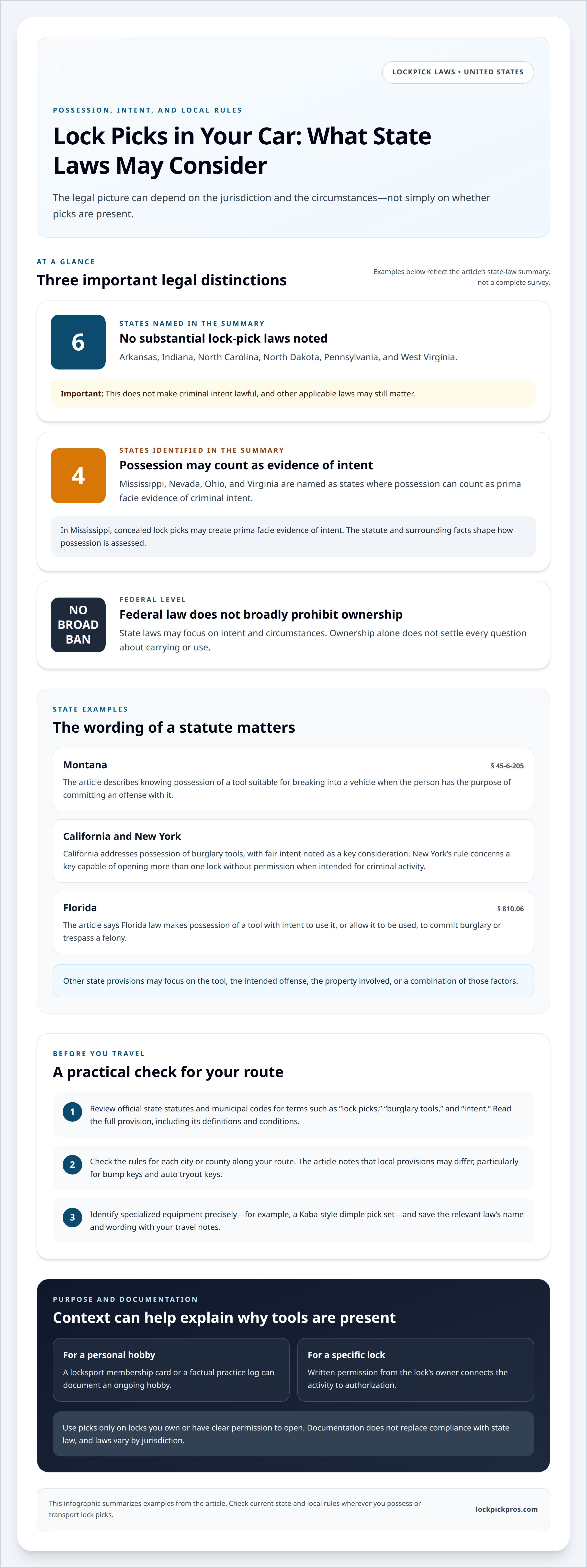
Montana law covers knowing possession of a tool suitable for breaking into a vehicle when the person has the purpose of committing an offense with it, according to the Montana Legislature under § 45-6-205. The rule identifies purpose as a key issue. For someone asking, “Can I carry lock picks in my car across state lines?” the laws of each state on the route matter.
States With and Without Lockpick Statutes
Lockpick statutes are state laws that name lock picks or include them under broader burglary-tool provisions. Arkansas, Indiana, North Carolina, North Dakota, Pennsylvania, and West Virginia have no substantial laws regarding lock picks in the available state-law summary. That doesn’t make criminal intent lawful; other applicable laws may still matter.
States with specific provisions take different approaches. California addresses possession of burglary tools, including lock picks, with fair intent noted as a key consideration. New York’s rule concerns a key capable of opening more than one lock without permission when intended for criminal activity. These examples show why you shouldn’t assume one state’s rule applies elsewhere.
Some statutes don’t name lock picks but cover tools suitable for unlawful entry or burglary. The wording may focus on possession, intent, the property involved, or a planned offense. The absence of a specific lock-pick statute isn’t blanket permission for every circumstance; read related laws, too.
Checking Local Lockpick Laws
Checking local lockpick laws means reviewing the rules for the state and municipality where you’ll possess or use the tools. Search official state statutes and municipal codes for “lock picks,” “burglary tools,” and “intent.” Read the full provision, including its definitions and conditions.
Then check each city or county along your route. Some municipalities may have rules that differ from state law, particularly for bump keys and auto tryout keys. For example, a Kaba-style dimple pick set is specialized equipment, so include its type in your search instead of relying only on general lock-pick terms. Save the law’s name and wording with your travel notes.
A Kaba dimple pick set illustrates why identifying the tool precisely can help focus a local-code search. Recheck the rules whenever your route changes, since a city’s provisions don’t establish the law in another jurisdiction.
States where possession may suggest criminal intent
Some state laws treat possession of lock picks as evidence of criminal intent, depending on the statute and circumstances. A common travel question is, “Can I carry lock picks in my car when crossing into a state with these rules?” The answer depends on the applicable law and the facts surrounding possession.
Circumstances as Evidence of Intent
Circumstantial evidence is information about the circumstances of possession that may help show a person’s purpose. In Mississippi, concealed lock picks may create prima facie evidence of intent, which the possessor may have to rebut. Mississippi, Nevada, Ohio, and Virginia are identified as states where possession can count as prima facie evidence of criminal intent.
How tools are carried and the surrounding circumstances can matter. A documented locksport session may help explain a lawful purpose, while evidence connected to attempted unauthorized entry may point to a different conclusion. No single detail establishes intent in every case. The statute and full context shape how possession is assessed.
Burglary Tool Statutes
A burglary-tool statute is a law addressing tools possessed or used with intent to commit an offense. Florida law makes possession of a tool with intent to use it, or allow it to be used, to commit burglary or trespass a felony, according to the Florida Legislature under § 810.06.
Other states frame these rules differently. Alabama Code § 13A-7-8 addresses possession of burglar’s tools. Georgia law addresses possessing a tool commonly used in burglary, theft, or another crime when the person intends to use it to commit a crime. The language matters: a statute may focus on the tool, intended offense, or both.
Proof of Lawful Use
Proof of lawful use is information supporting a legitimate reason for possessing lock picks. A locksport membership card or practice log can document an ongoing hobby, while written permission from a lock’s owner connects a specific activity to authorization.
Keep records factual and consistent. A dated log can identify the training lock you own and the session’s purpose. For work on another person’s property, written permission is the strongest fact to provide an investigator when explaining lawful activity. Documentation doesn’t replace compliance with state law, but it can clarify why the tools were present.
Intent and Unlawful Entry
Criminal intent is the purpose of committing an offense; unlawful entry means accessing property without authorization. Across U.S. states, using lock picks to gain unauthorized access can lead to burglary or trespassing charges. So, “Can I carry lock picks in my car?” is separate from whether a particular use is permitted.
Practicing on a lock you own differs from using picks to enter another person’s vehicle or residence without permission. If a statute requires intent, evidence tied to an attempted entry may be relevant. Ethical locksport stays within owned locks or explicit permission. For authorized pin-tumbler practice, a pin-tumbler practice pick set can support skill-building.
Differences between ownership, possession, carrying, and use
Ownership means having title to a set; possession means having control of it. Carrying means transporting it, while use means applying picks to a lock. Access rules can also apply in schools, airports, and other restricted places. Don’t bring tools into a venue unless its rules permit them.
Lock Picks in a Vehicle
Vehicle possession means having lock picks in or under your control inside a car. Carrying them in a vehicle is generally legal in the United States, but state law and circumstances can change the risk. Keep picks in a closed case rather than loose in the cabin, and separate them from other tools that could suggest a break-in plan.
Penalties for unlawful possession depend on the state statute and evidence of criminal intent. A first offense involving burglary tools may be treated as a misdemeanor in some circumstances, while tools connected to an actual break-in can contribute to felony burglary charges. The outcome depends on the alleged conduct and applicable law, not simply on picks being in a vehicle.
For example, picks stored for authorized practice differ from tools carried alongside evidence of attempted unauthorized entry. A secure case doesn’t make unlawful intent lawful, but organized transport helps distinguish storage from active use.
Federal Restrictions on Possession
Federal restrictions are national rules that apply across state borders, distinct from state or local statutes. No U.S. federal law broadly bans owning lock picks, so the tools aren’t prohibited nationwide solely because they are picks.
Do not confuse lock picks with the firearm and ammunition rule in 18 USC § 922(g)(1). That provision concerns firearm or ammunition possession by people convicted of crimes punishable by more than one year in prison. State laws still matter during interstate travel, so compare the rules for each state on your route rather than relying on the general federal picture.
Concealed Picks and Bump Keys
Concealed possession means keeping lock picks hidden from view, while a bump key is specially cut to manipulate certain pin-tumbler locks. Mississippi treats concealed lock picks as prima facie evidence of intent, meaning the possessor may need to rebut that inference. Concealment is therefore a significant legal consideration there.
Bump keys may face different local rules from ordinary lock picks. Some municipalities have rules that differ from state law, particularly for bump keys and auto tryout keys. Before carrying either, review the relevant city or county code as well as state law. At schools, airports, and other controlled venues, follow posted restrictions and screening instructions. Don’t assume general ownership rules permit you to bring tools inside.
Documentation of a legitimate hobby or authorized security testing
Documentation of a legitimate purpose is a record showing why you possess lock picks. A membership card, practice log, or written permission can help explain recreational locksport or authorized security testing. Keep records factual and connected to the tools you carry, rather than relying only on a verbal explanation.
Written permission from the lock owner is the strongest fact to provide an investigator when explaining authorized lock-picking activity. For example, if a property owner authorizes testing a specific training lock, keep that permission with the lock’s description and the date. Permission should identify the owner and the lock or property covered, so the connection is clear.
Records for Locksport Practice
A practice log is a dated account of locksport sessions and the locks used. Include the practice lock’s make or identifying details, where you own or keep it, and the session’s purpose. For instance, note that you practiced on your own pin-tumbler training lock. A consistent log gives context for why picks are in your vehicle during a trip to or from practice.
Keep any locksport membership card alongside the log, if you have one. The records serve different purposes: the card identifies an organized hobby connection, while log entries document actual practice. Store copies digitally or in a separate folder, and keep the information accurate. Don’t create a record after an incident or describe practice that didn’t happen.
Records for Authorized Security Testing
Security testing records should connect the tools to a specific assignment. Retain the written scope identifying the authorized location and permitted activity, along with any notes identifying the property and approved task. These documents help distinguish an authorized test from unexplained possession.
Use a simple preparation routine before travel:
- Match the written authorization to the property and task.
- Keep the testing scope accessible with your other records.
- Store picks separately from unrelated tools and keep them in a closed case.
- Update the paperwork when the assignment or authorized property changes.
Authorization for one building doesn’t document permission to pick a different lock. Keep each authorization specific, and don’t use testing records to imply permission beyond their stated scope.
Keeping Documentation Clear
Organize records so their purpose is easy to understand. Pair a practice log with the training lock it describes, or keep written authorization with the corresponding testing scope. For a trip involving both authorized testing and personal practice, separate the records by purpose instead of combining them into one vague note.
Documentation supports an explanation; it doesn’t authorize entry beyond the permission given. Use picks only on locks you own or have explicit permission to open, and keep records current as your activity changes.
Municipal rules on specialized lock tools
Municipal rules are city or local provisions that may add requirements beyond state statutes. Some municipalities may have rules that differ from state lock-pick laws, particularly for bump keys and auto tryout keys. Check the rules for each tool type, not just the general state law.
Why Tool Type Matters
A specialized lock tool is equipment designed for a particular lock or access method. A standard lock pick set, a bump key, and an auto tryout key are distinct examples, and local rules may treat them differently.
Don’t assume a rule about lock picks also answers questions about bump keys or auto tryout keys. Read the exact terms in the local code. If a provision names a tool or describes its function, compare that wording with the equipment you plan to carry. Don’t treat different tools as interchangeable categories.
This distinction matters during travel. A driver crossing from one municipality to another may encounter different local provisions, even without leaving the state. For example, carrying a standard practice set and carrying vehicle-entry tools raise different tool-specific questions. The applicable text, not the tool’s intended label alone, guides the legal analysis.
How to Check a Municipality’s Rules
Use a location-by-location process before a trip. First, identify each city or municipality where you’ll possess or use the tools. Next, search its official municipal code for “bump key,” “auto tryout key,” “lock pick,” and broader terms such as “burglary tools.” Read the full provision, including definitions and any wording about intent or use.
Then compare the municipal wording with the relevant state statute. A local provision may address a specialized tool even when state law uses broader language. Save the code title and section number with your travel records. Recheck the text if your route changes; a rule in one city doesn’t establish the rule in another.
For example, someone carrying auto tryout keys for authorized vehicle work should search those exact words in each municipality’s code. Someone carrying only standard picks for practice should still check terms covering lock-manipulation tools. These searches identify applicable wording; they don’t replace permission to work on a particular lock or vehicle.
Practical Takeaway
Keep specialized tools separate and clearly identified, then match each type to the local code terms before traveling. Don’t infer permission from a nearby city’s rules or from a state-level summary. For ethical practice on locks you own or have permission to open, choose a standard pin-tumbler practice pick set suited to that activity.
Lockpick Pros: Practice Locks
Lockpick Pros offers Practice Locks for building locksport skills on locks designed for practice. Work with familiar pin-tumbler mechanisms, notice how the plug responds, and record what you learn. Practice only on locks you own or have explicit permission to open.
For readers planning to transport tools, Lockpick Pros also offers Everyday Carry (EDC) Tools for ethical hobby use. Tool choice doesn’t replace checking the laws where you’ll travel or documenting a legitimate purpose. Dimple Picks are another specialized option for hobbyists practicing on compatible locks.
Choose equipment suited to your authorized practice, then store and document it responsibly. Explore Lockpick Pros’ practice locks and tools to find the right fit for your learning goals.
Make Your Next Step a Practice Plan
Make your next step a learning goal, not simply a new set of tools. Choose one skill to refine, such as recognizing clear feedback from a pin or keeping tension steady as you work. A focused session makes small changes in technique easier to notice than trying to master several unfamiliar challenges at once.
As your confidence grows, set a personal benchmark for moving to a more demanding practice lock. You might aim for smoother control, more consistent feedback, or a clearer understanding of how your technique affects the plug. Progress doesn’t have to be fast to be meaningful. Patient practice gives each new challenge room to teach you something useful.
For a hobby built on precision, curiosity and respect belong together. Keep learning at a pace that suits you, and let each session strengthen your judgment as well as your skills. If you’d like guidance choosing a practice set for your next stage, ask Lockpick Pros about your situation. Stay curious, practice thoughtfully, and enjoy the progress you make.
Frequently Asked Questions
Are lock picks legal to possess in a car in the United States?
Generally, no federal ban prohibits having lock picks in a car. State or local rules can change the legal picture, especially when a statute addresses burglary tools or a particular type of key. For trips with multiple stops, identify the jurisdictions where the car will be parked, not just the starting point and destination.
Which states restrict or prohibit carrying lock picks?
California and New York have specific laws addressing burglary or lock-opening tools. Mississippi, Nevada, Ohio, and Virginia are identified as states where possession may count as prima facie evidence of criminal intent. These categories don’t necessarily mean every lock-pick set is outright banned. Check whether a law addresses possession, a particular tool, or possession connected to a criminal purpose.
Do laws distinguish between owning lock picks and carrying them in a vehicle?
They can. Ownership concerns who owns the tools; vehicle possession can also raise questions about who controlled them. For example, a set in a shared car may belong to one passenger while another person drives. That fact alone doesn’t settle the legal issue, but it shows why ownership, access, and the vehicle’s circumstances can be separate questions.
Can carrying lock picks be treated as evidence of intent to commit burglary?
In some states, possession can carry evidentiary weight, but it doesn’t automatically prove a burglary occurred. Mississippi, Nevada, Ohio, and Virginia are identified as states where possession may count as prima facie evidence of intent. In Mississippi, concealment is specifically relevant. An evidentiary presumption concerns how possession may be interpreted; it doesn’t prove every owner intends a crime.
Do rules differ for hobbyists and people who own lock picks for other reasons?
Purpose and circumstances can matter, but having a hobby doesn’t create a universal exemption from state laws. A person practicing locksport should use only locks they own or have explicit permission to pick. Hobby practice and other uses can therefore raise different questions, even when the tools are similar.
What steps can a hobbyist take to keep practice ethical?
Choose a lock you own or have explicit permission to pick, and keep it separate from locks in active use. Before practicing, confirm that the lock is set aside for that purpose and that you have permission to work on it. After practice, return the lock to its intended storage. Clear permission helps keep locksport focused on skill-building and respect for other people’s property.