

Is Owning Lockpicks Prima Facie Evidence? Laws by State
What if the same lockpick set is ordinary locksport gear in one state but evidence of criminal intent in another? In the United States, owning lockpicks is generally legal, but possession may be treated as prima facie evidence of criminal intent in Mississippi, Nevada, Ohio, and Virginia under specific circumstances. So, is owning lockpicks prima facie evidence in every case? No: the laws and circumstances matter.
It’s reasonable to want a clear answer before taking up lockpicking as a hobby. Possession alone does not tell the whole story: a state’s treatment of intent can matter. This guide explains where possession may carry evidentiary weight and how several states address lockpicks under criminal-tools laws.
You’ll also find the key distinction between owning tools for ethical locksport and possessing or using them with criminal intent. Understanding that difference can help you approach the hobby responsibly and see why state-specific rules matter.
Key Takeaways
- Lockpick ownership is generally legal across the United States, but state laws and evidence of intent can change how possession is treated.
- Learn why concealed picks may matter in Mississippi and which other states treat possession as possible evidence of criminal intent.
- See how Alabama and California criminal-tools laws focus on the circumstances and intended use of the tools.
- Understand how prima facie evidence is discussed in Virginia, Ohio, and Nevada, and why the legal details differ by state.
- Explore how the free Black Belt Challenge connects ethical practice, belt-by-belt progress, reward picks, and social sharing.
Is It Legal to Own a Lock Picking Tool Set in the US?
Lock-pick laws vary across the United States, and local rules may also apply. Federal 18 USC § 922(g)(1) addresses firearm and ammunition possession by certain people convicted of crimes punishable by more than one year in prison; it does not establish whether lockpicks may be possessed. Check current laws that apply to your location and circumstances.
Lock-Pick Ownership Across the United States
Possessing lock-picking tools is different from using them to open a lock. A general statement that ownership is permitted in all 50 states and the District of Columbia should not be treated as legal advice or as confirmation of current law. Rules may differ by location and circumstance. Always confirm the rules that apply, and never use tools on a lock without authorization.
States Where Statutes Permit Lockpicks
State laws may address lock-picking tools differently, and a general summary cannot establish what is permitted in a particular situation. Claims about New Jersey or New Mexico law should be checked against current statutes and official guidance before relying on them. Permission to possess tools, where applicable, does not establish permission to use them on a lock without authorization.
States With No Substantial Lock-Pick Laws
A description of a state as having no substantial laws specifically addressing ordinary lockpick possession is not a substitute for checking current law. The claim that New Hampshire has no guiding law prohibiting possession should be verified with current official sources. Regardless of possession rules, do not use tools to enter a building or vehicle without authorization.
State Laws on Lock-Pick Possession
State statutes may address tools in connection with suspected criminal activity, but summaries can omit important details. Before relying on descriptions of Arizona § 13-1505 or Connecticut § 53a-106, check the current statutory text and applicable official guidance. The citations alone do not establish whether possessing or using a particular tool is lawful in a specific situation.
States where lockpick possession may suggest criminal intent
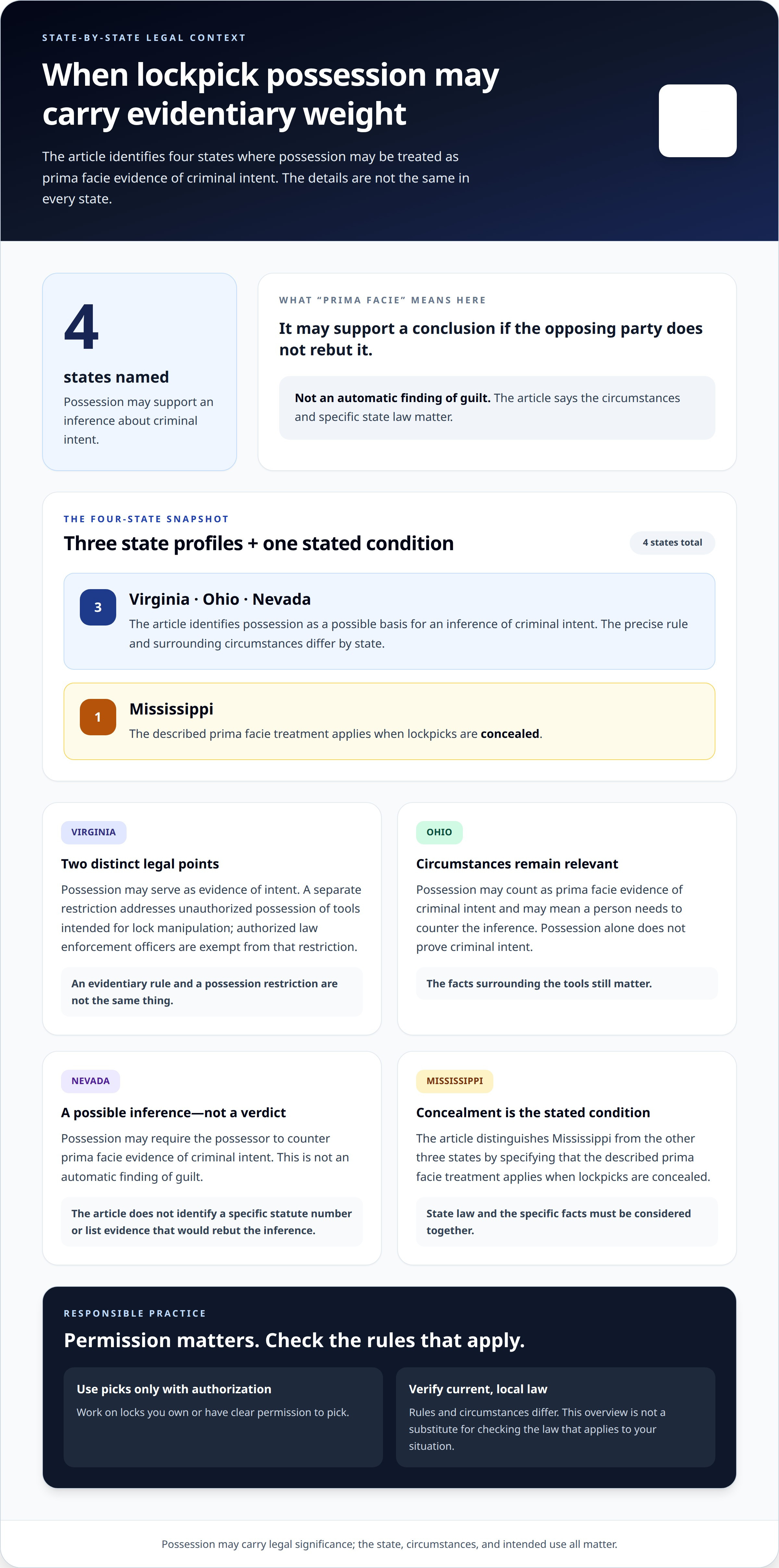
Prima facie evidence can support a conclusion if the opposing party does not rebut it. In criminal law, it may support an inference, but it does not automatically establish guilt. Mississippi, Nevada, Ohio, and Virginia are identified as states where lockpick possession may count as prima facie evidence of criminal intent. The answer to “is owning lockpicks prima facie evidence of criminal intent?” depends on state law and the circumstances.
In Virginia, possession may serve as evidence of intent, while a separate restriction addresses unauthorized possession of tools intended for lock manipulation. Authorized law enforcement officers are exempt from that restriction. These points are related but distinct: an evidentiary rule and a restriction on unauthorized possession are not the same. The circumstances and the specific legal issue matter.
Ohio also treats lockpick possession as possible prima facie evidence of criminal intent. This may mean a person needs to counter the inference. Possession alone does not prove criminal intent, and the facts surrounding the tools remain relevant. Lawful locksport practice, for example, differs from using picks to enter property without permission. So “is owning lockpicks prima facie evidence?” is only part of the legal question.
Nevada is likewise identified as a state where possessing lockpicks may require the possessor to counter prima facie evidence of criminal intent. This describes a possible evidentiary burden, not an automatic finding of guilt. The available description does not identify a specific Nevada statute number or list evidence that would rebut the inference. Do not assume one explanation resolves every case.
In Virginia, Ohio, and Nevada, possession may support an inference about intent, but the precise rule and surrounding circumstances differ. Mississippi adds a distinction: the described prima facie treatment applies when lockpicks are concealed. This contrast shows why the state and the specific facts must be considered together.
For ethical practice in any of these states, use picks only on locks you own or have clear permission to work on. Keep practice recreational and authorized. A practice lock at home is different from tools connected to an alleged unauthorized entry. These steps do not change state law, but they reinforce a clear boundary: permission matters, and possession can carry legal significance in Virginia, Ohio, and Nevada.
Alabama penalties for possessing criminal tools
Alabama treats possession of burglar’s tools as an offense under § 13A-7-8. Here, “criminal tools” means instruments possessed for intended criminal acts, such as burglary or theft. A lockpick’s presence alone doesn’t explain its purpose, but the law addresses tools in connection with criminal intent. That distinction matters for hobbyists who use picks only in ethical locksport.
The stated possible penalties include a fine of up to $500 and a jail term of 12 months. These figures describe potential consequences, not an automatic sentence for every person found with lockpicks. The charge and outcome depend on the facts and how the law applies to the alleged conduct. Don’t treat the listed maximum fine or jail term as a standard result.
Possessing picks to practice on a lock you own differs from possessing tools intended for burglary. That example clarifies the distinction of purpose, but it does not guarantee how a particular case will be assessed. Alabama’s criminal-tools rule makes intended use relevant, so surrounding circumstances may affect how possession is understood.
For responsible locksport in Alabama, keep practice limited to locks you own or have clear permission to work on. Use a dedicated practice lock, and keep your tools associated with that activity. These steps help describe a legitimate hobby purpose, but they don’t replace the legal elements of § 13A-7-8 or determine the outcome of a case.
The practical takeaway is to separate lawful practice from unauthorized entry. A pick set does not grant permission to open another person’s lock, even if it appears unused or easy to reach. In Alabama, using tools for burglary or theft can make possession part of a criminal-tools allegation. Never test a pick on a lock unless you own it or have permission.
Alabama’s rule is also distinct from states that specifically describe possession as prima facie evidence of intent. The available Alabama fact identifies possession of burglar’s tools as an offense under § 13A-7-8, with possible penalties of a $500 fine and a 12-month jail term. The central issue remains the tool’s connection to criminal purpose, not a claim that every lockpick owner commits an offense. Ethical practice means respecting permission every time.
California possession of burglar’s tools
California Penal Code § 466 addresses possessing tools with intent to feloniously break or enter a building. “Burglar’s tools” means instruments covered by that statute when held for the specified criminal purpose. The key distinction is intent: possession of a pick is not the same fact as intent to use it for unlawful entry. A lockpick’s intended use and surrounding circumstances matter.
For example, practicing on a lock you own is different from carrying picks to enter a building without permission. The example helps explain the role of purpose, but it doesn’t decide how a particular case will be treated. Section 466 focuses on intent to feloniously break or enter a building, not simply on whether someone can open a lock. Keep permission clear and practice limited to authorized locks.
California’s rule is specific about the intended act and the place involved. The listed statute refers to a building, so do not assume every possession situation involves identical facts. Nor should you treat possession of lockpicks as automatic proof of a crime. The circumstances surrounding the tools can matter, including their intended use and whether entry was authorized.
The rule is also described as a misdemeanor when a person cannot prove fair intent. “Fair intent” means a legitimate purpose for possessing or using the tools, such as lawful practice. This description makes the person’s purpose especially significant, but it isn’t a guarantee about how a charge will be filed or resolved. Section 466 remains the central identifier for California’s burglar’s-tools rule.
For an ethical locksport routine in California, follow practical safeguards. Use picks only on locks you own or have explicit permission to practice on. Keep practice tools associated with that activity, rather than using them near property you don’t control. If a lock belongs to someone else, get permission before working on it. These habits help distinguish authorized practice from the unlawful intent described under § 466.
California’s statute is neither a blanket ban on owning lockpicks nor permission to open any lock. The legally significant question described here is whether the tools are possessed with intent to feloniously break or enter a building. A hobbyist practicing at home and a person intending unauthorized entry present different circumstances. Respecting permission is the clearest boundary for ethical practice.
Prima facie evidence in Virginia, Ohio, and Nevada
Prima facie evidence is a legal concept that may support an inference unless it is rebutted. How it applies to lockpick possession depends on the relevant law and the circumstances. The information available here does not verify the claims about Virginia, Ohio, Nevada, or Mississippi, so it should not be treated as a summary of those states’ laws.
Before relying on a claim about Virginia, check the current state statutes and authoritative legal guidance. In particular, confirm whether the law addresses possession, intent, or a separate restriction on particular conduct. Do not assume that an exemption or an evidentiary rule applies without verifying its wording and scope.
The same caution applies to Ohio. The information here does not establish whether lockpick possession is prima facie evidence of criminal intent under Ohio law. Possession alone should not be described as proof of intent without a verified legal source. The purpose and circumstances may matter, but the applicable law must be checked.
The claim about Nevada is also unverified here. No specific statute or reliable description has been provided to establish whether possession creates an evidentiary inference, or what facts might rebut one. Avoid presenting a possible burden or defense as a settled rule unless it has been confirmed against current Nevada law.
Mississippi should be checked separately as well. The information available here does not verify the claim about concealed lockpicks or establish how that circumstance is treated under state law. Rules may differ among states, so claims about one jurisdiction should not be applied to another.
For ethical practice, use picks only on locks you own or have clear permission to work on. Before traveling with tools or relying on a claim about Virginia, Ohio, Nevada, or Mississippi, consult current official legal sources or qualified legal counsel. These steps do not determine what the law allows; they help avoid treating unverified descriptions as legal advice. Permission remains an essential boundary for responsible locksport.
Join the Free Black Belt Challenge
Lockpick Pros offers ethical locksport hobbyists a practical next step: the free Black Belt Challenge, along with beginner and advanced lockpick sets, practice locks, and Everyday Carry (EDC) Tools. The challenge supports structured skill progression, but does not grant permission to open locks. Practice only on locks you own or are authorized to work on, and treat permission as a basic part of ethical locksport.
Join the free Black Belt Challenge to begin an email sequence focused on belt-by-belt progress. Work through each rank in order, building skills with practice locks and equipment suited to your level. The progression gives a beginner a clear starting point and gives experienced hobbyists a way to mark continued development toward black belt.
The challenge connects skill progression with sharing. Participants post content showing picks in action on social media using Lockpick Pros tools, then share their progress as part of the community challenge. Reward picks are tied to belt progression and sharing. Documenting your practice lets other ethical hobbyists follow your development and contributes to the challenge’s social reach.
A $5,000 bounty is associated with reaching the challenge’s social reach goal. The bounty is tied to hitting that goal, not simply joining or posting once. The intended loop is practical: practice ethically, record your progress, share relevant content, and continue toward the next belt. The email sequence connects those stages, so you can focus on steady improvement rather than jumping from beginner skills straight to advanced ranks.
Lockpick Pros supports that journey with equipment for different experience levels, including practice locks, beginner sets, and advanced tools. Choose gear suited to your current skills, pay attention to tactile feedback, and keep every practice session within clear permission. The challenge brings skill development and community participation together, while steady practice builds the foundation for each next rank.
For questions about ethical locksport or choosing suitable practice equipment, contact Lockpick Pros.
Frequently Asked Questions
Can owning lockpicks be prima facie evidence of intent to commit burglary in the United States?
Whether owning lockpicks can be used as evidence of intent depends on the applicable law and the facts of a case. The legal effect of possession varies, and there is no single nationwide rule for every lockpick-possession situation.
How do state laws differ on owning or carrying lockpicks?
States differ in how they define prohibited tools, what intent must be shown, and whether the law addresses possession, use, or both. A city rule may add another layer. If you travel with lockpicks, check the rules in your destination and any local jurisdictions along the way. A state-level summary alone may not answer whether a particular public-carry situation is covered.
What must prosecutors prove to establish unlawful possession of burglary tools?
Prosecutors must establish the elements of the specific offense charged. Depending on the statute, those elements may address possession, the type or intended use of the tool, and a connection to a specified crime. Exact wording matters: a statute may require proof of intent, knowledge, or particular circumstances. Possessing a tool for locksport does not, by itself, determine whether every statutory element is met.
Does possession of lockpicks alone establish criminal intent, or are other circumstances required?
Whether possession alone can establish criminal intent depends on the applicable law and the facts of a case. Some laws allow possession to be considered as evidence in defined circumstances; others focus on intended use or surrounding facts. The distinction is between owning a tool and proving the elements of an offense. The applicable statute determines what must be established.
What circumstances can make lockpick possession evidence of criminal intent?
Possession may be considered alongside other evidence that connects the tools to a suspected offense or indicates intended unlawful use. The significance of any circumstance depends on the statute and the case. To assess the issue, distinguish the facts about possession from those suggesting a particular purpose. No single circumstance has the same legal effect in every state.
Are lockpicks legal to own or carry in my state or city?
The answer depends on the state and, in some places, local rules. Ownership, carrying tools in public, and using them are separate questions, so a general statement about ownership may not settle public-carry restrictions. For a particular location, check whether the rule concerns ordinary lockpicks or a related device, and whether it addresses possession or intended use. Do not assume neighboring cities follow identical rules.
What penalties apply to unlawful possession of lockpicks or burglary tools?
There is no single penalty for the entire country. Possible consequences depend on the charged offense, its classification under state law, and whether prosecutors allege a separate crime involving the tools. A burglary-tools allegation may be treated differently from an allegation involving trespass or burglary itself. The statute’s penalty provision determines the potential sentencing range.
What defenses are available for someone charged with possessing lockpicks?
Potential defenses depend on the charge and evidence. Relevant issues may include whether the person knowingly possessed the tools, whether the state can prove the required intent, and whether the statute covers the alleged conduct. Records documenting practice or permission to work on a lock may provide context. They do not guarantee a result.