

Choosing Between Plug Spinner Models and Accessories
What if you pick a lock, but the plug turns the wrong way? A plug spinner delivers a quick burst of rotational force to move the plug into the needed position before the pins bind again. Learning how to use a plug spinner means matching its direction to the required rotation, choosing a tip that fits the keyway snugly, and avoiding excess tension.
A plug spinner is a specialized tool, not a substitute for learning how a lock responds to careful picking. It can help correct a wrong-direction turn on a practice lock, but fit and controlled use matter: a tip that binds or too much tension can prevent the plug from moving freely.
This guide explains how plug spinners work and covers their basic use on locks you own or are authorized to practice on. It also compares model styles and accessories, including differences in handling and spring action, and explains common causes of incorrect rotation. Use the comparison to choose an option suited to your practice setup and build your locksport skills carefully.
Key Takeaways
- A plug spinner helps return a picked plug to the needed rotational position; it doesn’t replace learning to pick the lock.
- Tip fit, spinner direction, and light tension all affect whether the plug can rotate freely.
- Model differences include handling, portability, and spring strength, so match the design to your practice needs.
- Wrong-direction rotation or binding can keep a spinner from moving the plug as intended.
- Practice with locks you own or are authorized to use, and choose tools suited to your locksport skill level.
What Are Plug Spinners?
A plug spinner is a tool for correcting a specific problem: a picked lock plug has turned the wrong way. It applies a sudden burst of rotational force, moving the plug past the pins before they bind again. In some cases, that movement carries the plug through 180 degrees to its intended position. The spinner doesn’t pick the lock or make an unpicked lock open. It addresses plug direction after the lock has already been picked.
A spinner is relevant to a cylinder lock when the plug must turn in a particular direction to operate it. For example, a practice lock may turn freely after picking but stop before releasing its mechanism. A spinner can help correct the plug’s position. It isn’t a general-purpose tool for every lock type, and it won’t replace the picking skill needed to set the pins first.
A lock pick and a plug spinner do different jobs. A pick manipulates the pins so the plug can turn; a spinner moves a plug that has already been picked into the required rotational position. Other lock-opening tools may work on different mechanisms, so a spinner isn’t a universal substitute.
For responsible practice in the United States, use a spinner only on locks you own or have explicit permission to work on. Follow the rules where you live and practice. Laws vary by location, so check the laws that apply where you live before possessing or using lockpicking tools.
Practice locks offer a controlled way to learn how different plugs respond. Start with a practice cylinder, pick it, and notice whether it turns to the intended position or the wrong one. Then observe how the spinner’s direction and fit affect the result. Repeating this exercise helps distinguish a rotation problem from a pin-setting problem, without experimenting on a lock you depend on.
| Option | Primary job | Useful situation | Key distinction |
|---|---|---|---|
| Lock pick | Manipulates pins | Before the plug can turn | Sets up the lock for rotation |
| Plug spinner | Rotates a picked plug | Plug stopped in the wrong position | Corrects direction, not pin setting |
| Practice lock | Provides a learning target | Building familiarity with tools | Supports repeated, controlled practice |
When learning how to use a plug spinner, first determine whether the problem is incorrect plug direction or pins that haven’t been set. A practice lock helps make the distinction clear. Use a spinner for a rotation issue, and return to picking practice if the plug hasn’t turned freely.
Practice locks let you become familiar with different plug spinners and techniques. Traditional plug spinners have a simple, effective design.
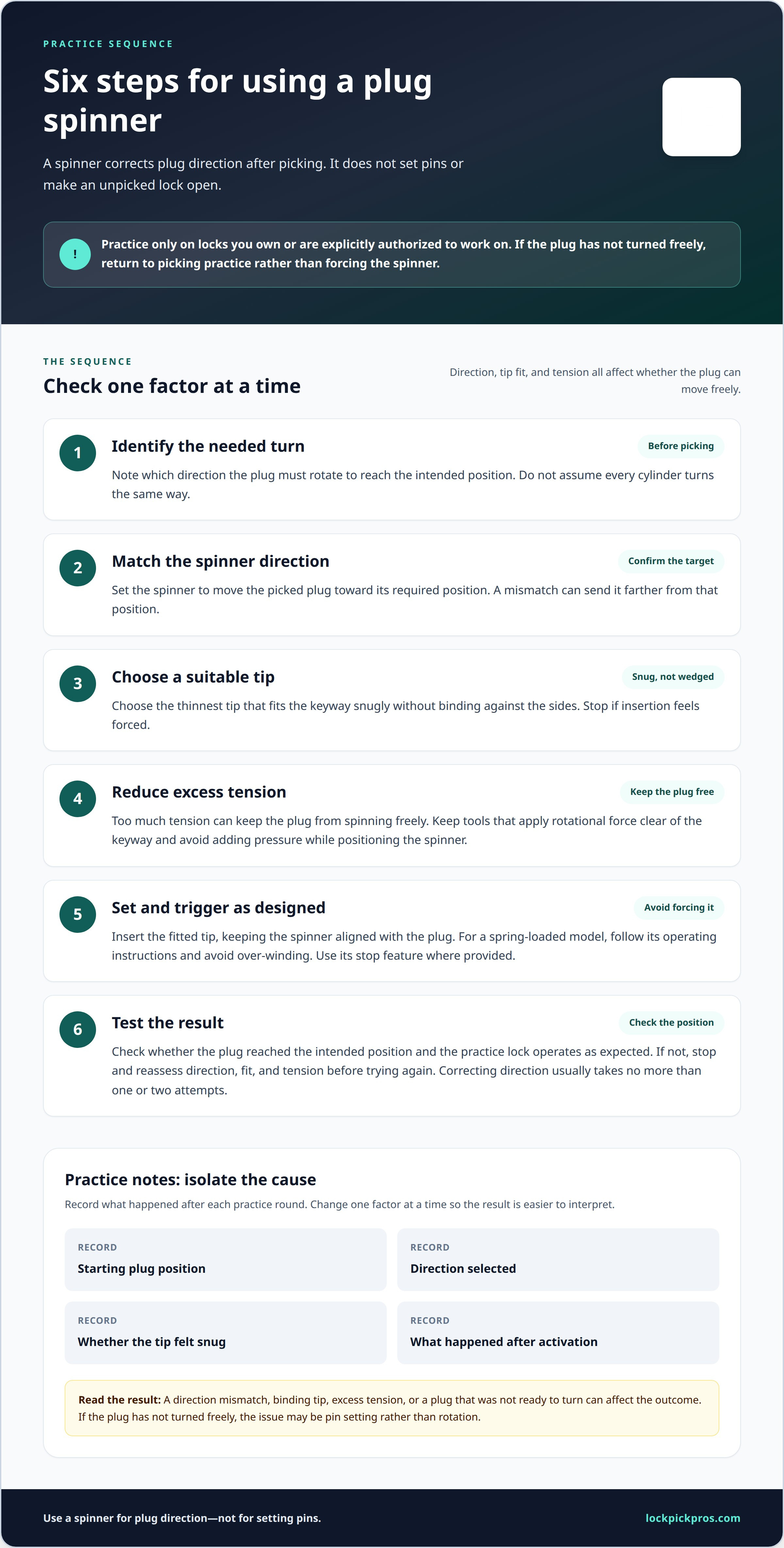
Steps for using a plug spinner
Practice on a training lock or a lock you own and are authorized to work on. A spinner corrects plug direction after picking; it doesn’t set pins. If the plug hasn’t turned freely, pause and return to picking rather than forcing the spinner.
- Identify the needed turn. Before you pick, note which direction the plug must rotate to reach the intended position. After picking, leave the plug turned the wrong way so the practice task is clear. Don’t assume the needed direction is the same on every cylinder.
- Match the spinner direction. Set the spinner to move the plug toward its required position. A mismatch can send the plug farther from that position. Recheck the lock’s intended turn before inserting the tool.
- Choose a suitable tip. Select the thinnest tip that fits the keyway. It should sit snugly without wedging against the sides. A tip that binds can interfere with movement, so stop if insertion feels forced.
- Reduce excess tension. Too much tension can keep the plug from spinning freely. Keep the keyway clear of tools that apply rotational force, and avoid adding pressure while positioning the spinner. The plug needs room to move.
- Set and trigger the tool as designed. Insert the fitted tip into the keyway, keeping the spinner aligned with the plug. For a spring-loaded model, follow its operating instructions and avoid over-winding. Most spring-loaded spinners have a stop feature, but forcing the mechanism can still disrupt practice.
- Test the result. After triggering the spinner, check whether the plug reached the intended position and the practice lock operates as expected. If it didn’t, stop and reassess direction, fit, and tension before another attempt. Correcting direction usually takes no more than one or two attempts.
Keep notes after each practice round. Record the plug’s starting position, the direction selected, whether the tip felt snug, and what happened after activation. These observations help distinguish a direction mismatch from binding or a plug that wasn’t ready to turn. Change one factor at a time; changing tip fit and direction together makes the result harder to interpret.
Build the picking skill that comes before spinner use with deliberate pin-setting practice. A standard pin-tumbler pick set can support that separate practice, while the spinner exercise stays focused on plug direction.
Keep the sequence simple: choose the thinnest tip that fits the keyway, insert it snugly, and trigger the spinner only after it is seated. If the fit isn’t snug, activation won’t provide a useful test because binding can make the result hard to interpret. With a spring-loaded model, avoid over-winding and use its stop feature where provided instead of forcing further movement. After triggering, check whether the lock is in the desired position and operates correctly. This distinguishes reaching the intended result from simply activating the tool.
Examples of plug spinner models and accessories
Plug spinner models differ in handling, spring action, and portability. These differences affect comfort and suitability for a practice lock, but none removes the need to match the tool to the keyway and rotation direction.
Check the keyway fit first, then consider spring strength and how you’ll handle the tool. A slim spinner may be easier to carry, while a stronger spring may suit a lock that needs quick rotation.
- A1 plug spinner: Its lightweight design supports comfortable, quick handling. Its spring action is a key consideration when comparing models.
- Right Hand RY5798: This model has a slim, lightweight profile. Its weaker spring may make it less suited to tougher locks.
- Right Hand RY57: This model is larger and less portable than other plug spinners. It may be a less convenient choice when compact carry matters.
- A-1 Style Cylinder Plug Spinner: This model recreates the A-1 #26 design. That named design reference can help distinguish it from other styles when reviewing product descriptions.
| Model | Handling | Spring or design detail | Selection consideration |
|---|---|---|---|
| A1 | Lightweight | Powerful spring | Quick handling and rotation |
| Right Hand RY5798 | Slim and lightweight | Weaker spring | Less suited to tougher locks |
| Right Hand RY57 | Larger | Not specified | Less portable |
| A-1 Style Cylinder | Not specified | Recreates A-1 #26 design | Compare design and fit |
Accessories matter most where the tool meets the lock. Select the thinnest tip that fits the keyway without binding; a tip wedged against the sides can obstruct rotation. A snug fit helps transfer the spinner’s movement to the plug, while a poor fit makes results harder to interpret. Don’t assume one tip suits every practice cylinder.
With an unfamiliar lock, test the tip fit gently before activating the spinner. If insertion feels forced, choose a thinner option instead of pushing harder. Keep the plug’s required direction in mind: even a well-matched model won’t correct a direction setting that points the wrong way.
Plug spinner prices vary by model and accessories, so there isn’t one reliable price for every option. They’re sold through specialist locksmith and locksport supply retailers; compare the model description, included tips, and intended fit before choosing.
How a plug spinner works
The key mechanical idea is impulse: rotational force applied over a very short interval. Compared with a slow hand turn, a quick impulse gives the plug less time to meet resistance during movement. The tool’s tip transfers that motion at the keyway, so alignment between spinner and plug matters for efficient force transfer.
Think of the spinner and plug as two parts that need to move together. If the tip sits crooked or catches against the keyway, some motion is lost at the contact point. A tip that sits securely helps transfer the spinner’s movement without wobbling. This is why fit matters mechanically, not just for comfort.
The plug’s movement also depends on resistance inside the cylinder. Pins, springs, and contact surfaces can resist rotation; friction or remaining pin interference can interrupt movement. The spinner doesn’t remove these conditions. Its rapid action is designed around the brief opportunity for the plug to move freely, which is why poor alignment or excess tension can affect the outcome.
- Input: The spinner supplies rotational movement through its handle and tip.
- Contact: The tip engages the plug so motion can transfer at the keyway.
- Resistance: Internal contact and external pressure can reduce the plug’s freedom to move.
- Result: The plug’s final position reflects both the direction of force and the resistance encountered.
Traditional plug spinners use a simple design, while spring-loaded versions store energy before release. A stop feature on most spring-loaded models limits winding travel. That stop is a mechanical boundary, not a cue to apply extra pressure. Forcing the mechanism when it stops can interfere with normal operation.
On a practice cylinder, treat each activation as an observation. Notice whether the spinner moves smoothly, whether the tip stays aligned, and whether the plug responds differently when external pressure is removed. These clues can help distinguish a tool-contact issue from resistance inside the lock. Change one condition at a time so the next result has a clear cause.
A plug spinner is most useful as a controlled locksport exercise with a lock you own or have permission to practice on. It offers a way to study force transfer and plug response, not a shortcut around learning the lock’s feedback. A steady setup makes those mechanical details easier to observe and record.
How incorrect plug rotation happens
A plug can appear to turn incorrectly if you judge its position by the lock’s exterior rather than the cylinder’s reference point. Distinguish the plug’s actual orientation from whether the entire lock mechanism has completed its intended action.
Causes of Incorrect Plug Rotation
One source of confusion is the relationship between the cylinder and the lock body. A cylinder may be mounted differently from a loose practice cylinder, so “left” or “right” from your viewpoint doesn’t always describe the same plug movement. Use the keyway and the lock’s known operating position as references instead of relying only on how the hardware looks from outside.
The plug may reach its expected position while the lock’s attached mechanism fails to respond as expected. The cylinder plug and the mechanism it operates are related, but they aren’t the same part. A practice lock can help distinguish a plug-position issue from a problem elsewhere in the assembly.
Common Mistakes and Fixes
A common diagnostic mistake is treating the lock’s failure to open as proof that the plug turned incorrectly. First observe the plug itself, using the keyway orientation as a reference. Then assess whether the lock’s operating component followed. This helps locate which part of the system caused the unexpected result, rather than simply adjusting the tool setup.
- Using viewpoint as the reference: Note the cylinder’s installed orientation before interpreting plug movement.
- Judging only by the lock’s response: Observe the plug and the lock mechanism separately.
- Changing several conditions at once: Record what moved and what did not before altering the practice setup.
- Practicing on unfamiliar hardware: Begin with a practice lock whose normal operating position is clear.
Keep a simple practice record with the lock type, cylinder orientation, visible plug position, and whether the mechanism responded. These observations can reveal a consistent mounting or interpretation issue without repeating the same attempt blindly. If the plug’s position is correct but the assembly doesn’t operate, stop treating it as a spinner-direction problem.
For continued practice with standard pin-tumbler locks, choose a standard pin-tumbler pick set and keep each session focused on locks you own or have permission to practice on.
Lockpick Pros
Lockpick Pros supports locksport practice with Beginner Lockpick Sets, Advanced Lockpick Sets, and Practice Locks. These products help hobbyists build skills at their own pace and choose equipment for ethical practice.
The free Black Belt Challenge gives pickers a path to progress through belt ranks, earn reward picks, and share picks-in-action content using Lockpick Pros tools. Sharing also contributes toward the challenge’s $5,000 bounty for reaching its social goal.
Join free, progress one belt at a time, and share your practice as you work toward Black Belt.
Make Your Next Practice Session Count
Keep learning how to use a plug spinner by treating each session as a controlled experiment. Choose a lock you’re authorized to practice on, note what you feel through the tool, and adjust your technique carefully. This habit can turn an occasional result into a clearer understanding of locksport.
As your practice develops, Lockpick Pros offers Beginner Lockpick Sets, Advanced Lockpick Sets, and Practice Locks to support different stages of learning. Choose equipment that fits the lock and skill you’re working on, rather than adding tools without a clear purpose.
Ready to build your practice setup? Contact Lockpick Pros for help choosing your next tool.
Stay curious, practice ethically, and take your next step one session at a time.
Frequently Asked Questions
What Does It Mean When a Plug Is "Rotated Incorrectly"?
It means the plug has turned away from the position the cylinder needs to operate. For example, a practice lock may turn smoothly but stop before its mechanism reaches the intended position. That doesn’t automatically mean the pins remain unset. Compare the plug’s stopping point with the lock’s operating position, then decide whether the issue is direction or incomplete picking.
What is a plug spinner and what is it used for?
A plug spinner is a specialized tool for moving a picked cylinder plug into its required rotational position. It is useful when a practice lock has been picked but the plug stops facing the wrong way. It doesn’t replace a lock pick or set pins. Think of it as a tool for correcting plug position, not completing the picking process.
How does a plug spinner work?
A plug spinner transfers a brief rotational impulse through a fitted tip to the plug. With a spring-loaded model, stored spring force helps create that quick movement. The aim is to move the plug before the pins bind again. If the plug is obstructed or the tip doesn’t sit properly, the impulse may not produce the intended movement. The result depends on fit, direction, and a freely moving plug.
How to use a plug spinner step by step?
To learn how to use a plug spinner, practice only on a lock you own or have permission to work on. First, determine the plug’s intended position and confirm it has been picked. Next, align the spinner for the required turn and select a tip that seats without force. Activate it according to its design, then assess the result. If movement is blocked, stop and diagnose the problem before trying again.
What tools and supplies are needed to use a plug spinner?
Use a plug spinner, a compatible tip, and a practice cylinder suited to the exercise. A lock pick and tension wrench are needed for the separate task of picking; the spinner doesn’t replace them. Keep a clear work surface to organize small tools, and use a notebook to record the lock, tip fit, and result. Lockpick Pros Practice Locks provide a dedicated setting for learning.
How do you use a plug spinner without damaging the lock?
Use a spinner gently and stop if the tip catches, the plug resists, or the tool reaches its winding stop. Don’t force a turn or repeat activation without identifying what blocked movement. Lockpick Pros states its tools are safe when used properly. Use only locks you own or have permission to practice on. Laws on lockpicking tools vary by location, so check the laws that apply where you live.
What are the safety and legal rules for using a plug spinner in the United States?
Use a plug spinner only on locks you own or have explicit permission to work on. Check and follow the laws that apply where you live and practice.