

Lishi Tool: How Lock Picking and Decoding Work Together
The defining feature of a Lishi tool is that picking and decoding happen together. It’s a specialized tool designed for a compatible lock, with a scale that helps interpret its cuts during the process. To understand what a Lishi tool does, look beyond opening a lock to the key information its design can help reveal.
Its history offers one way into the subject, but the practical question is whether the design suits a particular task. This guide explains the tool’s purpose, how models differ, and what to consider when choosing specialized equipment. It also puts Lishi tools in context for readers learning about lock work, from newcomers to hobbyists comparing specialized tools with general practice equipment. The aim is to explain what this design is intended to do, what its features mean in practice, and how to approach it thoughtfully and ethically.
Key Takeaways
- See how picking and decoding work together, and what the built-in scale contributes to the process.
- Explore the tool’s history and how its design relates to automotive lock work.
- Learn what information a Lishi tool can provide and how that differs from picking alone.
- Understand why matching a tool to the lock’s keyway is essential when comparing models.
- Find out when beginner lockpick sets and practice locks can support your next steps in ethical locksport.
Lishi 2-in-1 lock picking and decoding
A Lishi tool combines a picking function with a decoding scale in one specialized device. Its usefulness depends on the lock type, the model, and the information the user needs.
Picking and decoding functions
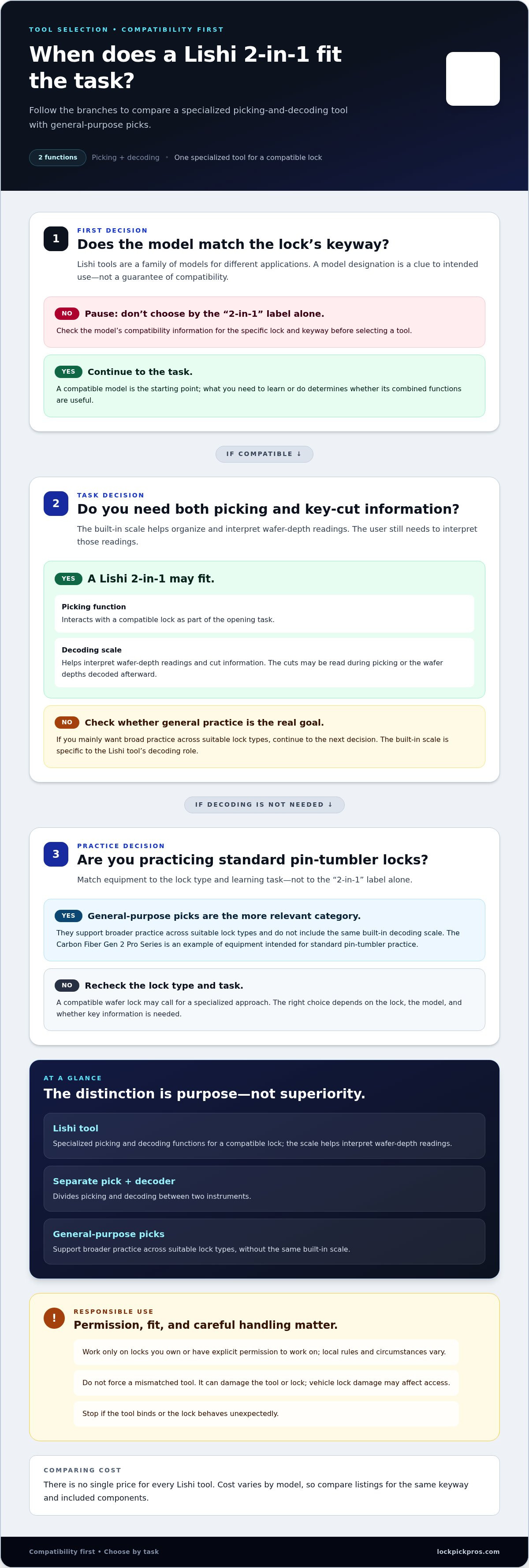
The picking function interacts with a compatible lock, while the scale helps interpret wafer-depth readings. Together, they can provide information about the lock’s cuts as it opens. This matters when a task involves both access and key information, rather than opening alone.
For example, a locksmith working on an authorized vehicle lock may need to understand its cut pattern. The scale organizes observations by wafer position, but the user still needs to interpret the readings. It won’t identify every lock or make an incompatible model suitable.
Comparison with other tools
A separate pick and decoder divide the work between two instruments. A Lishi tool combines those functions for a compatible keyway, making it relevant when both picking and decoding are needed. General-purpose picks, by contrast, support broader practice across suitable lock types but don’t include the same built-in scale.
The distinction is about purpose, not superiority. For example, someone practicing standard pin-tumbler locks may need general picks, while a compatible wafer lock calls for a specialized approach. Matching the tool to the lock matters more than choosing by the 2-in-1 label alone.
In the United States, legality depends on local rules and the circumstances of use. Use tools only on locks you own or have explicit permission to work on. Don’t assume the same rules apply everywhere.
There isn’t one price for every Lishi tool. Cost varies by model, so compare listings for the same keyway and included components. A different model may not provide a useful price comparison.
Using a mismatched tool or forcing it can damage the tool or lock. On a vehicle, lock damage may affect access. Stop if the tool binds or the lock behaves unexpectedly, and practice only with permission.
Choose equipment based on the task: general practice and specialized decoding call for different tools. That distinction keeps tool selection focused and responsible.
These functions describe a connected result, not simply two unrelated features placed together. The picking action is also the moment when cut information is read: a Lishi 2-in-1 pick reads a lock’s cuts while picking it, so the key is known when the lock opens. The tool can also be used to pick a lock and then decode its wafer depths. This sequence links the opening task with decoding, while keeping both functions within the same tool.
That distinction clarifies what the two-in-one description offers: picking provides the opening action, while decoding concerns wafer depths and cuts. The combined process makes it possible to work toward access and key information from a compatible lock, with the cuts read during picking and the wafer depths decoded afterward. Decoding remains a distinct part of the work, even when the tool supports both functions. The picking and decoding roles are linked in use, rather than being separate tasks that require unrelated tools.
History of Lishi tools
Mr. Li’s locksmith background is an important part of the story associated with Lishi tools. It connects the design to practical locksmith work, rather than presenting it solely as a locksport invention. For readers, the useful historical point is the link between field experience and a specialized tool concept. Professional experience can explain the problem a design addresses, but it doesn’t establish how well a particular model suits every lock.
The Lishi name refers to a family of models, not one fixed tool. That matters when considering its history: the family includes variations intended for different automotive applications. A model designation is a clue to its intended use, not a guarantee that all tools bearing the name have the same compatibility. The history is best understood as the development of a specialized product family, rather than a single universal design.
When tracing the tool’s development, keep three ideas separate: the person associated with the design, the tool’s purpose, and the range of models. Mr. Li’s professional experience provides biographical context. The tool’s combined role explains its identity, while the different versions show how specialization appears across the product family. This distinction prevents a biographical detail from being mistaken for a technical specification.
That distinction also helps put claims about Lishi history in context. A locksmith’s experience can explain the practical setting behind a design, but a model’s intended use depends on its own compatibility information. For example, a description of Mr. Li’s career doesn’t tell you whether a particular tool suits a specific lock. History provides context; identifying the right model is a separate decision.
For locksport learners, the history can clarify why specialized tools and general practice sets belong to different parts of the learning path. A practitioner studying standard pin-tumbler locks may prefer equipment intended for that practice, such as the Carbon Fiber Gen 2 Pro Series. That choice doesn’t replace the historical interest in Lishi tools. It simply connects the tool’s background to a practical question: which kind of lock and skill does the learner want to explore next?
Mr. Li had over 30 years of locksmith experience, a detail that gives the history a clearer professional backdrop. It places his association with the tools within a long period of work in locksmithing, while leaving the exact timeline of the design unstated. Experience is relevant context, but it should not be treated as proof of a particular development sequence or as a guarantee about how a tool performs. Keeping that distinction in view makes the biographical detail useful without asking it to answer questions it cannot settle.
For readers, the experience helps explain why practical locksmith work is part of the story, but it does not remove the need to identify a model carefully. The broader history can be considered alongside the tools’ specialized purpose, with compatibility still assessed separately for each application. In this way, the background informs an understanding of the product family without turning a career detail into a technical specification. The distinction preserves both the human context and the importance of model-specific information.
What Lishi tools do
A Lishi tool provides two kinds of information about a compatible lock. It interacts with the lock for picking, while its scale helps interpret wafer depths and key cuts. The result can be more than an open lock: the user can also understand the lock’s cut pattern. For example, a vehicle locksmith working on an authorized automotive lock can use the readings to identify key information.
The decoding function is useful when a task involves understanding a keyway, not just practicing lock manipulation. The scale organizes readings by wafer position, providing a reference rather than relying on memory alone. A recorded pattern can help explain how the lock’s cuts relate to its key. The tool doesn’t make every lock readable, though: the lock must be compatible with that specific Lishi model.
For learners, the process can build awareness of how a lock responds to touch. Users need to distinguish useful feedback from pressure or movement caused by the tool itself. Practicing on a lock they own can help connect a wafer’s position with its scale reading. This observation explains the relationship between physical lock parts and the decoded pattern, without treating the scale as an automatic answer.
What training or skills are needed to use a Lishi tool? The tool doesn’t require a special credential, but users need to identify the matching keyway, understand the scale, and interpret tactile feedback. Practicing on a lock they own or have permission to work on helps develop those skills responsibly.
Model selection is part of the task. First identify the lock’s keyway, then match it to the Lishi model designed for that keyway. A tool that doesn’t fit the lock cannot provide useful readings. For instance, don’t assume a model for one automotive keyway will suit another vehicle just because both locks are automotive.
A Lishi tool has a different role from a general practice pick. A standard pick can help develop broad lockpicking skills, while a Lishi tool is designed to read cuts on a compatible lock. Keep that distinction in mind when choosing practice goals: use general tools to learn picking fundamentals, and study Lishi readings when keyway matching and wafer-depth interpretation are relevant. Work only with locks you own or have clear permission to handle.
What is a Lishi tool and how does it work?
A Lishi tool is designed for compatible wafer locks, including some automotive locks. It combines lock manipulation and cut-depth reading in one instrument. The built-in scale provides reference points for interpreting wafer depths, connecting a wafer’s position with its cut information. Its purpose is both practical and diagnostic: it interacts with the lock and helps describe its key pattern.
Its operation is best understood as a sequence of observations, not a universal procedure for every lock. First, identify whether the lock’s keyway and mechanism match the tool. As the tool interacts with a compatible lock, interpret tactile feedback alongside the scale, which organizes observations by position. When the lock opens, the readings can help identify its cuts. Model compatibility shapes every part of the process.
The scale matters because wafer positions and depths are distinct. Think of a compatible automotive lock as having separate positions, each contributing information to the cut pattern. The scale provides a reference for recording that information. It doesn’t mean the tool reads every type of lock or that one model fits every vehicle. A pin-tumbler lock, for example, uses a different mechanism from a wafer lock.
The combined design can support two distinct goals. Opening a lock shows that its mechanism has moved into an operable state. Reading the scale provides information about the wafers and their depths. A locksmith working on an authorized vehicle lock may value both outcomes, while a locksport learner may focus on how feedback relates to the scale. This explains why a Lishi tool is not simply a general-purpose pick.
Accuracy depends on careful interpretation. A reading is meaningful only when the tool matches the lock and the user correctly relates each position to the scale. With a mismatched keyway, the scale cannot reliably describe the lock’s cut pattern. Identify the lock before using a tool; the specific model matters more than the general label “Lishi.”
Used ethically, this design can help explain how lock features relate to key information, without replacing broader mechanical knowledge. Practice only on locks you own or have permission to handle. Treat the scale as a reference, not an automatic guarantee of a correct key pattern. Matching, observation, and careful interpretation make the tool’s two functions understandable, while the lock’s design determines what those functions can reveal.
What are the different Lishi tool models and how do you identify the right one?
There are approximately 100 versions of Lishi tools for different automotive keyways. Each tool is designed for one specific keyway, so the name “Lishi” alone doesn’t identify a compatible model. The important distinction is the lock’s design, not simply whether it belongs to a vehicle. A tool intended for one keyway may not fit another, even when both locks serve similar purposes.
Choose a model based on compatibility, not appearance. Use the lock’s exact identification and the corresponding tool designation. Don’t assume that two vehicles from the same manufacturer share a keyway. A vehicle model name alone doesn’t establish a match. Compare the specific keyway information for the lock and tool.
The range of models reflects differences among automotive locks. A Lishi tool is designed for a particular keyway, rather than as a general pick for every lock. That makes the model designation essential when comparing tools. Two models may share a broad purpose but still be intended for different keyways. Similar appearance doesn’t make them interchangeable.
For responsible selection, confirm the lock’s identity through authorized records or documentation before choosing a model. Then compare that information with the tool’s stated compatibility. Don’t guess based on a vehicle badge, exterior appearance, or a similar lock in another vehicle. These clues don’t establish a keyway match. If the lock’s identity is uncertain, pause rather than testing an assumed match.
Compatibility also determines what the tool can tell you. A Lishi model is designed for its intended keyway; a different model may not fit or read as intended. The built-in scale is meaningful only in relation to a compatible lock. For instance, readings from a tool matched to one keyway shouldn’t be treated as a reliable guide to another lock’s cuts.
Keep the goal in view. A Lishi model is relevant when working with its specific compatible lock, while general locksport practice may call for tools designed for standard pin-tumbler locks. The Carbon Fiber Gen 2 Pro Series lock pick set is an option for that separate practice focus. Choosing by lock type keeps a specialized automotive tool distinct from a broader practice set.
Lockpick Pros: Beginner Lockpick Sets
At Lockpick Pros, we offer Beginner Lockpick Sets and Practice Locks for people building foundational locksport skills. Start with practice hardware you own or have permission to use, then focus on how tool movement relates to tactile feedback. This gives beginners a suitable way to explore basic concepts before considering specialized equipment, such as a keyway-specific Lishi tool.
As your interests develop, our Advanced Lockpick Sets and Everyday Carry (EDC) Tools offer other categories to explore. Choose based on the locksport practice you want to pursue, rather than expecting one set to suit every lock type. Ethical practice starts with clear permission and respect for property.
Explore the available sets and practice locks, or visit lockpickpros.com.
Choose Your Next Locksport Goal
Make each practice session about a clear skill, not just a successful opening. Focus on reading tactile feedback, keeping notes on your approach, or learning how a different lock mechanism changes the challenge. Understanding what a Lishi tool can do helps you decide whether specialized decoding fits your goal or whether general locksport practice is the better next step.
Keep practice ethical and deliberate. Choose a lock you’re authorized to handle, set one learning objective, and reflect on what you felt during the session. This habit turns each attempt into useful experience and helps you choose equipment based on what you want to practice.
For a next step with standard pin-tumbler locks, explore the Carbon Fiber Gen 2 Pro Series and choose a practice challenge that suits your developing skills.
Stay curious, practice responsibly, and enjoy building your skills one session at a time.
Frequently Asked Questions
What types of locks and vehicles are Lishi tools designed for?
Lishi tools are designed for specific automotive keyways, particularly compatible wafer-lock designs. They aren’t universal tools for every vehicle or lock. Before choosing one, identify the lock’s keyway and match it to the tool’s intended model. For example, two vehicles can have different keyways even if both use wafer locks. The match depends on the lock itself, not just the vehicle category or manufacturer.
How do locksmiths use a Lishi tool to pick and decode a lock?
Locksmiths match the tool to an authorized lock’s keyway, then use its picking and decoding functions together. The built-in scale helps interpret wafer positions and depths, creating a cut pattern for that compatible lock. Experience helps locksmiths read feedback and avoid assumptions. Use the tool only on locks you own or have clear permission to service.