

Mastering the Turn: The Ultimate Guide to Types of Tension Wrenches in 2026
What if the reason you're stuck on that Green Belt lock isn't your picking technique, but the piece of metal you're using to turn the plug? Most hobbyists focus entirely on their picks, yet the tension wrench is the true translator of the lock's internal language. If you've ever dealt with a wrench falling out of a tight paracentric keyway or felt your feedback go numb because of a flimsy tool, you know that the right equipment makes all the difference. Understanding the specific types of tension wrenches available in 2026 is the secret to moving past those stubborn plateaus and earning your next rank.
We know how frustrating it is when over-tensioning leads to bent tools or when generic wrenches fail to communicate what's happening inside the cylinder. You're here because you're ready to level up your skills and treat locksport like the precision craft it is. This guide promises to help you master the physics of tension so you can select the perfect tool for any keyway. We'll explore everything from Top of Keyway (TOK) essentials to specialized circular tensioners, giving you the technical edge needed to advance your belt rank and join the elite ranks of expert pickers.
Key Takeaways
- Understand the physics of the shear line and how your turning tool acts as a translator for every pin movement inside the cylinder.
- Learn to differentiate between various types of tension wrenches, including Bottom of Keyway (BOK) and Top of Keyway (TOK), to match your specific belt rank.
- Master the foundation of beginner lockpicking by using L-shaped tensioners to conquer White and Yellow belt practice locks with ease.
- Discover why switching to TOK flat bars is essential for providing the precise feedback needed for Green Belt challenges and security pins.
- Explore specialized turning tools for dimple and automotive locks to ensure you have the right kit for high-level Black Belt mastery.
The Physics of Tension: Why the Wrench is Your Most Important Tool
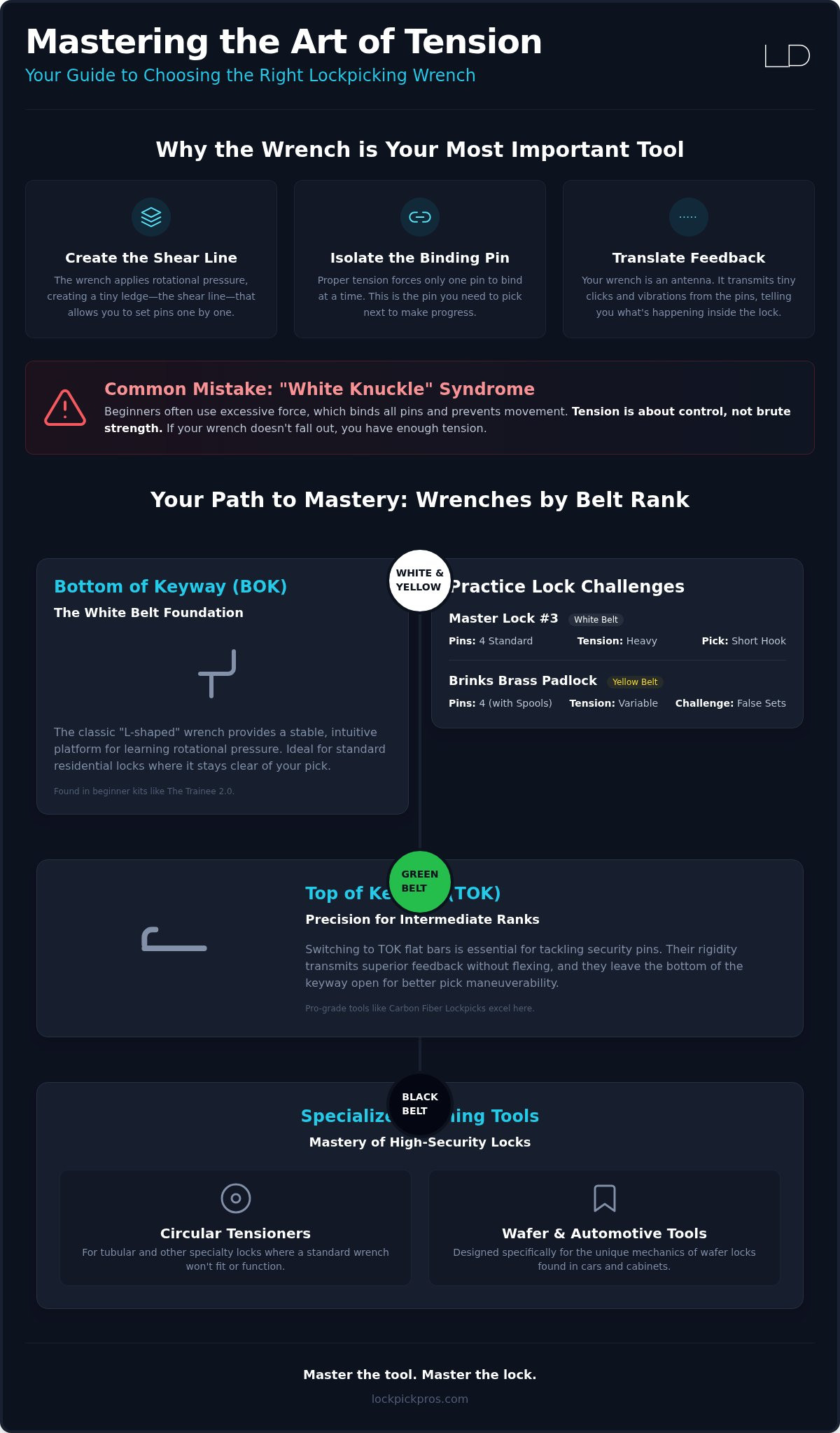
In the world of locksport, we often get distracted by the shiny hooks and rakes in our kits. But if you want to advance your belt rank, you need to understand that the Tension wrench is the real hero of your setup. It is the turning tool that creates the binding effect. When you apply pressure, you’re forcing the plug to rotate just enough that a single pin becomes stuck against the hull of the lock. This is known as the binding pin. Without this pressure, those pins would simply bounce back into place every time you lifted them with your pick.
The ultimate goal is to set every pin at the "Shear Line." This is the precise physical point where the gap between the plug and the housing is clear, allowing the cylinder to turn. Reaching this point requires a delicate balance of force. While you might use heavy tension on a standard Master Lock to get a satisfying click, that same brute force will fail you on high-security locks. Feather-light tension is usually the secret for intermediate and advanced challenges. Mastering different types of tension wrenches helps you feel exactly how much pressure you are applying at any given moment.
Tension vs. Torque: The Beginner’s Most Common Mistake
Tension is about control, not raw force. Many newcomers fall victim to "White Knuckle" syndrome. They grip the wrench so hard their fingers turn white and their hand begins to cramp. This excessive torque binds the pins so tightly that they cannot move at all. You might even end up bending your tools or snapping a pick. If you're practicing with The Trainee 2.0, try the light touch test. Place your finger on the wrench and apply only as much pressure as the weight of a single coin. If the wrench doesn't fall out, you have enough tension to start picking.
The Language of Feedback: Listening with Your Fingers
Feedback is how the lock communicates with you. It is a series of tiny vibrations and clicks that travel through the tool and into your hand. When you use professional-grade gear like our Carbon Fiber Lockpicks, these signals are much clearer. You'll eventually learn to identify "counter-rotation." This happens when a spool pin pushes back against your wrench as you try to set it. A rigid wrench is better for intermediate belt ranks because it doesn't flex or soak up these vibrations. This ensures every tiny movement inside the keyway is felt instantly, allowing you to map the binding order with precision.
Bottom of Keyway (BOK) Tensioners: The White Belt Foundation
Every journey in locksport starts with the classic L-shaped wrench. Often called the "windshield wiper" style, these are the most common types of tension wrenches found in foundational kits. They are the default choice for White and Yellow belt levels because they provide a stable, intuitive platform for learning rotational pressure. Because they sit at the bottom of the keyway, they stay out of the way of your pick in most standard residential locks. For those just starting their beginner lockpicking journey, The Trainee 2.0 includes a variety of BOK tools to help you master this essential balance.
Technical Breakdown: Conquering the Master Lock #3
The Master Lock #3 is the quintessential White Belt challenge. It features a 4-pin stack comprised entirely of standard pins with no security features. To open this lock, follow these technical steps:
- Tension Tool: Select a medium-width BOK wrench from your kit.
- Tension Level: Apply heavy tension. This lock has loose tolerances, so firm pressure helps bind the pins clearly.
- Pick Choice: Use a standard short hook or a triple peak rake.
- Instructions: Insert the wrench into the bottom of the keyway. Apply heavy clockwise pressure. Lift each pin until you hear a distinct click. Since there are no security pins, the plug will snap open once the fourth pin reaches the shear line.
Technical Breakdown: The Brinks Brass Yellow Belt Challenge
Once you graduate to Yellow Belt, practice locks like the Brinks Brass Padlock introduce spool pins. This lock typically contains a 4-pin stack with at least one spool pin designed to create a false set. Mastering this requires a shift in your pick set selection and feel.
- Tension Tool: Use a narrow BOK wrench to avoid binding the cylinder wall.
- Tension Level: Start with medium tension, but be ready to lighten it.
- Pick Choice: A short hook is required for the precision needed to navigate spools.
- Instructions: Apply medium tension. You will likely feel a "false set" where the plug rotates slightly but the lock doesn't open. This means the spool pin is trapped. Lighten your tension to "feather" levels and gently lift the spool. You will feel counter-rotation against your wrench before the pin sets and the lock opens.
The Limitations of BOK Tension
BOK tensioners are fantastic for beginners, but they have a major drawback. They eat up valuable real estate. In tight keyways, the wrench itself might block your pick. This prevents you from reaching the pins at the very back. If you find your pick getting cramped, it is a sign to graduate to TOK tools. Ready to prove your skills? Join our free Black Belt Challenge today. Progress through the ranks, share your "picks-in-action" on social media, and help the community hit our reach goals to unlock the next community bounty! Upgrade to our professional carbon fiber series to bridge the gap toward intermediate precision.
Top of Keyway (TOK) Flat Bars: Precision for Intermediate Ranks
As you move beyond the basics, you'll encounter locks that simply won't open with standard bottom-of-keyway tools. This is where Top of Keyway (TOK) flat bars, also known as pry bars, become your best friends. Unlike the BOK wrenches discussed earlier, these tools sit at the very top of the plug. This placement clears the entire bottom section of the keyway, granting you full access for deep hooks and complex picking angles. If you are aiming for your Green Belt, TOK is essential. For pickers ready to tackle these intermediate challenges, the Gen 2 Pro Max Stealth Edition offers the rigidity needed to feel every pin movement.
Technical Breakdown: The Master Lock 410 LOTO
The Master Lock 410 LOTO is a classic Green Belt hurdle. It features a 6-pin stack that is notoriously difficult: five spool pins and one serrated pin. To conquer this paracentric keyway, your pick set selection must include a thin profile hook. Follow these technical steps:
- Tension Tool: Use a 0.040" or 0.050" TOK flat bar for a snug fit.
- Tension Level: Feather light. Heavy tension will trap the spool pins and prevent counter-rotation.
- Pick Choice: A deep hook in 0.015" or 0.018" thickness to navigate the tight warding.
- Instructions: Apply light clockwise tension. Locate the serrated pin (often in position 5) and set it first. Once set, you'll likely enter a false set. Gently probe the remaining five spool pins. When you feel the plug rotate counter-clockwise against your wrench, you've found a spool. Ease off the tension just enough to let the pin click into place without dropping previous sets.
Serrated vs. Knurled Tips: Keeping the Tool Seated
The most common frustration with TOK bars is having them fly out of the lock mid-pick. To combat this, look for serrated or "toothed" tips. These tiny ridges bite into the metal of the plug, creating a mechanical bond that resists slipping. This is especially helpful during the counter-rotation phase of a 410 LOTO. Knurled handles ensure your fingers don't slide when managing the delicate balance of practice locks with high-security features. Always remember the "Flush Fit" rule: match your tool thickness to the keyway gap exactly to maximize feedback.
Mastering these types of tension wrenches marks the shift from guessing to truly knowing what's happening inside the lock. Ready to prove your skills? Join our free Black Belt Challenge today! Progress through the ranks, share your "picks-in-action" on social media, and earn community rewards as you climb toward expert status. Upgrade to our professional carbon fiber series to ensure your gear can handle the precision required for intermediate and advanced security pins.
Specialized Turning Tools for Advanced Belt Challenges
As you ascend into the Purple and Brown belt ranks, the standard pin tumblers you've mastered give way to complex, high-security mechanisms. High-security European cylinders and intricate dimple locks present paracentric keyways that make standard types of tension wrenches useless. These locks require you to apply pressure in narrow channels where a normal pry bar simply won't fit. Whether you're facing a disc detainer or a multi-row dimple cylinder, your success depends on having a tool that navigates internal obstacles without blocking your pick path. For these expert-level challenges, we recommend the HUK 8pcs Kaba tools, which are specifically designed for the precision required in specialty dimple picking.
The Flag and the Turning Tool: Kaba 8 Technical Breakdown
The Kaba 8 is a formidable advanced dimple lock that serves as a gateway to high-security mastery. It features an 8-pin stack arranged in two opposing rows of four pins each. While the pins are often standard in shape, the extreme precision tolerances and overlapping rows make it a difficult challenge. To succeed, your pick set selection must include high-quality flag picks and specialized tensioners.
- Tension Tool: Use a specialized dimple tensioner from the Honest Locksmith Supplier Tools set to grip the center of the plug.
- Tension Level: Medium-light. Excessive force will bind the precision-machined plug against the housing.
- Pick Choice: A small right or left-facing flag pick.
- Instructions: Insert your tensioner and apply light clockwise pressure. Use your flag pick to probe the side-mounted pins. Locate the first binder in the right row and rotate the flag to lift it until it clicks. Repeat this for the left row. You must balance the tension carefully, as setting a pin in one row can often drop a pin in the other if your pressure isn't perfectly consistent.
Wafer and Automotive Tension Techniques
Automotive locks introduce another unique hurdle. Shuttered keyways and wafer-thin components require a "Circular" or "Wheel" tensioner. These tools provide constant, even pressure across the entire plug, which is essential for "jiggling" techniques. Standard wrenches often slip or apply uneven torque, which can bind the wafers and prevent the lock from opening. Mastering these specialized tools is what separates a trainee from a true expert in the locksport community.
Ready to prove you've got what it takes? Join our free Black Belt Challenge today! Progress through the ranks, share your "picks-in-action" on social media, and help the community hit our reach goals to unlock exclusive rewards. Upgrade to our professional carbon fiber series to ensure your gear can handle the intense feedback of advanced belt challenges.
Mastering Tension Control: Your Path to the Black Belt
True mastery in locksport isn't about how many locks you've opened. It is about how well you understand the feedback coming through your tools. To reach the higher belt ranks, you must move beyond simply picking and start analyzing. We recommend the "Two-Wrench" method for every new lock you encounter. Before you ever insert a pick, test the keyway with different types of tension wrenches. Try a Bottom of Keyway (BOK) wrench first, then a Top of Keyway (TOK) bar. One will always feel more "solid" and transmit vibrations more clearly. That is the tool that will lead you to the open.
Developing finger sensitivity takes dedicated practice. Try a "Pulse Tension" drill. Apply steady pressure, then slightly increase and decrease it while probing a pin. This helps you identify the difference between a pin that is truly set and one that is caught in a false set. Maintenance is also vital for high-level feedback. Wipe your tools down after every session to prevent rust. Avoid letting the tips become too "polished" or smooth from wear. A bit of texture helps the tool bite into the plug, ensuring your tension remains consistent during a difficult pick.
Selecting Your Progression Kit
As you move toward Purple Belt and beyond, your gear needs to be as precise as your technique. The Carbon Fiber Gen 2 Pro Series is the ultimate upgrade for pickers who need maximum rigidity and weightless control. For those who want to be prepared for any keyway, building a modular set with the Pro Series Expansion ensures you always have the right thickness and reach. If you're still early in your journey, reviewing What is in a Beginner Lock Pick Set? will help you identify the gaps in your current kit.
The Black Belt Challenge: Share to Earn
Lockpick Pros is more than just a store; it is a community of ethical hobbyists. We want to see your progress! Join our free Black Belt Challenge to start your official ranking journey. The process is simple. Document your successful opens on video, ensuring you show the lock being picked and then gutted to verify the pins. This "Picks-in-Action" loop is how you earn your community belt verification.
Sharing your content on social media doesn't just earn you respect. It earns you rewards. We frequently post community bounties for hitting social reach goals. By sharing your passion for the sport, you help us grow the community and unlock exclusive discounts and gear rewards for everyone. Click the link below to join the challenge, upgrade your tools at each tier, and start your path to the Black Belt today!
Take Control of the Plug and Earn Your Next Belt
Mastering the turn is the single most effective way to improve your opening rate and advance through the locksport ranks. We've explored how the wrench acts as your primary translator, turning mechanical resistance into the feedback you need to set pins at the shear line. From the simple L-wrench to advanced pry bars, understanding the specific types of tension wrenches in your kit ensures you never face a keyway you can't navigate. You now have the technical knowledge to choose between BOK stability and TOK precision for those tricky security pins.
It's time to put that knowledge into practice and join our ethical community of pickers. Our precision carbon fiber tools are designed to provide the professional feedback required for high-level mastery. Ready to level up? Join the Free Black Belt Challenge and upgrade your tools today! You'll earn rewards for sharing your "picks-in-action" content and receive support from mentors at every belt rank. The path to the Black Belt is a journey of refinement, and we're excited to see you master every turn. Keep picking ethically and keep pushing your limits!
Frequently Asked Questions
What is the difference between a tension wrench and a torque wrench?
Do I need a Top of Keyway (TOK) wrench for beginner locks?
You don't strictly need a TOK wrench for White or Yellow belt locks, but it's a great habit to start early. Most beginner padlocks have wide keyways that accommodate Bottom of Keyway (BOK) tools easily. However, learning TOK early prepares you for the cramped, paracentric keyways you'll face at the Green Belt level. It also keeps the bottom of the keyway clear for your pick.
Why does my tension wrench keep falling out of the lock?
Your wrench is likely falling out because it isn't matched to the thickness of the keyway or it isn't seated deep enough. If you're using BOK tools, ensure the tip is wide enough to stay wedged against the plug. For TOK bars, look for serrated tips that bite into the metal. This prevents the tool from slipping during counter-rotation or when you're managing security pins.
Can I make my own tension wrench from a windshield wiper blade?
Yes, many hobbyists in the locksport community craft their own tools from the stainless steel inserts found in windshield wiper blades. It's a classic way to expand your collection of types of tension wrenches for free. While these DIY tools are great for foundational practice, professional carbon steel tools will always provide superior vibration transmission and durability when you're tackling high-security locks.
What is the best tension wrench material for feedback?
High-carbon spring steel and stainless steel are the gold standards for transmitting vibrations from the pin stack. These materials are rigid enough to communicate tiny movements, like a spool pin setting or a serrated pin clicking. Professional series tools often use these materials to ensure you feel every mechanical signal clearly. This clarity is critical for identifying binding orders and advancing your belt rank.
How much tension should I actually be using?
Most pickers use far too much tension when they start their journey. You should generally use feather tension, which is roughly the pressure required to hold a piece of paper against a wall. Standard locks might require slightly more heavy tension to bind the pins. However, high-security locks almost always respond better to a light touch that allows the pins to move freely past the shear line.
Is it illegal to carry a tension wrench in my EDC kit?
As of August 2026, lockpicks are legal to possess in most US states as long as there is no intent to commit a crime. However, statutes vary significantly by location. For example, California Penal Code 466 lists them as burglary tools if possessed with felony intent. Always check your local laws before adding a types of tension wrenches set to your everyday carry kit to stay within ethical and legal boundaries.