

Tensioning a Tubular Lock: Understanding Rotational Tension and Feedback
What if better feedback comes from using less force, not more? When tensioning a tubular lock, rotational pressure on the center plug helps reveal how the pins respond, but too much force can make those cues harder to read and put unnecessary strain on your tools. It’s also reasonable to wonder whether a standard tension wrench fits a circular keyway. Tubular locks call for a different approach to tension and tool fit.
This guide explains what rotational tension does, how feedback differs from guesswork, and why a purpose-made tubular tension tool may offer better control than a standard wrench. You’ll also learn how to practise responsibly on locks you own or have clear authorization to work on, and where broader locksport kits fit into your learning path. Tubular locks are a specialty challenge, separate from the main belt-ranking progression, so this article will help you understand the technique without mistaking general-purpose picks for tubular-specific tools.
Key Takeaways
- Understand how controlled rotational tension helps you notice tactile feedback without mistaking it for proof that a lock is opening.
- Learn why tensioning a tubular lock calls for a different tool context than working with a standard pin-tumbler lock.
- Use a short preparation checklist to keep practice focused on locks you own or have clear authorization to work on.
- Choose tools for the mechanism you’re practising; the Carbon Fiber Gen 2 - Pro Series supports broader locksport practice, not tubular-specific work.
- Build your skills through patient, responsible practice and pay attention to how pressure affects feedback and tool strain.
What Does Tensioning a Tubular Lock Actually Do?
Tension is controlled rotational force applied to a component of a lock. In a tubular lock, that force is directed to the central plug, the part that can rotate when the mechanism permits it. Tensioning a tubular lock is not the same as pushing a pick into the mechanism or probing randomly. It creates a mechanical condition that lets a learner notice how the plug and internal parts respond to contact.
That distinction matters. A pick supplies movement and contact; tension supplies rotation. They may interact during locksport practice, but they do different jobs. Feedback felt through a tool is information about resistance or movement, not proof that a lock is opening. Treating every click or change in pressure as a result can lead to guesswork and excessive force.
How tubular locks differ from familiar pin-tumbler locks
In a familiar pin-tumbler lock, pin stacks sit along a line inside the plug and surrounding body. A tubular pin-tumbler lock arranges its pin stacks around a circular keyway instead. The layout changes the shape and orientation of the mechanism, so tools made for one configuration may not suit the other. Individual designs still vary, so avoid assuming every tubular lock behaves exactly alike.
The Tubular pin tumbler lock overview describes the basic design and helps place this mechanism in context. A plug is the movable inner part that a key turns. Rotational tension means applying turning force to that plug, rather than pressing a tool inward. The direction and feel of resistance depend on the particular lock and the point of contact.
What a tension wrench contributes
A tension wrench is a tool that applies rotational force to the plug. Its role is different from a pick’s: it acts on rotation, while a pick makes contact with internal components. Tension is only one part of the broader mechanical interaction among the tool, plug, pins, and lock body. Feeling a change through a tool can offer useful information, but it doesn’t identify its cause on its own.
Tension is controlled rotational force on a lock component, used to observe mechanical feedback rather than to push or probe.
That definition is useful beyond tubular mechanisms. It keeps the focus on controlled input and careful observation, not force. For ethical practice, work only on locks you own or have clear authorization to use. If you’re exploring other lock types, choose tools made for their mechanism; for example, specialized dimple-lock picks belong to a different practice context, not tubular-lock work.
Tubular-Lock Tension and Tactile Feedback: The Core Concepts
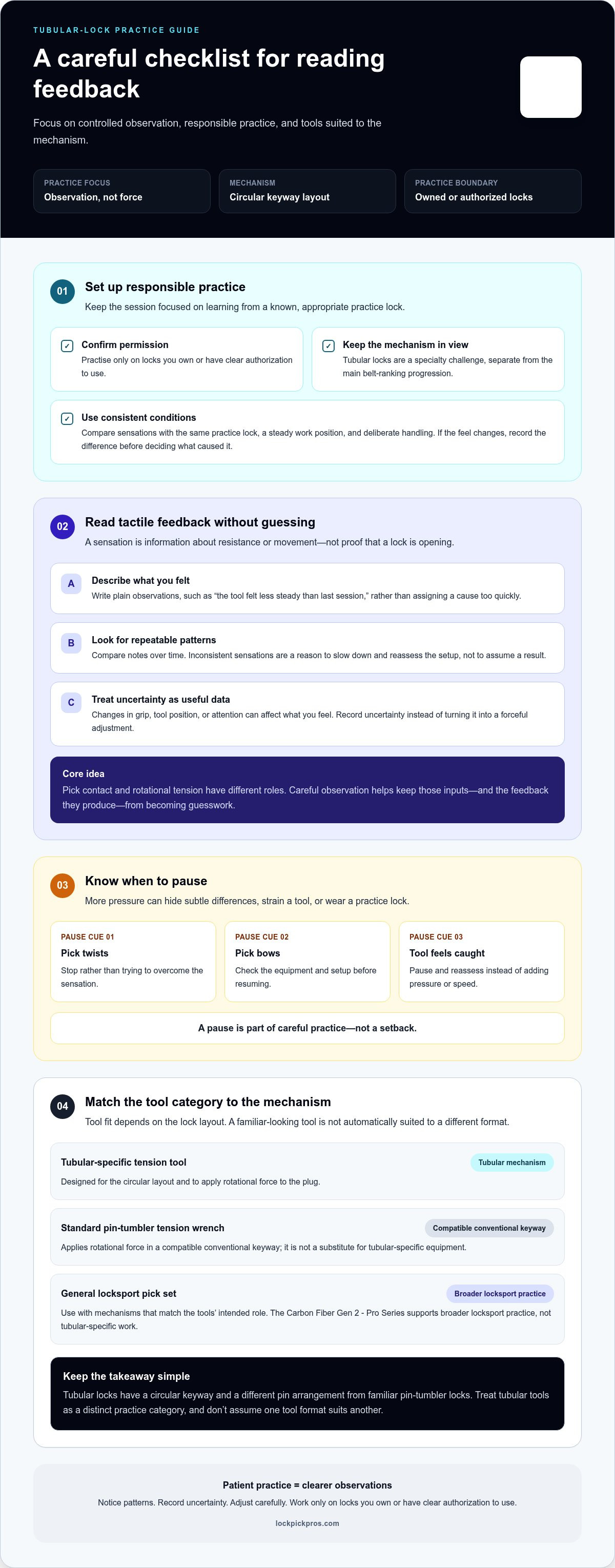
Learning from tactile cues takes more than noticing a single change. A useful practice session compares sensations under similar conditions: the same practice lock, a steady work position, and deliberate, unhurried handling. If the feel changes between attempts, record the difference without deciding too quickly what caused it. That habit helps distinguish repeatable observations from impressions shaped by grip, tool position, or attention.
Recognizing feedback without overinterpreting it
Use plain notes to describe what happened, not what you think the lock did. For example, write “the tool felt less steady than last session” rather than naming a specific internal state. Compare notes over time, and treat inconsistent sensations as a reason to slow down and reassess your setup. This makes practice more methodical and helps keep assumptions from turning into forceful adjustments.
Why more force is not a shortcut
Increasing pressure can cover up subtle differences and make comparisons less useful. It may also strain a tool or cause wear to a practice lock. If a pick twists, bows, or feels caught, stop rather than trying to overcome the sensation. Resume only after checking the equipment and your setup. A pause is part of careful practice, not a setback.
Good tactile practice means noticing patterns, recording uncertainty, and making careful adjustments.
Keep sessions focused on locks you own or have clear authorization to use. If your observations are difficult to compare, simplify the practice conditions rather than adding pressure or speed. Patient, consistent attention gives you a clearer basis for learning from each session.
Tubular Tension Tools vs. Standard Tension Wrenches
Tool choice starts with the mechanism, not with how familiar a tool looks. Tubular locks have a circular keyway, so equipment made for that layout differs from a standard tension wrench used with many conventional pin-tumbler locks. For ethical locksport, use practice tools only with locks you own or have clear authorization to work on. The comparison below focuses on tool roles, not methods for opening a lock.
| Tool category | Intended role | Practice context |
|---|---|---|
| Tubular-specific tension tool | Designed to fit the circular layout and apply rotational force to the plug | Practice focused on tubular mechanisms |
| Standard pin-tumbler tension wrench | Applies rotational force in a compatible conventional keyway | General practice with suitable pin-tumbler locks |
| General locksport pick set | Provides picks and tensioners for broader locksport practice | Use with mechanisms that match the tools’ intended role |
When a dedicated tubular tool is a different category
A tubular-specific tool is shaped for a different keyway and mechanism arrangement than a standard wrench. That difference in fit matters: a tool designed for one format shouldn’t be assumed to suit another. Treat tubular tools as a distinct category of practice equipment, and avoid using a mismatch as a test of force or tool strength. This comparison is about choosing equipment responsibly, not a guide to applying it.
For learners exploring tensioning a tubular lock, keep the distinction clear: understanding rotational tension is not the same as having a tool designed for that lock. Read tool descriptions for their intended practice context, and stop if a tool bends, binds, or otherwise feels strained. A poor fit can make feedback harder to interpret.
What a general locksport kit is suited to
The Carbon Fiber Gen 2 - Pro Series includes 16 stainless-steel picks and 6 tensioners. Those contents support broader locksport practice; they do not make the set a tubular-specific kit. Match a tool to the lock type you’re practising rather than assuming that a general-purpose set covers every mechanism.
For example, a learner working through conventional pin-tumbler practice can use an appropriate pick and tensioner from a general kit, while a tubular-lock lesson calls for equipment intended for that format. These are different practice contexts. Keeping them separate helps avoid confusion about what a set contains and what its tools are meant to do.
A tool’s intended role describes its design purpose, not a guaranteed result on any lock.
As you build a broader locksport toolkit, the Carbon Fiber Gen 2 - Pro Series offers a defined set of picks and tensioners for general practice. Choose equipment by mechanism, keep practice authorized, and let tool fit guide your next learning step.
How to Practise Tubular-Lock Concepts Responsibly
Responsible locksport starts before a tool touches a lock. Set a clear purpose for each session: observe your practice setup, build patience, and protect both the equipment and your boundaries. Use this preparation checklist to keep practice organized. It isn’t a sequence for defeating a lock.
- Choose a practice lock you own or have explicit authorization to use.
- Set it on a stable work surface with enough light to handle tools carefully.
- Keep practice hardware separate from locks relied on to secure a home, vehicle, or personal property.
- Check applicable local rules before practising, since requirements can vary by location.
- Keep a notebook nearby for observations, questions, and any signs of tool or lock strain.
Set up a suitable learning environment
A dedicated practice space makes it easier to focus and avoid improvising. Keep the selected practice lock, suitable tools, and notes together, and don’t work on a lock that serves an active security purpose. After a session, record observations in neutral language, such as “movement felt uneven.” Notes help you compare sessions without turning an uncertain impression into a definite conclusion.
Before starting, inspect the equipment for visible damage. If a tool feels forced, movement becomes inconsistent, or you suspect the lock may be getting damaged, stop. Don’t push through resistance. Pause, set the equipment aside, and review what happened before deciding whether to continue another time.
Build skill through patience and ethical boundaries
Start by practising observation, not speed. Give yourself time to note what feels consistent and what remains uncertain. Move to a more difficult mechanism only when you can stay patient and recognize signs of strain. Every session must be limited to locks you own or have clear authorization to use.
For a community progression option, join the free Black Belt Challenge. Joining starts an email sequence where participants can earn reward picks as they progress through belt ranks and share their progress on social media using Lockpick Pros tools. Picks-in-action posts contribute to the challenge, which includes a $5,000 bounty for reaching its social reach goal. Participation doesn’t guarantee a particular outcome.
Keep practice focused on authorized locks and responsible sharing. If you’re also building a broader locksport toolkit for compatible mechanisms, explore the Carbon Fiber Gen 2 - Pro Series. Keep tubular-lock practice distinct, patient, and within clear ethical boundaries.
Continue Your Locksport Journey with the Right Practice Tools
Understanding tubular tension is one useful part of locksport, but it doesn’t make every lock type interchangeable. A tool can only support practice when its shape and purpose match the mechanism. Keep tubular-lock concepts distinct from standard pin-tumbler practice, and choose equipment for the lock you’re learning with. That simple habit helps set clear expectations and keeps practice focused on skill, observation, and responsible use.
Choose practice tools that match the lock type
The Carbon Fiber Gen 2 - Pro Series is a general locksport kit, not a tool designed specifically for tubular locks. It contains 16 stainless-steel picks and 6 tensioners, making it relevant to broader locksport practice with compatible mechanisms. Those contents describe the kit, not a promise that it suits every lock or produces a particular result. Match each tool to its intended practice context.
As you plan your next steps, use a belt-level progression guide to identify skills to develop over time. The community’s belt-ranking system offers a way to organize practice from foundational techniques toward more complex challenges. A tubular lock can remain a specialty learning project alongside that progression rather than being treated as a required rank milestone.
Equipment choice is part of the learning process. Note which mechanism you’re practising, what you want to learn, and whether the tool fits that context. If it doesn’t, pause and choose appropriate equipment rather than forcing a match. The picks and kits are backed by a lifetime warranty, but that doesn’t make rough handling a substitute for careful practice.
Take the next step one skill at a time
Progress is easier to sustain when each session has a clear focus. Build observation habits first, then move on to new practice locks and mechanisms as your skills develop. The free Black Belt Challenge is a community option for following belt ranks over time. Participants can share progress as part of the challenge, keeping the focus on responsible locksport and steady learning. Sharing is a way to take part, not a promise of a particular outcome.
Keep every practice session limited to locks you own or have clear authorization to use. Don’t practise on a lock that protects property or access unless you have explicit permission. That boundary matters at every skill level, from first practice through advanced locksport.
Ready to build a broader toolkit for compatible locksport practice? Explore the Carbon Fiber Gen 2 - Pro Series and choose tools that match your next learning goal. Keep tubular-lock work separate from general pin-tumbler practice, stay patient, and progress one responsible step at a time.
Make Your Next Practice Session Count
Let your next session focus on one learning goal: observing carefully, staying patient, or building consistency with a familiar practice lock. A clear goal gives you a way to measure progress beyond whether a lock opens. As your interests grow, keep tubular-lock concepts distinct from practice with other mechanisms, and select equipment that fits each type of locksport challenge.
Tensioning a tubular lock is a specialty skill, while a broader locksport kit can support practice with compatible mechanisms elsewhere in your journey. The Carbon Fiber Gen 2 - Pro Series is intended for broader locksport practice, not as a tubular-specific set. Explore the Carbon Fiber Gen 2 - Pro Series as you plan your next step in ethical locksport.
Keep practice to locks you own or have clear authorization to use, and respect applicable local rules. Progress at a pace that leaves room for careful observation and good judgment. Every thoughtful session is a step forward, so keep learning and enjoy the challenge.
Frequently Asked Questions
What does tensioning mean in a tubular lock?
It means applying controlled turning force to a lock component so you can observe how the mechanism responds. That’s different from pushing a tool inward, which creates contact but doesn’t itself apply rotational force. During practice, treat changes in feel as observations rather than confirmation of a particular lock state. Keep the exercise conceptual, and work only on locks you own or have authorization to use.
Is a tubular lock tension wrench different from a standard tension wrench?
It can be. Tension tools are made for different lock layouts, and a tool shaped for one mechanism shouldn’t be assumed to fit another. A tubular-specific tool belongs to a different equipment category from a standard wrench intended for a compatible conventional pin-tumbler lock. Check the intended mechanism when selecting practice equipment, and don’t force a tool that doesn’t fit naturally.
Can a beginner learn about tubular-lock tensioning?
Yes. Beginners can learn the concepts through patient, ethical locksport practice, starting with suitable practice equipment and basic observation rather than rushing toward complex mechanisms. A practice lock lets you focus on noticing differences in contact and movement without working on something relied on for security. Lockpick Pros also provides access to Lockpicking Bootcamp video tutorials with purchases, which can support broader beginner learning.
How much tension should be applied to a tubular lock?
There isn’t a universal amount or setting that applies to every tubular lock and tool. Designs differ, so keep practice controlled and stop if a tool binds or movement feels forced. Excess pressure may make small changes harder to notice and can strain equipment. If you’re unsure what a sensation means, pause, release the pressure, and note the observation rather than increasing force.
Can a standard lock pick set be used on a tubular lock?
Don’t assume a general pin-tumbler set includes tubular-specific tools or is compatible with a tubular lock. The Carbon Fiber Gen 2 - Pro Series contains 16 stainless-steel picks and 6 tensioners for broader locksport practice, but that content is not a claim that it’s a tubular-lock kit. Match equipment to the mechanism and its intended practice context before using it.
Will tensioning damage a tubular lock?
Careful handling can help limit unintended wear, but no tool or technique can guarantee that damage won’t occur. Forceful pressure, binding, or repeated rough contact may strain equipment or the practice lock. Use a dedicated practice lock, check it for visible changes between sessions, and stop if movement becomes forced or a tool feels stuck. Don’t continue by applying more pressure.
Is it legal to practise tubular-lock picking in the United States?
There isn’t one answer that applies to every location and circumstance. Rules can vary, so check the requirements that apply where you live and practise. Keep locksport ethical: use only locks you own or have clear authorization to work on. Don’t treat a lock’s accessibility as permission to practise on it, and avoid using tools on property without authorization.