

What to Say if Police Find Your Lock Picks: Your Rights
What if the key distinction isn’t the lock picks, but whether you’re being questioned during a traffic stop or after an arrest? Knowing what to say if police find your lock picks can help you respond calmly without guessing about your rights.
It’s understandable to feel pressure to explain why you have them. In the United States, ask, “Am I free to leave?” If you’re in custody, say, “I want to remain silent and speak with a lawyer.” Don’t lie or obstruct officers.
This guide explains when to ask for a lawyer, how to decline questions, and what differs during a vehicle stop. It also covers which documents you may need to show and how to state clearly that you don’t consent to a search. The aim is to give you calm, practical phrases while keeping ethical locksport and your rights in view.
Key Takeaways
- If you’re in custody, clearly say that you want to remain silent and speak with a lawyer before answering questions.
- Don’t invent an explanation about your lock picks. You can decline questions and state that you don’t consent to a search.
- Ask, “Am I free to leave?” to clarify whether the encounter is continuing or you can go.
- During a vehicle stop, provide your driver’s license, registration, and proof of insurance when asked, while keeping questions separate from required documents.
- Stay calm and don’t interfere with officers; use clear, brief statements to communicate your choices.
1. Can I talk to a lawyer before answering questions?
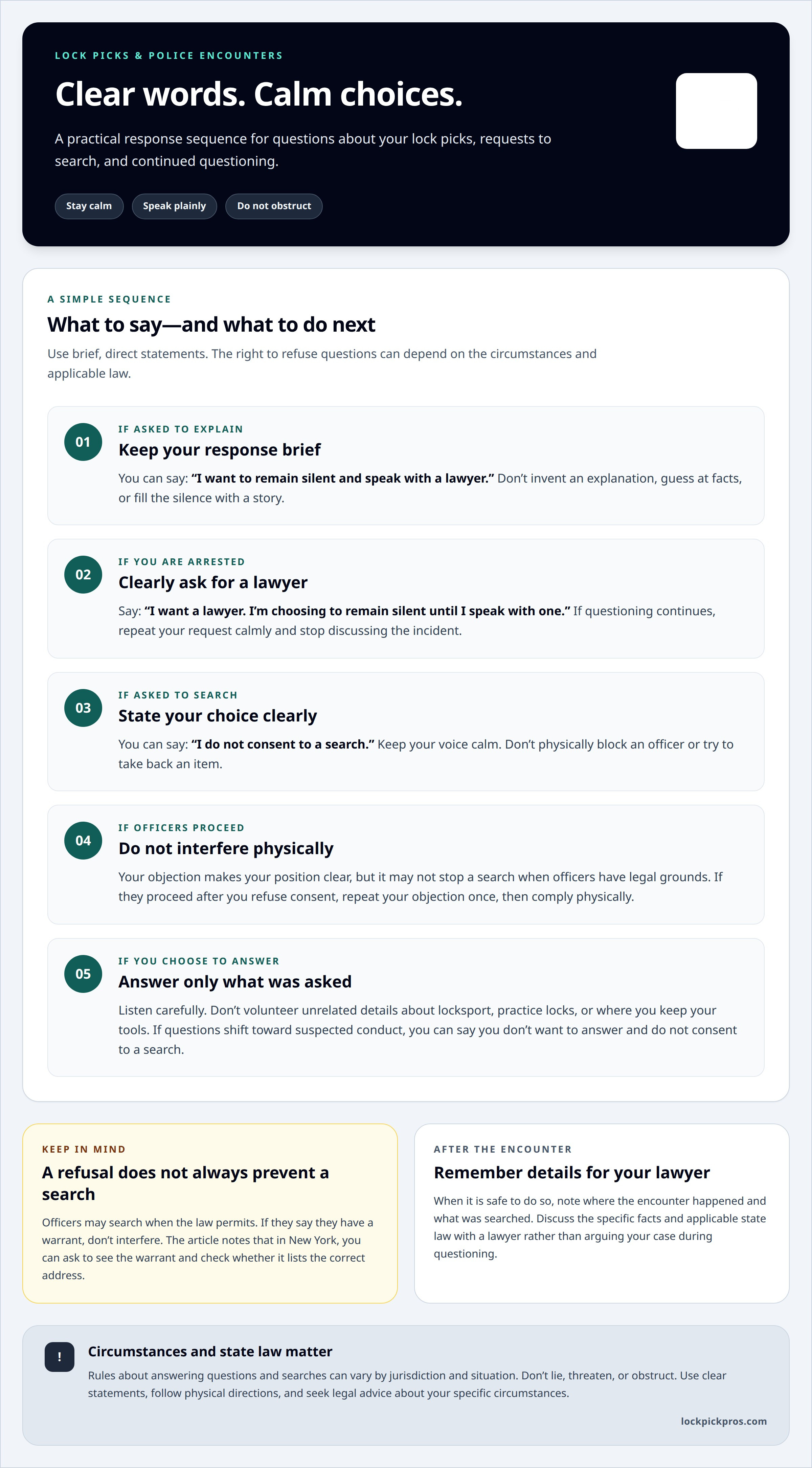
Yes. You can ask to speak with a lawyer before answering law enforcement questions. If officers find lock picks and ask why you have them, keep your response brief: “I want to remain silent and speak with a lawyer.” Don’t fill the silence with an explanation, excuse, or guess. Your words may shape how officers interpret the encounter.
If you’re arrested, clearly request a lawyer before discussing the circumstances. Say, “I want a lawyer. I’m choosing to remain silent until I speak with one.” Repeat the request calmly if questioning continues. Don’t answer questions about where the picks came from, which locks you’ve practiced on, or why you were carrying them. In Washington, an arrested person who can’t afford a lawyer has the right to a free lawyer and should ask police how to contact one. Washington guidance also advises against explaining before speaking with counsel.
A locksmith’s work, a hobbyist’s practice, and locksport participation don’t create one nationwide rule. The relevant law and circumstances depend on the state and situation, so describe your activity truthfully to your lawyer rather than trying to argue your case during questioning. A locksport practice setup should stay clearly separate from unauthorized access; for practice on locks you own or have permission to pick, a dimple-pick set is a specialized tool, not an explanation officers need to hear.
Are lock picks legal to own in the United States? No single answer applies to every state and situation, so don’t assume possession alone makes conduct lawful or unlawful. Which states restrict possession or require a license? Requirements depend on state law. Ask a lawyer familiar with the state where the encounter happened instead of relying on a nationwide assumption.
Possession may be considered alongside surrounding circumstances, such as an allegation of unauthorized entry. The picks alone don’t explain those circumstances. What penalties apply? There is no single nationwide penalty for unlawful possession. State law, the alleged conduct, and the charge affect potential consequences, so don’t guess about penalties during questioning. If arrested, request a lawyer first, then discuss the specific state and facts privately with counsel.
2. What if I speak to law enforcement officers anyway?
Your rights still matter if you answer an officer. Whether you must answer law enforcement questions can depend on the circumstances and jurisdiction. You can refuse consent to a search of your belongings, vehicle, or home. Say clearly, “I do not consent to a search.” Keep your voice calm, and don’t physically block an officer or try to take back an item.
That statement makes your objection clear, but it doesn’t necessarily stop officers from searching. Police may have legal grounds to search in some situations, including certain vehicle searches. If an officer says they have a warrant, don’t interfere. In New York, you can ask to see the warrant and check whether it lists the correct address. If officers proceed after you refuse consent, repeat your objection once, then comply physically and note what happened for your lawyer later.
Speaking can create a record. An officer’s questions aren’t off the record, even if the conversation feels informal or happens beside your car. For example, saying, “I brought the picks to practice on a friend’s lock,” may prompt questions about permission, location, and timing. Don’t invent a reason, guess at facts, or change your account to fit an officer’s questions. If you don’t want to answer, say so directly and stop explaining.
If you choose to answer a basic question, listen carefully and respond only to what was asked. Don’t volunteer unrelated details about locksport, locks you’ve handled, or where you keep your tools. If questions shift toward suspected conduct, you can say, “I don’t want to answer questions. I do not consent to a search.” If you’re under arrest, clearly request a lawyer and stop discussing the incident. Avoid arguing about the law at the roadside. An officer’s question is not a private conversation.
Rights when police stop, search, or question you depend on the circumstances and applicable law. You may be able to refuse questions or consent, but officers may still search when the law permits. Don’t obstruct, threaten, or lie. Instead, state your choice clearly, follow physical directions, and remember the details you can safely recall, such as where the encounter happened and what was searched. For ethical practice after the encounter, a standard pin-tumbler pick set can support work on locks you own or have permission to practice on.
3. Remaining silent and declining to answer questions
If an officer asks why you have lock picks, you can say, “I would like to remain silent.” That states your choice without inventing a reason or starting a debate. If you want legal advice before answering, add, “I want to speak with a lawyer.” Then stop discussing the picks, your practice, or where you were going. A clear statement is more useful than a lengthy explanation.
Use plain words. “No comment” may sound unclear, while a direct statement identifies your decision. If an officer again asks whether you’ll explain, calmly repeat that you’re choosing not to answer questions. Don’t nod along to a statement you disagree with, guess at details, or make up a story because silence feels uncomfortable. A brief, consistent response avoids conflicting explanations.
The setting matters. Whether you may refuse to answer questions can depend on the circumstances and any applicable legal duties. A person in custody may have the right to remain silent, but the rules can vary. Some U.S. states may require someone who is stopped and told to identify themselves to provide their name. That doesn’t automatically require answers about lock picks, practice locks, or a particular location.
Separate identification from questioning. If an officer asks for your name, don’t assume the rules are the same in every state. Requirements vary, and the circumstances of the stop matter. You can ask, “Am I required to provide identification?” Stay calm, and don’t turn uncertainty into a false answer. If you’re unsure whether you must respond, request a lawyer.
Silence is different from lying. In the United States, lying to a government official can be a crime, while remaining silent until consulting a lawyer is not. For example, don’t claim the picks belong to someone else if that isn’t true. Don’t guess about a lock or event you can’t remember. Decline to answer instead. When considering what to say if police find your lock picks, a truthful, brief refusal is clearer than an improvised story.
Keep your conduct as clear as your words. Don’t interrupt, threaten, hide the picks, or physically resist an officer. If you choose to stop answering, say so directly rather than giving partial explanations. In New York, a person stopped by police can say, “I would like to remain silent.” This direct phrase communicates your choice without adding details.
If questioning continues after you invoke silence, briefly repeat your request and avoid discussing the facts. If you’re arrested, clearly ask for a lawyer before answering further questions. For ethical locksport, practice only on locks you own or have permission to pick. Knowing what to say if police find your lock picks doesn’t mean you need to improvise an explanation during an encounter.
4. Asking whether you are free to go
Ask directly whether you’re free to leave: “Am I free to leave?” In New York, a person stopped by police should ask whether they’re under arrest or free to leave. The answer helps clarify what officers are communicating. It doesn’t require you to explain why you have lock picks or answer unrelated questions.
Ask calmly, then listen. If the officer says you’re free to leave, do so without arguing or making sudden movements. If the officer says you’re not free to go, don’t walk away or physically resist. Instead, ask, “Am I being detained, or am I under arrest?” This seeks clarity but doesn’t change the officer’s decision.
An unclear answer calls for one brief follow-up, not a debate. You might say, “I want to understand. Am I free to leave now?” Don’t treat silence, a pause, or an officer turning away as permission. Wait for a clear response before leaving, and keep your hands visible if you’re holding a bag or lock-pick case.
If officers say you’re free to go, you can leave without giving a reason for carrying picks. Don’t stay to volunteer details about locksport, a practice lock, or a planned trip. If an officer asks another question as you prepare to leave, you can say, “I don’t want to answer questions. Am I free to go?” Keep the exchange respectful and brief.
If officers say you’re detained or under arrest, don’t try to end the encounter by explaining your hobby. Ask whether you’re under arrest, then clearly state that you want to remain silent and speak with a lawyer. Asking about your status isn’t a substitute for requesting a lawyer. If you’re arrested, make that request directly and avoid discussing the facts.
New York City has a specific identification rule for certain investigative encounters. When investigating criminal activity, officers must identify themselves and explain the reason for the interaction. If they don’t arrest or ticket you, they must provide a business card at the end of the encounter. Unless responding to an emergency, an officer must also provide identification and a business card upon request.
Keep the steps simple: ask whether you’re free to leave, listen, and follow the answer without physical resistance. If the answer is unclear, ask once more. If the encounter becomes an arrest, stop discussing the lock picks and request a lawyer. These steps help you communicate clearly without turning a roadside conversation into an argument.
5. Police stops in a vehicle
A roadside stop can involve required driving documents as well as questions about items in your car. In the United States, a driver pulled over for a traffic violation may be required to show a driver’s license, vehicle registration, and proof of insurance. That doesn’t mean you must answer questions about lock picks. Keep these parts of the encounter separate.
Once stopped, keep your hands visible and avoid reaching suddenly toward a bag, glove compartment, or console. Provide the required documents when asked. If lock picks are visible or an officer asks about them, don’t grab or hide them. You can say, “I don’t want to answer questions,” and ask whether you’re free to leave. If officers direct you to stay, don’t drive away.
Rules and stop procedures can differ by state. In Washington, a driver must show a driver’s license and registration when police ask. In New York, drivers must show a license, vehicle registration, and proof of insurance upon request. In California, officers must tell a person the reason for a street or vehicle stop before asking questions. These examples show why drivers should follow document instructions while treating investigative questions separately.
If an officer asks to search the car, say, “I do not consent to a search.” State your objection clearly, but don’t physically interfere if officers proceed. Refusing consent communicates your position; it doesn’t prevent a search when police have another legal basis. In New York, police may briefly detain someone when they have reasonable suspicion of a crime. A person arrested in a car may have the car searched.
A pat-down differs from a vehicle search. An officer may conduct a pat-down when the legal standard for a weapons frisk is met; suspicion of a concealed weapon alone may not fully describe that standard. Don’t reach toward a pocket or physically argue if an officer begins a pat-down. If you object, say so calmly. Focus on the officer’s instructions rather than trying to retrieve or explain the picks.
During a stop involving vehicle-related locks, keep hobby tools separate from driving documents and answer only what you choose. Vehicle locksmith tools differ from standard locksport picks. Carrying tools doesn’t call for an improvised roadside explanation. After the stop, write down details you remember, including the location, questions asked, and whether officers searched. Choose equipment for lawful locksport practice only on locks you own or have permission to pick.
Lockpick Pros: Practice Locks
Lockpick Pros offers practice locks for ethical locksport and skill-building at home. After learning how to respond during a police encounter, keep practice separate: work only on locks you own or have permission to pick. A dedicated practice lock lets you focus on tactile feedback and technique without involving a vehicle or someone else’s property.
New to the hobby? Beginner Lockpick Sets can support early practice, while Vehicle Locksmith Tools and Dimple Picks serve more specialized interests. Choose tools for the lock type you’re practicing, and store them responsibly when not in use. Lockpicking is a skill developed through patient, ethical practice, one session at a time.
For questions about practice locks or getting started, contact Lockpick Pros.
Carry Your Locksport Practice Forward
Knowing what to say if police find your lock picks starts with staying calm and choosing clear, truthful words. Outside that moment, build a locksport routine around permission, responsible storage, and practice on locks you own or are authorized to pick. Keep your hobby separate from any real-world lock or vehicle you don’t have permission to work on.
Your next practice step can match your experience. Lockpick Pros offers Beginner Lockpick Sets and Advanced Lockpick Sets for different stages of skill development, along with Practice Locks for focused sessions. Choose deliberately, pay attention to tactile feedback, and let steady practice guide your progress.
If you’d like help selecting equipment for your locksport practice, contact Lockpick Pros about the Carbon Fiber Gen 2 Pro Series. Keep learning, practice ethically, and enjoy each new challenge.
Frequently Asked Questions
Are there any exceptions to the general rule that I do not have to answer questions?
Yes, but exceptions concern specific legal duties, not a general duty to explain your tools. A grand jury subpoena, for example, requires you to follow its instructions about when and where to report to court. Keep the subpoena and note its reporting details. Don’t treat an officer’s interview request as equivalent to a subpoena. Read the document carefully to understand what it directs you to do.
Can I talk to a lawyer before answering questions?
Yes. If officers propose a voluntary interview, you may refuse, request an attorney’s presence, and discuss the time and place. You may also ask to learn the questions beforehand. These options can help you arrange legal advice without answering on the spot. Keep any written invitation or scheduling messages, and distinguish an interview request from formal legal paperwork.
Do I have to answer questions asked by law enforcement officers?
Generally, you don’t have to answer a question simply because an officer asks. To clarify what’s being requested, you can ask, “Is this a request, or are you directing me to do something?” Listen to the response and don’t guess about your obligations. A question seeking an explanation differs from a direct instruction or formal legal document.
What if I speak to law enforcement officers anyway?
If you’ve already answered, focus on keeping an accurate record instead of trying to revise your account during another roadside conversation. As soon as practical, write down the questions you remember and your answers. Note which details you recall clearly and which are uncertain. Preserve related messages or receipts, and share the record privately with your lawyer. Don’t coordinate accounts with anyone else involved.
Do you have to answer police questions about lock picks in the United States?
Generally, there’s no blanket U.S. rule requiring an explanation solely because lock picks are present. The practical answer depends on the encounter and any separate legal requirement, not just the tools. Distinguish a request to explain the picks from a question about identity or an immediate instruction. If the request is unclear, ask what the officer is asking you to do.
Can police search a car or bag for lock picks without a warrant?
Yes, in some circumstances, a warrant isn’t the only possible basis for a search. The rules can depend on the state, the reason for the stop, and whether an arrest occurred. For example, in Washington, police may search an arrested person and the area close by. That example doesn’t mean every bag or vehicle search is automatically permitted.
What should you do if police arrest or charge you for possessing lock picks?
Keep every citation, charging paper, property receipt, and court notice together. Make a private timeline of where the picks were found and who owned or had permission to use the lock involved. Preserve supporting messages and receipts, then share them with your lawyer. Avoid discussing case details online or with possible witnesses. Review court paperwork promptly so you don’t miss a date or instruction.