

The Ultimate Guide to Choosing a Lockpick Set

So, you’re ready to dive into the exciting world of locksport, but the sheer number of options is overwhelming. How do you choose the right lockpick seti when some have five pieces and others have fifty? What’s the real difference between a hook and a rake, and how can you be sure you're buying a durable, high-quality kit that won’t bend or break on your first practice lock? It's easy to feel lost before you even begin.
Don't worry-we've got your back. Welcome to the community! This ultimate guide is your personal mentor, designed to cut through the noise and build your confidence. We’ll walk you through the foundational tools every ethical lockpicker needs, explain what separates a beginner kit from an expert-level one, and give you the knowledge to make a smart purchase. From your first practice lock to advanced challenges, you'll learn how to find the perfect set that matches your skill level and goals. Let's get you started on your journey.
Key Takeaways
- Start your locksport journey by choosing quality over quantity; a foundational set with fewer, better tools provides the crucial feedback needed to build solid skills.
- Master the two fundamental components of any kit-the picks and the tension wrenches-as understanding their synergy is the first step to opening any lock.
- Recognize when you've outgrown your first kit. This guide helps you decide when to upgrade to a more advanced lockpick set to tackle new challenges.
- Learn what separates hobbyist and professional kits, from material science to specialized profiles, to ensure your next investment matches your ambition.
Anatomy of a Lockpick Set: Understanding Your Essential Tools
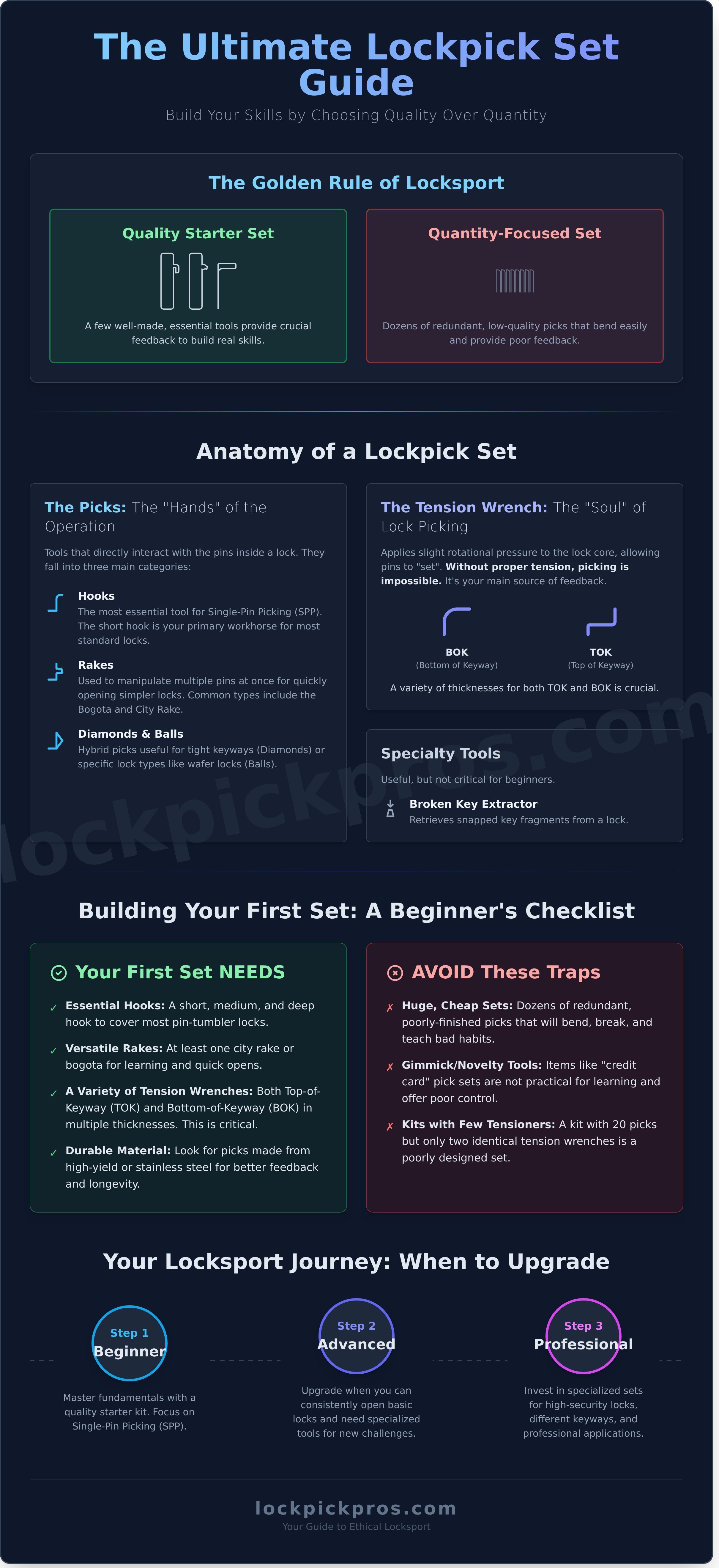
When you first look at a lockpick seti, it's easy to get mesmerized by a high piece count. But in the world of locksport, quality always triumphs over quantity. Many oversized sets are filled with redundant or poorly made tools. A truly effective kit is built on two fundamental components: picks and tension wrenches. These tools work in harmony to manipulate a lock’s internal mechanisms. For a deeper dive into the mechanics, this lock picking overview provides excellent foundational knowledge. The final piece is a sturdy case, which isn't just for show-it protects your precision instruments and keeps you organized for your next challenge.
The Picks: Hooks, Rakes, and Diamonds
Picks are the tools that directly interact with the pins inside a lock. While there are countless profiles, they generally fall into a few key categories. For any ethical lockpicker, understanding these is your first step to mastery.
- Hooks: The most crucial tool for a technique called Single-Pin Picking (SPP). The short hook is your go-to for most standard locks and is an absolute essential.
- Rakes: These picks, like the popular Bogota or City Rake, have complex profiles designed to move multiple pins at once. They are used to quickly "rake" open simpler locks.
- Diamonds and Balls: These are hybrid picks. Diamonds are useful for manipulating pins in tight keyways, while ball picks are often used for wafer locks.
A beginner doesn't need twenty different picks. A couple of quality hooks and a versatile rake are all you need to start earning your first locksport belts.
The Tension Wrench: The 'Soul' of Lock Picking
If picks are the hands, the tension wrench (or tensor) is the soul of the operation. This simple L-shaped bar applies slight rotational pressure to the lock's core. This pressure is what allows the pins, once lifted correctly, to "set" at the shear line. Without proper tension, picking is impossible. You'll encounter two main types: Top of the Keyway (TOK) and Bottom of the Keyway (BOK). Having a variety of thicknesses for both is far more important than having dozens of pick profiles. The tension wrench is also your main source of feedback, transmitting subtle clicks and movements from inside the lock directly to your fingers.
Extractors and Other Specialty Tools
As you explore a complete lockpick seti, you might find other interesting tools. A broken key extractor does exactly what its name implies-it helps you retrieve a snapped key from a lock. You may also see wafer rakes or jiggers, designed for non-pin-tumbler locks often found on desks or mailboxes. While useful in specific situations, these are not critical tools for a beginner focused on learning the fundamentals of pin-tumbler locks.
Choosing Your First Lockpick Set: A Beginner's Guide
Ready to start your locksport journey? The first step is choosing the right tools. When searching for your first lockpick seti, it's easy to get overwhelmed by massive kits with dozens of tools. But here's a secret from the pros: quality beats quantity, every single time. Your goal is to learn the art of single-pin picking (SPP), a foundational skill that requires precision, not a hundred redundant picks. A smaller, well-made set paired with a good practice lock is the key to building real, lasting skill.
What to Look for in a Beginner Set
A great beginner set focuses on the essentials. You don't need a huge collection, just the right tools for the job. Understanding how these tools interact with the pins is crucial, and academic resources like MIT's guide to lock mechanics can provide a deep dive into the physics at play. Look for a kit that includes:
- Essential Hooks: A short, medium, and deep hook are the workhorses of single-pin picking. These will cover the vast majority of pin-tumbler locks you'll encounter.
- Versatile Rakes: At least one or two rakes, like a city rake or a bogota, are perfect for learning the basics of raking and for opening simpler locks quickly.
- A Variety of Tension Wrenches: Tension is half the battle. Your set must include both Top-of-Keyway (TOK) and Bottom-of-Keyway (BOK) tensioners in various thicknesses.
- Durable Material: Look for picks made from high-yield steel. They provide better feedback and are far less likely to bend or break while you're learning.
What to Avoid in Your First Set
Just as important as knowing what to look for is knowing what to skip. Many large, unbranded sets from massive online marketplaces are filled with low-quality, poorly finished metal that will bend easily and give you terrible feedback. Avoid these common traps:
- Sets with dozens of redundant, poorly made picks.
- Bulky or novelty sets, like "credit card" picks, which are not practical for serious learning.
- Kits that lack a good selection of TOK tension wrenches.
- Cheap, unbranded sets that prioritize quantity over quality.
Our Recommendation for Newcomers
The ideal starting point is a foundational kit built for learning. It should contain a curated selection of essential hooks, a versatile rake, and a robust collection of tensioners. This focused approach gives you everything you need to master the fundamentals without the distracting clutter of unnecessary tools. A quality beginner lockpick seti is an investment in your skill development.
Ready to build your skills the right way? Shop our curated Beginner Lockpick Sets and start your locksport journey with confidence.
Leveling Up: When and How to Upgrade Your Lockpick Set
Your first lockpick seti was your entry into the exciting world of locksport. You've opened your practice locks, felt the thrill of that first click, and now you're hungry for more. But how do you know when you've truly outgrown your beginner kit? The signs are usually clear: you feel limited by the pick profiles you have, you're encountering locks that just won't open, and you're curious about more advanced techniques like Top of the Keyway (TOK) tensioning.
If you're hitting a wall, don't get discouraged. It doesn't mean you've stopped learning; it means you're ready to evolve. Upgrading your tools is a natural and exciting step in your journey to earning the next belt.
Tackling Security Pins: Spools, Serrated, and Mushrooms
Beginner locks use standard pins, but most real-world locks contain security pins designed to thwart picking attempts. These pins-like spools, serrated, and mushrooms-give false feedback, making you think you've set a pin when you haven't. The mechanics of these pins, as detailed in foundational texts like the MIT Guide to Lock Picking, require a more nuanced approach. Standard hooks often aren't deep enough to navigate around them. You'll need deeper hooks and specialty profiles made from high-quality steel that transmit every subtle click and counter-rotation directly to your fingers. This superior feedback is essential for defeating security pins and earning your next locksport rank.
Expanding Your Tension Tool Collection
Tension is half the battle in lock picking, and the simple L-shaped tensioners in a basic kit can only take you so far. As you advance, you'll need a wider variety of tools to control the core precisely. This is where TOK tensioning comes in.
- Flat Bars: These slide into the top of the keyway, providing direct rotational force and leaving more room for your pick.
- Twisted Wrenches: These offer a more ergonomic grip and can help in tight or awkwardly positioned keyways.
The goal is to find a tension wrench that fits the keyway perfectly, with no wiggle or slop. A snug fit translates to better control and clearer feedback from the pins.
Moving to Advanced and Specialized Sets
An advanced lockpick seti isn't just about having more picks; it's about having the right picks. These sets offer more refined profiles, thinner gauges for restrictive European keyways, and tools for entirely different types of locks. You'll gain access to a wider array of hooks, rakes, and specialized tools designed for specific challenges, such as dimple locks or wafer locks found on cabinets and cars. This is where you move from a generalist to a specialist, equipping yourself to tackle nearly any lock you encounter in your ethical picking journey.
Ready for the next challenge? Explore our Advanced Sets.
Professional & Specialized Kits: For the Serious Practitioner
When you move beyond the hobby, your tools must evolve with you. A professional lockpick seti is an investment in reliability, precision, and efficiency. While beginner sets are designed for learning, professional kits are built for performance under pressure. For locksmiths, penetration testers, and first responders, tool failure is not an option. This is where the ‘buy it for life’ mentality takes hold, prioritizing exceptional materials and a comprehensive selection for any challenge.
Material Matters: Steel, Titanium, and Carbon Fiber
The feedback a pick transmits is directly tied to its material. Professionals demand the best because it translates to faster opening times and greater success. Here’s a quick comparison:
- High-Quality Steel: Most elite picks use 301 High Yield steel. It offers a superb balance of flexibility and strength, snapping back to its original shape without permanently bending like cheaper metals.
- Titanium: Incredibly lightweight and durable, titanium picks are resistant to corrosion and built to last. However, they are more expensive and can provide less tactile feedback than high-grade steel.
- Pick Thickness: Professionals carry multiple thicknesses. A standard .025" pick is a durable workhorse, while a slender .015" pick is essential for navigating narrow European or high-security keyways.
Kits for Specific Jobs: Dimple, Tubular, and Automotive
A standard hook and rake won't open every lock. As you advance, your collection will need to specialize. High-security locks often require dedicated tools, such as dimple picks with specialized flag tips to manipulate the unique pin mechanisms. Likewise, tubular picks are necessary for the circular locks found on safes and vending machines. Automotive entry requires an entirely different set of tools, including jiggers, rakes, and bypass tools designed for car-specific locks.
Building a Custom Set vs. Buying a Master Kit
Should you build your own kit or buy a pre-made one? The answer depends on your focus. Building a set piece by piece allows you to create a highly personalized toolkit tailored to your exact needs. However, a comprehensive, pre-made professional lockpick seti offers immense value and ensures you are prepared for any situation. Either way, a high-quality, organized case is non-negotiable for protecting your investment and keeping your precision tools ready for action. Explore our expert-level kits to find the perfect foundation for your professional journey.
Key Factors to Consider Before You Buy Any Set
You're ready to start your locksport journey. That's fantastic! But before you purchase your first lockpick seti, let's run through a final checklist. Investing in the right tools from the beginning sets you up for success, prevents frustration, and ensures you're practicing the craft responsibly. Think about where you want to go with this skill-are you a casual hobbyist or aiming to earn your next belt ranking? Your goals will shape your choice.
Pick Material and Finish
The heart of any good pick is the metal it's made from. Look for sets crafted from high-quality, high-yield stainless steel. This provides the perfect balance of flexibility to navigate the keyway and stiffness to transmit crucial feedback. A smooth, polished finish isn't just for looks; it's essential for performance. A polished pick glides over pins, preventing damage to the lock's internal mechanisms and reducing unnecessary friction that can mask the subtle clicks you need to feel.
Handle Comfort and Feedback
You'll be spending a lot of time holding these tools, so comfort is key. Handles range from bare metal to ergonomic molded grips. While bare metal offers raw, unfiltered feedback, molded handles can provide superior comfort for longer practice sessions. This is largely a matter of personal preference, but a great handle does more than just feel good. It effectively transmits the vibrations from the pins to your fingertips, allowing you to interpret what's happening inside the lock with greater precision.
Legality and Ethical Considerations
This is the most important part. As ethical lockpickers, we follow a strict code of conduct that keeps the sport positive and legal. Before you buy any tools, commit these rules to memory:
- Check Your Local Laws: Ownership and carry laws for lock picking tools vary by state and country. It is your responsibility to know and follow the regulations in your area.
- The Golden Rule: Never, ever pick a lock you do not own or have explicit, documented permission to pick. This includes locks that are "in use."
- Join the Community: Locksport is about understanding mechanics, solving puzzles, and celebrating skill. It is not about unauthorized entry. Engage with the community to learn and share in a positive environment.
Choosing the right lockpick seti is your foundational step toward mastering a challenging and rewarding skill. By focusing on quality materials, functional design, and unwavering ethics, you are building a solid foundation for your future in locksport. Ready to find the perfect tools for your journey? Explore our curated collection of beginner and professional sets.
Unlock Your Potential: The Right Tools Await
You've explored the anatomy of essential tools, learned what to look for in a beginner's kit, and discovered when it's time to level up. The path to becoming a skilled practitioner isn't about having the most complex gear; it's about having the right gear for your stage of the journey. Whether you're just starting out or tackling advanced challenges, the core principle remains the same: quality tools provide the feedback necessary for skill refinement. Finding the perfect lockpick seti is your first, most important step toward mastering this rewarding hobby.
At Lockpick Pros, we live and breathe this sport. We are deeply committed to promoting legal and ethical lock picking, which is why our tools are designed for and trusted by the locksport community worldwide. We stand behind our precision-engineered products with a complete satisfaction guarantee, ensuring you have the support you need to push your boundaries. Your next challenge is waiting to be conquered.
Ready to start? Find your perfect lockpick set today!
Frequently Asked Questions
How many picks does a good lockpick set really need?
Quality always beats quantity. A great starting lockpick seti doesn't need dozens of tools. Focus on a core group of 3-5 essential picks, like a short hook, a medium hook, and a city rake. Most importantly, your set must include a variety of tension wrenches for both Top and Bottom of Keyway tensioning. These foundational tools are all you need to build solid skills and begin your journey in the sport of lockpicking.
What is the difference between a $20 set and a $100+ set?
The difference is precision, feedback, and durability. Inexpensive sets often use poorly finished, stamped metal that can break easily and provide muddy feedback. A premium $100+ set is crafted from high-quality steel with a smooth, polished finish and ergonomic handles. This superior construction translates directly into better feedback from the lock's pins, which is critical for skill refinement and advancing to higher-level locks. It's an investment in your locksport education.
Are credit card lockpick sets effective for serious learning?
Credit card sets are a fun novelty but are not effective tools for serious locksport practice. Their thin, flimsy construction and lack of proper handles offer very poor feedback and control, which will frustrate your learning process. For genuine skill development, you need a dedicated set with rigid, full-size tools. Think of a credit card set as an emergency gadget, not a training tool for mastering the craft of lockpicking.
How should I clean and maintain my lockpick set?
Proper maintenance protects your investment. After each practice session, wipe your picks and tension wrenches with a clean, dry cloth to remove oils and debris. For long-term care, apply a very light coat of a rust-inhibiting oil, like 3-in-1, and wipe off the excess. Always store your tools in their case to protect the delicate tips from damage. This simple routine ensures your precision tools will last for years.
Is it legal to carry a lockpick set with me?
Legality depends entirely on your location and intent. Laws vary dramatically between states and countries. In many places, simple possession is legal, but carrying them with "intent to commit a crime" is a felony. As an ethical lockpicker, you should only use your tools on locks you own. We strongly advise you to research your local statutes thoroughly to ensure you are always in compliance with the law and representing the locksport community responsibly.
What is the best lockpick set for a complete beginner?
The best lockpick set for a complete beginner focuses on foundational tools, not a huge number of picks. Look for a kit that includes a few high-quality hooks (like a short and medium hook), one or two rakes, and a good selection of tension wrenches for both Top of Keyway (TOK) and Bottom of Keyway (BOK) tensioning. This focused approach provides exactly what you need to master the core skills without overwhelming you with unnecessary tools.