

Ethical Lock Picking: 2026 Locksport Integrity & Community Guidelines
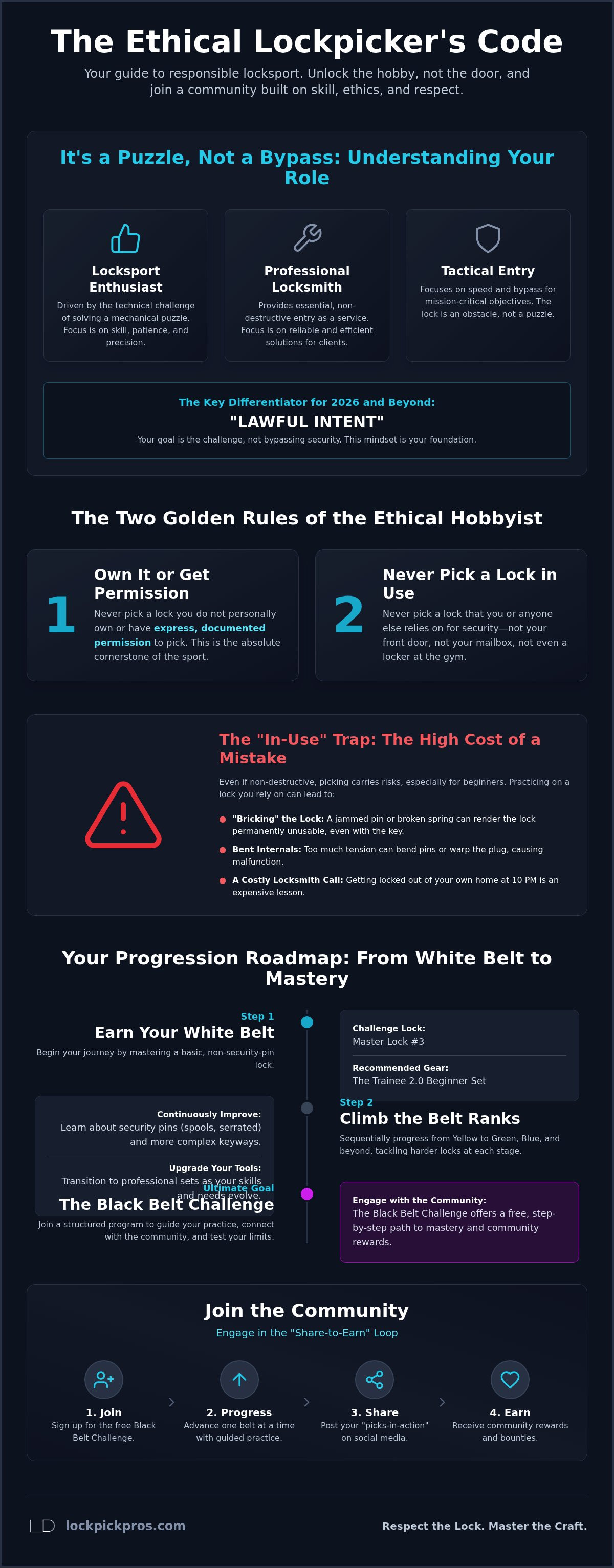
The difference between a criminal and a locksport enthusiast isn't the tools they carry; it's the code of ethics they live by. If you've ever hesitated to buy your first set because you're worried about being perceived as a criminal, you're not alone. Transitioning from a curious onlooker to a respected hobbyist requires a firm grasp of the locksport community guidelines. These rules aren't just suggestions. They are the foundation of a sport that values mechanical puzzles, transparency, and responsible disclosure over anything illicit.
It's natural to feel a bit of anxiety when you're starting out. You might be confused by conflicting state laws or worried you'll accidentally damage your own front door lock. We've been there, and we're here to tell you that lockpicking is an accessible, rewarding challenge when you approach it correctly. In this guide, you'll master the foundational rules of ethical picking and learn how to progress through the community's official ranking system. We'll give you a clear framework to follow, explain how the belt system works, and help you choose your first beginner set with confidence. From understanding the 2026 updates to California Penal Code 466 to earning your first White Belt, your journey to mastery starts here.
Key Takeaways
- Understand the core philosophy of locksport as a mechanical puzzle and how it differs from tactical entry or professional locksmithing.
- Master the foundational locksport community guidelines, specifically the two golden rules regarding lock ownership and security.
- Navigate the legal landscape by learning the importance of lawful intent and the proper way to transport your tools in a professional carrying case.
- Launch your progression roadmap by mastering the Master Lock #3 and earning your White Belt with The Trainee 2.0 beginner set.
- Join the Black Belt Challenge to access a step-by-step path to mastery and earn community rewards through our Share-to-Earn loop.
The Foundation of Locksport: What is Ethical Lock Picking?
Ethical lockpicking is the dedicated, competitive pursuit of manipulating locking mechanisms for sport, a hobby better known as locksport. While professional locksmiths provide essential services and tactical entry teams focus on speed, hobbyists are driven by the technical challenge of the "open." For an ethical lockpicker, a lock isn't a security barrier meant to keep people out. It's a complex, mechanical puzzle waiting to be solved through patience and precision. Understanding What is Locksport? helps clarify that our community focuses on the intricate manipulation of internal components rather than the simple bypass of security. In 2026, the core differentiator for our community is "Lawful Intent." This principle means your primary goal is the mechanical challenge rather than overcoming security, ensuring your focus remains on skill development within a safe, legal framework.
Locksport vs. Criminal Intent
Owning a set of picks doesn't make someone a criminal any more than owning a scalpel makes them a surgeon. Tools alone don't define a crime; your intent and the setting do. Locksport is a legitimate sport defined by precision, patience, and a structured ranking system. The global community is largely guided by Lockpickers United (LPU), which maintains the standards for skill progression and belt ranks. When you follow the locksport community guidelines, you're joining a network of enthusiasts who treat every cylinder as a technical challenge to be mastered. If you're a curious beginner, starting with a foundational set like The Trainee 2.0 allows you to practice these skills in a controlled, ethical environment.
Why Ethics Matter in 2026
Maintaining a sterling reputation as a hobby is vital for keeping our tools accessible and legal. As jurisdictions update their statutes, such as the 2026 revisions to California Penal Code 466, ethical behavior serves as your best defense. It protects you from legal misunderstandings by clearly demonstrating that your interest is purely recreational and educational. Adhering to locksport community guidelines isn't just about following rules; it's about preserving the integrity of the sport for the next generation of pickers. This specific discipline is defined as the practice of only opening locks you own or have explicit, documented permission to manipulate. By sticking to these high standards, we ensure that the sport remains a respected, protected, and thriving pastime for everyone involved. It transforms a potentially misunderstood activity into a rewarding journey of technical mastery.
The Two Golden Rules of the Ethical Hobbyist
The heart of the hobby beats within two non-negotiable rules. These aren't just suggestions for newcomers; they're the pillars of the locksport community guidelines. To stay on the right side of the law and the community, you must live by these two principles:
- Rule #1: Never pick a lock that you don't own or have express permission to pick.
- Rule #2: Never pick a lock that is in use or that you rely on for security.
Adhering to these rules marks your psychological shift from someone interested in "breaking in" to a hobbyist dedicated to mechanical internals. You're here for the puzzle, not the bypass. When you look at a lock, you should see a sequence of binding pins and shear lines rather than a door to be opened. This perspective change is what separates the masters from the amateurs. It's about the "click" of a successful set, not the "open" of a restricted area. This mindset is championed by groups like The Open Organisation Of Lockpickers, who focus on the educational and recreational aspects of the craft.
Many beginners don't realize that picking carries a risk of "destructive entry." Even if you aren't using a drill, the act of picking can permanently damage a cylinder's delicate springs or pins. If a spring binds or a pin gets stuck in a chamber, that lock is effectively "bricked." While picking is technically non-destructive, a heavy hand can change that quickly. Beginners often apply too much tension, which can bend pins or warp the plug. If you're practicing on a lock you rely on, you might find yourself unable to use your key later that night. That's a high price to pay for a few minutes of practice.
The In Use Trap
Imagine it's 10 PM on a Tuesday and you've just bricked your front door lock while practicing. That's a costly mistake and a long wait for a locksmith. The "in use" rule covers everything from your apartment door to the padlock on your gym locker. If you rely on it for security, don't put a pick in it. Instead, use dedicated practice locks or cutaway cylinders. These tools are designed for repeated manipulation and allow you to see the pins move, which is essential for building muscle memory. Once you're ready to step up your skill, consider the Carbon Fiber Gen 2 Pro Series for tools that offer superior tactile feedback.
Express Permission vs. Assumed Permission
Verbal permission from a friend "letting you try" their old padlock isn't enough. You should always ensure the person giving permission actually owns the lock. For service members or security professionals, this ethical framework is part of professional development. It ensures your skills are used responsibly and legally. To get started safely, check out The Trainee 2.0 to find the right practice locks and tools for your first belt rank. Sticking to these locksport community guidelines keeps the community safe and ensures the sport remains a respected, protected pastime for everyone.
Navigating the Legal Landscape: Lawful Intent and Equipment
In 2026, the legal landscape for lockpicking tools is defined by transparency. While possession is legal across the United States, the concept of "intent" remains the deciding factor. Forty states have explicit statutes protecting your right to own tools for lawful purposes. However, in states like Mississippi, Nevada, Ohio, and Virginia, possession can be considered prima facie evidence of criminal intent. This places the burden on you to prove a lawful purpose. Adhering to locksport community guidelines is your most effective way to demonstrate that you are a hobbyist. By treating your tools as sports equipment, you align yourself with the ethical standards that keep this hobby legal and respected.
Being open about your hobby is a powerful tool for legitimacy. When asked about your gear, a simple "I am a locksport enthusiast" goes a long way. This transparency is backed by academic research on security, which highlights how hobbyists help identify mechanical vulnerabilities that manufacturers can then fix. By framing your practice as a contribution to security awareness, you move the conversation away from illicit activity and toward technical mastery.
Proving Lawful Intent
The best way to show hobbyist intent is to carry a practice lock with your set. If you're ever stopped, having a dedicated practice cylinder alongside your picks immediately signals that you're looking for a puzzle, not a door. Your LPU belt rank also serves as a vital digital credential. It proves you're part of a structured community with a clear progression path. Never use concealed carry styles that might look suspicious. Instead, keep your gear in a professional carrying case or tool roll. This organization reinforces your status as a disciplined practitioner. If you're just starting your collection, The Trainee 2.0 provides a professional foundation that looks and feels like legitimate sports equipment.
2026 International Standards
The global trend in 2026 is a move toward recognizing locksport as a legitimate skill-based hobby. More jurisdictions are updating their burglary tool statutes to focus on aggravating factors rather than the mere possession of picks. When traveling, TSA guidelines remain consistent: lockpicks are permitted in both carry-on and checked bags. However, you should always check the local statutes of your destination before you fly. For those moving into intermediate tiers, the Carbon Fiber Gen 2 Pro Series offers the precision needed for advanced locks while maintaining a professional appearance that fits perfectly in any travel-ready kit. Following the locksport community guidelines ensures you remain a responsible ambassador for the sport, no matter where your practice takes you.
Your Progression Roadmap: From White Belt to Mastery
Progression in this sport is a journey of skill refinement. It's not just about getting the "open." It's about proving you understand the mechanical puzzle inside the cylinder. Following the locksport community guidelines ensures your growth is recognized by the global community. By adhering to these ethical standards, you move from a curious beginner to a ranked enthusiast with digital credentials to prove your standing. Your roadmap to mastery is structured around the community belt system, which maps specific locks to difficulty tiers.
Your first step is gathering the right foundational tools. Start with The Trainee 2.0 and a transparent practice lock. This combination allows you to see the internal movement of the pins as you manipulate them. Once you've developed a feel for the mechanics, you can begin the official ranking climb:
- Step 1: Master the Master Lock #3 to earn your White Belt.
- Step 2: Move to Yellow Belt locks like the Master Lock 140 or the ABUS 64TI/30.
- Step 3: Level up your tactile feedback with the Carbon Fiber Gen 2 Pro Series for intermediate challenges.
- Step 4: Document your successful opens and share your "picks-in-action" with the community.
The White Belt Mindset: Master Lock #3
The Master Lock #3 is the classic entry point for every ethical picker. It features a standard 4-pin stack with relatively wide tolerances. While it's tempting to rake this lock open in seconds, the locksport community guidelines prioritize Single Pin Picking (SPP). This technique builds the precision you'll need for higher ranks. Use a standard hook pick and apply light-to-medium tension. Work through the stack from front to back, feeling for the pin that resists movement. When it reaches the shear line, you'll feel a distinct "click" and the plug will give slightly. Master this sensation; it's the core of the sport.
Yellow Belt Challenges: ABUS 64TI/30
Once you've mastered basic pin stacks, the ABUS 64TI/30 offers a significant step up in difficulty. This lock features much tighter tolerances and often includes security pins like spools. Spool pins are designed to give "false sets," where the plug rotates but the lock doesn't open. You'll need precise tension control to identify counter-rotation feedback. This feedback tells you exactly which pin needs to be manipulated to clear the shear line. To navigate these tighter keyways and advanced security features, you need tools that offer maximum sensitivity. If you're ready to tackle these intermediate puzzles, it's time to upgrade to professional carbon fiber series tools for the best tactile response.
Join the Community: The Black Belt Challenge and Beyond
The journey of an ethical picker doesn't end once you pop your first Master Lock #3. Locksport is a social endeavor, and the true reward lies in connecting with a global network of enthusiasts who share your passion for mechanical puzzles. To help you navigate this path, we've created the Black Belt Challenge. This free-to-join roadmap is available to all Lockpick Pros customers, providing a structured guide from your first White Belt open to the elite ranks of the community. It turns your practice sessions into a meaningful progression, ensuring you always have a clear goal in sight.
Our community thrives on a Share-to-Earn loop. This program encourages you to record your progress and share your "picks-in-action" on social media. By documenting your journey, you earn rewards that help you fund your next tool upgrade. It's a way to build your kit while helping others learn from your successes and failures. We also feature a Community Bounty program. When our collective social reach hits specific milestones, we unlock exclusive gear for the community. This includes high-tier rewards like the Gen 2 Pro Max Stealth Edition. Following the locksport community guidelines during these shares ensures the hobby remains respected and accessible to everyone.
Recording Your Picks-in-Action
To earn official community ranks, you'll need to film your successful opens. A clear, ethical video starts by showing the lock is not installed. Hold it in your hand or secure it in a vise to prove it's a dedicated practice piece. You must keep the lock in the frame at all times to maintain the integrity of the "open." For intermediate and advanced belt ranks, the community requires you to "gut" the lock on camera. This involves disassembling the cylinder to show the pin stack and any security pins, verifying that the lock hasn't been tampered with. If you find yourself stuck on a difficult high-security cylinder, sharing your footage is the best way to get troubleshooting advice from more experienced pickers.
The Path to the Black Belt
Reaching the top tier of the belt system is a significant achievement that requires years of disciplined practice. At the Black Belt level, you'll be tackling world-class high-security locks that feature complex sidebars, rotating pins, and active elements. Many experts at this level even begin custom tool making, crafting specialized picks to defeat unique mechanisms. Once you've reached this peak, the focus often shifts to mentoring. Helping a new hobbyist understand the locksport community guidelines or guiding them through their first spool pin is incredibly rewarding. Ready to start your official ascent to the top? Join the Black Belt Challenge and upgrade to the Carbon Fiber Gen 2 Pro Series!
Master the Craft and Join the Elite
Transitioning from a curious beginner to a ranked enthusiast is about more than just opening locks. It's about adopting a mindset that views every cylinder as a technical puzzle rather than a security barrier. By strictly following the locksport community guidelines, you protect the reputation of our hobby while ensuring your own legal safety through clear, lawful intent. With over 10,000 hobbyists already ranked in our belt system, you're joining a massive, supportive network of mentors and peers.
Whether you're starting with our 100% Satisfaction Guarantee on all Beginner Sets or you're ready for the precision-engineered feedback of high-end gear, your path to mastery is clear. The "open" is just the beginning of your journey toward the Black Belt. It's time to refine your skills with the best tools in the industry and share your progress with the world. Upgrade Your Gear with the Carbon Fiber Gen 2 Pro Series!
Keep practicing, stay ethical, and we'll see you at the next belt rank.
Frequently Asked Questions
Is lockpicking a good skill for preppers?
Yes, lockpicking is an excellent skill for preppers because it fosters a deep understanding of mechanical security. It teaches you to identify vulnerabilities and strengthens your problem-solving abilities under pressure. However, preppers must still follow the locksport community guidelines to ensure they're practicing legally and ethically. Developing these skills on practice locks at home is far more effective than trying to learn during a real emergency. It's a technical challenge that builds true self-reliance.
Can I pick a lock if I lost the key to my own house?
No, you shouldn't attempt to pick your own house lock if you're locked out. This violates one of the core rules of the hobby: never pick a lock that is in use. There's a high risk of damaging the internal springs or pins, which can permanently "brick" the cylinder. If that happens, even a working key won't open it. You should call a professional locksmith instead to avoid a much more expensive repair bill later.
What is the best lock pick set for a total beginner in 2026?
The Trainee 2.0 is the best selection for a total beginner in 2026. This set includes essential hooks and tension wrenches designed specifically for those starting their belt ranking journey. We recommend pairing it with a transparent practice lock so you can visualize the pin movement. This combination helps you build the muscle memory needed to tackle real cylinders like the Master Lock #3. It's a foundational kit that provides everything you need to succeed.
How do I prove I have lawful intent if I am carrying lock picks?
Proving lawful intent starts with how you carry your gear. Always keep your tools in a dedicated professional carrying case rather than loose in your pocket. Carrying a dedicated practice lock alongside your picks is the most effective way to show you're a hobbyist. If you're open about being an enthusiast and follow the locksport community guidelines, you demonstrate that your interest is purely recreational. Your digital belt rank also serves as excellent proof of standing.
Are transparent practice locks actually useful for learning?
Transparent practice locks are incredibly useful for beginners during the first few hours of training. They allow you to see exactly how the pins react to your pick and tension wrench. This visual feedback is vital for understanding the concept of the shear line. However, once you understand the mechanics, you should quickly transition to "blind" practice locks. This move ensures you're learning to rely on tactile feedback rather than your eyes for higher belt ranks.
What happens if I accidentally break a pick inside a lock?
If a pick snaps inside a cylinder, don't panic or try to force it out with another pick. You should use a specialized broken key extractor tool to gently grip and slide the fragment out. Breaking a tool is a common part of the learning process, especially when you're still mastering tension control. This is exactly why we emphasize never picking locks that are in use. If it's a practice lock, it's just a minor setback in your training.
How long does it take to get a White Belt in locksport?
Most dedicated beginners can earn their White Belt in just a few hours of focused practice. The requirements usually involve successfully picking a basic 4-pin cylinder like the Master Lock #3. Once you understand how to find the binding pin and set it at the shear line, the "open" comes quickly. It's an encouraging first step that builds the confidence you'll need as you progress toward more complex Yellow and Orange belt challenges in the future.
Where can I find the official 2026 Lock Difficulty Reference Guide?
You can find the official 2026 Lock Difficulty Reference Guide right here on our central hub page. This guide is updated continuously to match the latest LPU and community standards. It maps hundreds of common locks to their specific belt tiers, from White through Black. Using this reference ensures you're always practicing on the right hardware for your current skill level. It's an essential tool for any picker looking to climb the ranks systematically and ethically.