

What Are Bypass Tools? The 2026 Guide to Non-Destructive Entry in Locksport
What if the most effective way to open a high-security lock had absolutely nothing to do with picking the pins? For many hobbyists, the question of what are bypass tools often comes up when they hit a wall with tight tolerances or frustrating security pins. It's common to feel like you're stuck, but understanding these tools isn't about finding a "cheat code." It's about developing a professional level of mechanical intuition that every ethical lockpicker needs.
We know the frustration of buying expensive gear only to find it doesn't fit the practice lock on your bench. That's why this 2026 guide focuses on your specific locksport journey. You'll discover how bypass tools allow you to skip the pins entirely by targeting the mechanical flaws in the lock's design. We'll break down the mechanics of shimming, combing, and decoding to help you master vulnerabilities that standard hooks and rakes simply can't touch.
We're going to map these essential tools to the community belt ranking system, from foundational White Belt gear to the precision instruments needed for Black Belt mastery. You'll learn how to build a well-rounded EDC kit using the Carbon Fiber Gen 2 Pro Series for maximum tactile feedback during complex decoding tasks. It's time to expand your skills beyond the pin stack and see the lock for what it really is.
Key Takeaways
- Learn the core difference between picking, which targets the shear line, and bypassing, which exploits mechanical vulnerabilities in the latch or cam.
- Master the use of shims and comb picks to open locks efficiently by targeting specific internal design flaws rather than individual pins.
- Gain a clear understanding of what are bypass tools and why they represent a knowledge based skill set essential for every ethical hobbyist.
- Discover how to map bypass techniques to the types of locks found at each tier, from White Belt padlocks to advanced high security cylinders.
- Find out how to use the Carbon Fiber Gen 2 Pro Series to gain the tactile feedback required for the Black Belt Challenge.
Defining Bypass Tools: The Science of Skipping the Pins
Every hobbyist eventually asks a fundamental question: what are bypass tools and why do I need them? These are specialized instruments designed to manipulate a lock's internal mechanism without interacting with the pin stack. While traditional picking focuses on the pins, bypassing looks for a way around them. It is a separate discipline that requires a different kind of mechanical intuition and a deep appreciation for engineering oversights.
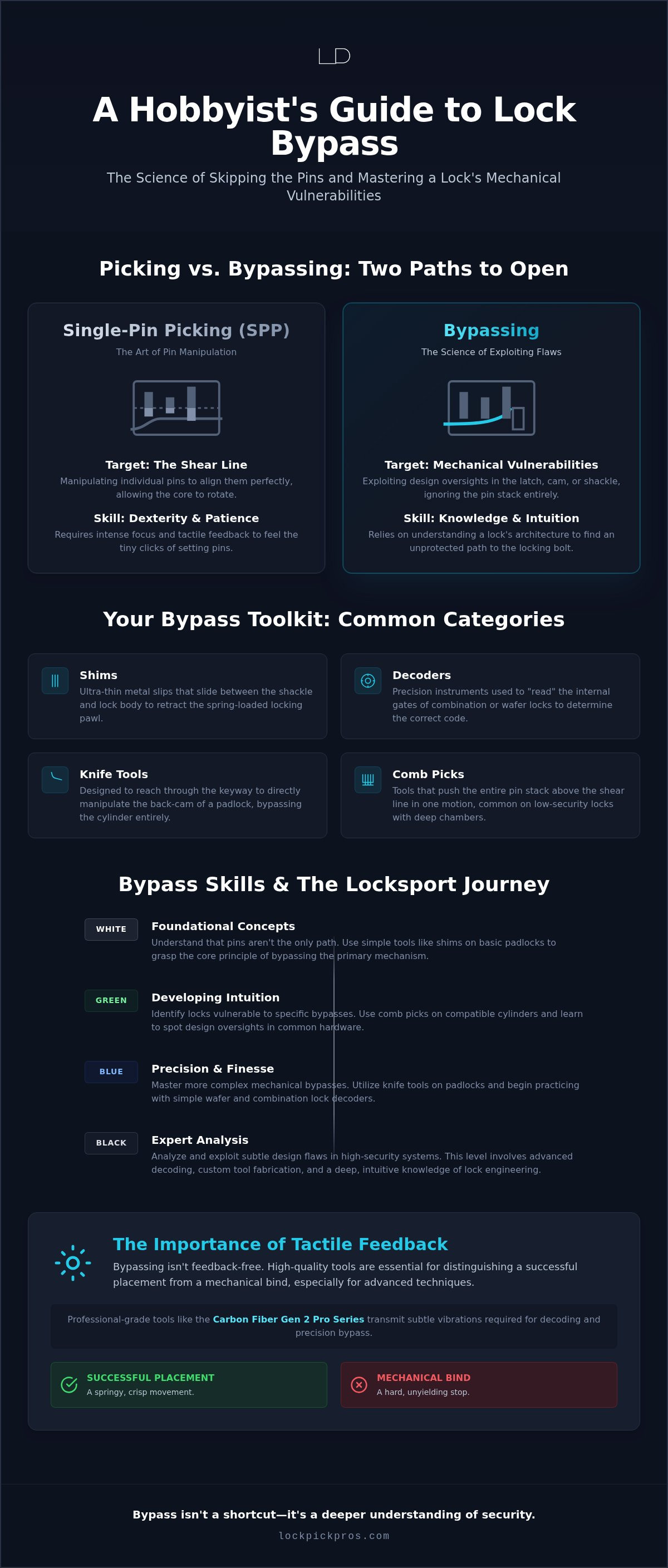
The fundamental difference lies in the target. Picking targets the shear line. You spend your time trying to get the driver pins and key pins to separate at exactly the right height. Bypassing ignores the pins entirely. Instead, it targets the latch, shackle, or cam. This technique, often referred to as a Lock bypass, allows you to defeat a lock by exploiting the way the underlying mechanism was built. While the formal belt ranking system focuses heavily on single-pin picking, the broader 2026 locksport curriculum treats bypassing as an essential parallel skillset. It turns you from a picker into a true student of security.
From an ethical mentor's perspective, understanding a lock's flaws is the highest form of mastery. It's not about taking the easy way out. It's about recognizing that every lock is a puzzle with multiple solutions. When you learn what are bypass tools, you begin to see the mechanical vulnerabilities that designers overlooked. This knowledge makes you a more well-rounded hobbyist and a better advocate for real-world security standards.
How Bypass Differs from Single Pin Picking (SPP)
Single pin picking requires intense focus and tactile feedback from every individual pin. You're looking for that tiny click that tells you a pin is set. Bypassing is more about identifying a design oversight. It relies on finding a path to the locking bolt that the manufacturer left unprotected. A mechanical vulnerability is a design flaw that allows access without a key or traditional picking. While SPP proves you have the dexterity to manipulate components, bypassing proves you have the knowledge to exploit the system's architecture.
The Role of Feedback in Bypass Success
Don't assume that bypassing is feedback-free. You still need to feel the internal components to know if your tool is seated correctly. High-quality materials like the Carbon Fiber Gen 2 Pro Series are essential for this. The carbon fiber handles transmit subtle vibrations that cheaper tools muffle. This sensitivity helps you distinguish between a successful tool placement and a mechanical bind. If you feel a hard, unyielding stop, you're likely binding against the housing. A springy, crisp movement usually signals you've found the bypass point. This level of precision is vital as you move through the Lock Picking Belt Levels Explained guide and tackle more complex challenges.
Common Categories of Bypass Tools and How They Work
Understanding what are bypass tools requires looking at the specific mechanical flaws they target. Unlike picks that feel for individual pin states, these tools exploit design oversights. They are frequently used in Physical penetration testing to demonstrate how quickly a lock can be defeated without ever manipulating the core. By learning these categories, you expand your knowledge from simple picking to full mechanical analysis.
- Shims: These are ultra-thin metal slips designed to slide between the shackle and the lock body to physically push back the spring-loaded locking pawl.
- Decoders: These instruments are used to "read" the internal gates of combination or wafer locks, allowing you to determine the correct code or key bitting.
- Knife Tools: These are specifically designed to reach through the keyway to hit the back-cam of a padlock, bypassing the entire cylinder mechanism.
- Comb Picks: These tools are designed to push the entire pin stack above the shear line in low-security locks with deep chambers.
Each of these tools represents a different way to think about a lock. When you're building your kit, it's helpful to have a variety of these options available for different scenarios. For high-sensitivity tasks like decoding, using the Carbon Fiber Gen 2 Pro Series ensures you don't miss the subtle feedback required for success.
The Mechanics of Shimming a Padlock
Shimming is one of the most satisfying bypass techniques to master. First, you must identify a non-ball-bearing shackle. Look for a springy feel when you press the shackle down; ball-bearing locks won't budge. Second, insert the shim into the shackle gap on the side where the latch is located. Use a steady, circular motion to depress the spring-loaded latch. Precision-cut shims are much safer for your practice locks than DIY versions, as they lack the jagged edges that can jam your mechanism.
Comb Picking and Over-Lifting
This technique exploits the "stack height" vulnerability found in budget padlocks. If there is enough room in the lock housing, you can push the entire pin stack out of the way to turn the plug. Comb picks work by moving both the key pin and driver pin into the housing simultaneously. When you're practicing on Master Lock #3 clones, you can use the Pro Series Expansion to find the right comb profile for that specific keyway. It's an eye-opening experience to see a lock open in seconds without ever touching the shear line.
The Ethics of the Bypass: Picking vs. Non-Destructive Entry
Every ethical hobbyist lives by two golden rules: only pick locks you own and never pick a lock that is currently in use. These rules are the foundation of our community. While Single Pin Picking (SPP) focuses on fine motor skills, understanding what are bypass tools is about achieving mechanical literacy. It is a knowledge based skill rather than a dexterity based one. You aren't just feeling for clicks; you're identifying a specific engineering oversight that allows for non-destructive entry. Professionals use these techniques for speed and efficiency, but hobbyists use them to master the full spectrum of security vulnerabilities. For those ready to move into more complex territory, our guide on Mastering the Advanced Lock: A Guide to High-Security Picking covers the next steps in your journey.
Is Bypassing 'Cheating' in Locksport?
There is often a lively debate on whether bypassing counts as "real" lockpicking. In the context of belt rankings, the community views these as separate but complementary disciplines. You can't bypass your way to a Green Belt because that rank requires you to gut the lock and prove the pins were picked. However, a true Black Belt candidate is expected to be proficient in all forms of entry. Mastery means knowing how to defeat a lock through its primary mechanism and its secondary vulnerabilities. When you successfully use a bypass, document the process. Sharing your "picks-in-action" content helps the community learn and provides the verification needed for higher tier recognition.
Preserving Your Practice Locks
Improper bypass technique is the fastest way to ruin a high quality practice lock. If you force a shim or a comb pick into a tight space, you risk crushing internal springs or bending the locking pawls. This is why using the right gear is so important. The Carbon Fiber Gen 2 Pro Series is designed to give you the sensitivity required to feel when a tool is binding before damage occurs. Instead of relying on brute force, you use the tactile feedback to adjust your angle and pressure. To ensure the longevity of your kit, keep your tools clean and free of debris. A well maintained bypass set will protect your investment and keep your practice locks functioning perfectly for years.
Mapping Bypass Tools to the Community Belt Ranking System
You've learned the mechanics and the ethics; now it's time to talk about your progression. The locksport community uses a 9-tier belt ranking system to classify both lock difficulty and picker skill. While you must single-pin pick a lock to earn your stripes, knowing what are bypass tools is what separates a trainee from a master. We map these tools to specific tiers so you can build your kit logically without buying gear you aren't ready for yet. As you progress, your understanding of what are bypass tools will evolve from simple shims to complex decoding instruments.
- White to Yellow Belt: Focus on basic padlock shimming and warded pick sets. These target the most common mechanical gaps in entry-level hardware.
- Orange to Green Belt: This is where you introduce comb picks and basic latch shims. You'll start seeing how budget padlocks fail when the entire pin stack is over-lifted.
- Blue to Purple Belt: Mastery at this level requires decoders for combination locks and high-security shims that can bypass more complex shielding.
- Brown to Black Belt: At the elite level, you'll often use custom-fabricated bypass tools designed for specialized high-security cylinders like the EVVA MCS.
The Foundational Bypass Kit (White to Yellow)
Every journey starts with the basics. For White Belt locks like the Master Lock #3, the mechanical gaps are often wide enough for simple padlock shims. Warded pick sets are also essential at this stage. These tools allow you to feel how a lock operates when the pins aren't the primary obstacle. If you're looking for a solid starting point, The Trainee 2.0 offers the perfect foundation for your bypass education. Practicing on these common locks helps you visualize the internal flaws before you move to tighter tolerances.
The Professional Upgrade (Blue and Beyond)
Once you reach the Blue Belt tier, the challenges become significantly more technical. The 2026 community update re-ranked the Magnum Mont Blanc to the Blue Belt level, requiring much better feedback from your tools. Transitioning to the Carbon Fiber Special provides the enhanced sensitivity you need for these intermediate tiers. For advanced civil bypass tasks, using the HUK 8pcs Kaba Lockpick Tools becomes a game changer. Specialized decoders become mandatory at the Purple Belt level, as you'll need to "read" internal gates that are invisible to the naked eye.
Ready to master the most sensitive feedback in the sport? Upgrade your kit with the Carbon Fiber Gen 2 Pro Series and start conquering high-security vulnerabilities today.
Join the Black Belt Challenge: Master the World’s Toughest Locks
Achieving the Black Belt rank in 2026 is the ultimate milestone for any ethical hobbyist. It requires more than just picking; you must complete "Epic Quests" and mentor others in the community. This is where your knowledge of what are bypass tools truly shines. Our free Black Belt Challenge provides the roadmap you need to transition from a skilled picker to a master of mechanical vulnerabilities. By joining this challenge, you commit to a journey of continuous learning and skill refinement that goes far beyond the basic pin stack.
To help you document this journey, we've developed the Share-to-Earn loop. When you successfully navigate a high security bypass, record it using your Carbon Fiber Gen 2 Pro Series kit. Sharing these "picks-in-action" moments on social media doesn't just prove your skill; it earns you exclusive community rewards. We've even established a community bounty for hitting social reach goals. Your content helps other hobbyists understand the nuances of non-destructive entry, fostering a more knowledgeable and ethical locksport environment.
How to Record a Community-Verified Bypass
Verification is everything in the upper tiers of locksport. When you record your bypass, ensure your camera angles and lighting allow the viewer to see both the tool and the lock face clearly. Start by explaining your process. Why did you choose this specific bypass tool for this lock? Showing the mechanical intuition behind your choice is what earns respect from the community. Once your video is ready, tag Lockpick Pros to unlock your next tier of rewards and contribute to the collective knowledge of the sport.
Your Next Step Toward Mastery
There has never been a better time to add bypass techniques to your foundational skills. As you've seen throughout this guide, understanding what are bypass tools is about more than just opening a lock; it's about mastering the physics of security. Every Black Belt in the community started as a curious beginner with a single hook and a dream of mastery. You have the tools, the roadmap, and a supportive community ready to cheer you on as you progress through the ranks.
Don't let tight tolerances or complex security pins hold you back any longer. It's time to see the lock for the mechanical puzzle it truly is. Your journey to the top starts with a single click and the right mentor by your side.
Join the Free Black Belt Challenge and Master High-Security Locks!
Elevate Your Locksport Skills to the Next Tier
You've now explored the science behind shimming, decoding, and combing. Gaining a deep understanding of what are bypass tools transforms you from a standard picker into a complete mechanical analyst. It's about recognizing the design flaws that manufacturers overlooked. By integrating these specialized techniques into your belt ranking journey, you're mastering the full spectrum of ethical locksport. This knowledge-based approach is exactly what separates intermediate hobbyists from true experts.
The Carbon Fiber Gen 2 Pro Series features precision handles designed for unmatched feedback during these high-sensitivity tasks. When you pick up this series, you'll also receive free entry into our community Black Belt Challenge. Start recording your successful bypasses today. Our Share-to-Earn program lets you turn your "picks-in-action" content into valuable tool rewards while helping others in the community learn.
Upgrade to the Carbon Fiber Gen 2 Pro Series and Start Your Bypass Journey Today!
Your path to mastery is wide open. Every expert started as a curious beginner with a single set of tools. Take the next step and join a community of passionate hobbyists who are pushing the boundaries of the sport together. We can't wait to see you earn your next belt.
Frequently Asked Questions
What is the difference between a lockpick and a bypass tool?
A lockpick is designed to manipulate individual pins until they reach the shear line, while a bypass tool targets the mechanical mechanism behind the cylinder. Instead of working through the lock's security pins, you're looking for design oversights like an exposed latch or an unshielded cam. Understanding what are bypass tools means recognizing that you can skip the pins entirely to achieve non-destructive entry by interacting directly with the locking bolt.
Are bypass tools legal for hobbyists to own?
Ethical hobbyists usually find these tools legal to own as long as they're used on locks they own in a legal setting. However, laws regarding "burglary tools" vary significantly by state and country. You should always check your local regulations before making a purchase. At Lockpick Pros, we focus on the sport of locksport and require all our community members to use their gear responsibly for practice and skill progression.
Can I use bypass tools on high-security locks?
Yes, but high-security locks often feature shielding specifically designed to prevent basic bypass attempts. Advanced cylinders might require specialized decoders or custom tools to exploit their unique vulnerabilities. As you reach the Brown and Black Belt tiers, you'll encounter locks like the MIWA WR that demand extreme precision. Tools like the Carbon Fiber Gen 2 Pro Series provide the tactile feedback necessary to navigate these complex internal housings effectively.
Is shimming a lock considered a bypass technique?
Shimming is absolutely a classic bypass technique because it ignores the pin stack entirely. By sliding a thin piece of metal between the shackle and the lock body, you physically depress the locking pawl. This method exploits the gap in the shackle's design rather than the security of the cylinder. It's one of the most effective ways to open non-ball-bearing padlocks and is a foundational skill for any well-rounded hobbyist kit.
Do I need a special license to buy bypass tools?
In most jurisdictions, you don't need a professional locksmith license to purchase bypass tools for hobbyist use. Most of our community members are ethical pickers who use these instruments for skill refinement and belt progression. While some specific regions have stricter sales regulations, the majority of the locksport community can access these tools freely. Always ensure you're following the Golden Rules of locksport and using your equipment on locks you own.
Can comb picks open any padlock?
Comb picks are not universal tools and only work on specific padlocks with enough internal "stack height" to accommodate both the key and driver pins. Many budget padlocks and Master Lock clones are vulnerable because their pin chambers are drilled deeper than necessary. However, most modern high-security locks have corrected this flaw by limiting the space above the shear line. You'll need to identify which locks in your collection have this specific vulnerability.
Which belt rank requires knowledge of bypass tools?
While the formal LPU belt system focuses on single-pin picking, achieving a Black Belt in 2026 requires a comprehensive understanding of all entry methods. You won't use a bypass to qualify for lower tiers like Green Belt, as those require you to gut the lock to prove the pins were picked. However, mastering what are bypass tools is essential for the "Epic Quests" and mentoring roles required for the highest levels of the sport.
What is the best bypass tool for a beginner to start with?
Padlock shims are the best starting point for a beginner because they clearly demonstrate the concept of skipping the pins. They're inexpensive and work on many common locks found in the White and Yellow Belt tiers. Warded pick sets are another excellent choice for those just starting their bypass journey. These tools help you build the mechanical intuition needed before you move on to more complex tasks like decoding or using comb picks.