

How to Organize Your Lock Picks: 2026 Locksport Guide
You are finally making progress on a stubborn ABUS 72/40 to secure your Green Belt, but when you reach for that specific top-of-keyway tension wrench, it is gone. You are left digging through a tangled pile of steel while your concentration evaporates. Most hobbyists face this exact frustration as they transition from curious beginners to serious contenders in the locksport community. As your collection grows, a cluttered workspace does not just look messy; it actively holds back your skill progression. Learning how to organize your lock picks is the best way to ensure you are ready for the next challenge.
We all agree that hunting for tools is the fastest way to lose your "feel" for the pins. This guide will show you how to create a high-performance picking station that grows with your belt rank. You will master your gear and clear your workspace with a comprehensive system for everything from tension tools to practice locks. We are going to explore portable kits that protect your Carbon Fiber Gen 2 Pro Series tools and professional pinning trays designed for complex June 2026 Black Belt requirements, including the newly added MIWA WR lock. Let's get your gear sorted so you can focus on the next click.
Key Takeaways
- Discover how a structured workspace maintains your concentration and prevents the metal-on-metal wear that ruins pick feedback.
- Compare the benefits of hard shell cases for your Carbon Fiber Gen 2 Pro Series against portable tool rolls for local locksport meetups.
- Master how to organize your lock picks by belt tier to ensure your foundational tools stay separate from advanced security pin kits.
- Identify the best storage systems for practice locks and keys to prevent scratched finishes and disorganized bins.
- Prepare your station for the Black Belt Challenge with a layout optimized for recording high-quality social media content.
The Psychology of a Clean Picking Station: Why Organization Matters
Lock sport is a game of millimeters and microscopic feedback. When you are deep into a session, your brain is processing the subtle clicks of a serrated pin or the counter-rotation of a spool. This mental state, often called "flow," is fragile. A cluttered desk is more than an eyesore; it is a source of constant micro-distractions that break your concentration. If you have to look away from the lock to hunt for a 0.015-inch hook in a pile of steel, you have already lost the "feel" of the plug. Learning how to organize your lock picks is about protecting your mental bandwidth as much as it is about tidying your desk.
Ethical lockpickers treat their gear as precision instruments for skill refinement. As you move past the White Belt level and transition from The Trainee 2.0 to more specialized kits, your storage habits must evolve. A "bag of tools" might work for a beginner, but advanced hobbyists view their station as a curated laboratory. Proper organization reflects a respect for the craft of lock picking, ensuring that every tension wrench and pick is ready for high-level performance without the risk of "pick fatigue" caused by loose, metal-on-metal storage.
Reducing Cognitive Load During Complex Picks
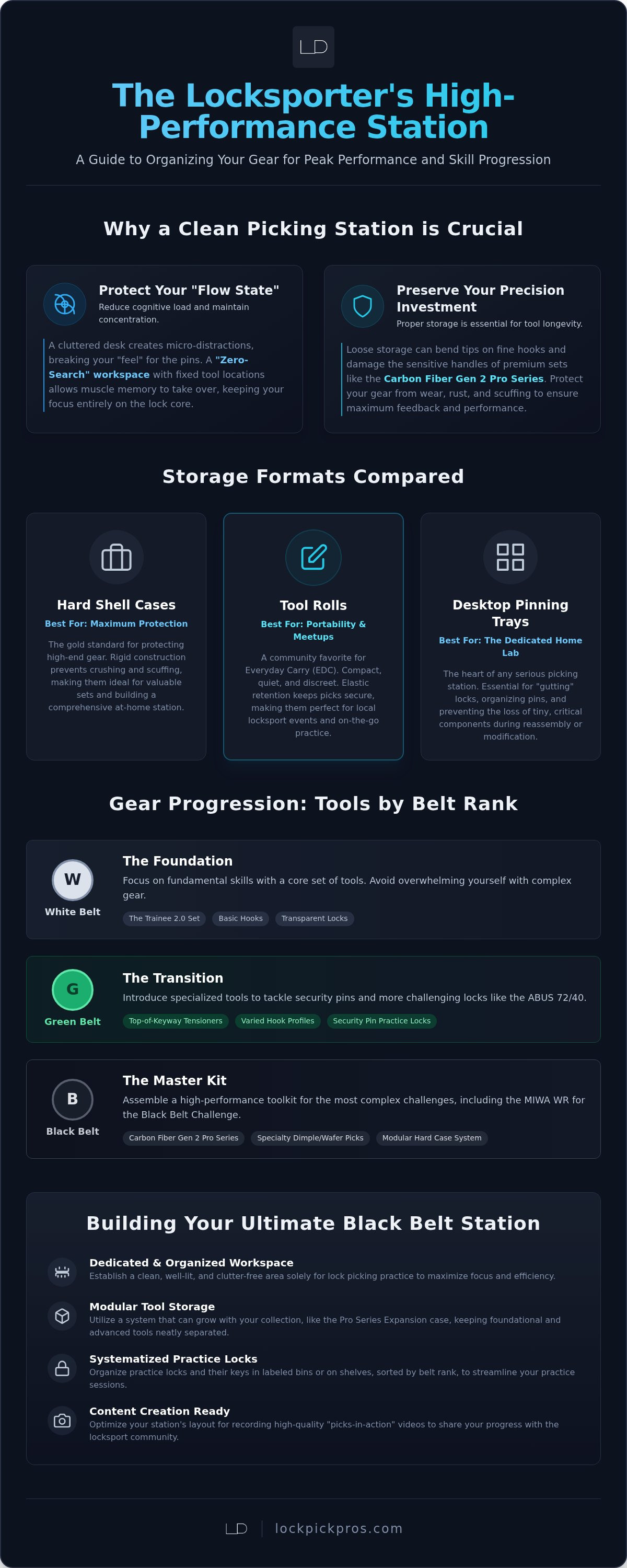
High-level picking relies on muscle memory. Your hand should be able to find a specific medium hook or a pry bar without your eyes ever leaving the lock core. This level of intuition only comes when your tools are in the same place every single time. A Zero-Search workspace is an environment where every tool has a fixed, dedicated location, allowing the hobbyist to maintain total focus on the lock core without visual interruption. This system also helps you identify tool gaps. If a slot in your case is empty, you know exactly what is missing for your next belt rank challenge.
Protecting Your Precision Investment
Organization is also a matter of tool longevity. Advanced tools like the Carbon Fiber Gen 2 Pro Series feature handles designed for maximum feedback, which require different spacing than traditional steel picks to avoid scuffing. Beyond the handles, the business end of your picks is vulnerable. Storing fine hooks loosely can lead to accidental tip damage or bending. Furthermore, spring steel tension wrenches are susceptible to humidity and environmental wear. Dedicated slots in a carrying case or a pinning tray prevent rust and keep your tools in peak condition for the June 2026 community standards.
Storage Formats Compared: Cases, Rolls, and Trays
As you advance through the belt ranks, your storage needs shift from a single pouch to a multi-format system. Choosing the right format depends on whether you are practicing at your desk or heading to a local meetup. Understanding how to organize your lock picks effectively means matching your storage to your environment. While a beginner might manage with a single pouch, an expert pursuing the June 2026 Black Belt requirements needs a system that handles everything from standard hooks to complex dimple picks.
Hard shell cases provide the gold standard for protecting high-end gear. Unlike basic steel picks, Carbon Fiber Gen 2 Pro Series tools benefit from rigid protection to maintain their precise feedback qualities. These cases prevent the handles from being crushed or scuffed in transit, which is vital for maintaining the professional aesthetic of an ethical picker's kit. For those with a growing collection, the Pro Series Expansion offers a modular way to let your storage grow alongside your skills.
The Portable Picking Kit: EDC and Tool Rolls
Tool rolls are the favorite for Everyday Carry (EDC) and community events. When evaluating a roll, consider elastic retention versus pocket-based systems. Elastic bands keep picks silent and secure, while pockets allow for varying pick thicknesses. This "stealth" organization is a hallmark of the ethical locksport community, ensuring your tools are kept discreetly and securely. If you are just starting your journey, it helps to understand what is in a beginner lock pick set before choosing your first portable roll.
The Desktop Pinning Station
At the home lab, organization takes a different form. A dedicated Pinning Tray is the heart of any serious picking station. It ensures that when you "gut" a lock for a Green Belt or higher verification video, every pin and spring stays in its designated lane. The history of lock-picking competitions shows that speed and precision are often decided by how well a picker knows their station. Many pros integrate magnetic strips into their desktop setup for quick-access tension wrenches, ensuring the right tool is always a second away. To get the most out of your high-performance gear, consider upgrading to the Carbon Fiber Gen 2 Pro Series for your primary desktop kit.
Organizing by Tier: Toolsets for Every Belt Rank
Success in locksport is a journey of increasing complexity. As you move through the ranks, your toolkit shouldn't just get bigger; it should get smarter. The way you learn how to organize your lock picks should mirror your progress from a White Belt novice to a Black Belt master. There are significant psychological benefits of mastering a hobby, and seeing your organized tools evolve provides a tangible sense of achievement. By categorizing your gear by belt tier, you avoid the "clutter creep" that often slows down intermediate pickers. This tiered approach ensures your foundational tools don't get buried under advanced specialty flags you aren't ready to use yet.
The Foundational Kit (White to Yellow)
Beginners should keep their station focused and lean. At this stage, you are primarily working with 0.025" picks and standard Bottom of Keyway (BOK) tensioners. The Trainee 2.0 is the core of this tier. Keep these foundational tools front and center where they are easily accessible. When storing your first practice locks, labeling your keys is critical for progression. Nothing kills a practice session faster than a pile of identical keys and no way to verify which one belongs to your current project. For a full breakdown of the requirements for these early stages, check out our guide on Lock Picking Belt Levels Explained.
The Professional Pivot (Green to Black)
Once you reach the Green Belt, you will encounter serrated, spool, and mushroom pins. Your organization must become more granular to handle the increased technical demand. This is the stage where you integrate the Gen 2 Pro Max Stealth Edition for high-security challenges. You will need to manage advanced tensioners, including various Top of Keyway (TOK) pry bars, and dedicated gutting tools for verification videos. Use your pinning tray to create sections for specific pin types to keep your "gutted" locks organized during the re-pinning process.
Advanced ranks like Purple and above require specialty tool management. Keep your Dimple Picks, wafer jigglers, and disc detainer tools in dedicated slots. This prevents tip snagging and ensures your most delicate flags are always protected. Achieving a June 2026 Black Belt rank is about precision. Storing your specialty gear separately ensures you can pivot between standard pin-tumbler locks and high-security MIWA WR locks without fumbling through your case. This level of organization is essential for the "Zero-Search" workspace we discussed earlier.
Managing the Clutter: Practice Lock and Key Organization
Most guides focus exclusively on the tools, but your practice locks often take up the most space. Tossing your padlocks into a single "lock bin" is a recipe for frustration. You end up with scratched finishes and a bowl of mystery keys that don't seem to fit anything. As you master how to organize your lock picks, you must also develop a robust system for the locks themselves. Grouping your collection by community-assigned belt rank is the most efficient way to track your progress and stay motivated.
Choosing between a pegboard and a drawer system depends on your specific collection. Pegboards offer excellent visibility for lighter locks and keep your workspace clear. However, as you move into high-security brass and steel, the cumulative weight can become a problem for standard hooks. Reinforced drawer systems are often better for heavy padlocks. Use color-coded tags to match keys to their respective locks. This allows you to verify a pick without "spoiling" the challenge by seeing the bitting on the key beforehand.
Visualizing Your Progression
Create a clear physical separation between your "Open" locks and your current "Project" locks. This visual distinction provides a massive psychological boost during those long, difficult practice sessions. Use a labeling system on the back of each lock to track the number of pins and specific security features like spools or serrations. It is essential to practice lock rotation regularly so you don't start picking by memory instead of reacting to the actual pin feedback.
Storage Solutions for Heavy Padlocks
Large padlocks require specialized infrastructure to prevent damage. Reinforced drawer dividers keep your collection from shifting and clashing when you open the station. For a truly professional touch, consider custom foam inserts similar to those found in Advanced Lock Pick Sets. A helpful DIY tip is using short segments of PVC pipe to create vertical storage tubes inside a deep drawer. This keeps each lock upright, protected, and easy to grab. To ensure you have the precision needed to tackle these heavy projects, equip yourself with the Carbon Fiber Gen 2 Pro Series.
Building Your Ultimate Black Belt Challenge Station
The pinnacle of the locksport journey is the Black Belt. By the time you reach this level, you aren't just picking locks; you're documenting a legacy of skill. A Black Belt station is more than a desk. It is a production studio where your technical expertise meets community engagement. Learning how to organize your lock picks for the camera is just as important as organizing them for the pick itself. The "Share-to-Earn" loop turns your organized station into a performance multiplier. High-quality "picks-in-action" content requires a workspace where tools are accessible but out of the camera's path to ensure a clear, unedited view of the lock and the "gutting" process required by the June 2026 standards.
Your top-tier tools, such as the Carbon Fiber Special, deserve a dedicated display. These aren't just tools; they are the precision instruments that will carry you through the most difficult challenges, including the newly added MIWA WR lock. A serious competitor's checklist for a Black Belt station includes:
- A stable camera rig that captures the lock and your hands in a single, continuous frame.
- A clean, high-contrast pinning tray for clear visibility of pins and springs during the disassembly phase.
- Dedicated lighting that eliminates shadows inside the keyway to show the pins moving.
- A "ready rack" for your most-used TOK tensioners and hooks to prevent fumbling during a recorded pick.
Joining the Black Belt Challenge
Starting your recorded progression is the best way to hold yourself accountable and connect with the wider community. You can Join the Black Belt Challenge for Free Today! This program guides you through each tier, encouraging you to share your setup as you advance. Sharing your organized station does more than just show off your gear. It unlocks community bounties and rewards for reaching social reach goals, fostering a culture of mentorship. Remember, achieving Black Belt rank now requires mentoring at least two other pickers, so your organized station serves as a visual teaching tool for those you guide.
The Future of Your Collection
A professional station is never truly finished. Always leave at least 20% "growth space" in your tool rolls and cases for new specialty flags or bypass tools. Maintaining this system requires a "Sunday Reset," where you clean your picks, check for tip wear, and reorganize your practice locks by their belt rank. If you are just starting, learn how to choose your first beginner lock pick set to build a foundation that supports this future growth. Keeping your gear sorted today ensures you are ready for the expert-level challenges of tomorrow.
Master Your Workspace and Your Craft
An organized station is the hallmark of a serious locksport hobbyist. By mastering how to organize your lock picks, you protect your precision tools and clear the mental path to that elusive "open." Order reduces cognitive load. It's about more than tidiness; it's about performance. Having a dedicated spot for every hook and tensioner allows you to focus entirely on the feedback from the pins. You are now equipped with a system that scales with your skills, from White Belt basics to the technical rigors of the June 2026 Black Belt standards.
Join 10,000+ ethical pickers in our community and take the next step in your journey. Our precision Gen 2 Carbon Fiber series is available now to give you the tactile feedback you need for high-security locks. We offer secure payments and free shipping on all orders to help you build your ultimate station. Ready to level up? Start the Black Belt Challenge and upgrade your kit today! We are excited to see your organized setup as you earn your way to the top.
Frequently Asked Questions
What is the best way to store lock picks for travel?
The most effective way to travel with your gear is using a compact tool roll with elastic retention. These rolls keep your picks silent and prevent the metal tips from rubbing together during transit. For ethical pickers, a discreet carrying case ensures your tools stay secure and protected from the elements. Always double check that your most used hooks are easily accessible for quick sessions at community meetups.
Can I use a magnetic strip to hold my picks?
Magnetic strips are excellent for organizing steel tension wrenches and standard picks at a stationary home lab. They provide instant access during a complex pick when you need to switch tools without looking away. However, avoid using magnets for tools with delicate finishes or carbon fiber handles. Grit can sometimes get trapped between the magnet and the tool, which might cause unnecessary scuffing over time.
How do I keep my practice locks from getting scratched during storage?
Individual soft pouches or lined bins are the best solution for maintaining the finish of your practice locks. High-security brass padlocks are prone to tarnishing and scratches if they are piled together. You can also use small adhesive felt pads on the bottom of heavy locks to prevent them from marring your desktop. This keeps your collection looking professional for your next social media "pick-in-action" recording.
Is it better to organize lock picks by type or by belt rank?
Organizing by belt rank is generally superior for hobbyists who are actively pursuing the next level. This method allows you to master how to organize your lock picks by separating your foundational 0.025" tools from advanced 0.015" hooks used for tight keyways. It keeps your workspace focused on the task at hand. You can still group by type within each rank category to maintain a logical and efficient flow.
How do I prevent my tension wrenches from getting lost?
Small tension wrenches are the easiest tools to lose in a cluttered workspace, so use dedicated magnetic strips or small labeled tins. Some pro pickers use color-coded heat shrink tubing on the handles to group them by thickness. This makes it easy to grab a 0.040" or 0.050" pry bar instantly. Always return each wrench to its specific slot immediately after your practice session ends to avoid the "clutter pile" problem.
What should be in a portable 'go-bag' for locksport meetups?
Your go-bag should contain a curated selection of five to seven essential picks and a full range of tensioners. Include at least two "Project" locks you are currently working on and one "Comfort" lock you can open reliably to show others. A small, portable pinning tray is also vital if you plan to gut a lock for a fellow hobbyist. This setup ensures you are ready for any challenge without carrying excessive weight.
How often should I clean and reorganize my picking station?
You should perform a quick reorganization after every session and a deep clean once a month. Use this time to wipe down your steel picks with a light coat of oil to prevent rust, especially in humid environments. Check your pick tips for burrs or bending that might affect feedback. Keeping a clean station ensures that your focus remains entirely on the pins rather than searching for misplaced gear or fighting snagged tools.
Do carbon fiber lock picks require special storage cases?
Carbon fiber tools definitely benefit from rigid hard-shell cases that provide dedicated spacing for each handle. The handles are designed for maximum tactile feedback, and keeping them separated prevents scuffing from other metal tools in your kit. While they are incredibly strong, protecting the finish ensures they remain comfortable for long picking sessions. A quality case also prevents accidental tip damage to these high-performance instruments during transport to local events.