

Mushroom Pin Picking Techniques: Mastering High-Security Feedback in 2026
That deep false set you just landed isn't a victory; it's a carefully designed mechanical trap. You've likely felt that heart-sinking click when a perfectly set pin drops back into the plug because you applied just a hair too much pressure. It's incredibly frustrating to lose your progress right when you think you're seconds away from a successful open. While you might already know how to pick spool pins, mushroom pins introduce a deceptive taper that demands a completely different level of finesse. We know that inconsistent feedback can make even the most patient hobbyist want to set their tools aside.
In this guide, you'll learn the precise tension and counter-rotation techniques needed to defeat mushroom security pins and level up your locksport belt rank. We're going to dive into the physics of how these pins interact with the shear line and show you how to interpret the subtle signals sent through your tension wrench. We'll explore the specific feedback provided by the Carbon Fiber Gen 2 Pro Series and provide a clear roadmap to help you master these high-security puzzles. By the end, you'll have the confidence to tackle advanced locks and move one step closer to your Black Belt Challenge goals.
Key Takeaways
- Understand how the unique anatomy of mushroom pins, featuring beveled heads and narrow waists, is designed to trap your pick at the shear line.
- Gain the sensory skills needed to distinguish a standard click from a security pin thud while mastering how to pick spool pins and mushroom variants.
- Discover the precise counter-rotation techniques required to recover from deep false sets without dropping your previously set pins.
- Learn why professional tools like the Carbon Fiber Gen 2 Pro Series are essential for interpreting the delicate vibrations found in high-security cylinders.
- Map your progression through the community ranking system and prepare for the technical requirements of the ultimate Black Belt Challenge.
Understanding Mushroom Pins and How to Pick Spool Pins
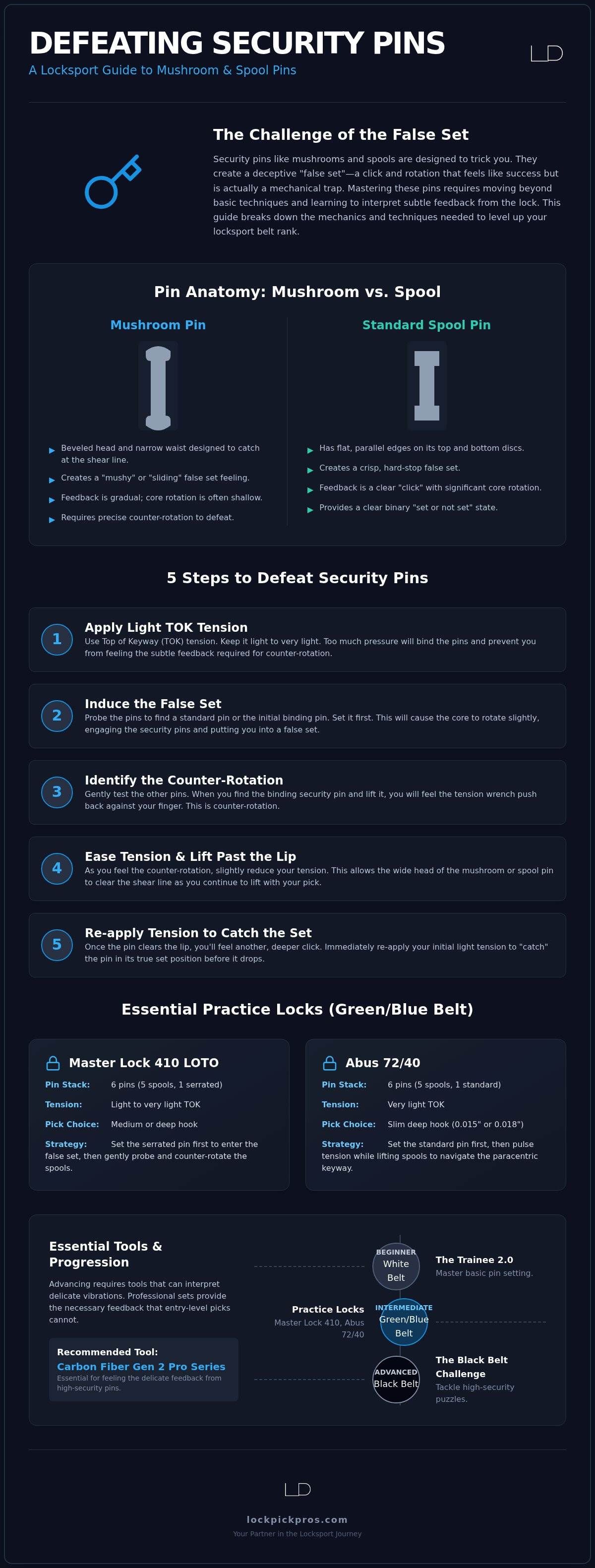
Mushroom pins represent a sophisticated evolution of the pin tumbler lock mechanism. These pins feature a wide, beveled head and a narrow stalk or waist. While you're learning how to pick spool pins, you'll quickly discover that the mushroom's taper creates a deceptive, "sliding" false set rather than the crisp, hard stop of a standard spool. The design purpose is to catch the shear line and simulate a successful set, tricking the picker into stopped rotation. These pins are the gatekeepers of Green Belt and Blue Belt locks, requiring enthusiasts to move beyond basic raking. Ethical locksport is about mastering these internal mechanics through practice on your own locks, refining your tactile senses for the journey toward technical mastery.
Mushroom Pins vs. Spool Pins: The Subtle Differences
The primary visual and tactile difference lies in the taper. A standard spool pin has flat, parallel edges on its top and bottom discs, creating a binary "set or not set" state. In contrast, a mushroom pin's head is beveled. This taper means the core rotation is often shallower and the feedback is "mushy" rather than sharp. When figuring out how to pick spool pins, you can often feel a clear click; with mushrooms, you'll feel a gradual resistance as the bevel rides up the shear line. This requires extreme pick placement precision, as your hook must stay perfectly centered on the narrow waist to avoid slipping off the pin.
Common Locks Featuring Mushroom Security Pins
The Master Lock 410 LOTO is a classic Green Belt challenge. It features a 6-pin stack typically consisting of five spools and one serrated pin, often located in chamber five. To master this lock:
- Tension: Apply light to very light Top of Keyway (TOK) tension.
- Pick Choice: A medium or deep hook is necessary to reach behind low-cut pins in the tight keyway.
- Instructions: First, locate the serrated pin and set it to enter the initial false set. Gently probe the remaining five spools. When you feel counter-rotation, ease your tension slightly to let the mushroom-like head clear the shear line.
The Abus 72/40 is another essential milestone for intermediate pickers. It contains a 6-pin stack with one standard pin and five spools that offer feedback nearly identical to mushroom pins due to the restrictive warding. To master this lock:
- Tension: Use very light TOK tension to prevent the pins from binding too hard against the paracentric keyway.
- Pick Choice: A slim deep hook (0.015" or 0.018") is required to navigate the warding without touching the plug walls.
- Instructions: Identify the standard pin (frequently in position one) and set it first. Once in the false set, pulse your tension while lifting the spools. Watch for the core to rotate backward as the pin's taper clears the shear line, then immediately re-apply tension to catch the set.
Transitioning from The Trainee 2.0 to these high-security cylinders is a major milestone. These locks teach you to "read" the lock's internal story, moving you closer to the ultimate Black Belt Challenge.
Identifying the False Set and Sensory Feedback
When the core of your lock suddenly clicks and rotates roughly 5 to 20 degrees without opening, you've entered the false set. It's a pivotal moment in any picking session. For those learning how to pick spool pins, this rotation is often a hard, crisp stop. Mushroom pins behave differently. Because of their tapered heads, the transition into a false set feels less like a snap and more like a gentle slide. You'll hear a dull thud rather than the sharp metallic click of a standard pin setting. This subtle auditory cue is your first hint that you're dealing with a security feature.
The Physics of the False Set
The false set occurs when the narrow stalk of the pin is caught at the shear line. As you apply tension, the core rotates until it physically hits the thicker head of the security pin. This is explained in detail in this academic paper on lock mechanics, which highlights how tolerances affect feedback. Beginners often make the mistake of increasing tension here. They think they're close to an open and want to force it. In reality, heavy tension at this stage locks the mushroom head even tighter against the plug. It makes counter-rotation impossible and can even bend your tools.
Differentiating Feedback Types
Standard pins offer binary feedback. They're either binding or they're set. Mushroom pins are far more analog. When you press a binding mushroom pin, you'll feel gradual resistance as the tapered head slides against the edge of the plug. It feels "mushy" compared to the rigid feedback of a standard pin. If you're dealing with serrated pins, you'll feel multiple tiny clicks as each serration passes the shear line. To truly distinguish these micro-vibrations, many hobbyists upgrade to the Carbon Fiber Gen 2 Pro Series picks. These tools are designed to transmit these subtle signals directly to your fingertips.
Mapping the pin stack is your next move. Gently probe each chamber with a shallow hook. A set pin will feel springy. A standard binder will feel rock solid. A security pin in a false set will feel solid but will cause the core to want to rotate backward when you apply light upward pressure. This counter-rotation is the key to understanding how to pick spool pins and their mushroom cousins successfully. You're looking for the pin that fights back against your tension wrench. That's your binder.
- Standard Feedback: Firm, rigid, and produces a sharp click.
- Mushroom Feedback: Soft, sliding resistance followed by core movement.
- Serrated Feedback: Multiple small, shallow clicks.
Step-by-Step Techniques for How to Pick Spool Pins (Mushroom Variant)
Mastering the mushroom pin requires a shift in how you visualize the internal struggle. You've already identified the false set; now you need to navigate out of it. Establishing a light tension baseline is your first priority. If you use heavy hands here, you'll pin the mushroom head against the shear line so hard that it won't budge. You want just enough pressure to keep the core rotated but not enough to freeze the mechanics. Once you're set, use a shallow hook to probe the stack. You're looking for the one pin that feels rock solid and refuses to move without fighting your tension wrench.
When you find that binder, it's time for the counter-rotation dance. As you lift the pin, the core will want to rotate back toward its neutral position. You must allow this to happen. This is the heart of how to pick spool pins and their tapered mushroom cousins. Once the pin's head clears the shear line, you'll feel a distinct click as the plug rotates forward again. Be prepared for the "Two Steps Forward, One Step Back" rule. Setting a high-security pin often vibrates the plug enough to drop a previously set standard pin. Don't panic. Just go back, touch up the dropped pins, and keep your progress moving toward the open.
The Counter-Rotation Dance
To successfully set a mushroom, you need to "float" your tension. This means you aren't just holding the wrench; you're actively responding to the lock's feedback. Counter-rotation is the core's natural push-back against the pin's taper. If you fight this movement, you'll likely overset the pin or even snap your pick. The MIT Guide to Lock Picking explains that this feedback is a direct result of the pin's geometry. Use the "Jiggle Test" after every click. A set pin will have a tiny bit of springy movement, while a pin still trapped on its bevel will feel stiff and unresponsive.
Advanced Tension Control
Your choice of tension tool makes a massive difference when learning how to pick spool pins. Top of Keyway (TOK) tension is almost always superior for security pins because it leaves the bottom of the keyway open for your pick. It also prevents the wrench from binding against the lock body, which can mask subtle feedback. For the most precise control, the Carbon Fiber Gen 2 Pro Series offers the rigidity needed to feel these micro-movements. Try using pulsed tension; gently oscillating your pressure can help nudge a stubborn mushroom head past the shear line without dumping the rest of your set pins.
Essential Tools for High-Security Pin Picking
Standard picks are the foundation of locksport, but they have limits. When you're figuring out how to pick spool pins, the feedback is often loud and clear. Mushroom pins are different. Their tapered design creates a soft, sliding sensation that standard spring steel often masks. If your pick is too thick or made of soft metal, it absorbs the micro-vibrations you need to hear. You need high-yield steel or carbon fiber to transmit that data from the pin to your hand effectively.
Profile selection is just as important as material. Standard hooks are often too shallow to navigate the paracentric keyways found in Green and Blue Belt locks. You need a deep hook to reach behind standard pins that are already set. This allows you to nudge a high-set mushroom pin without disturbing the rest of the stack. Pairing these hooks with flat-bar tension tools for Top of Keyway (TOK) control is the gold standard for high-security picking. TOK tools ensure you aren't binding the wrench against the lock body, which is a common way feedback gets killed.
Professional Series Equipment
The Carbon Fiber Gen 2 Pro Series is engineered specifically for this level of sensitivity. Carbon fiber's rigidity means every "thud" of a mushroom pin is amplified. If you encounter more exotic security pins, the Pro Series Expansion provides the specialized profiles needed for tight tolerances. While steel picks are great for intermediate progression, carbon fiber offers a distinct advantage when the feedback becomes "mushy" and difficult to read. It's the difference between guessing a pin's position and knowing exactly where it sits.
Maintaining Your Tools
A professional picker's tools are always polished. Even tiny burrs from the manufacturing process can create friction noise. This noise competes with the feedback from the pins. Sanding your picks with high-grit paper makes them glide through the keyway silently. Also, check that your tension wrench isn't binding against the lock face. If the wrench touches anything but the plug, your feedback will be dead. Store your picks in a dedicated carrying case to prevent the tips from bending during transport. Damaged tips can lead to oversetting and unnecessary frustration.
Ready to feel the difference in your next session? Upgrade to the Carbon Fiber Gen 2 Pro Series for precision feedback.
Mastering the Progression: From Green Belt to Black Belt
As you move beyond the fundamentals of beginner lockpicking, your focus naturally shifts from simple opens to the pursuit of technical mastery. Transitioning from acrylic practice locks and The Trainee 2.0 to high-security cylinders is the defining moment for any hobbyist. This is the stage where you truly learn how to pick spool pins and mushroom variants with consistent, repeatable success. The community belt ranks provide a clear, standardized roadmap for this journey, turning every new lock into a rewarding milestone of achievement.
To plan your next move and identify which locks fit your current skill level, consult our central Lock Difficulty Reference Guide. This hub serves as a comprehensive ranking reference, mapping common locks to their specific belt classes based on community standards from LPU and Reddit. Whether you are aiming for Green, Blue, or the ultimate Black Belt, this guide ensures you're always tackling challenges that advance your skills without unnecessary frustration.
The Black Belt Challenge
Our community thrives on a unique "share-to-earn" loop designed to celebrate your progress. We encourage every enthusiast to join the free Black Belt Challenge to track their technical growth. The progression is simple and rewarding: join the challenge for free, progress one belt at a time, and upgrade your gear at each tier to match the increasing mechanical difficulty. Your pick set selection becomes critical as you reach intermediate tiers; professional series tools are often required to feel the subtle feedback found in high-security cylinders. By sharing your "picks-in-action" content on social media, you help us reach community social reach goals. This triggers a community bounty, providing exclusive rewards for all active participants in the challenge.
Final Tips for Success
Technical mastery in locksport is a marathon, not a sprint. Consistency is your greatest tool; fifteen minutes of focused daily practice on various security pins beats a sporadic four-hour session every time. This regular contact helps you internalize the subtle counter-rotation and "mushy" feedback patterns we've explored in this guide. You'll begin to read the lock's internal story through the pick tip, feeling the difference between a trapped pin and a true set. Ready to earn your next belt and join a global community of ethical lockpickers? Join the Black Belt Challenge today!
- Join for Free: Start your ranking journey today without any upfront costs.
- Earn Rewards: Share your progress on social media to unlock exclusive community gear and bounties.
- Mentor Others: As you reach the highest ranks, give back by helping new pickers master the basics.
Refine Your Feedback and Level Up Your Rank
Mastering the unique taper of mushroom pins is a major milestone in your locksport journey. These pins are sensory puzzles. You've learned that they demand active tension management and a deep understanding of the core's movement. While you've likely practiced how to pick spool pins before, these high-security variants require a much lighter touch and a willingness to "dance" with counter-rotation. By interpreting the sliding bevel instead of fighting it, you're now ready for technical challenges like the Master Lock 410 LOTO.
Precision tools are the bridge between frustration and success. Our precision carbon fiber series tools are used by ethical lockpickers worldwide to amplify the lock's internal story. We're here to support your climb through the ranks with our free community belt ranking guide and specialized gear. It's time to put these techniques to the test on your own locks and document your progress toward technical mastery.
Take the Black Belt Challenge and Master Security Pins!
We can't wait to see your picks-in-action content as you move toward your next rank. Keep practicing, stay patient, and always pick ethically.
Frequently Asked Questions
What is the main difference between a mushroom pin and a spool pin?
A mushroom pin features a beveled or tapered head, whereas a spool pin has flat, horizontal edges. This taper creates a sliding sensation when you're learning how to pick spool pins and their variants. The mushroom's design is specifically intended to trap your pick at the shear line while providing a more deceptive, mushy feel. Understanding this geometric difference helps you anticipate how the core will react under tension.
How can I tell if I am in a false set caused by a mushroom pin?
You'll know you're in a false set when the plug rotates significantly, usually between 5 and 20 degrees, but the lock won't open. With a mushroom pin, this rotation often feels less distinct than the sharp click of a spool. You might feel the core want to move slightly as the pin's taper interacts with the shear line. Testing for counter-rotation on each pin is the best way to confirm your position.
Why do my other pins drop when I try to pick a mushroom pin?
Pins drop because setting a security pin requires counter-rotation. As the core moves backward to let the mushroom head pass the shear line, the tension holding other pins in place is momentarily released. This is a normal part of the process often called the Two Steps Forward, One Step Back rule. You'll simply need to go back and touch up those dropped pins once the security pin is successfully set.
Do I need special tools to pick locks with mushroom pins?
While standard picks can work, high-performance tools like the Carbon Fiber Gen 2 Pro Series are highly recommended. These picks use rigid materials to transmit subtle vibrations that standard spring steel might absorb. When you are mastering how to pick spool pins and mushrooms, having a deep hook and precise Top of Keyway tension wrenches makes a massive difference in your success rate and overall feedback quality.
Which belt rank typically includes locks with mushroom security pins?
Mushroom pins are most common in the Green Belt and Blue Belt tiers of the locksport community. Locks like the Master Lock 410 LOTO are classic examples that use these security features to challenge intermediate pickers. As you progress through the ranking system, you'll encounter more complex pin stacks that mix mushrooms with serrated or standard pins. Achieving these ranks proves you've mastered the delicate art of counter-rotation and technical precision.
Is it legal to practice picking locks with mushroom pins at home?
In the United States, it's generally legal to practice lockpicking on locks you own in a private setting. The locksport community follows a strict ethical code: never pick a lock you don't own and never pick a lock that is currently in use. We view lockpicking as a legitimate hobby focused on skill refinement and mechanical puzzles. Always check your local state laws to ensure you're practicing within legal boundaries and ethical standards.
What is counter-rotation and why is it important for security pins?
Counter-rotation is the backward movement of the lock core when you apply upward pressure on a trapped security pin. It's the most important signal in high-security picking. This movement happens because the pin's wider head must push the plug back toward its neutral position to clear the shear line. Learning to float your tension wrench to allow this movement without dumping all your set pins is a vital skill for every serious hobbyist.
Should I use Top of Keyway (TOK) or Bottom of Keyway (BOK) tension for mushrooms?
Top of Keyway (TOK) tension is usually the better choice for security pins. It provides much clearer feedback and leaves the bottom of the keyway open for your pick to move freely. Bottom of Keyway (BOK) wrenches can sometimes bind against the lock body, which masks the subtle counter-rotation signals sent by mushroom pins. Using a flat-bar TOK tool ensures you have the precise control needed for navigating advanced cylinders and tight tolerances.