

Lock Picking Tools: The 2026 Beginner's Guide
Lockpicking isn't a clandestine skill for the shadows; it's a precision sport of mechanical puzzles and community mastery. You've likely seen those cheap, flimsy sets online and wondered if they're actually worth your time. If you're currently asking yourself what tools do I need to start lock picking, you're already on the right path toward ethical locksport. It's completely normal to feel intimidated by technical jargon like pin tumblers or tension control when you're just starting out. We know the fear of buying a "junk" set that breaks on the first try, and we're here to help you avoid those common pitfalls.
This guide provides everything you need to launch your journey with confidence and integrity. We'll show you exactly which foundational tools, like The Trainee 2.0, will get you through your first practice lock and into the rewarding world of belt rankings. You'll learn the essential tool kit for beginners, the roadmap for progressing through community-standard tiers, and the ethical rules that keep this hobby fun for everyone. By the time you finish reading, you'll have a clear list of starting equipment and the knowledge to earn your first "open" successfully. Let's turn that curiosity into a lifelong skill.
Key Takeaways
- Learn exactly what tools do I need to start lock picking by mastering the "Big Three" essentials: the hook, the rake, and the tension wrench.
- Commit to the ethical lockpicker's code by practicing only on locks you own and avoiding any hardware currently in use.
- Discover why Single Pin Picking (SPP) is the gold standard for locksport athletes compared to the quick-entry method of raking.
- Navigate the community belt ranking roadmap, transitioning from White Belt starter kits to high-yield steel tools as you advance.
- Kickstart your journey to mastery by joining the free Black Belt Challenge and sharing your progress to earn community rewards.
The Essential 'Big Three' Tools for Every Ethical Lockpicker
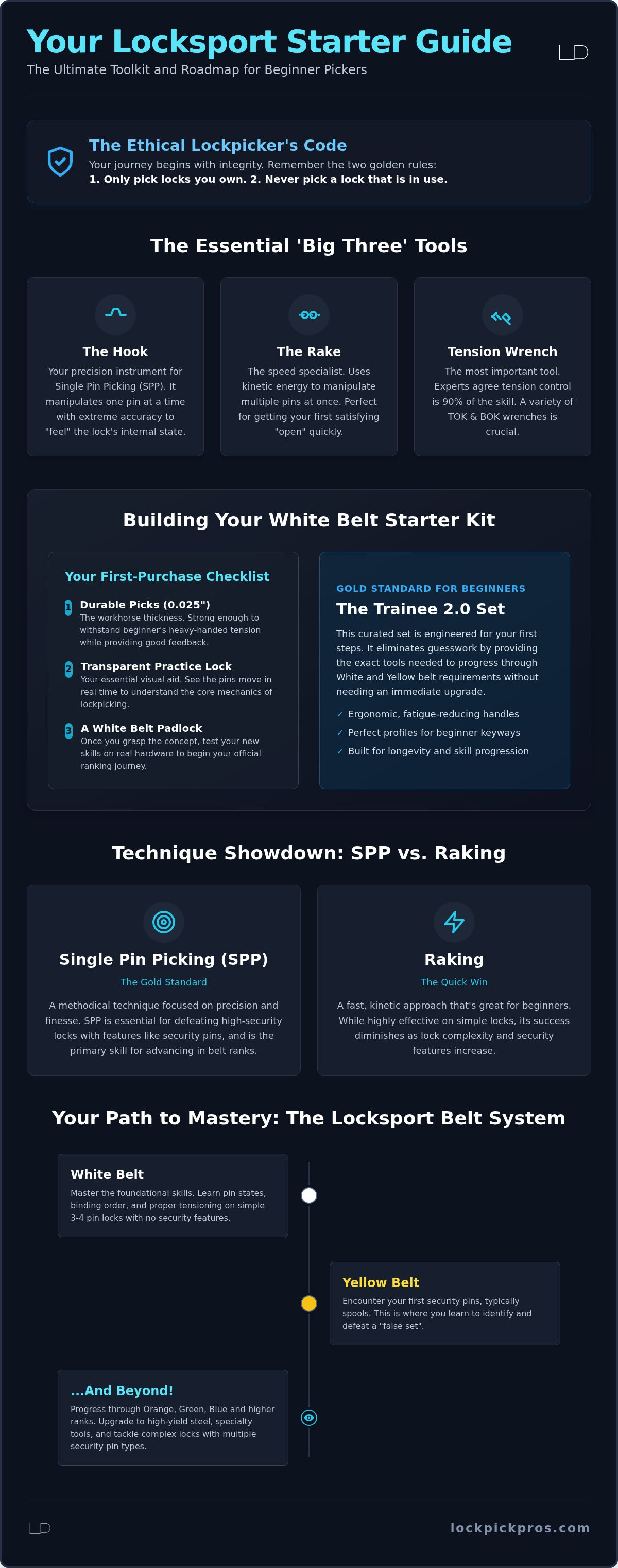
Starting your locksport journey is a rush, but you shouldn't just grab a paperclip and hope for the best. If you're asking, what tools do I need to start lock picking, the answer lies in The Essential 'Big Three' Tools: the hook, the rake, and the tension wrench. Before you touch a pick, you must embrace the ethical lockpicker's code. Only pick locks you own or have explicit permission to pick. Never pick a lock that is in use, like your front door, because even a small mistake can leave you stranded. Precision-engineered steel tools provide the crisp feedback you need to succeed, whereas DIY household objects lack the rigidity required to communicate what's happening inside the lock.
The Hook: Your Precision Instrument
The hook pick is the heart of Single Pin Picking (SPP). It's designed to manipulate one pin at a time with extreme accuracy. A short hook is the most versatile tool for White Belt locks because it fits comfortably in most beginner keyways. You'll use it to "feel" the pins, identifying which one is binding and which one is springy. It's about finesse, not force. Mastering the hook allows you to understand the binding order, which is the sequence in which pins must be set to open the lock.
The Rake: The Speed Specialist
Raking is a different beast. Instead of individual attention, you use tools like a Bogota or City rake to manipulate multiple pins at once. It's often the fastest way for a beginner to get their first "open." This technique relies on kinetic energy and speed to bounce pins into place. While it's satisfying to hear that click in seconds, raking has limits. As you climb toward higher-security belt ranks, sophisticated locks are designed to resist these "attack" methods, forcing you back to the precision of the hook.
Tension Wrenches: The Most Important Tool
Ask any veteran and they'll tell you that tension control is 90% of the skill. Without the right amount of turning pressure, those pins will never stay set. You'll encounter Bottom of Keyway (BOK) and Top of Keyway (TOK) tensioners. Having a variety of tension tools is actually more important than having dozens of picks. High-quality sets like The Trainee 2.0 include several tension options to ensure you can find the perfect fit for any keyway. We use the community belt ranking system to help you choose your gear, ensuring you aren't overwhelmed by advanced tools before you've mastered these foundational basics.
Building Your White Belt Starter Kit
If you're wondering what tools do I need to start lock picking, don't make the mistake of buying random individual picks. While some community forums suggest a "buy as you go" approach, beginners often end up with a drawer full of tools they don't know how to use. A curated beginner set ensures you have the correct tensioners and pick profiles from day one. To understand the physics behind your gear, Building Your White Belt Starter Kit requires a solid grasp of pin tumbler mechanics and how steel interacts with brass pins.
Starting correctly means following a proven roadmap. Beginners frequently ask what tools do I need to start lock picking because they want to avoid breaking expensive gear. Follow this simple three-step checklist to set yourself up for success:
- Choose picks with a 0.025" thickness: These are the workhorses of the hobby. They are durable enough to survive the heavy-handed tension common in your first few weeks of practice.
- Secure a transparent practice lock: This is your primary visual aid. It allows you to see the internal components move in real time.
- Find a White Belt padlock: Once you understand the mechanics, test your skills on real metal hardware to begin your official ranking journey.
The Trainee 2.0: The Gold Standard for Beginners
The The Trainee 2.0 is specifically engineered for those starting their locksport journey. It features comfortable, ergonomic handles designed for long practice sessions, which significantly reduces hand fatigue while you learn the nuances of feedback. This set is perfectly mapped to the White and Yellow belt requirements. It provides the longevity you need to progress through your first two ranks without needing an immediate tool upgrade.
Transparent vs. Cutaway Practice Locks
Transparent locks are the ultimate training wheels for any new hobbyist. They allow you to visualize the pin tumbler mechanism as your pick interacts with the springs and driver pins. Once you understand the internal movement, you should transition to "feeling" the pins with a metal cutaway lock. This bridge is essential for mastering the Lock Picking Belt Levels Explained roadmap. As you sharpen your senses and stop relying on your eyes, you'll eventually find yourself ready for the Carbon Fiber Gen 2 Pro Series tools that expert-level athletes rely on for precision feedback.
Single Pin Picking (SPP) vs. Raking: Which Tools Win?
Every newcomer reaches a crossroads where they must choose between speed and precision. Raking is the art of using kinetic movement to bounce pins into place, while Single Pin Picking (SPP) is the surgical manipulation of individual components. When you're figuring out what tools do I need to start lock picking, you'll quickly realize that your choice of technique dictates your gear. While raking offers instant gratification, SPP is the true skill of a locksport athlete. It's the difference between guessing a password and actually knowing the code. To progress through the community belt ranks, you'll eventually need to master both, but your focus should always lean toward the precision of SPP.
The Case for Single Pin Picking
SPP is the gold standard because it prepares you for high-security locks that feature spool or serrated pins. These security pins are designed to give false feedback, which can easily trap a rake. By using a hook pick, you learn to identify the unique "click" of a set pin versus the "mushy" feel of a false set. For this level of detail, thin profiles and polished edges are non-negotiable. Rough tools dampen the vibrations you need to feel. A standard hook from the Pro Series Expansion is a perfect upgrade for this stage. It provides the reach and feedback necessary for skill refinement. Many hobbyists find a meditative quality in SPP; it's a quiet, focused battle of wits between you and the cylinder.
The Quick Win: Raking Basics
Raking remains a valuable part of your arsenal, especially for building initial confidence. Snake rakes are excellent for "scrubbing" pins in a smooth, rhythmic motion, while triple peak rakes use aggressive peaks to simulate a key's profile. These tools are fantastic for opening White Belt locks in seconds. However, don't let quick wins turn into bad habits. Beginners should avoid "bitch picking," which is the act of randomly scrubbing the pick inside the lock without any regard for tension or pin feedback. It's a low-skill approach that often leads to bent tools and frustration. Instead, use raking as a diagnostic tool to see if a lock has a simple bitting before switching to the precision of a hook. As you move toward Yellow and Orange belt locks, you'll find that what tools do I need to start lock picking shifts from simple rakes to specialized hooks that can bypass security features.
Upgrading Your Arsenal: Tools for Yellow Belt and Beyond
Transitioning from a hobbyist to a locksport athlete means refining your gear. When you first asked what tools do I need to start lock picking, the durable 0.025" picks in your starter kit were the right answer. They survived the heavy tension of learning. However, as you target Yellow Belt locks and beyond, you'll encounter paracentric keyways. These tight, warding-heavy paths require thinner profiles like 0.020" or 0.015" tools to reach the pins without getting stuck. If you're still wondering what tools do I need to start lock picking for intermediate challenges, the focus shifts from durability to precision and feedback. High-yield steel becomes critical here. It offers the strength needed to prevent snapping while maintaining a profile thin enough to dance through complex keyways.
The Carbon Fiber Advantage
As you progress, the "feel" of the lock becomes your primary guide. Carbon fiber handles are a game changer because they don't dampen vibrations like rubber or plastic. They act as a tuning fork, transmitting the subtle feedback of a pin setting or a spring's resistance directly to your hand. If you want to dive deeper into the science, check out our guide on The Benefits of Carbon Fiber Lock Picks. Many of our community members who are chasing their Green or Blue belts prefer the Gen 2 Pro Max Stealth Edition for its unmatched sensitivity and lightweight design. It's about removing the barriers between your senses and the internal components of the lock.
Specialty Tools for Higher Ranks
The world of locksport is vast. You'll eventually move beyond standard pin tumblers. High-security locks, such as those from Kaba, often use dimple pins that require specialized Dimple Picks to manipulate. At this stage, you should also consider a pinning tray and gutting tools. Learning to take a lock apart and put it back together is essential for understanding internal mechanics. It's a key requirement for higher belt ranks. Read more in our article on Lock Rekeying for Beginners to see how this skill refines your picking technique. When you're ready to stop guessing and start feeling every micro-movement, it's time to upgrade to the Carbon Fiber Gen 2 Pro Series.
Joining the Locksport Community: Your Path to Black Belt
Locksport is more than a solo hobby; it's a global community of problem-solvers and precision athletes. If you've been asking what tools do I need to start lock picking, you're likely ready to move beyond the kitchen table and into the world of competitive skill progression. The true heart of this sport lies in the community-driven belt ranking system. This framework provides a structured path for every newcomer to grow from a curious novice into a master of the craft. By following this roadmap, you ensure that your pick set selection and practice locks always match your current skill level, preventing the frustration that comes from tackling high-security hardware too early.
The Black Belt Challenge
We invite every newcomer to join our Free Black Belt Challenge. This is a sequential roadmap that mirrors the rigorous standards of the LPU and Reddit locksport communities. You'll start at the White Belt level, mastering basic pin tumblers, and work your way through Yellow, Orange, and Green toward the legendary Black Belt. To earn your certification at each tier, you'll submit "picks-in-action" videos. These videos serve as proof of your technical skill and your unwavering commitment to the ethical lockpicker's code. Join the challenge for free today and start your journey toward the elite ranks of ethical pickers.
Earn Your Skill: The Reward System
In 2026, the locksport community is more interactive than ever. Our "Share-to-Earn" loop is designed to support your progression every step of the way. When you document your journey and share your successful "opens" on social media, you aren't just showing off your progress; you're earning tool upgrades. We also feature a community bounty for hitting specific social reach goals, which unlocks exclusive gear and advanced specialty tools. This system ensures that as your skills grow, your arsenal evolves with you. It's about fostering engagement and celebrating every click of a set pin.
Before you take your first step, here is your final checklist for success:
- Tools: Ensure you have a high-quality starter kit like The Trainee 2.0.
- Ethics: Commit to the code of only picking locks you own and never picking locks in use.
- Practice Lock: Start with a transparent lock to build your mental model of the internal mechanics.
If you're still wondering what tools do I need to start lock picking to hit that first milestone, the answer is simple. Shop Beginner Sets and secure your foundational gear to earn your first rank today.
Earn Your First Open and Beyond
You now have a clear answer to the question, what tools do I need to start lock picking. By focusing on the "Big Three" essentials and committing to the ethical lockpicker's code, you're ready to tackle your first practice cylinder. Locksport is a journey of skill refinement. It moves from foundational White Belt kits to the precision of high-yield steel as you advance. Our Official 2026 Locksport Belt Ranking Kits are designed to grow with you. They ensure you always have the right feedback for every security pin you encounter.
These tools are used by ethical lockpickers worldwide because they rely on precision-engineered high-yield steel to deliver the best results. Don't let your journey stop at a single open. Join our community of athletes and push your boundaries one belt at a time. It's time to turn that curiosity into a master-level skill.
Join the Black Belt Challenge and Get Your First Starter Kit Today!
We can't wait to see your first "picks-in-action" video as you climb the ranks. Your path to mastery starts with the very first click.
Frequently Asked Questions
Is it legal to own lock picking tools in the United States?
In the vast majority of the United States, owning lock picking tools is completely legal for hobbyists and ethical pickers. However, a few states have specific laws where possession might be viewed as intent to commit a crime if you aren't a professional. You should always check your local and state regulations before making a purchase. At Lockpick Pros, we focus on the sport of lockpicking, ensuring our tools are used responsibly within the law.
Can I pick my own front door lock if I lose my keys?
You should never pick a lock that is currently in use, even if you own the property. Front door locks are complex and can easily be damaged during a picking attempt, potentially leaving you locked out and facing an expensive repair bill. Ethical lockpicking is about practicing on hobbyist gear like practice locks. If you are locked out of your home, your best bet is to contact a professional locksmith service rather than risking your security.
What is the best lock pick set for a total beginner in 2026?
The Trainee 2.0 is the gold standard for anyone asking what tools do I need to start lock picking in 2026. This curated set includes the "Big Three" essentials: a versatile hook, a reliable rake, and high-quality tension wrenches. Unlike random sets found elsewhere, this kit is specifically mapped to the White and Yellow belt requirements. It features ergonomic handles and precision-engineered steel, making it the perfect foundation for your new hobby.
What is 'locksport' and how is it different from locksmithing?
Locksport is the competitive and recreational side of lockpicking, where enthusiasts treat locks as mechanical puzzles to be solved. It focuses on skill building and community rankings rather than providing a service. Locksmithing is a professional trade involving installation, repair, and emergency access. While locksmiths use similar tools, the goals are different. Locksport athletes pick for the challenge and the satisfaction of the "open," always adhering to a strict code of ethics.
Do I really need a transparent practice lock to start?
While not strictly mandatory, a transparent practice lock is the fastest way to build your mental model of how a pin tumbler works. Seeing the pins move as you apply tension and lift them with your pick bridges the gap between theory and feel. It helps you understand the binding order and the feedback you'll eventually rely on. Once you've mastered the visual aspect, you can transition to metal locks to refine your tactile senses.
What are the different belt levels in lockpicking?
The locksport community uses a color-coded belt ranking system to track skill progression, ranging from White to Black. White belt represents the foundational level, where you pick basic padlocks. As you advance to Yellow, Orange, and eventually the elite Black belt, the locks become significantly more complex, featuring security pins and paracentric keyways. This system provides a clear roadmap for your journey, helping you choose the right practice locks and tools for your current expertise.
How long does it take to learn how to pick a basic padlock?
Most beginners can achieve their first "open" on a basic White Belt padlock within 15 to 30 minutes of focused practice. The key is having the right equipment and understanding the basic mechanics of tension. If you're wondering what tools do I need to start lock picking to see quick results, a standard hook and a tension wrench are your best friends. Consistent practice will sharpen your speed and help you feel the pins more clearly.
Are carbon fiber lock picks worth the extra money for beginners?
Carbon fiber lock picks are an incredible investment once you've mastered the basics. For a total beginner, the durability of high-yield steel in a set like The Trainee 2.0 is usually more important. However, as you move toward Yellow belt and beyond, the enhanced feedback from carbon fiber handles becomes invaluable. They transmit vibrations more clearly than plastic, allowing you to feel the subtle movements of security pins that would otherwise go unnoticed.