

How to Use Automotive Jigglers: A Masterclass for Locksport Enthusiasts (2026)
Jiggling is a precision vibration technique, not a random act of luck. While it might look like you're just shaking a metal template, successful bypass requires a deep understanding of feedback loops. Many hobbyists who start their journey with beginner lockpicking find themselves feeling completely lost when faced with the springy, erratic behavior of an automotive wafer lock. We know how frustrating it is to over-set a wafer or struggle with the "Goldilocks" level of tension. If you've been searching for how to use automotive jigglers without feeling like you're just guessing, you've come to the right place.
This guide is designed to transform your approach from blind luck to technical mastery. We'll break down the specific mechanics of wafer locks and the exact patterns needed to achieve a clean open on your practice locks. By the end of this masterclass, you'll have the confidence to add these bypass tools to your kit and move one step closer to earning your next belt ranks. Let's get started on refining your tactile sensitivity and expanding your hobbyist skill set through structured progression.
Key Takeaways
- Understand the mechanical differences between sliding wafer plates and traditional pins to master the centering technique.
- Learn how to use automotive jigglers by identifying keyway profiles and executing precise vibration patterns instead of random movement.
- Discover why starting with a foundational set is the best way to practice before you're ready to upgrade to the Carbon Fiber Gen 2 Pro Series.
- Identify how mastering these bypass tools helps you level up through the community belt ranks as you progress toward expert status.
- Join the Black Belt Challenge to share your skills with the ethical locksport community and earn rewards for your practice milestones.
Automotive Jigglers and Their Role in Locksport
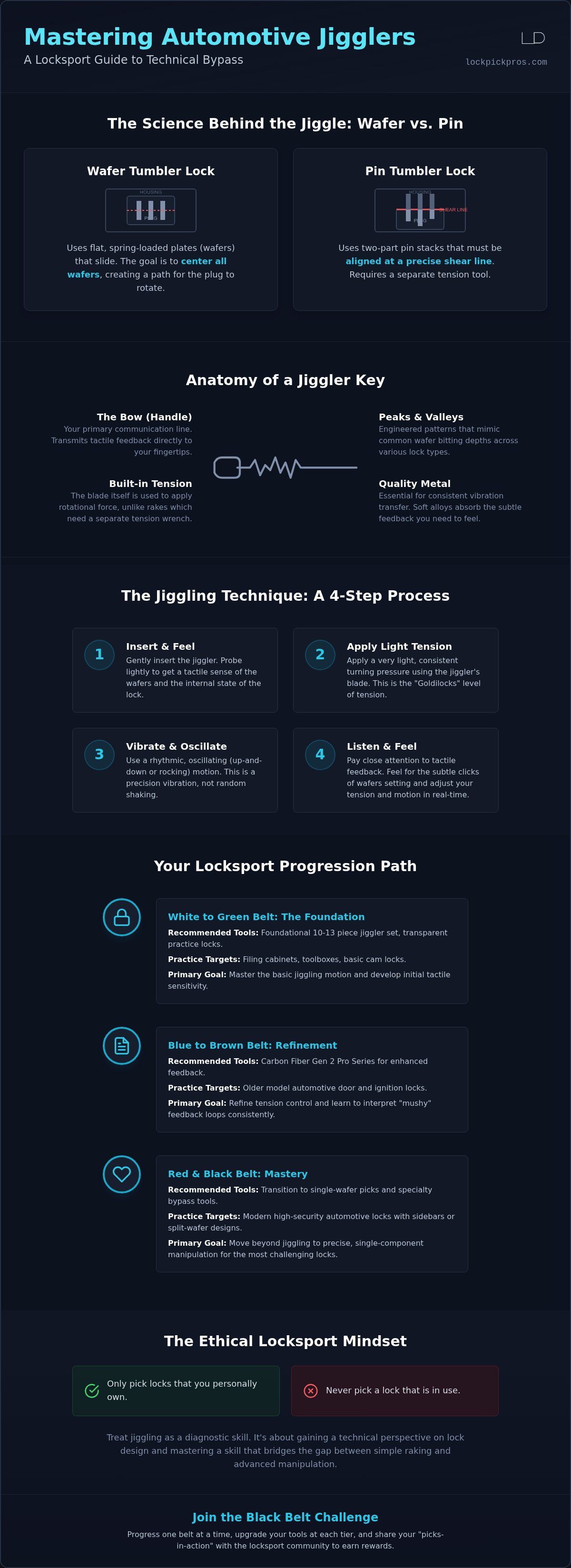
Automotive jigglers are a fascinating subset of bypass tools that every serious hobbyist should understand. These are pre-cut patterned tools designed specifically for the Wafer tumbler lock, which is the standard mechanism found in most vehicle doors and ignitions. In the locksport community, we distinguish between a jiggler and a traditional rake based on how they interact with the cylinder. While a rake requires a separate tension wrench to apply torque, a jiggler uses its own blade to provide "built-in tension." This makes learning how to use automotive jigglers a unique challenge that tests your ability to balance vibration and rotation simultaneously. Ethical lockpickers study these tools to broaden their understanding of non-pin-tumbler security. It's a foundational step for anyone looking to master the full spectrum of mechanical locksport.
The Anatomy of a Jiggler Key
A standard set, typically found in 10-piece or 13-piece configurations, features a variety of peak and valley patterns. These shapes aren't random. They represent common bitting depths found across various vehicle manufacturers. The "bow" or handle of the key is your primary communication line with the lock. It needs to be sturdy enough to allow for a rhythmic, oscillating motion without bending. High-quality metal is essential for consistent vibration transfer. Cheap, soft alloys tend to absorb the subtle feedback you need to feel. You want a tool that transmits the "click" of a setting wafer directly to your fingertips, allowing you to adjust your pressure in real-time. This tactile connection is what separates a lucky open from a repeatable skill.
Ethical Use and the Locksport Mindset
At Lockpick Pros, we are passionate about ethical lock picking for hobbyists. This means adhering to the foundational rules: never pick a lock you don't own and never pick a lock that's in use. We frame jiggling as a diagnostic skill rather than a method of entry. It helps you understand the tolerances and warding of a lock without the surgical precision of single pin picking. Studying these tools allows you to see how different mechanical systems respond to varied inputs. It's about gaining a technical perspective on lock design and mastering a skill that bridges the gap between simple raking and advanced manipulation. By practicing on your own loose locks, you build the muscle memory required for higher-tier belt rankings.
Understanding Wafer Locks: The Science Behind the Jiggle
To master how to use automotive jigglers, you first need to understand the hardware they're designed to bypass. Unlike the pin-tumbler locks found on front doors, wafer locks rely on flat, spring-loaded plates called wafers. These plates slide up and down within the plug. When the correct key is inserted, it aligns the center of each wafer so that neither the top nor the bottom protrudes into the lock housing. This alignment creates a clear path for the plug to rotate. Because of their design and often looser manufacturing standards, many hobbyists find it easier to pick wafer-tumbler locks compared to high-tolerance pin stacks.
You'll encounter these mechanisms in various hobbyist practice targets. While they're synonymous with older vehicle doors and ignitions, they're also the standard for filing cabinets, toolboxes, and cam locks. Understanding the mechanical tolerances of these locks is key. In many cases, the gap between the wafer and the housing is large enough that a "close enough" key pattern can allow the lock to turn. This is precisely the vulnerability a jiggler exploits.
How Universal Patterns Exploit Tolerances
The "peaks and valleys" on a jiggler blade aren't random designs. They're engineered to mimic the average heights of common wafer bitting. When you oscillate the tool, you're using vibration-induced setting to bounce the wafers into their centered positions. The slight turning pressure you apply catches the wafers at the moment they're correctly aligned. However, keep in mind that jigglers have their limits. Modern high-security automotive locks often use sidebars or split-wafer designs that require much more precise manipulation than a standard jiggler can provide. For those advanced challenges, you'll eventually need to transition to single-wafer picking.
Feedback Loops: Feeling the Wafers
Learning to interpret feedback is what separates a trainee from a pro. When you're working a wafer lock, the feedback is famously "mushy" compared to the crisp, metallic "click" of a pin tumbler. You're feeling for a reduction in spring tension as the wafers find their home. If you feel heavy resistance through the handle, you're likely over-setting a wafer or applying too much torque. Counter-rotation in a wafer lock occurs when the plug attempts to spin backward slightly as a wafer is forced out of a binding state. To get the most out of your practice sessions, using a tool like the Carbon Fiber Gen 2 Pro Series can significantly enhance the subtle vibrations you feel, making it easier to tell when you're making progress.
Selecting Your Tools: From Beginner to Pro Series
Making the right pick set selection is about matching your gear to your current skill level and target difficulty. When you're just branching out from beginner lockpicking into the world of wafer bypass, a standard 10-piece set is your best friend. It provides the essential profiles needed to understand the "mushy" feedback we discussed earlier without overwhelming you with niche templates. As you progress toward higher belt ranks, the limitations of standard steel become apparent. That's when you'll want to upgrade to the Carbon Fiber Gen 2 Pro Series. These aren't just tools; they're high-fidelity instruments designed to transmit the most subtle wafer movements directly to your hand.
While full-sized tools are the standard for practice locks like automotive doors, don't overlook the utility of Mini Jigglers. These smaller templates are vital for the compact wafer stacks found in desk drawers and filing cabinets. Regardless of the size, tool maintenance is critical. Check your blades regularly for stress whitening or micro-cracks. A snapped tool inside a cylinder is a frustrating setback that can usually be avoided with a quick inspection and proper cleaning after every session.
Material Matters: Steel vs. Carbon Fiber
The core difference between these materials lies in their vibration transfer properties. High-yield steel is incredibly durable and a great choice for those still learning the "pulsing" tension method. However, steel can absorb some of the kinetic energy you need to feel. Carbon fiber is much more rigid, acting as a direct conduit for the vibrations occurring inside the lock. You can read more about the benefits of carbon fiber lock picks to understand the physics of feedback. This material also helps prevent hand fatigue, allowing you to focus on your technique during long sessions.
Building Your Vehicle Entry Kit
For a comprehensive setup that covers everything from Trainee-level locks to expert-level challenges, the Gen 2 Pro Max Stealth Edition is the ultimate choice. It's a curated collection that ensures you're never caught without the right profile for a specific keyway warding. As you refine your skills, you might find that you prefer certain "go-to" patterns for specific manufacturers. Organizing these within your case allows for faster identification during timed challenges. Once you've mastered the foundational templates, the Pro Series Expansion provides the specialized profiles needed to tackle more complex, high-tolerance wafer arrangements.
Mastering the Technique: How to Use Automotive Jigglers
Mastering how to use automotive jigglers is less about brute force and more about rhythmic finesse. It starts with selecting a template from your kit that mirrors the warding of the keyway. You aren't looking for a perfect match, but the profile should slide in with minimal resistance. Once you're inside, enter the "searching" phase. Gently move the tool back and forth to locate the wafer stack. You'll feel the springy resistance of the plates against the metal blade. This is where your tactile training pays off. You're looking for that specific "mushy" feedback we discussed earlier.
The secret to a successful open lies in your tension hand. Avoid the heavy, constant torque used for pin tumblers. Instead, use the "pulsing" method. Apply light pressure to the plug, then release it slightly in sync with your jiggling movements. This allows wafers to bounce freely into their centered positions without getting trapped by excessive friction. If you find yourself struggling with the subtle feedback of these movements, upgrading to the Carbon Fiber Gen 2 Pro Series can help you feel exactly when a wafer hits the shear line. Recognizing the open happens when the plug suddenly gives way under your pulsing pressure. Stop jiggling immediately to avoid over-setting the wafers as the lock turns.
The Three Essential Movement Patterns
Efficiency in locksport comes from knowing which movement to execute. Don't just vibrate the tool randomly. Try these three community-standard patterns to find what the lock responds to best:
- The Scrub: Move the jiggler rapidly in and out horizontally. This uses kinetic energy to bounce multiple wafers simultaneously.
- The Circle: Rotate the handle in small, elliptical motions. This helps the peaks of the jiggler find the "sweet spot" where the wafers center themselves.
- The Seesaw: Rock the tool up and down vertically. This leverages individual wafers into position, which is perfect for locks with extreme bitting differences.
Troubleshooting Common Jiggling Issues
If the lock feels "stuck" and the plug won't budge, you've likely over-set a wafer. Don't force it. Completely release your tension and let the wafers reset before trying a different pattern or movement. Sometimes, a jiggler is simply incompatible with the lock's internal warding, requiring you to swap to a different template. In high-quality wafer locks, a false set is detected when the plug rotates significantly but remains blocked by a security feature or a slightly misaligned plate. If this happens, slightly ease your tension while continuing a gentle seesaw motion to coax the final wafers into place.
Leveling Up: The Black Belt Jiggler Challenge
Mastering the art of the bypass is a critical milestone for any enthusiast looking to climb the Lock Picking Belt Levels. While many hobbyists focus solely on pin tumblers, the ability to handle wafer mechanisms is what separates a trainee from a well-rounded picker. Learning how to use automotive jigglers effectively allows you to tackle locks that would otherwise stall your progression. As you move from White to Yellow belt and beyond, you'll find that versatility is your greatest asset. We've created the Lockpick Pros Black Belt Challenge to help you document this journey and prove your skills to the wider community of ethical lockpickers.
Technical Milestone: The Master Lock #101
In the early stages of beginner lockpicking, you should focus on low-security wafer locks to build your confidence. The Master Lock #101 is a perfect candidate for your first technical milestone. This lock features a 5-wafer stack with no security wafers, making it an ideal entry point for practicing bypass techniques. To successfully open this lock, follow these specific steps:
- Tool Selection: Choose a medium-peak jiggler template from your kit that matches the keyway warding.
- Tension Level: Use very light, pulsing clockwise tension. Avoid heavy torque, as it will bind the wafers and prevent them from sliding.
- Step 1: Insert the jiggler fully into the keyway until you feel the back of the wafer stack.
- Step 2: Apply your light tension and execute a rapid "Scrub" motion, moving the tool in and out horizontally.
- Step 3: If the lock doesn't turn, transition to the "Seesaw" motion to leverage individual wafers that might be sitting higher in the stack.
- Step 4: Feel for the plug to give way. If it feels stuck, release tension completely to reset the wafers and start again.
For those just starting, we recommend practicing these movements with The Trainee 2.0. This allows you to build foundational muscle memory before moving to high-tolerance vehicle locks. Documenting your picks is a vital part of the locksport culture and is necessary to advance through the belt ranks. Recording a successful open not only serves as proof for verification but also helps you analyze your own technique.
The Share-to-Earn Community Bounty
Locksport is more than just a solo hobby; it's a thriving global community. We encourage you to join our social groups and share your progress with fellow hobbyists. Our Picks-in-Action reward system is designed to celebrate your wins. When you post a video or photo of a successful wafer bypass using our tools, you earn community points. These points lead to exclusive rewards and discounts on advanced gear. We've even established a community bounty for reaching collective social reach goals. Join the Black Belt Challenge today, refine your skills, and start earning your way to the top!
Master the Bypass and Claim Your Next Belt
You've now got the foundational knowledge to transform your approach to wafer locks. By understanding the mechanical tolerances of these sliding plates and practicing specific patterns like the Scrub or Seesaw, you're moving beyond guesswork. Mastery of how to use automotive jigglers is ultimately a journey of tactile refinement. It's about feeling the lock's response and adjusting your rhythm in real time. Whether you're working through White belt milestones or aiming for expert status, the right tools make a massive difference in your progression.
Our community of over 50,000 ethical lockpickers is waiting to see your progress. Professional carbon fiber tools provide the crisp feedback you need to conquer even the most stubborn wafer stacks. Don't wait to start your next chapter in the locksport world. Join the Free Black Belt Challenge and Master Your Tools! We're excited to see your picks-in-action as you earn your way through the ranks. Keep practicing, stay ethical, and enjoy the challenge of the open.
Frequently Asked Questions
Are automotive jigglers legal to own and use for practice?
Yes, owning these tools is generally legal for ethical lockpickers in the United States, but you must check local statutes. As of August 2026, TSA guidelines permit lockpicks in both carry-on and checked baggage. The key is to follow the community code: only pick locks you own or have explicit permission to use. Never use them on a lock that is currently in service or protecting property you don't own.
Will a jiggler key work on every car door lock?
No, jigglers are not universal skeleton keys. They are specifically designed for wafer tumbler locks, which are common in older vehicles and cabinets. Modern high-security automotive locks often feature sidebars or split-wafer designs that require more advanced manipulation. Understanding how to use automotive jigglers means recognizing their limitations and knowing when a lock requires a different specialty tool like a dimple pick or single-wafer picking technique.
Do I need a separate tension wrench when using a jiggler?
You don't need a separate tension wrench because the tool's blade provides built-in tension. Unlike standard picking where you use a wrench to apply torque, you apply light turning pressure directly through the jiggler handle. This allows you to execute the pulsing method, where you vary the rotation in sync with your vibration patterns. It's a self-contained bypass method that simplifies the process while requiring a high degree of tactile sensitivity.
How do I know which jiggler pattern to start with?
Start by selecting the template that most closely matches the warding and keyway profile of your target lock. You want a pattern that slides in smoothly without binding on the edges. Most hobbyists begin with the most common peaks and valleys found in a standard 10-piece set. If one pattern doesn't yield results after a minute of focused movement, reset the wafers and try the next most similar profile in your kit.
Can I damage my car lock by using a jiggler key?
You can definitely damage a lock if you apply excessive force or use low-quality tools. Ethical lockpickers always practice on loose locks rather than their own vehicle's ignition. Aggressive jiggling can bend the wafers or even cause a tool to snap inside the keyway. To minimize risk, use high-quality materials like those in our Carbon Fiber Lockpicks series and focus on rhythmic vibration rather than brute strength or heavy torque.
What is the difference between a jiggler and a bump key?
These tools operate on entirely different mechanical principles. A bump key is used for pin-tumbler locks and relies on a sudden kinetic impact to jump pins above the shear line. Automotive jigglers are designed for wafer locks and use a combination of vibration and light tension to center sliding plates. While both are bypass tools, they aren't interchangeable; using a jiggler on a pin-tumbler lock simply won't work.
How long does it typically take to open a lock with a jiggler?
The time to open varies significantly based on your skill level and the lock's tolerances. A seasoned hobbyist might achieve an open in just a few seconds, while a trainee might spend several minutes finding the right rhythm. It's important to remember that jiggling is a technical skill. If you haven't achieved an open within a few minutes, it's usually better to reset the wafers and try a different movement pattern.
Can jigglers be used on pin-tumbler locks like front door deadbolts?
No, jigglers are ineffective on pin-tumbler deadbolts. These locks use cylindrical pins that require precise vertical lifting, whereas jigglers are shaped to manipulate flat sliding wafers. If you're looking to tackle home security locks, you should stick to our Beginner Lockpick Sets featuring hooks and rakes. Learning how to use automotive jigglers is a specialized skill meant for the specific mechanics of vehicle doors, toolboxes, and filing cabinets.