

Lock Pick Laws in California: A 2026 Guide for Ethical Hobbyists
What if the precision tools you use to master your favorite hobby could technically be used as evidence against you? It's a heavy question that many beginners face when they first research the lock pick laws in California. We know the fear of being charged with possession of burglary tools is real, especially when legal jargon makes it hard to tell what's actually allowed. You want to focus on the click of a set pin and the satisfaction of an open lock. You shouldn't have to worry about a potential misdemeanor while honing your skills.
Becoming a responsible member of the locksport community starts with knowing your rights and responsibilities. Whether you're a newcomer with a basic set or an expert chasing a Black Belt, you deserve to practice your craft without constant uncertainty. This guide breaks down the 2026 updates to California Penal Code 466 and explains why your intent is your strongest legal safeguard. We'll explore how to demonstrate you're an ethical hobbyist, how the law treats new electronic tools, and how you can confidently carry your gear to the next community meetup as you climb the belt ranks.
Key Takeaways
- Master the specifics of California Penal Code 466 to understand how the lock pick laws in California protect ethical hobbyists who lack criminal intent.
- Discover how to clearly demonstrate your lawful intent by focusing on practice locks and documented skill progression within the locksport community.
- Learn the best practices for safely transporting your picks to local meetups without attracting unnecessary legal scrutiny.
- Explore how the community belt ranking system provides a structured and ethical roadmap for moving from beginner sets to advanced tools.
- Get ready to join the Black Belt Challenge and earn rewards by sharing your progress within our supportive and legal environment.
Understanding California Penal Code 466: The Basics
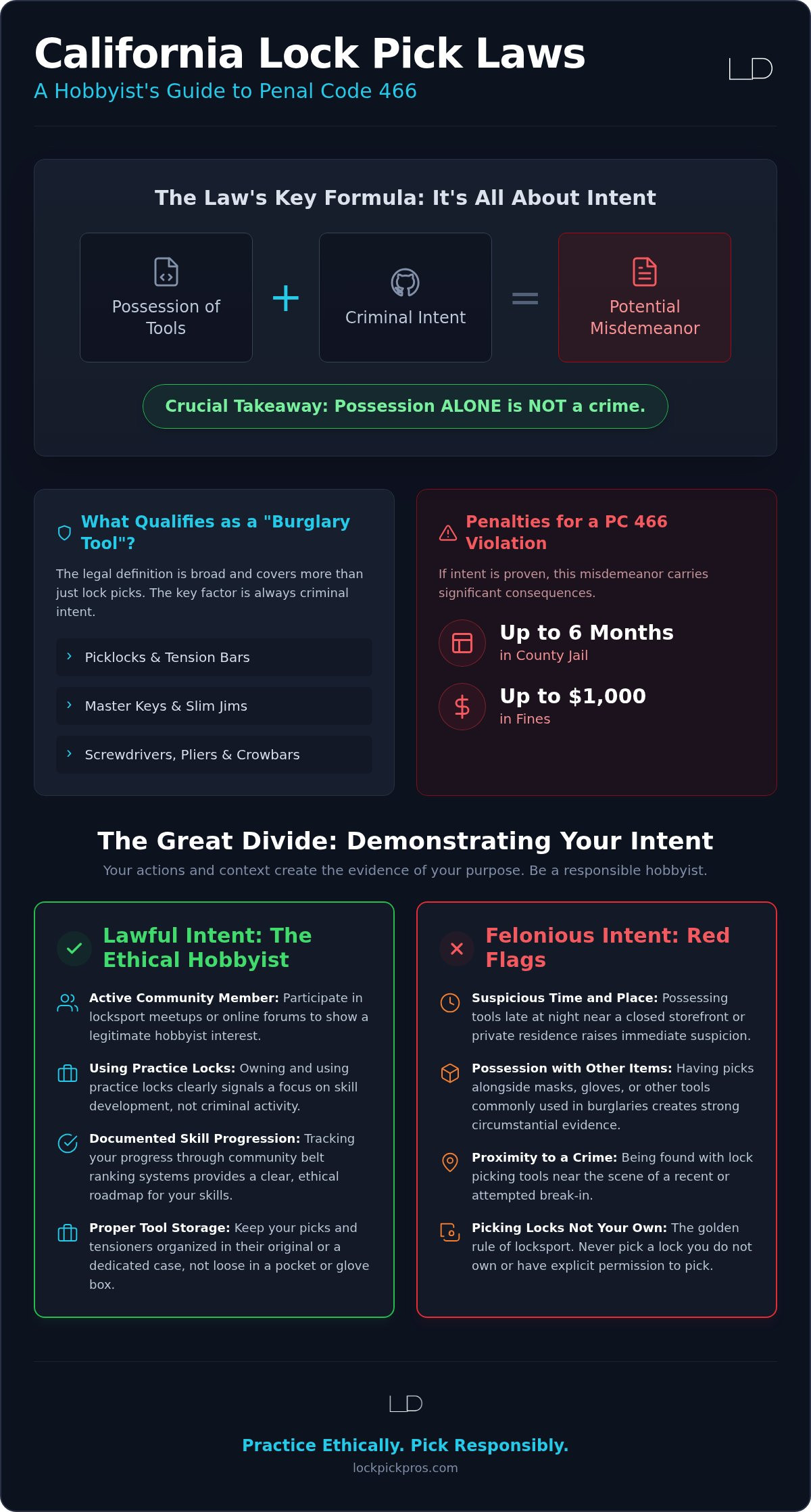
California's legal system can feel like a maze, but the foundation is surprisingly clear once you look at the text. California Penal Code 466 is the primary statute governing "burglary tools." It's the big one you need to know. For anyone exploring the lock pick laws in California, the most vital thing to remember is that this law requires both the possession of a tool and the specific intent to commit a crime for a conviction to happen.
Crucially, possession alone is not a crime in the state of California. You aren't a criminal just because you have a hobby. This distinction is what allows the community of Ethical Locksport to thrive in the Golden State. Being an ethical picker means you respect the gear and the law equally.
What Qualifies as a Burglary Tool?
The legal definition of a burglary tool in California is quite broad. The code specifically mentions items like picklocks, tension bars, and floor-safe door pullers. It also includes everyday items like screwdrivers, vise grip pliers, and master keys if they're paired with criminal intent. Modern locksport tools like hook picks and slim tension wrenches are technically "instruments" under the law, but their presence in your home alongside practice locks tells a story of curiosity, not crime.
As a hobbyist, your tools often look different from what a professional locksmith might carry. While a professional might have heavy-duty vehicle entry kits, a beginner in our community likely starts with something like The Trainee 2.0. These sets are designed for learning and skill progression. They're built for the tactile challenge of a hobby, not for "breaking and entering."
The Misdemeanor Classification
Violations of PC 466 are typically classified as misdemeanors in California. If someone is caught with these tools and a prosecutor can prove they intended to break into a building or vehicle, the penalties are serious. A conviction can lead to up to six months in county jail and fines reaching $1,000.
Why does this matter to you? Understanding this classification helps ethical hobbyists take the law seriously. It encourages us to keep our tools secure and our practice confined to our own locks. It's about being a responsible mentor for others. When you treat your gear with the respect the law demands, you protect the reputation of the entire sport. You don't just pick locks; you represent a community of precision and integrity.
The Core Nuance: Proving Felonious Intent
Intent is the "smoking gun." Without it, possession isn't a crime under California Penal Code 466. Learning about the lock pick laws in California is easier when you realize the state isn't out to stop your hobby. The law focuses on why you have the tools, not just that you have them. Prosecutors carry the burden of proof. They must show you intended to commit a burglary. This is a high bar for them to clear when you're an ethical hobbyist who follows the community code.
The fundamental divide for residents is the difference between lawful intent and felonious intent. Lawful intent is about the challenge of the sport. Felonious intent is about breaking the law. Most people don't realize that the same set of picks can be viewed through two completely different lenses depending on the situation. The state needs more than just the gear to make a case; they need a reason to believe you were planning a crime.
Circumstantial Evidence of Intent
Context matters. If you're carrying picks near a closed storefront at 3 AM, law enforcement will have questions. It looks different than sitting in a park or a coffee shop with friends during a locksport meetup. Circumstances often dictate the perception of intent. If picks are found alongside items like masks, gloves, or floor-safe door pullers, the "burglary tool" label becomes much harder to shake.
Being an active part of the locksport community helps a lot. It shows you have a legitimate, skill-based reason for owning these instruments. When you can show you're pursuing a specific belt rank, your picks aren't "burglary tools." They're sporting equipment. Public participation in the community serves as a clear record of your dedication to the craft as an ethical picker.
Proving Lawful Intent with Your Tools
How you store your gear says everything about your purpose. Keep your tools in their original cases. Don't let them rattle around loose in a pocket or a car console. Owning a Trainee 2.0 along with a clear practice lock is a strong indicator of hobbyist intent. It demonstrates you're focused on learning the mechanics of the lock, not bypassing security in the real world.
Documentation is your best friend. Keep track of your progress through the belt ranking system. If you can show a history of picking practice locks at home, it builds a solid case for lawful intent. As you advance, you might want to upgrade to more precise gear. For those moving into intermediate challenges, the Carbon Fiber Gen 2 Pro Series offers the feedback needed for high-security practice while maintaining your status as a dedicated student of the craft. Staying connected with other pickers ensures you stay on the right side of the lock pick laws in California.
Ethical Locksport vs. Criminal Activity
Locksport isn't about breaking things; it's about understanding how they work. To the uninitiated, a set of picks might look like a burglar's toolkit, but to us, it's a collection of precision instruments for puzzle-solving. Navigating the lock pick laws in California is much easier when your actions align with the global locksport community's standards. This community thrives on a foundation of integrity, treating every cylinder as a mechanical challenge rather than a barrier to someone else's property.
The global community follows a strict code of ethics that mirrors the requirements for staying safe under various lock picking laws. By adhering to these standards, you create a clear distinction between a "picker" and a "prowler." This isn't just about optics; it's about building a lifestyle that prioritizes security and respect. When your behavior is consistently ethical, you're much less likely to face the "felonious intent" questions we explored in previous sections.
The "Two Rules" of locksport are the non-negotiable pillars of our hobby. First, never pick a lock you don't own or have explicit permission to pick. Second, never pick a lock that is in use (a "service lock"). Following these rules provides a moral and legal safety net. If you only pick locks that are clamped into a bench vise or held in your hand, you're clearly engaged in a skill-building exercise. It's almost impossible for a prosecutor to argue criminal intent when the lock you're working on isn't attached to a door.
The Role of Practice Locks
Clear or cutaway locks are the best tools for proving you're learning a skill. These specialized cylinders allow you to see the pins move, turning the internal mechanics into a visual lesson. They differ from "field use" locks because they're designed for transparency, not security. Using these tools shows you're interested in the "how" of the mechanism. Check out our Lock Picking Belt Levels Explained for more on how practice progression keeps your hobby focused and legal.
Locksmith Licensing in California
You don't need a license to be a hobbyist. In California, a locksmith license is only required if you're performing locksmithing "for hire." This means if you're charging someone to open their car or house, you need to be registered with the Bureau of Security and Investigative Services. For the rest of us, picking is a personal pursuit.
There's a huge psychological benefit to "professionalizing" your hobby with high-quality tools. While you aren't a locksmith, using precision gear like a pinning tray or high-yield picks changes how you view the craft. It shifts the mindset from "getting in" to "mastering the art." By treating your practice like a serious discipline, you naturally stay within the ethical boundaries that keep you safe in the eyes of the law.
Practical Best Practices for California Hobbyists
Being a hobbyist in the Golden State means being prepared. Knowing the lock pick laws in California is step one. Step two is practicing good habits that prove your intent every time you leave the house with your gear. It's about being a responsible mentor for the community. When you treat your tools with respect, you protect the reputation of the sport. The goal is to ensure your intent is never questioned by staying organized and transparent.
If you're ever stopped by law enforcement, stay calm. Explain you're a locksport enthusiast. Use terms like "mechanical puzzles," "belt ranking," and "ethical picking." This frames the conversation around skill and competition rather than illicit activity. It helps to have your gear stored in a way that screams "hobbyist" rather than "burglar." Follow this simple routine when heading to a meetup:
- Place your picks and tension wrenches in a dedicated carrying case.
- Include a clear or cutaway practice lock in the same kit.
- Keep a digital or printed copy of the community belt ranking list nearby.
- Store the entire kit in your trunk or a locked bag during transit.
The trunk is your friend. Keeping your tools out of the passenger compartment shows they aren't for immediate "field use." It's a small detail that speaks volumes about your lawful intent. As you advance toward higher ranks, your gear will likely become more specialized. For those ready to step up their game, the Carbon Fiber Gen 2 Pro Series offers a professional look and feel that clearly distinguishes you as a serious student of the craft.
The "Hobbyist Kit" Checklist
Your kit should be a self-contained proof of your hobby. Never carry picks loose in your pocket. This can be misinterpreted as trying to hide them for quick access. Always carry a practice lock. It's hard to argue you're looking for trouble when you have your own practice cylinder right there. Also, avoid bringing your tools to sensitive areas like banks, schools, or government buildings. Even if it's legal, it's not worth the headache. Common sense is your best legal defense when navigating lock pick laws in California.
Traveling with Your Set
California is a big state, and you might find yourself flying to a convention or a major competition. If you're dealing with the TSA, remember that lock picks are generally allowed in checked bags. While they might be permitted in carry-ons, checking them avoids a long conversation at the security gate. For more details on what to pack, check out our guide on Traveling with Your Lock Pick Set. Whether you're driving down the PCH or flying into SFO, keep your gear secure and your intent obvious.
Advancing Your Skills Ethically with Lockpick Pros
The belt ranking system is more than just a way to track your progress. It's a roadmap for ethical mastery that aligns perfectly with the lock pick laws in California. By following a structured path, you're building a body of work that proves your intent is purely about sport and skill refinement. Every "open" you record and every belt you earn serves as a testament to your dedication as an ethical picker. It's the ultimate way to show that your tools are for sport, not for mischief.
Choosing the right gear for your current level is part of that journey. As you move from foundational locks to those with complex security pins, your requirements for feedback and precision will change. We're here to act as your mentor, ensuring you have the right instruments for every stage of your progression. When your equipment matches your documented skill level, your status as a legitimate hobbyist becomes undeniable.
From White Belt to Expert
Every journey begins with the basics. For those just starting, The Trainee 2.0 provides the foundational feedback needed to understand pin states and basic tensioning. As you graduate from simple cylinders to those with security pins, your gear needs to evolve. The Pro Series Expansion is designed to help you tackle the intermediate challenges of Orange and Green belts where precision becomes the difference between a set pin and a dropped stack.
Once you reach the advanced tiers like Blue or Purple belt, the feedback from your tools is everything. High-quality gear like the Carbon Fiber Gen 2 Pro Series signals a serious commitment to the sport. These tools offer unmatched rigidity and sensitivity, allowing you to feel the tiniest movements within a high-security core. Carrying professional grade equipment alongside a collection of advanced practice locks is a powerful way to show you're a dedicated athlete. It makes it clear that your interest in the lock pick laws in California is about protecting your right to pursue a technical and demanding discipline.
Join the Black Belt Challenge
We believe in rewarding the grind. That's why we created the Black Belt Challenge. It's a free community initiative designed to push your boundaries while keeping you grounded in ethical practice. The challenge follows a specific progression: join for free, master one belt at a time, and upgrade your tools as the difficulty spikes. It's a journey of mastery that turns a niche skill into a lifelong passion for many pickers.
Our "share-to-earn" loop is the heart of our community. When you hit a new milestone, share your "picks-in-action" content on social media. Not only do you get to show off your skills, but you also earn rewards toward your next gear upgrade. We even have a community bounty for hitting social reach goals to foster engagement. It's about growing the sport together while staying safe and legal. Ready to start your journey? Join the Free Black Belt Challenge Today!
Elevate Your Skills as an Ethical Picker
You've now seen that mastering the art of locksport in the Golden State is entirely possible when you prioritize ethics and transparency. The most important lesson is that your intent defines your legal standing. By following the community's "Two Rules" and keeping your practice focused on cylinders you own, you stay on the right side of the lock pick laws in California. Treat your tools like the precision instruments they are. Secure storage and clear documentation of your belt ranking progress are your best allies.
Joining a community of like-minded hobbyists provides a supportive environment where you can grow without fear. We're here to help you as an Ethical Locksport Community Member by providing Free Black Belt Challenge Access. Using precision-engineered tools isn't just about picking faster; it's about respecting the craft. Ready to elevate your skills with gear that matches your dedication? Master the sport ethically. Shop our Beginner Lock Pick Sets. Keep practicing, stay curious, and enjoy the click!
Frequently Asked Questions
Are lock picks illegal to own in California?
No, lock picks are not inherently illegal to own in the state of California for ethical hobbyists. Possession of these tools is perfectly legal as long as you don't have the specific intent to use them to commit a burglary or another felony. The law focuses on why you have the tools rather than the gear itself. As long as you're practicing on locks you own, you aren't breaking any laws.
Do I need a license to buy lock picks in CA?
You don't need a professional locksmith license or any special permit to purchase or own lockpicking tools in California. Licensing is only required for individuals who perform locksmithing services for hire under the Bureau of Security and Investigative Services. Hobbyists can freely buy beginner lockpick sets or advanced picks for personal use, practice, and skill progression without any state registration or professional certification.
Can I carry my lock pick set in my pocket in California?
While it isn't strictly illegal to have picks in your pocket, doing so can be misinterpreted depending on the context of your location. Carrying tools on your person in public spaces or near sensitive buildings might look suspicious to law enforcement. It's much safer to keep your gear in a dedicated carrying case inside a bag or your vehicle's trunk to clearly signal your status as an ethical hobbyist.
What happens if the police find lock picks in my car?
Finding picks in a car isn't an automatic crime, but officers will evaluate the situation to determine your intent. If your tools are stored in a professional case alongside practice locks and community belt ranking documentation, it supports a claim of lawful intent. However, if they're found loose near items like gloves or masks at an unusual hour, it could lead to a misdemeanor charge under the lock pick laws in California.
Is lockpicking considered a crime if I only pick my own locks?
Picking locks you own or have explicit permission to open is a completely legal activity known as locksport. This practice is a recognized competitive hobby focused on the mechanical challenge of the cylinder. By sticking to the "Two Rules" of the community, you ensure your practice remains ethical and legal. Most hobbyists find that using dedicated practice locks at home is the best way to develop their skills safely.
What is California Penal Code 466?
California Penal Code 466 is the primary statute that criminalizes the possession of "burglary tools" when there is intent to commit a crime. The law was recently amended on January 1, 2026, to include modern electronic devices like key programmers and signal extenders. For a conviction, a prosecutor must prove both that you possessed the tools and that you intended to use them to break into a building or vehicle. Understanding this code is essential for navigating lock pick laws in California responsibly.
How can I prove I am a locksport hobbyist and not a burglar?
You can demonstrate your lawful intent by keeping your tools in original cases and carrying practice locks with your kit. Being an active member of the locksport community and participating in the belt ranking system provides a clear record of your dedication to the sport. Pointing to your progress in the Black Belt Challenge or showing a digital copy of the community belt list helps explain your hobby to others calmly.
Are bump keys and jigglers legal in California?
Bump keys, jigglers, and other bypass tools are legal to possess under the same intent rules as standard picks. These items are specifically listed in the California Penal Code 466 as potential burglary tools if used with criminal intent. For hobbyists, these are often treated as advanced mechanical puzzles. It's vital to keep these specialized tools secured and used only in a controlled, legal environment for skill refinement and personal mastery.