

Compact Lock Pick Kit for Travel: The 2026 Locksport Guide
What if your next long flight was actually the perfect opportunity to finally master that stubborn American Lock 1100? Most hobbyists leave their gear at home because they're tired of bulky rolls taking up precious luggage space or they're terrified of a TSA agent confiscating their favorite picks. We've all felt that hesitation when packing a compact lock pick kit for travel, wondering if our passion for locksport will be misunderstood at the security checkpoint.
It's frustrating to let your skills go cold just because you're away from your home workbench. You deserve to sharpen your picks whether you're in a hotel room in Tokyo or a lounge in London. This guide will show you how to curate a high-performance, lightweight kit that meets the 2026 TSA guidelines for tools seven inches or less in length. We'll dive into the legal protocols for ethical lockpickers, explore why our Carbon Fiber series is the ultimate choice for mobile kits, and help you keep your belt rank progression on track while you're on the move.
Key Takeaways
- Learn why every gram counts and how to prioritize high-strength materials like carbon fiber for a lightweight, durable setup.
- Audit your tool selection by your current belt rank to avoid over-packing unnecessary picks for a short trip.
- Navigate 2026 TSA regulations with confidence by keeping your compact lock pick kit for travel under the seven-inch tool limit.
- Discover the "Pouch Factor" to choose a carrying case that shields your delicate tool tips without hogging luggage space.
- Use your travel time to advance toward the Black Belt Challenge by focusing on surgical tool selection and ethical practice.
Essential Compact Lock Pick Kits for Travel
Building a compact lock pick kit for travel is about surgical precision. It's the difference between dragging a heavy toolbox and carrying a slim, high-performance pouch that fits in your pocket. Modern locksport isn't confined to a basement workbench anymore. We want tools that move with us. In 2026, advances in miniaturization and handle materials mean you can carry a full range of profiles without the bulk. You don't need thirty picks; you need the right four or five. This evolution in gear allows you to maintain your practice routine without sacrificing luggage space.
Why does portability matter so much? For the ethical hobbyist, it's about consistency. If you're chasing higher ranks, you can't afford a two-week break while on vacation. A dedicated travel kit differs from Everyday Carry (EDC) tools because it's designed for long practice sessions. While EDC tools are often folding multi-tools meant for emergencies, a travel kit uses single-piece picks. These provide the crisp feedback you need for security pins. We prioritize single-piece picks in slim pouches over bulky multi-tools because tactile sensitivity is everything in locksport. You need to feel every click, and a dedicated travel kit ensures you don't lose that connection.
The Ethical Traveler’s Mindset
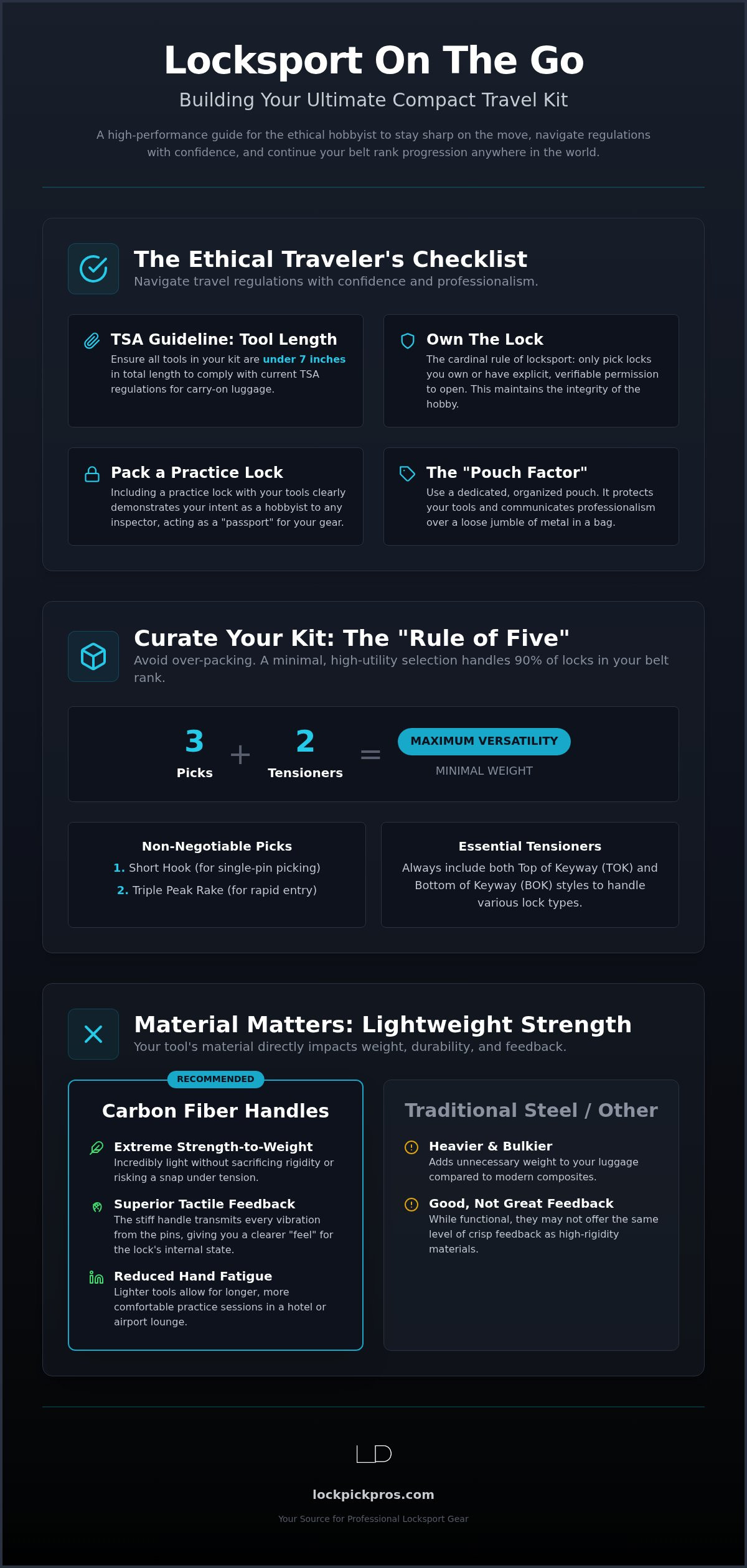
Carrying picks across borders or state lines requires a rock-solid commitment to the locksport code of ethics. We only pick locks we own or have explicit permission to use. It's a simple rule that keeps our community respected and safe. When you pack your compact lock pick kit for travel, always include a dedicated practice lock in your bag. This isn't just for training during your flight. It serves as a visual "passport" for your hobby. If your bag is ever inspected, having a clear practice cylinder alongside your tools immediately validates your status as a legitimate hobbyist rather than someone with illicit intent.
Locksport on the Move
Traveling is a unique opportunity to encounter regional lock variations you won't find at home. Use your downtime in hotel rooms or transit lounges to refine your feel for different tolerances. These sessions are vital for maintaining your lock picking belt levels. Whether you're working through a White Belt padlock or a complex Blue Belt cylinder, having your tools ready ensures your skills stay sharp. Don't forget to document your progress. Sharing "picks-in-action" photos from interesting locations is a great way to engage with the community and work toward our Black Belt Challenge. Every click of a set pin brings you closer to that next rank.
Evaluating Portability: What to Look for in a Travel Kit
Choosing a compact lock pick kit for travel requires balancing weight with extreme durability. You're miles away from your full bench. If a pick snaps or bends, your practice session ends immediately. Every gram counts in a carry-on bag, but shaving weight shouldn't mean sacrificing the structural integrity of your tools. High-strength materials and clever handle designs allow modern pickers to carry professional-grade gear without the bulk of a traditional locksmith roll.
The "Pouch Factor" is your first line of defense. Your carrying case must be slim enough to slip into a side pocket but rigid enough to shield delicate tool tips. Avoid storing picks loose in your bag. An organized, high-quality pouch does more than protect your gear; it communicates professional hobbyist intent to anyone who sees it. Clean organization is much easier to explain to authorities than a tangled mess of metal at the bottom of a backpack.
Carbon Fiber vs. Steel for Lightweight Sets
There's a reason expert pickers are moving toward advanced composites. There are several benefits of carbon fiber lock picks for the mobile hobbyist. The most significant advantage is the strength-to-weight ratio. Carbon fiber handles are incredibly light, yet they won't bend or snap like cheap aluminum or plastic alternatives. This rigidity provides superior feedback, allowing you to feel the subtle movements of security pins even in a smaller tool format. These handles also reduce hand fatigue during long practice sessions in airport lounges or hotel rooms. If you're serious about your travel setup, consider upgrading to the Carbon Fiber Gen 2 Pro Series for the ultimate lightweight experience.
Size vs. Versatility: The EDC Balance
Don't fall into the trap of over-packing. We recommend the "Rule of Five" for travel kits: three picks and two tensioners. This curated selection handles 90% of the locks you'll encounter in your current belt rank. A short hook and a triple peak rake are non-negotiable. The short hook allows for precise single-pin picking on complex keyways, while the rake quickly clears basic padlocks to keep your momentum high. Versatility also depends on your tensioners. You must include both Top of Keyway (TOK) and Bottom of Keyway (BOK) wrenches. TOK tensioning is often essential for tighter European keyways, while BOK remains the standard for most common practice locks. This five-piece foundation ensures you're ready for any challenge without adding unnecessary weight to your luggage.
Curating Your Travel Pick Selection by Belt Rank
Your current skill level is the primary blueprint for your gear. A compact lock pick kit for travel shouldn't be a random assortment of metal; it should be a surgical reflection of your goals. Beginners often feel the urge to pack massive 32-piece sets, but these usually include redundant rakes that add weight without adding value. Each tool in your travel pouch must earn its place. By matching your pick set selection to the community belt ranks, you ensure you have the right feedback for the specific locks you intend to practice on. This focused approach reduces clutter and builds the psychological confidence that comes from using a familiar, high-quality setup in an unfamiliar environment.
The White Belt Traveler’s Essentials
If you're just starting your beginner lockpicking journey, simplicity is your greatest ally. We recommend using the Trainee 2.0 as your foundational travel base. Including transparent practice locks in your bag allows you to visualize pin movement during transit, which is vital for building muscle memory. When you're ready to move to a real lock like the Master Lock #3, follow these technical steps:
- Pin Stack: 4 standard pins.
- Pick Choice: Standard short hook.
- Tension: Heavy Bottom of Keyway (BOK) tension.
- The Process: Insert your BOK wrench and apply firm, heavy pressure. Use your hook to find the first binding pin. Lift it until you hear a sharp click. Because these locks have wide tolerances, you'll need that heavy tension to keep the standard pins from dropping while you hunt for the next binder. Repeat until the plug rotates.
Intermediate and Advanced Travel Curation
As you progress toward Green belt and beyond, the technical requirements of your kit change. You'll encounter security pins like spools and serrated drivers that require much higher tactile sensitivity. This is where upgrading to the Carbon Fiber Gen 2 Pro Series becomes a game-changer for the traveler. For a common Green belt challenge like the Abus 72/40, your approach must be much more delicate:
- Pin Stack: 6 pins (typically 1 standard and 5 spools).
- Pick Choice: Slim profile hook (.015 or .018 inch) to navigate the paracentric keyway.
- Tension: Very light Top of Keyway (TOK) tension.
- The Process: Apply light TOK tension. First, locate and set the standard pin (usually pin 1) to drop the lock into a "false set." You'll feel the plug rotate slightly. Next, probe the remaining pins to find a spool. As you lift a spool, the plug will want to rotate backward (counter-rotation). Ease off your tension slightly to allow this movement, then click the pin into place. Repeat this for all five spools until the lock opens.
Focusing on tools that offer maximum feedback for these security pins ensures your travel time translates into real skill progression toward the next rank.
Legal Considerations and TSA Guidelines for Lock Picks
The golden rule for any traveling locksporter is simple: research your destination before you cross state or national lines. While we view our tools as instruments of skill and patience, law enforcement in some jurisdictions may view them differently. Understanding the nuances of local legislation is the best way to protect your hobby and your gear. Transparency is always your most powerful tool. Concealing a compact lock pick kit for travel often creates unnecessary suspicion, whereas being open about your status as an ethical hobbyist builds trust with security personnel.
Understanding State and International Laws
Legality often hinges on the distinction between possession and intent. In many regions, owning lock picks is perfectly legal unless there is evidence of criminal intent. However, some "prima facie" states, such as Mississippi, Nevada, Ohio, and Virginia, may place the burden of proof on you to demonstrate that you are a law-abiding hobbyist. International travel adds another layer of complexity. Some countries maintain strict restrictions on importing "locksmith tools." We recommend checking with local law enforcement or reputable locksport community forums for the most current legal status of tools in your specific destination. Carrying a copy of a locksport code of ethics can also help demonstrate your commitment to the craft.
Navigating Airport Security with Picking Tools
According to the latest 2026 TSA guidelines, lock picks are permitted in both carry-on and checked bags. The critical requirement is tool length; all tools must be 7 inches or less in length to pass through security checkpoints. While you can pack your compact lock pick kit for travel in your carry-on, remember that the individual TSA officer has the final say on what is allowed through. If you want to minimize the chance of a manual bag search, consider placing your kit in a checked bag. Always wrap any sharp objects securely to prevent injury to inspectors.
When explaining your gear, use professional terminology. Refer to your activity as "locksport" rather than "picking locks." As mentioned in previous sections, keeping a dedicated practice lock in your bag is the most effective way to prove your hobbyist intent. It transforms a collection of metal picks into a cohesive training set. If you are looking for a professional-grade setup that meets these length requirements while offering elite performance, upgrade your travel gear with the Carbon Fiber Gen 2 Pro Series.
Mastering Portability with Lockpick Pros Gear
At Lockpick Pros, we know your passion for locksport doesn't stop when you leave your home. We design every compact lock pick kit for travel with the mobile hobbyist in mind. It's about more than just making tools smaller; it's about engineering precision gear that survives the rigors of frequent travel while providing the elite feedback you need to progress. Whether you're stuck in a terminal or relaxing at a destination, our tools are built to perform under pressure. We're committed to providing the community with gear that balances professional strength with extreme portability.
The Gen 2 Pro Max Stealth Edition represents the pinnacle of high-end travel kits. It combines a slim profile with the rugged durability required for the road. We use high-yield materials that resist bending; this ensures your favorite hook stays true even after being packed and unpacked dozens of times. Every trip you take is an opportunity to build your legacy. With the right gear in your pouch, every opened lock brings you one step closer to your Black Belt. Don't let your skills stagnate while you're away from your workbench.
Our Top Travel-Ready Pick Sets
For those who prioritize a minimal footprint, the Carbon Fiber Special is the gold standard. It features an ultra-light profile that vanishes into your luggage while offering incredible strength. If you need more versatility for complex keyways encountered abroad, the Pro Series Expansion adds depth to your travel kit without adding significant weight. We also put immense thought into our carrying cases. They're specifically designed to provide maximum protection for your tool tips in the smallest possible space, ensuring your high-performance picks arrive in perfect condition.
Join the Black Belt Challenge
Traveling shouldn't slow down your progression; it should accelerate it. We invite every ethical picker to join our free Black Belt Challenge. It's designed to guide you through the ranks one belt at a time, providing a clear path to mastery. While you're on the road, take part in our "Share-to-Earn" loop. Document your "picks-in-action" by taking photos or videos of your successful opens in unique travel locations. It's the perfect way to stay engaged with the community while you explore the world.
Post your content on social media and tag us to earn community rewards. We even offer community bounties for hitting social reach goals, which helps you earn rewards for upgrading your gear at each tier. Join the challenge today for free, progress through your belt ranks, and start sharing your journey toward mastery. Your next great open could be just one flight away.
Your Next Open Awaits on the Road
Traveling doesn't have to mean pausing your locksport journey. By curating a high-performance compact lock pick kit for travel, you can turn every transit delay into a productive practice session. You now have the blueprint to stay light by selecting tools specifically for your current belt rank. We've explored how staying under the 2026 TSA seven-inch limit and carrying a practice lock helps maintain transparency with security officers. It's about being an ethical hobbyist who is always ready for the next challenge, no matter where you land.
You have the knowledge to carry your passion anywhere in the world. Our precision carbon fiber tools are designed to give you elite feedback while surviving the rigors of the road. It's time to put these strategies into action and start earning those higher belt ranks while you explore. Join the Black Belt Challenge and build your travel kit today! We can't wait to see your "picks-in-action" content from your next destination. Keep picking, stay ethical, and we'll see you on the leaderboards.
Frequently Asked Questions
Is it legal to fly with a lock pick set in my carry-on luggage?
Yes, the TSA permits lock picks in both carry-on and checked bags as long as the tools are seven inches or less in length. While these 2026 regulations are clear, the individual officer at the checkpoint always has the final decision. We recommend packing your tools neatly in a professional case to show they are part of an organized hobbyist kit rather than loose items.
What is the best compact lock pick kit for a total beginner?
We recommend starting with the Trainee 2.0 as your first compact lock pick kit for travel. It includes the foundational profiles like short hooks and rakes that help you master basic padlocks while on the move. This set is designed to be lightweight and portable, making it the perfect companion for anyone just beginning their journey through the community belt ranks during their downtime.
Do I need a special license to carry lock picks for travel?
You don't need a professional locksmith license to carry tools for locksport in most jurisdictions. However, laws vary significantly between different states and countries. Some regions might consider possession suspicious if you can't prove your hobbyist status. Always research local statutes before you cross borders to ensure you are following the specific rules of your destination and maintaining your status as an ethical picker.
How many picks should I actually include in a travel kit?
A surgical selection of five tools is usually plenty for any trip. We suggest packing three picks, such as a short hook, a deep hook, and a rake, paired with two tension wrenches for top and bottom of keyway use. This "Rule of Five" approach keeps your kit slim and manageable. It ensures you have the versatility needed to tackle most locks in your current belt rank without extra weight.
Can carbon fiber lock picks pass through metal detectors?
Most carbon fiber picks will still trigger metal detectors because the pick itself is made of high-strength steel. While the carbon fiber handles are incredibly lightweight and non-metallic, the business end of the tool must be metal to provide the necessary feedback and durability. Always place your compact lock pick kit for travel in a bin for screening to avoid unnecessary manual bag searches or delays.
What should I do if a security officer questions my lock pick set?
Stay calm and use professional terminology like "locksport" or "ethical lockpicking" to describe your hobby. Explain that these are tools for a competitive sport focused on skill and puzzle-solving. Showing a dedicated practice lock from your bag is the fastest way to demonstrate your intent. Most officers are simply curious once they realize you are practicing a legitimate hobby rather than engaging in any illicit activity.
Are there specific countries where I should never bring my lock picks?
You should be extremely cautious in countries with strict "burglary tool" laws or those that require all locksmiths to be government-licensed. Japan and certain European nations often have more rigid regulations regarding the import of picking tools. Always verify current customs and local laws via official government websites or community legal guides before you pack your gear for any international flight to avoid tool confiscation.
How do I prove that I am an ethical hobbyist and not a criminal?
The best way to prove your intent is through transparency and visible community involvement. Carry a practice lock, maintain an active social media presence showing your progress through the belt ranks, and keep your tools in a professional carrying case. Being part of the Black Belt Challenge provides a clear narrative of skill progression. This separates a dedicated hobbyist from someone with criminal motivations in the eyes of authority.