

Carbon Fiber vs. High Yield Lockpicks: The 2026 Professional Comparison
The strongest steel pick in your kit might actually be the reason you're stuck on that Green Belt challenge. It's frustrating when you're deep into a practice session and your hand starts to cramp, or worse, you lose that subtle "click" of a serrated pin because your tool is too stiff. Every serious hobbyist eventually faces the carbon fiber vs high yield lockpicks debate. You want gear that survives a restricted keyway without snapping, but you also need to feel exactly what's happening inside the plug.
In this comparison, you'll master the technical differences between carbon fiber and high-yield steel so you can select the perfect tools for your specific locksport goals. We'll break down why the "acoustic feedback" of carbon fiber handles is a game-changer for identifying security pins and how 301 high-yield stainless steel provides the structural integrity needed for heavy tension. Whether you're aiming for your next belt rank or just want to reduce tool breakage, this guide ensures your kit is ready for the most demanding locks.
Key Takeaways
- Learn why 301 high-yield stainless steel with tensile strength exceeding 270,000 PSI is the gold standard for navigating tight, paracentric keyways without permanent bending.
- Discover the technical performance differences of carbon fiber vs high yield lockpicks to determine which material provides the "tuning fork" feedback needed for serrated pins.
- Understand how the specialized composite resin in carbon fiber handles reduces hand fatigue during long practice sessions while amplifying subtle acoustic signals.
- Master the strategy of tool selection by matching thin-profile high-yield steel (0.015" to 0.018") to restricted keyways and carbon fiber to complex security pin stacks.
- Identify the right moment to upgrade your kit using tools like the Trainee 2.0 as you progress through the community belt ranking system toward your Black Belt.
Understanding High-Performance Lockpick Materials in 2026
Success in modern locksport isn't just about technique; it's about the physics of your tools. As you progress, the choice between carbon fiber vs high yield lockpicks becomes the defining factor in whether you open a lock or bend a pick. Carbon fiber lockpicks are engineered with advanced composite resins specifically to maximize vibration transfer from the pin stack to your fingertips. Conversely, high-yield lockpicks utilize specialized 301 stainless steel with a tensile strength exceeding 270,000 PSI. Understanding these materials is an essential skill for the legitimate profession of locksmithing and hobbyist locksport alike.
Choosing the right material determines your ability to advance through the lock picking belt levels explained in our community guides. While entry-level sets often use generic spring steel, the 2026 market has shifted toward high-performance alloys. This transition from beginner materials to professional-grade tools is necessary once you encounter the tight tolerances and security pins found in intermediate and advanced locks.
The Evolution of Professional Lockpicking Tools
Manufacturing in 2026 has revolutionized how we handle our picks. Composite handles are no longer just aesthetic; they're refined for an ergonomic grip that prevents slipping during high-pressure sessions. We've seen a massive transition from standard 301 stainless to high-yield "MAX" strength alloys that resist permanent deformation. For those tackling Green Belt locks and beyond, professional tools like the Carbon Fiber Gen 2 Pro Series are no longer optional. They provide the precision needed to navigate paracentric keyways that would destroy a standard tool. Even for those just starting to level up, tools like The Trainee 2.0 serve as the perfect bridge to these professional materials.
Tensile Strength vs. Vibrational Fidelity
A stronger pick isn't always the best choice for every lock. There's a constant trade-off between pick thickness and material rigidity. High-yield steel allows for incredibly thin profiles, sometimes down to 0.015", while maintaining the structural integrity to move stubborn pins. However, carbon fiber excels in vibrational fidelity, acting like a tuning fork for your hand. Yield strength is the specific point where a metal pick permanently deforms and fails to return to its original straight shape. For the ultimate balance, sets like the Gen 2 Pro Max Stealth Edition combine high-yield shafts with carbon fiber handles. This hybrid approach ensures you don't sacrifice durability for the feedback required to feel those tiny serrations.
The Carbon Fiber Advantage: Acoustic Feedback and Precision
In the locksport community, we often talk about "feeling" the lock. When you weigh up carbon fiber vs high yield lockpicks, the primary advantage of carbon fiber isn't structural strength; it's acoustic feedback. Think of a high-end composite handle as a tuning fork. It amplifies the micro-vibrations of a pin hitting the shear line. While traditional rubber or plastic handles tend to deaden these signals, carbon fiber transfers energy with incredible fidelity. This allows you to distinguish between a pin that's truly set and one that's just caught on a serration.
Beyond feedback, the extreme lightweight construction of the Carbon Fiber Gen 2 Pro Series is a massive relief during long practice sessions. If you've ever spent 30 minutes battling a stubborn paracentric keyway, you know that hand fatigue is the enemy of precision. A lighter tool requires less grip tension. This keeps your hands relaxed and your senses sharp for those tiny movements inside the plug. It's a game-changer for anyone pursuing higher belt ranks where sessions can stretch on as you hunt for that last binding pin.
Mastering High-Security Feedback
Feedback is your best friend when you hit the Green Belt level. Take the American Lock 1100, for example. It's famous for its serrated pins and spools that give confusing signals. Carbon fiber handles help you identify the subtle counter-rotation of a spool pin before it sets. Without this clarity, it's easy to overset pins or lose your place in the picking sequence. Professional-grade handles ensure that every click is felt, not muffled by the "mushy" feel of cheap plastic or rubber grips.
Durability Myths of Composite Picks
A common misconception in some forums is that carbon fiber is too brittle for serious work. In reality, modern professional sets are designed to handle significant stress. The Carbon Fiber Special is built to withstand the heavy tension required for stubborn locks without cracking. While the steel pick itself possesses high mechanical properties such as: the yield strength, the tensile strength and the ductility, the composite handle provides the rigid housing necessary to deliver that power. To maintain your high-end tools, keep them clean and avoid dropping them on hard surfaces to prevent micro-fractures in the resin.
If you're ready to elevate your sensory game and stop guessing what's happening inside the core, consider trying the Carbon Fiber Gen 2 Pro Series for your next session.
High Yield Stainless Steel: Structural Strength for Tight Keyways
While carbon fiber handles are the king of feedback, the material of the pick's shaft determines whether you actually open the lock or end up with a ruined tool. High-yield stainless steel is the professional standard for 2026. It's specifically engineered to allow for much thinner profiles, typically between 0.015" and 0.018", without immediate bending. In the ongoing debate of carbon fiber vs high yield lockpicks, high-yield steel is the clear winner for structural "muscle." It outperforms standard "full hard" 301 stainless by offering superior resistance to permanent deformation.
One of the most critical properties of this material is "spring-back." This refers to the pick's ability to return to a perfectly true, straight line even after being subjected to heavy tension. In restricted Euro cylinders or complex paracentric keyways, you'll often have to leverage your pick against the warding. Standard steel might take a permanent set, but high-yield alloys stay straight. This reliability is why veteran pickers keep a variety of steel thicknesses in their kits for different regional lock types.
The Physics of Thin-Profile Picking
Thin tools are necessary for high-security locks, but they're naturally more fragile. High-yield steel is the gold standard for 0.015" thickness because it prevents "pick-warp." This occurs when the metal twists or bows under the heavy spring tension found in high-quality commercial cores. Without the rigidity of high-yield alloys, a thin pick would feel like a wet noodle inside the lock. A professional-grade hook pick must possess a tensile strength exceeding 270,000 PSI to resist permanent deformation when navigating high-tension security pins. This strength allows you to apply the exact pressure needed to set a pin without the tool absorbing your force through bending.
Durability in the Field: Locksmith Applications
Professional locksmiths often prefer high-yield steel because their work frequently involves "blind" entries where they can't see the pins. In these scenarios, the tool takes a lot of abuse. High-yield steel offers incredible resistance to abrasion and metal fatigue over thousands of cycles. It doesn't just last longer; it stays reliable. If you're building a professional locksmith tool kit, including high-yield picks is a non-negotiable requirement. These tools handle the grit and grime of real-world locks better than almost any other material. They provide a level of trust that's essential when you're on a job and a tool failure isn't an option. For the ethical locksport hobbyist, this means more time picking and less money spent replacing snapped hooks.
Choosing Your Tool: Security Pins vs. Restricted Keyways
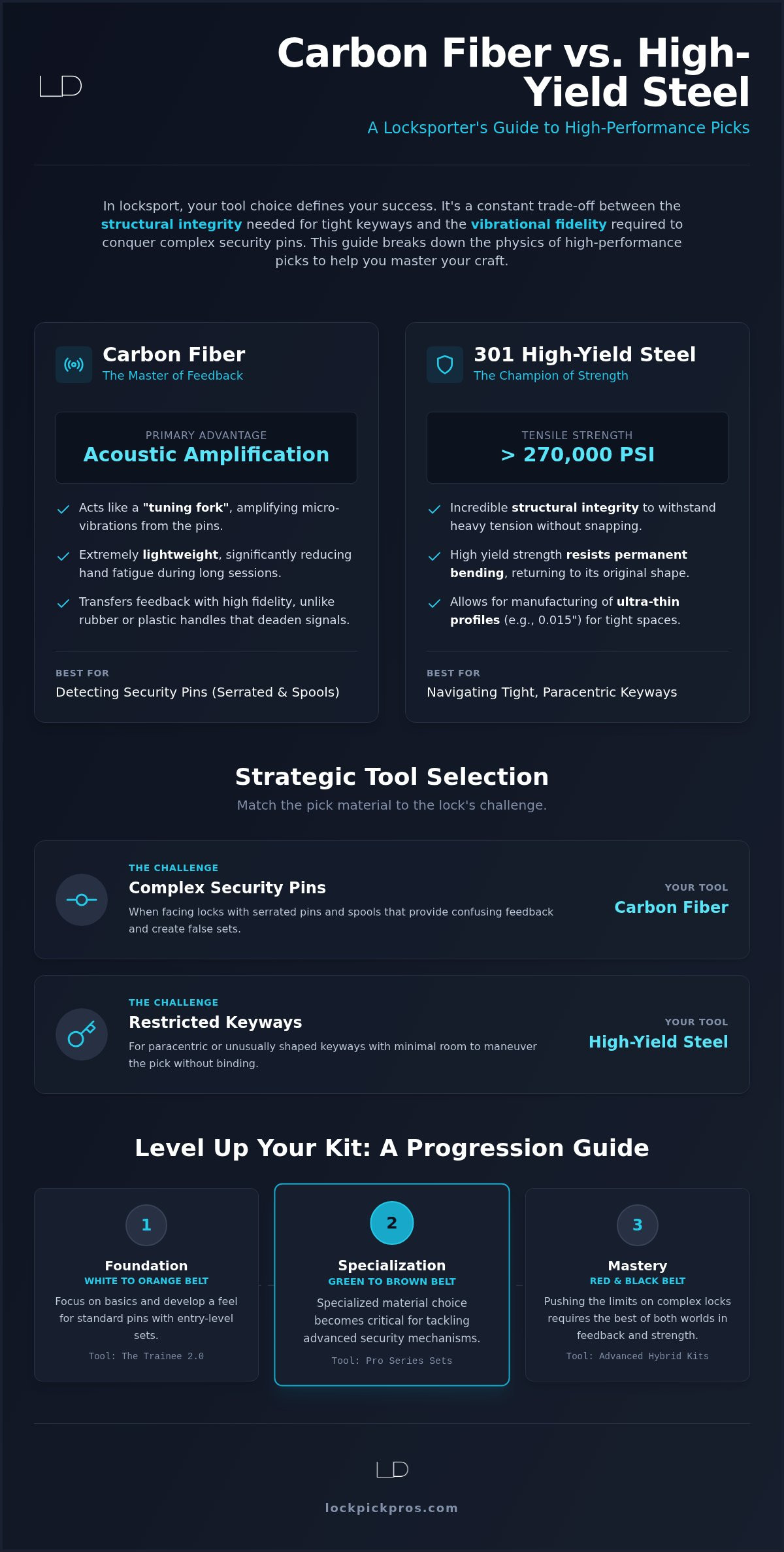
Successful picking is often a game of matching the right material to the specific obstacle inside the core. When you're weighing up carbon fiber vs high yield lockpicks, your decision should be based on whether the lock's primary defense is its pin stack or its keyway profile. Carbon fiber is your scalpel for surgical precision. It excels in low-tension scenarios where you need to feel the "chatter" of tiny serrations. High-yield steel is your workhorse. It provides the structural muscle needed for high-tension sessions and prevents tool deflection when you're forced to pick at an awkward angle.
If you're dealing with sensitive pins that require a delicate touch, carbon fiber handles provide the sensory clarity to avoid oversetting. However, if the lock has heavy spring tension, a carbon fiber pick might flex too much. In those cases, high-yield steel's rigidity ensures that every ounce of force you apply at the handle is delivered directly to the pin. This prevents the "mushy" feel that leads to dropped pins and reset stacks.
Scenario 1: The American Lock 1100 (Green Belt)
The American Lock 1100 is a rite of passage in the locksport community. Its internal mechanics usually consist of five pins with a mix of serrated drivers, serrated key pins, and spools. This combination is designed to give you false feedback. The Gen 2 Pro Max Stealth Edition is the ideal choice here because it combines a high-yield shaft with a carbon fiber handle. Use very light tension. This allows the carbon fiber to "talk" to you. You'll feel the distinct difference between the deep click of a set pin and the shallow, gritty vibration of a serration. Without that amplified feedback, it's incredibly easy to get lost in the "serrated trap."
Scenario 2: Restricted European Door Cylinders
European cylinders often feature tight, zig-zagging paracentric keyways that are notorious for eating standard picks. These locks require thin-profile tools that can navigate around the warding without snapping. The Pro Series Expansion in high-yield steel is necessary for these challenges. You'll inevitably experience "pick-rub" where your tool scrapes against the sides of the keyway. High-yield steel handles this abrasion without losing its edge or taking a permanent bend. It allows you to leverage the tool against the warding to reach high-cut pins in the back of the lock, providing the durability that composite materials alone might lack in such a cramped space.
Ready to master your next high-security challenge? Upgrade to the Carbon Fiber Gen 2 Pro Series and feel the difference that professional-grade materials make in your feedback loop.
Upgrading Your Kit for the Black Belt Challenge
Mastering the sport requires more than just hours of practice; it requires the right evolution of gear. As you climb the ranks, the debate of carbon fiber vs high yield lockpicks shifts from curiosity to a tactical necessity. Beginners usually start with durable steel to learn the basics without the risk of breaking expensive tools. However, once you hit the intermediate tiers, you need equipment that matches the complexity of the locks you're facing. The Trainee 2.0 serves as the perfect bridge to professional materials. It offers the refined profiles needed to tackle more complex pin stacks while keeping the price point accessible for those still refining their tension control.
Our community thrives on the "Black Belt Challenge." This isn't just a training program; it's a share-to-earn loop designed to reward your dedication to the craft. When you join the challenge for free, you'll progress one belt at a time, upgrading your tools at each tier to meet new technical demands. We encourage you to share your "picks-in-action" content on social media. By documenting your success, you can earn rewards and help the community hit social reach goals to unlock a community bounty. It's an exciting way to showcase your skills while fostering engagement with fellow hobbyists.
Building a Hybrid Professional Kit
Most experts don't limit themselves to just one material. They carry a hybrid kit that includes both carbon fiber and high-yield steel hooks to handle any situation. Carbon fiber handles are essential for the sensory feedback needed on high-security locks with mushroom or spool pins. High-yield steel is often better for the thin "flags" and hooks used in advanced belt tiers where keyway space is at a premium. Organizing your kit for mobility ensures you're always ready for ethical locksport events or community meetups. A well-curated set allows you to switch between a "scalpel" for feedback and a "workhorse" for restricted keyways instantly.
Join the Ethical Locksport Community
The core of our sport is the "ethical picker" code of conduct. We only pick locks we own or have explicit permission to pick, and we never pick locks that are in use. Following this code is vital for the integrity of our community. To earn your community-verified belt ranks, you'll need to document your progress clearly. This often involves filming your pick and gutting of a lock in one continuous take to prove your skill. Join the free Black Belt Challenge today, share your success with the community, and earn your place among the masters of the sport.
Elevate Your Skills for the Next Tier
Choosing between carbon fiber vs high yield lockpicks marks a major milestone in your locksport journey. You've learned that high-yield stainless steel provides the structural integrity needed for restricted keyways, while carbon fiber handles act as a tuning fork for security pins. Building a hybrid kit prepares you for the unpredictable challenges found in higher belt ranks. Professional-grade materials don't just make picking easier; they make the feedback more readable.
Our tools are engineered for maximum vibrational feedback and are trusted by community-ranked Black Belt pickers. We stand behind our gear with a satisfaction guarantee for all ethical hobbyists. Don't let muffled feedback hold you back from your next achievement. Upgrade to the Carbon Fiber Gen 2 Pro Series and Conquer the Green Belt! Keep practicing, stay ethical, and we'll see you at the next belt rank!
Frequently Asked Questions
Is carbon fiber more durable than high-yield steel for lockpicking?
High-yield steel is structurally more durable for the pick's shaft, while carbon fiber is primarily used for handles to enhance feedback. When evaluating carbon fiber vs high yield lockpicks, remember that carbon fiber composites can be brittle if misused as a lever. Conversely, 301 high-yield steel has a tensile strength over 270,000 PSI to resist snapping. Most professional sets use a hybrid design to combine the strength of steel with the sensory benefits of carbon fiber.
Can I use carbon fiber picks on every type of lock?
You can use them on most locks, but they excel in pin tumbler systems where feedback is critical. For locks with extremely heavy spring tension or seized cores, high-yield steel is often the safer choice to prevent tool deflection. Carbon fiber is a precision instrument. It's less suited for bypass techniques or brute-force attacks on vehicle locks. It's best to reserve composite tools for locks requiring surgical accuracy and a light touch.
Why do professional lockpicks use high-yield steel instead of regular stainless?
Professional tools use high-yield steel because it resists permanent deformation better than standard 301 stainless. In the debate of carbon fiber vs high yield lockpicks, the steel's "spring-back" property is what allows a 0.015" pick to return to its original shape after heavy use. Regular stainless steel often takes a permanent bend under the same pressure. This ruins the tool's precision and makes it difficult to navigate tight keyways in future sessions.
What is the best pick thickness for high-security locks (Green Belt)?
A thickness of 0.018" to 0.020" is usually the "sweet spot" for Green Belt locks like the American Lock 1100. This provides enough strength to handle security pins while remaining thin enough to navigate paracentric keyways. If the keyway is exceptionally restricted, you might need to drop down to 0.015". This requires high-yield alloys. These alloys ensure the pick doesn't warp or twist under the lock's internal spring pressure during a long session.
Will carbon fiber picks help me feel security pins better?
Yes, carbon fiber handles significantly amplify the acoustic and tactile signals from the lock's pins. Unlike plastic or rubber grips that absorb energy, the composite resin acts as a conductor for micro-vibrations. This makes it much easier to identify the distinct "chatter" of serrated pins or the counter-rotation of a spool. It's a critical upgrade for any hobbyist struggling to differentiate between a set pin and a tricky false set.
How do I prevent my high-yield steel picks from bending?
Preventing bends starts with using proper tension and avoiding excessive upward force. High-yield steel is tough, but it still has a limit known as its yield point. If you find yourself pushing hard, you're likely caught on the warding or trying to move a pin that isn't binding. Lightening your tension allows the pins to move more freely. This protects your tools from unnecessary stress and prevents permanent warping of the pick shaft.
Is it worth upgrading to carbon fiber if I am still a White Belt?
It's generally better to wait until you reach the Orange or Green Belt tiers before investing in carbon fiber. Beginners often use too much tension. This can be hard on high-end composite tools. Starting with a durable steel set like the Trainee 2.0 helps you develop the "soft touch" required for advanced gear. Once you can consistently open basic locks without bending your picks, you're ready for the sensitivity of carbon fiber handles.
Are carbon fiber lockpicks legal to carry for hobbyists?
In the United States, lockpicks are legal to own in most states, though specific regulations vary by location. For example, states like Ohio and Virginia consider possession "prima facie" evidence of intent unless you can prove a lawful purpose. As an ethical locksport hobbyist, you should carry a practice lock and your belt-ranking credentials. This helps demonstrate that your tools are for sport and skill refinement rather than any illicit activities.