

2026 Locksport Starter Guide: Beginner Lock Pick Sets
Why do most new hobbyists end up with a drawer full of bent metal they'll never use? It's a common trap to think a bigger kit means better results, but in the world of locksport, precision always beats volume. You're likely eager to pop your first Master Lock #3 and join the thousands of ethical pickers in the community belt ranking system. We know it's frustrating when tools snap or you realize half your set is useless filler. Understanding what to look for in a beginner lock pick set is the first step toward mastering the tactile puzzle of a cylinder lock.
We're here to help you build a foundational toolset that sets you up for long-term success. You'll discover how to choose high-quality picks that provide the feedback necessary for Single Pin Picking (SPP) rather than just relying on luck. This guide covers everything from material durability to the specific requirements for your White and Yellow belt milestones. We'll explore the essential hooks and tensioners you need to start your journey and help you avoid the confusion of belt requirements. Let's get you ready to join a community of passionate hobbyists and start earning your ranks.
Key Takeaways
- Learn why a curated set of five precision tools is superior to bulky kits filled with useless filler picks that just take up space.
- Discover exactly what to look for in a beginner lock pick set to ensure you have the essential profiles like the short hook for single pin picking.
- Understand how high-yield stainless steel and carbon fiber handles improve tactile feedback, letting you feel every pin click during practice.
- Identify the best practice locks, from clear acrylic to metal cutaways, to help you visualize the shear line as you earn your first belt.
- Get a clear roadmap for joining the community-led Black Belt Challenge and progressing from a curious trainee to an expert hobbyist.
The Foundation of Locksport: What Defines a Beginner Set?
A beginner set is much more than a random assortment of metal hooks. It's a carefully curated selection of tools designed specifically for pin-tumbler locks. Knowing what to look for in a beginner lock pick set means focusing on tools that help you solve the puzzle rather than bypass it. This hobby is built on a foundation of ethics. We only pick locks that we own and that are not currently in use. This ensures that the hobby of locksport remains a positive, skill-based pursuit for everyone involved.
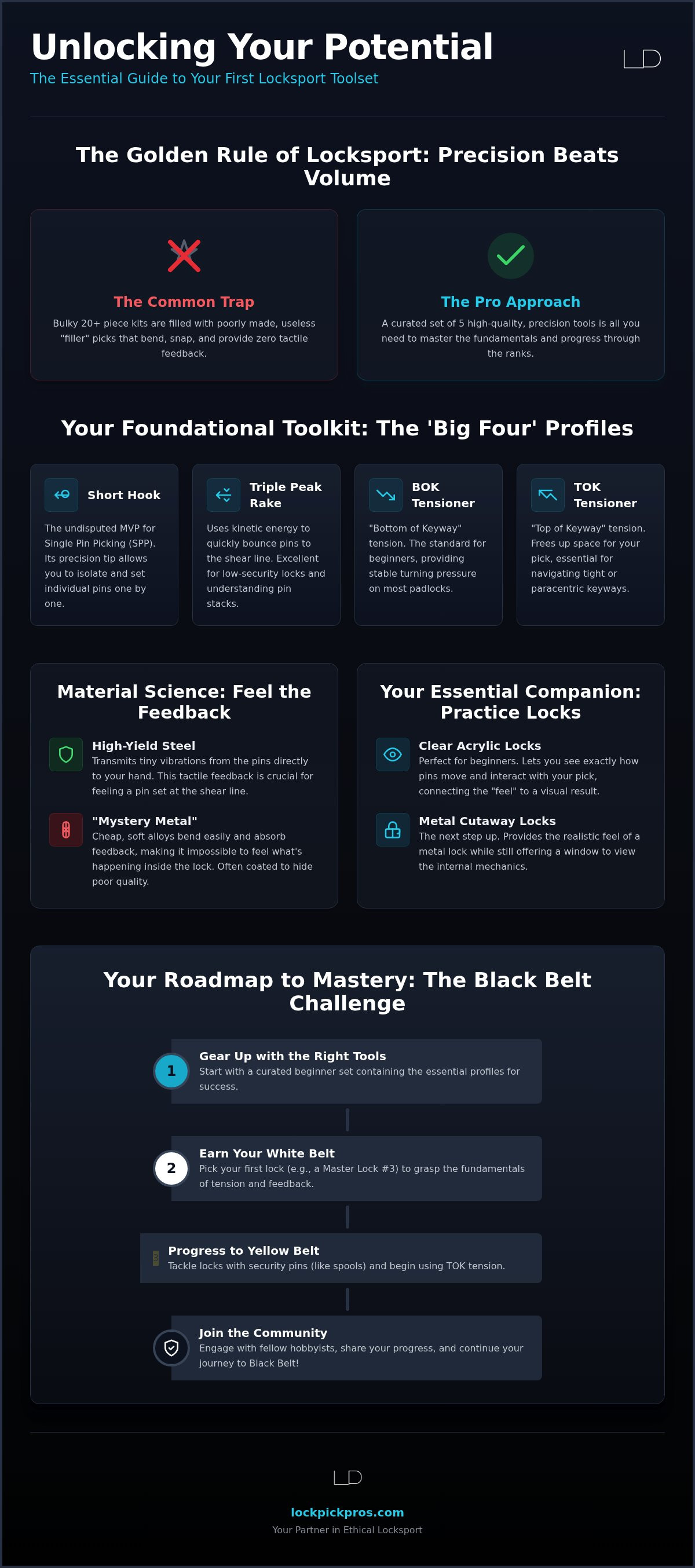
One of the most vital lessons for any new picker is the "Quality over Quantity" rule. You'll often see cheap kits with 20 or 30 pieces, but most of those are useless filler. In reality, five high-quality tools will serve you better than a dozen poorly made ones. These premium tools provide superior feedback. Feedback is the way a pick communicates what's happening inside the lock. It's the vibration you feel in your hand as a pin reaches the shear line. If your tools are too thick or made of soft metal, that signal gets lost. You want a kit that lets you feel every tiny click.
The White Belt Mindset
Every journey starts with a single step. In our community, that step is earning your White Belt. This rank signifies that you've grasped the basics and successfully opened your first lock. Most beginners start with simple padlocks like the Master Lock #3. These usually have four standard pins and provide a great introduction to tactile feedback. Focusing on these early challenges prevents you from feeling overwhelmed. You can find a complete breakdown of the journey in our guide to Lock Picking Belt Levels Explained. It's the perfect roadmap for your progression.
Hobbyist vs. Professional Tools
There's a significant difference between emergency tools and sport tools. Emergency tools are designed for one-time use by someone in a hurry. Sport tools are built for thousands of practice sessions. Ergonomics play a huge role here. If you're spending an hour practicing on a difficult cylinder, a thin metal handle will cramp your hand. You should also avoid the "black-coated" mystery metal sets found on generic marketplaces. These coatings often hide poor-quality steel that snaps easily. When considering what to look for in a beginner lock pick set, prioritize sets like The Trainee 2.0. These are engineered for durability and offer the precision required for Single Pin Picking. High-quality materials ensure your tools grow with you as your skills improve.
The 'Big Four' Profiles Every Starter Kit Needs
Building a foundational kit isn't about collecting dozens of different shapes. It's about having the right geometry to tackle specific mechanical challenges. Physical security relies on the interaction of pins and springs, and your tools are the interface that allows you to manipulate that system. When you're deciding what to look for in a beginner lock pick set, ensure it contains these four essential profiles:
- The Short Hook: This is the undisputed MVP of Single Pin Picking (SPP). Its shallow profile allows you to reach individual pins without over-setting the ones in front of them.
- The Triple Peak Rake: This tool uses kinetic energy to bounce pins into place. It's excellent for understanding how different pin stacks react and for getting quick opens on low-security White Belt locks.
- Bottom of the Keyway (BOK) Tensioner: These L-shaped wrenches are the standard for beginner padlocks. They sit at the bottom of the keyway and provide a stable platform for applying turning pressure.
- Top of the Keyway (TOK) Tensioner: You'll need these sooner than you think. TOK wrenches provide more room for your pick in tight keyways, which is a requirement for many Yellow Belt locks.
Single Pin Picking (SPP) Essentials
SPP is the core skill of locksport. While raking is fun, the hook is your primary tool for earning higher belt ranks. Pick thickness is a critical factor here. A 0.025" pick is sturdy and perfect for wide-open Master Lock keyways. However, as you progress, you'll encounter paracentric keyways that require a thinner 0.015" profile to navigate the tight turns. For a perfectly balanced start, we recommend The Trainee 2.0. It provides the exact profiles and thicknesses needed to master these foundational techniques without the clutter of unnecessary tools.
Mastering Tension Control
Ask any pro and they'll tell you that tension is 90% of the battle. A tension wrench is the tool that applies the turning force required to bind pins. Without the right amount of torque, the pins won't stay at the shear line. Beginners often use "Heavy" tension, which can mask the subtle clicks you're looking for. Learning to use "Feather" tension is the secret to feeling security pins later on. Your set needs multiple wrench widths to ensure a snug fit in different locks. A loose wrench slips and ruins your feedback, while a tight one can bind the lock core entirely. As you refine your touch, you might consider upgrading to the Carbon Fiber Gen 2 Pro Series for even better vibration transmission.
Material Science: Why Steel and Carbon Fiber Matter
Choosing the right profiles is only half the battle. The materials used to construct those tools determine how long they'll last and how much they'll tell you about the lock's internals. When you're researching what to look for in a beginner lock pick set, the metal quality is your top priority. High-yield stainless steel is the industry standard for a reason. It offers the perfect balance of durability and "springiness." This means the pick can flex under pressure without permanently deforming or snapping. Cheap sets often use soft, low-grade steel that bends the moment you hit a stubborn pin, or brittle pot metal that shatters without warning.
Handle design is equally important for your progression. A bare metal pick might feel fine for five minutes, but it'll quickly cause hand fatigue during a long practice session. Look for "dipped" or "sandwich" handles that provide a wider surface area for your grip. These designs distribute pressure more evenly across your fingers, preventing the cramping that stops a practice session short. You can also perform a simple "flex test" to check quality. A good pick should feel rigid but resilient. If it feels like a wet noodle or feels like it might crack when you apply slight pressure, it's a sign of poor material science.
The Carbon Fiber Advantage
Carbon fiber is a game-changer for locksport enthusiasts. It's incredibly lightweight, but its real secret is vibration transmission. Because carbon fiber is so stiff, it doesn't dampen the tiny movements of the pins. It acts like a megaphone, sending every click and set directly into your fingertips. This increased feedback is vital for beginners who are still learning to distinguish between a binding pin and a set pin. While beginners often use too much force, the extreme durability of the Carbon Fiber Gen 2 Pro Series ensures the tools can handle the learning curve. It's an investment in your ability to "see" inside the lock through touch alone.
Pick Finishing and Polishing
The finish of your tools is just as critical as the metal itself. When you're deciding what to look for in a beginner lock pick set, pay close attention to the edges. Quality tools are typically laser-cut and then tumbled to remove sharp burrs. A rough pick will snag on the pins or the warding of the keyway, creating "false feedback" that confuses you. Smooth, polished picks glide through the lock, allowing you to focus on the pins rather than fighting the tool. Before you start picking, run your fingernail along the edge of the pick. If you feel any snags or rough spots, it's time to refine the finish with some high-grit sandpaper or move up to a better-manufactured set.
Practice Locks: The Essential Companion to Your Set
Buying the right tools is only the first half of the equation. Without a variety of practice locks, even the best picks won't help you develop the muscle memory needed for locksport. When you're determining what to look for in a beginner lock pick set, consider how your tools pair with training devices that bridge the gap between theory and practice. You need a way to map your progress. Using community standards like our Lock Difficulty Reference Guide helps you choose targets that match your current skill level, from White Belt basics to advanced security pins.
Clear acrylic locks are a fantastic starting point for the first hour of your journey. They allow you to see the springs compress and the pins reach the shear line in real time. However, don't stay in the "clear" phase too long. Once you understand the mechanics, move to cutaway locks. These are real metal lock bodies with a window milled into the side. They provide the authentic friction and "crunch" of a real lock while still offering a visual safety net. For the best long-term investment, look for rekeyable practice locks. These allow for progressive pinning, where you start with just one pin stack and gradually increase the difficulty until you're picking all five or six pins blindly.
The Visual Learning Phase
In the beginning, your eyes do the work your fingers haven't learned yet. Using a transparent lock helps you visualize the relationship between your pick tip and the pin stack. It's the fastest way to understand why a short hook is better for reaching the back pins than a rake. Once you can open an acrylic lock in seconds, it's time to test your skills on a standard Master Lock #3. This is the universal milestone for your White Belt rank. For a deeper dive into the specific tools you should have on your bench, check out our guide on What is in a Beginner Lock Pick Set? to ensure you aren't missing any essentials.
Progressing to Real Hardware
Real locks feel different than training tools. Acrylic is smooth and forgiving, while brass and steel cylinders offer "crisp" or "mushy" feedback that can be confusing at first. For a standard 4-pin tumbler lock, you'll generally need a moderate level of tension. If you press too hard, the pins will bind so tightly they won't move. If you're too light, they'll just drop back down. You're looking for that "Goldilocks" zone where the pins click into place with a distinct tactile snap. To get the most out of these subtle vibrations, you should upgrade to the Carbon Fiber Gen 2 Pro Series, which is specifically designed to transmit these delicate signals more clearly than standard plastic-handled picks.
Your Roadmap to Mastery: The Black Belt Challenge
Now that you understand the mechanics and materials, it's time to put that knowledge into practice. Locksport isn't just a solo activity; it's a journey shared with a global community of ethical pickers. We've designed a clear path to help you progress from your first click to expert-level mastery. Following a structured roadmap ensures you don't get stuck on difficult locks without the right skills or tools. If you're still wondering what to look for in a beginner lock pick set, the answer is a kit that grows with you through every belt rank.
- Step 1: Secure Your Foundation. Start with The Trainee 2.0. This set is specifically curated to handle White and Yellow belt locks without the distraction of useless filler tools.
- Step 2: Join the Challenge. Sign up for our Black Belt Challenge for free. This gives you access to our community trackers and specific milestones for each tier of progression.
- Step 3: Document Your Success. Record your first "open" on a Master Lock #3. This is your official entry into the White Belt rank. Seeing the pins set and the shackle pop on camera is a rite of passage for every hobbyist.
- Step 4: Share and Upgrade. Post your "picks-in-action" content on social media. Sharing your progress helps you earn community rewards that fund your future gear upgrades.
The Share-to-Earn Loop
We believe in rewarding those who help grow the sport. When you post your successful picks and tag #LockpickPros, you earn points toward advanced gear like the Pro Series Expansion. This expansion kit adds the specialized profiles you'll need for Orange and Green belt locks. We also offer a community bounty for hitting social reach goals. By sharing your journey, you help demystify the hobby and build a reputation as a skilled, ethical picker. It's a great way to connect with mentors who can offer technical advice when you hit a stubborn security pin.
Ethical Commitment
As you carry your kit, remember that our community is built on trust and responsibility. Never pick a lock that is in use or one that you do not own. This rule is absolute. It protects the integrity of the hobby and ensures you are always practicing with lawful intent. Your tools are for sport and skill refinement, not for bypassing security in the real world. Ready to earn your first stripe? Join the Black Belt Challenge today and start your journey toward locksport mastery.
Master Your First Lock and Earn Your Belt
You've seen that the secret to success isn't a massive kit filled with filler tools. It's about precision, tactile feedback, and a commitment to the ethical code of the hobby. By focusing on the "Big Four" profiles and choosing high-yield materials like carbon fiber, you've already mastered the hardest part of what to look for in a beginner lock pick set. You're now ready to move from visualizing the shear line in an acrylic lock to popping your first real Master Lock #3 and earning that White Belt rank.
We're here to support every click and set along your path. Our community-vetted belt progression kits ensure you always have the right tool for the next challenge. Plus, our share-to-earn rewards program means your social reach helps fund your gear upgrades as you climb the ranks. It's time to stop watching and start picking. Join the Free Black Belt Challenge and Get Your Starter Gear to begin your journey toward expert-level mastery. We can't wait to see your first open; let's get those pins moving!
Frequently Asked Questions
Is lockpicking legal for hobbyists in 2026?
Lockpicking is legal for hobbyists in most regions as long as you have lawful intent and follow strict ethical guidelines. At Lockpick Pros, we focus on ethical lockpicking, which means only picking locks you own and that aren't in active use. You should always check your local laws; however, the hobby is widely recognized as a legitimate sport. Staying within the locksport community helps ensure you're practicing responsibly and legally.
What is the best lock pick set for a total beginner?
The Trainee 2.0 is widely considered the definitive starting point for new hobbyists. When deciding what to look for in a beginner lock pick set, you want a curated collection of high-quality hooks and tension wrenches rather than a massive kit of filler tools. This set provides the exact profiles needed to earn your White and Yellow belts. It balances durability with the feedback required to understand what's happening inside the cylinder.
Do I need a clear practice lock to learn?
Clear acrylic locks are excellent tools for your first hour of practice because they let you visualize the mechanical interaction between the pick and the pins. They help you understand the shear line and pin stacks quickly. However, you should transition to metal cutaway locks or real padlocks soon after. Real locks provide the authentic tactile feedback and "crunch" that plastic training tools simply cannot replicate during serious practice sessions.
What is the difference between raking and single pin picking (SPP)?
Raking is a technique used to open locks quickly by manipulating multiple pins simultaneously with a scrubbing motion. Single Pin Picking (SPP) is the precise method of setting one pin at a time. While raking is fun for low-security opens, SPP is the gold standard skill required for advancing through the community belt ranks. Most higher-tier locks include security pins that specifically defend against raking, making SPP mastery essential for progression.
How many picks should a beginner set actually have?
A beginner set should actually have between five and seven essential tools. You don't need dozens of picks; you need a few high-quality hooks, a reliable rake, and a variety of tension wrenches. Large kits often include "filler" tools that beginners never use and that provide poor feedback. Focus on a foundational kit that emphasizes quality materials like high-yield stainless steel over a high piece count to ensure your tools last.
Can I use these tools to unlock my house if I'm locked out?
No, you should never use locksport tools to unlock a door you rely on for security. One of the most important rules of ethical lockpicking is to never pick a lock that is in use. Picking can accidentally damage the internal springs or pins, leaving you with a permanently broken lock. If you're locked out of your home, it's best to contact a professional locksmith rather than risking your safety and property damage.
What are belt ranks in lockpicking?
Belt ranks are a tiered progression system used by the locksport community to classify lock difficulty and track your skill level. The system starts at White Belt for simple padlocks and progresses through Yellow, Orange, and eventually to Black Belt for expert-level high-security locks. Earning belts is a powerful motivator that helps you structure your learning. It provides a clear roadmap for which tools to buy and which locks to tackle next.
How long does it take to learn the basics of locksport?
Most beginners can learn the basics and pop their first Master Lock #3 within just a few hours of focused practice. Understanding the mechanical theory takes minutes, but developing the tactile "feel" for the pins takes a bit longer. While you'll get your first "open" quickly, reaching intermediate tiers like Green or Blue belt typically takes several months of consistent practice. It's a journey of skill refinement that rewards patience and steady progression.